Topics: Market Mapping, Outsourced Recruitment Solutions, Sourcing
Posted on August 28, 2024
Written By Ranjana Singh




Simply posting a job ad and hoping to find the best candidates is like casting a wide net in an empty ocean, inefficient and often unproductive. Think of recruitment as a treasure hunt where the map is your key to success. This map is what we call talent market mapping, sometimes also referred to as recruitment market mapping, because it helps recruiters chart the talent landscape with precision.
Talent mapping in recruitment goes beyond traditional hiring methods by outlining the employment landscape of your current market, particularly focusing on competitors, talent availability, and hiring trends. It’s a strategic approach that helps recruiters identify where the right talent is located and how best to reach them.
The candidate market mapping process provides valuable insights into talent shortages, competitor hiring trends, candidate movement, and future workforce opportunities, helping staffing firms make more proactive and data-driven recruitment decisions. In 2026, more recruiters are using AI-driven market intelligence and proactive talent mapping strategies to build stronger long-term talent pipelines and improve hiring speed.
Market mapping is a powerful research technique that recruiters use to pinpoint and analyze the talent landscape in a specific industry or location. It’s not just about creating a list of potential candidates; it’s about digging deep to understand companies, candidates, and market trends to find the right fit for job openings.
1. Finding the Right Companies: It starts with identifying which companies matter and where they stand in the market.
2. Understanding the Job Market: This means getting a feel for current job trends, demands, and shifts in the industry.
3. Looking at Competitor Hiring Practices: Studying how competitors are hiring and what strategies they’re using. Benefits of Market Mapping in Recruitment
As a recruiter, you know that finding top talent is a challenging task. You need to be able to identify the right candidates who not only have the right set of skills but also fit into your company culture. Market mapping can help you achieve this goal by providing valuable insights into the job market.
Recruitment is becoming increasingly proactive in 2026. Recruiters are no longer waiting for applications to come in because skilled talent is becoming harder to find across healthcare, technology, engineering, and executive hiring markets.
This is why talent mapping strategy has become critical for staffing firms that want to improve hiring speed, strengthen pipelines, and make smarter recruitment decisions. Modern recruiters use recruitment market mapping to:
Recruiters can identify skilled candidates before positions even open. This creates a stronger long-term talent pipeline and reduces dependency on reactive hiring.
Many industries are facing skill shortages and increasing competition for experienced professionals. Candidate market mapping helps recruiters understand where talent is available and which regions are becoming talent-scarce.
When recruiters already know the talent landscape, they can submit qualified candidates faster and improve time-to-fill metrics for clients.
Market mapping gives recruiters access to hiring trends, salary benchmarks, competitor activity, and talent availability data. This helps staffing firms make more strategic hiring decisions.
Executive search market mapping helps recruiters identify leadership talent, understand competitor organizational structures, and approach passive candidates more strategically.
As a recruiter, you know that finding top talent is a challenging task. You need to be able to identify the right candidates who not only have the right set of skills but also fit into your company culture. Market mapping can help you achieve this goal by providing valuable insights into the job market.
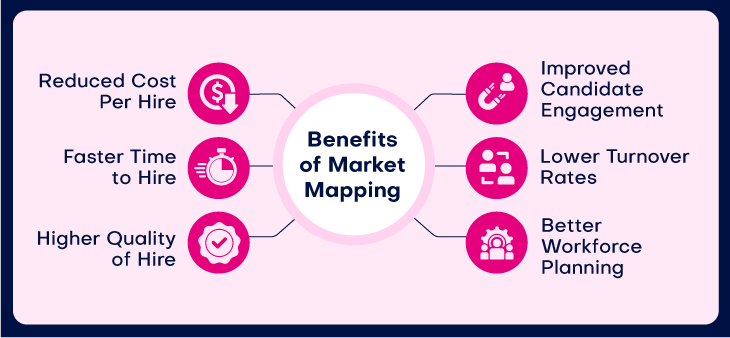
Market mapping helps companies avoid wasting money on unsuitable job boards, wrong-fit candidates, or lengthy hiring cycles. By identifying the right talent pool early, businesses cut unnecessary recruitment expenses.
With a mapped-out talent landscape, recruiters already know where to look. This proactive approach shortens the search process and ensures critical positions are filled quickly.
Instead of relying on random applications, recruiters can target and engage high-potential candidates who are most suited to the role. This leads to stronger hires who perform better and stay longer.
Market mapping allows recruiters to understand candidate behavior, preferences, and career goals. By tailoring communication, recruiters build trust and keep candidates engaged throughout the hiring journey.
Since the process emphasizes better role-to-candidate alignment, employees are more satisfied in their positions. This reduces attrition and saves firms from repeated rehiring costs.
Market mapping provides a forward-looking view of talent availability, competitor hiring activity, and industry trends. This helps businesses plan for future workforce needs and avoid talent shortages.

1. Set Clear Objectives: Determine the goals of your market mapping project. Are you looking to fill a specific role, understand market trends, or identify potential candidates for future positions?
2. Identify Key Markets: Focus on specific industries, companies, and geographical regions relevant to your recruitment needs.
3. Gather Data: Collect information from various sources, including LinkedIn, industry reports, company websites, and networking events.
4. Analyze Talent Pools: Categorize potential candidates based on their skills, experience, and current roles. Identify key players and rising stars.
5. Map Out Competitors: Understand the talent strategies of your competitors by analyzing their organizational structures and key personnel.
6. Visualize the Data: Create visual representations, such as organizational charts and talent maps, to easily identify trends and gaps.
Successful recruitment market mapping requires a structured and data-driven approach. Modern staffing firms combine recruiter expertise, AI tools, and talent intelligence platforms to build accurate market insights.
The first step is understanding the purpose of the market mapping project. Recruiters need clarity on whether the goal is executive hiring, niche talent sourcing, future workforce planning, or competitor analysis. Setting clear objectives helps recruiters focus on the right talent market and build a more effective sourcing strategy.
Recruiters analyze industries, locations, and competitor organizations to understand where relevant talent is concentrated. This process also helps staffing firms identify which companies are actively hiring, where skill shortages exist, and which markets offer better hiring opportunities.
Recruiters gather data from multiple sources such as LinkedIn, ATS platforms, industry reports, AI sourcing tools, and candidate databases. This helps create a clearer picture of talent availability, hiring trends, salary benchmarks, and candidate movement across the market.
Candidates are categorized based on skills, experience, certifications, seniority, and hiring demand. This allows recruiters to identify high-potential talent pools, understand market competitiveness, and focus on candidates who best match client requirements.
Monitoring competitor hiring activity helps recruiters understand talent movement, salary trends, workforce expansion, and emerging skill demand. These insights allow staffing firms to improve hiring strategies and stay ahead in competitive recruitment markets.
The final step is creating proactive talent pipelines for current and future hiring needs. Instead of starting sourcing from scratch every time, recruiters maintain engaged candidate pools that improve hiring speed, recruiter productivity, and long-term recruitment scalability.
Also Read: Top Recruitment Outsourcing Companies in USA
1. LinkedIn Recruiter: A powerful tool for identifying and connecting with potential candidates.
2. ZoomInfo: Provides detailed information on companies and their employees.
3. TalentNeuron: Offers insights into talent supply and demand, compensation benchmarks, and competitive intelligence.
4. SeekOut: An AI-powered platform for sourcing and talent mapping.
AI is rapidly changing how recruiters perform talent market mapping and candidate research. Instead of manually collecting market data, recruiters can now use AI-powered tools to analyze talent availability, identify hiring trends, and build talent pipelines faster. Modern AI-driven recruitment market mapping helps staffing firms:
AI sourcing platforms can scan thousands of candidate profiles, databases, and online platforms within minutes. This helps recruiters quickly identify relevant candidates based on skills, experience, location, and job requirements. Instead of spending hours on manual searches, recruiters can focus on engaging qualified talent faster.
AI tools go beyond simple keyword matching by analyzing candidate skills, certifications, work history, and behavioral patterns. This helps recruiters identify candidates who are genuinely suitable for a role, improving candidate quality and reducing mismatched submissions. Better candidate matching also improves client satisfaction and placement success.
AI-powered recruitment intelligence platforms help recruiters identify emerging hiring trends, growing skill demand, and potential talent shortages. Staffing firms can use these insights to prepare for future hiring needs, advise clients strategically, and build pipelines before demand increases.
AI helps recruiters maintain organized and updated candidate pipelines by automatically tracking candidate activity, skills, and engagement levels. This allows staffing firms to build proactive recruitment strategies instead of starting sourcing from scratch for every new requirement.
Automation reduces repetitive administrative tasks such as profile screening, data collection, and candidate tracking. This significantly improves recruiter productivity and allows teams to spend more time on relationship-building, client communication, and placements rather than manual research work.
To measure the effectiveness of your market mapping recruitment process, it’s important to track the right KPIs. The key performance indicators include:
1. Time-to-Hire Reduction: Evaluates how quickly roles are filled after implementing market mapping strategies.
2. Pipeline Strength: Assesses the quality and quantity of candidates available for current and future openings.
3. Market Coverage: Measures how well your market mapping efforts capture the full talent landscape, including competitors and niche roles.
Many staffing firms use market mapping strategies for staffing firms not only for hiring but also for business development and client acquisition.
Strong recruitment intelligence helps recruiters demonstrate market expertise during client conversations. Instead of offering generic hiring support, recruiters can provide valuable insights around talent availability, salary trends, hiring competition, and workforce challenges. This helps staffing firms:
Recruiters who understand the talent market deeply are often able to close clients faster and deliver stronger hiring outcomes.
Also Read: Top Candidate Sourcing Companies in USA : What Businesses Need to Know
1. Comprehensive Market Research
Explore and expand into new job markets with detailed insights on talent availability, industry presence, and salary ranges by geography.
2. Targeted Insights
Identify and evaluate candidate availability and demand within your target market, focusing on geographical talent distribution.
3. Talent Analysis
Gain insights into skill sets, candidate expectations, and growth potential to refine your recruitment strategies. 4. Global Expertise: As an offshore staffing partner, QX Global Group provides outsourced market mapping solutions to help businesses develop data-driven growth strategies.
In 2026, successful recruitment is becoming increasingly proactive, data-driven, and intelligence-led. Staffing firms that rely only on reactive hiring strategies may struggle withtalent shortages, slower placements, and reduced market visibility. This is why talent market mapping and proactive recruitment intelligence are becoming essential for long-term hiring success.
By combining AI-driven recruitment insights, structured market research, and proactive talent pipeline building, staffing firms can improve hiring speed, recruiter productivity, and client delivery performance.
Market mapping for recruiters helps identify where the right talent is located, what skills are available, and how competitors are hiring. By having this data in hand, recruiters can make smarter choices, reduce hiring time, and improve the overall quality of hires.
The key elements of a market mapping recruitment include identifying target companies, analyzing competitor hiring practices, understanding salary benchmarks, and mapping out potential candidates. Together, these elements provide recruiters with a clear and actionable talent strategy.
The difference between talent mapping and market mapping lies in scope. Together, they form the basis of effective talent market mapping, where recruiters analyze both individual career paths and broader market dynamics. Talent mapping focuses on individual candidates—their skills, career paths, and readiness for roles. Market mapping, on the other hand, looks at the bigger picture, analyzing the overall talent landscape, industry trends, and competitor activity.
Recruiters should use a structured market mapping recruitment framework because it ensures consistency, accuracy, and efficiency. With a framework in place, recruiters can systematically gather data, benchmark competitors, and create reliable talent pipelines.
A typical market mapping recruitment process can take anywhere from a few weeks to a couple of months, depending on the industry, role complexity, and market size. The process involves gathering data, analyzing talent availability, and building insights before moving into active recruitment.
Companies often choose to outsource market mapping recruitment services to experts like QX Global Group because it saves time, reduces costs, and provides access to specialized tools and global talent insights. By outsourcing, recruiters can focus on engaging candidates while experts handle the research and analysis.
AI improves talent mapping in recruitment by helping recruiters analyze candidate data faster, identify skill trends, track talent movement, and build stronger candidate pipelines. AI-powered sourcing tools also reduce manual research and improve recruitment efficiency.
Recruiters often struggle with limited market visibility, outdated candidate data, skill shortages, and time-consuming research processes. Many staffing firms also find it difficult to maintain updated talent pipelines while managing active hiring requirements.
Recruiters can use talent mapping strategy to build proactive talent pipelines, improve workforce planning, identify future hiring trends, and reduce dependency on reactive hiring. This creates stronger long-term recruitment scalability.
Limited visibility into the talent market can slow sourcing efforts, increase hiring costs, and reduce candidate quality. Without proper candidate market mapping, recruiters may struggle to identify where skilled talent exists and how competitors are hiring.
Enjoyed our blog? Discover more about how our recruitment outsourcing process can slash your costs by up to 60%! Take the next step—book a call by entering your details.

Education:
B.Com(Hons), Delhi University

Ranjana Singh is a data-driven B2B content marketer who loves creating well-researched content and blending it with storytelling. At QX, she leverages data insights and lead analysis to craft high-performing LinkedIn campaigns, blogs, newsletters, and sales collateral that drive MQLs and brand visibility across the US and UK markets. Her work is rooted in performance—every strategy starts with deep analysis of content metrics, funnel behavior, and audience engagement trends to deliver measurable marketing impact.
Expertise: Data-Backed Content Marketing Strategy, SEO & Organic Growth, LinkedIn & Newsletter Marketing, MQL Attribution & Lead Source Analysis, Recruitment Industry Marketing (US & UK),
Originally published Aug 28, 2024 07:08:54, updated Jun 01 2026
Topics: Market Mapping, Outsourced Recruitment Solutions, Sourcing
22 Nov 2024
In the UK, executive search and headhunting challenges are some of the toughest recruiters. Hiring s...
Read More18 Sep 2024
Sourcing and recruitment are related terms often used interchangeably. However, they are not the sam...
Read More16 Sep 2024
Outsourcing recruitment is a growing trend in HR departments across the world. It involves using spe...
Read More02 Aug 2024
Today, when the business world is obsessed with cut-throat competition, the importance of hiring and...
Read More