Topics: 2025 Staffing Trends, Global Staffing Market, Global Staffing Trends, Staffing Projections
Posted on December 19, 2024
Written By Ranjana Singh




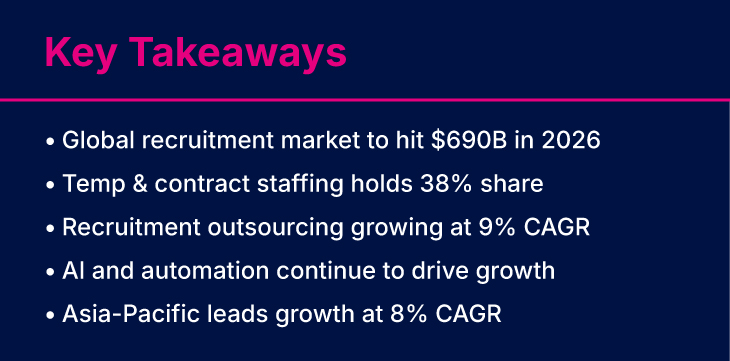
We are almost halfway into 2026, and the global staffing market continues to show strong signs of recovery, transformation, and long-term growth.
According to the latest staffing market analysis by Mordor Intelligence, the global recruitment market is expected to grow from USD 642.28 billion in 2025 to USD 690.3 billion in 2026 and is projected to reach USD 989.32 billion by 2031.
Want to learn what’s driving this growth, which staffing trends are shaping 2026, and why AI, outsourced recruitment, and workforce flexibility are becoming essential for staffing firms? Read on to find out.
The global staffing market continues to expand across regions and industries as companies increase hiring investments and modernize recruitment operations.
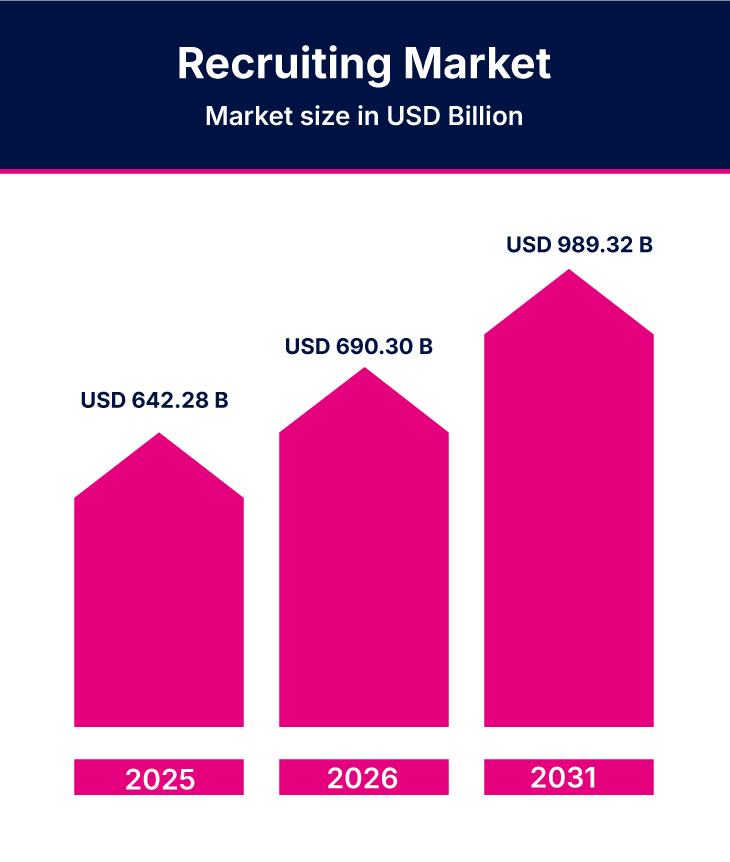
The global staffing market was valued at approximately USD 642.28 billion in 2025 and is expected to continue growing steadily over the next few years. This staffing industry growth forecast for 2026 reflects rising demand for workforce flexibility, specialized hiring, and outsourced recruitment support globally.
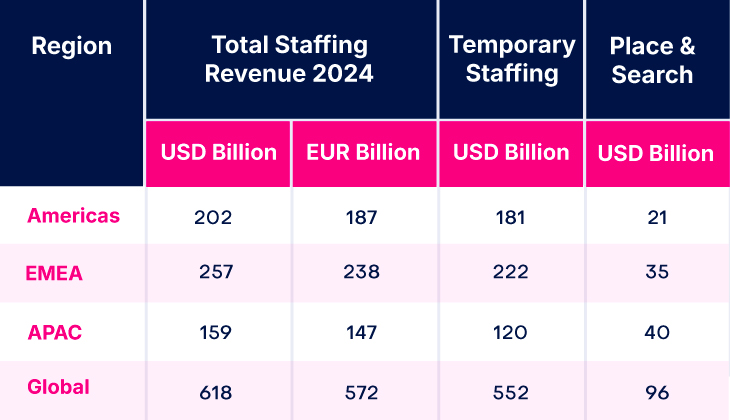
Different regions are experiencing staffing industry growth at different speeds depending on labor shortages, economic recovery, technology adoption, and workforce trends.
The United States remained the world’s largest staffing market in 2025, supported by strong hiring demand across:
Although some businesses remain cautious about hiring, long-term recruitment demand continues to remain stable. Latin American countries such as Brazil and Argentina are also seeing rising adoption of temporary staffing and contingent workforce solutions.
EMEA continues to remain one of the largest contributors to global staffing revenue. Temporary staffing dominates the region, especially across:
The region is also seeing increasing demand for specialist staffing, compliance-focused hiring, and renewable energy recruitment.
Asia-Pacific is expected to be the fastest-growing staffing market globally with an expected 8.12% CAGR.
Growth in the region is being driven by:
India and China are expected to remain key contributors to global staffing market trends and predictions for 2026 and beyond.

Some sectors are expected to experience much stronger staffing industry growth because of digital transformation, workforce shortages, and changing business demands.
IT and telecom held 29.15% market share in 2025.
Demand remains high for:
The continued growth of AI, automation, and digital transformation is keeping technology hiring strong globally.
Healthcare and life sciences staffing is expected to grow at a 9.04% CAGR between 2026 and 2031.
This growth is being driven by:
Healthcare staffing remains one of the strongest staffing industry trends 2026 because of ongoing global healthcare workforce pressure.
Manufacturing and engineering recruitment demand is increasing because of:
Businesses are actively hiring engineers, technicians, robotics specialists, and operational workforce talent.
Also Read: Top Recruitment Outsourcing Companies in USA for Staffing Firms
Several major workforce trends 2026 are reshaping the global recruitment market. Businesses are now prioritising workforce flexibility, faster hiring, automation, and skills-based recruitment strategies.
AI in recruitment is becoming a major driver of staffing industry transformation. Recruitment firms are increasingly using AI-powered tools for resume screening, candidate sourcing, skills matching, recruitment analytics, and AI video interviews. These technologies help reduce manual workload, improve hiring speed, and manage large candidate databases more efficiently. AI-driven recruitment technology is expected to contribute around +1.8% to market growth.
Businesses are increasingly shifting toward flexible workforce models by hiring more freelancers, temporary workers, contract staff, and project-based specialists. This helps companies scale teams quickly and manage workforce costs during uncertain economic conditions. The rise of contingent staffing is becoming one of the biggest global staffing market trends in 2026.
Talent shortages continue to remain a major challenge across industries such as healthcare, engineering, AI, cybersecurity, and software development. A projected shortage of 85.2 million skilled workers by 2030 is increasing demand for staffing and recruitment services globally. Businesses are relying more on staffing firms to access skilled talent faster.
Skills-based hiring is becoming increasingly common as businesses focus more on practical abilities rather than only degrees. Employers are evaluating candidates based on technical skills, assessments, real-world experience, and job-specific competencies. This approach helps improve hiring quality while expanding access to wider talent pools.
The staffing industry is evolving rapidly because of workforce automation, changing hiring expectations, and digital recruitment transformation.
Temporary and contract staffing held a 38.32% market share in 2025, showing continued demand for flexible workforce models. Businesses prefer flexible staffing because it helps them manage workforce costs, scale faster, handle seasonal demand, and access specialised talent quickly. This trend continues to remain one of the biggest drivers shaping the global staffing market in 2026.
Outsourced recruitment services are expected to grow at a 9.23% CAGR through 2031 as businesses increasingly outsource functions such as candidate sourcing, resume screening, recruitment administration, interview coordination, compliance management, and workforce reporting.
This is creating strong demand for providers like QX Global Group, which help staffing firms scale through offshore recruitment support, recruitment technology, and structured hiring operations.
As hiring becomes more complex, outsourcing is becoming a key part of the recruitment industry outlook for 2026 and beyond.
Businesses increasingly want a balance between recruitment technology and human expertise. This is driving demand for hybrid recruitment models that combine AI in recruitment, workforce automation, recruitment analytics, and candidate engagement support with experienced recruiters.
Hybrid and managed service providers are expected to grow at a 10.05% CAGR, making them one of the fastest-growing segments in the global recruitment market.
Despite strong staffing industry growth, recruitment firms continue facing operational, economic, and compliance-related challenges.
Economic uncertainty continues to affect recruitment spending globally. Many businesses remain cautious about permanent hiring and long-term workforce expansion due to changing market conditions. However, demand for specialised talent remains strong across sectors such as healthcare, engineering, cybersecurity, and technology, where skill shortages continue to drive hiring activity.
Large companies are increasingly building their own internal talent acquisition teams to manage hiring directly. As a result, staffing firms are shifting their focus toward specialist recruitment, healthcare staffing, executive hiring, embedded recruitment, and offshore recruitment support. This trend is increasing the need for more strategic and value-driven staffing partnerships.
As AI adoption grows, businesses are paying closer attention to recruitment compliance and candidate data privacy. Staffing firms now need stronger processes around AI transparency, bias monitoring, secure hiring systems, and fair hiring practices. Compliance is becoming a key differentiator in the global recruitment market, especially for firms handling sensitive candidate data and AI-driven hiring workflows.
Also Read: Top Candidate Outsourcing Companies in USA – What Staffing Firms Need to Know
Several high-growth opportunities are emerging as businesses continue modernising recruitment operations and workforce strategies.
Staffing firms that invest in technology, scalability, and specialised recruitment support are expected to benefit the most from future staffing industry growth.
The staffing industry is becoming more technology-driven, specialised, and competitive. To stay ahead, staffing firms need to modernise operations, improve recruiter productivity, and build more scalable hiring strategies.
Automation is becoming essential for improving recruitment efficiency and reducing operational pressure. Staffing firms are increasingly investing in tools that support AI sourcing, resume screening, recruitment analytics, candidate engagement, and workflow automation. These technologies help recruiters spend less time on repetitive administrative tasks and more time on placements, client relationships, and revenue-generating activities.
Specialised staffing continues to outperform general staffing across many markets. Industries such as healthcare, cybersecurity, engineering, AI, and life sciences are expected to see strong long-term demand growth. Staffing firms that build niche expertise and deeper industry knowledge can improve placement quality, strengthen client relationships, and achieve better margins in competitive markets.
Recruiter burnout and rising hiring volumes continue to affect staffing firms globally. Offshore recruitment support is helping firms improve scalability and operational efficiency without significantly increasing internal costs. Providers such as QX Global Group support USA staffing firms through candidate sourcing, resume screening, compliance management, interview coordination, recruitment administration, and database management. This allows recruiters to focus more on placements, client engagement, and business growth.
Candidate engagement is becoming increasingly difficult in competitive hiring markets. Staffing firms need to improve response times, communication, follow-up processes, hiring speed, and mobile recruitment experience to reduce candidate drop-offs. A smoother and faster hiring journey improves candidate satisfaction, strengthens employer branding, and increases offer acceptance rates.
As AI adoption grows, businesses are becoming more cautious about recruitment compliance, data privacy, and hiring transparency. Staffing firms need stronger processes around data protection, AI governance, fair hiring practices, and compliance-ready workflows. Strong compliance standards are becoming an important differentiator in the global recruitment market, especially for firms handling sensitive candidate information and AI-driven hiring systems.
The recruitment industry’s outlook beyond 2026 remains positive as businesses continue investing in hiring, workforce flexibility, and recruitment technology. The future of staffing will be shaped by:
Businesses will increasingly look for staffing partners that can provide faster hiring, workforce scalability, better candidate quality, and technology-enabled recruitment support.
The staffing industry is no longer only about filling vacancies. It is increasingly focused on helping businesses build smarter, scalable, and future-ready workforce strategies.
We are almost halfway into 2026, and the global staffing market continues to evolve rapidly. AI in recruitment, workforce automation, contingent staffing, and outsourced recruitment services are reshaping how businesses hire talent globally. At the same time, companies continue facing talent shortages, compliance pressures, and increasing demand for workforce flexibility.
These global staffing market trends and predictions for 2026 show that staffing firms must now move beyond traditional recruitment models and focus on technology, scalability, specialised hiring, and operational efficiency.
Firms that invest in recruitment technology, offshore recruitment support, candidate engagement, and workforce automation will be better positioned to benefit from long-term staffing industry growth.
Some of the biggest staffing industry trends in 2026 include AI-driven recruitment, outsourced recruitment services, contingent staffing growth, skills-based hiring, workforce automation, and recruitment analytics. Companies are also increasingly adopting flexible hiring models to manage economic uncertainty and talent shortages.
AI is helping staffing firms automate repetitive recruitment tasks such as resume screening, candidate sourcing, interview scheduling, and skills matching. This improves recruiter productivity, reduces time-to-hire, and helps staffing firms manage larger hiring volumes more efficiently.
Staffing firms are shifting toward skills-based hiring because employers now prioritize practical abilities and job-specific skills over only degrees or titles. This approach helps improve candidate quality and access wider talent pools.
Industries expected to see strong staffing demand include: Healthcare and life sciences IT and telecom Engineering and manufacturing Cybersecurity AI and analytics Logistics and supply chain. Healthcare staffing is expected to grow particularly fast because of ageing populations and global workforce shortage.
Contingent staffing is growing because businesses want more workforce flexibility. Hiring temporary workers, contractors, and project-based specialists helps companies scale teams quickly and manage workforce costs more efficiently.
Staffing agencies can stay competitive by combining AI recruitment tools with human expertise. Automation helps improve sourcing, screening, and recruiter productivity, while recruiters continue managing relationships and candidate engagement.
Demand for skilled professionals is growing faster than workforce supply across industries such as healthcare, engineering, and technology. Burnout, education gaps, and changing workforce expectations are making talent shortages worse.
Staffing firms face challenges around data privacy, compliance, bias monitoring, and AI transparency. They also need proper processes to ensure AI supports fair and accurate hiring decisions.
Candidates now have more job options and higher expectations. Slow communication, delayed feedback, and long hiring processes often lead to candidate drop-offs and lower engagement.
Businesses are turning to outsourced recruitment services because they want faster hiring, reduced recruiter workload, lower operational costs, and scalable recruitment support. Outsourcing also helps companies access offshore recruitment expertise, recruitment technology, and specialised hiring support without increasing internal headcount.
Enjoyed our blog? Discover more about how our recruitment outsourcing process can slash your costs by up to 60%! Take the next step—book a call by entering your details.

Education:
B.Com(Hons), Delhi University

Ranjana Singh is a data-driven B2B content marketer who loves creating well-researched content and blending it with storytelling. At QX, she leverages data insights and lead analysis to craft high-performing LinkedIn campaigns, blogs, newsletters, and sales collateral that drive MQLs and brand visibility across the US and UK markets. Her work is rooted in performance—every strategy starts with deep analysis of content metrics, funnel behavior, and audience engagement trends to deliver measurable marketing impact.
Expertise: Data-Backed Content Marketing Strategy, SEO & Organic Growth, LinkedIn & Newsletter Marketing, MQL Attribution & Lead Source Analysis, Recruitment Industry Marketing (US & UK),
Originally published Dec 19, 2024 08:12:49, updated Jun 01 2026
Topics: 2025 Staffing Trends, Global Staffing Market, Global Staffing Trends, Staffing Projections
04 Dec 2024
With just one month left until 2025, the staffing industry is gearing up for another year of transfo...
Read More