It’s 9:30 AM. A recruiter logs in to find 18 open roles, hundreds of new applications, and three clients asking for updates. And that too, before the first coffee is finished!
The problem with the recruitment industry isn’t talent. There are candidates, plenty of them.
The real challenge lies in everything that happens between a CV landing in the system and a shortlist reaching the client.
Screening resumes, coordinating interviews, updating the ATS, sending follow-ups, these tasks quietly eat into a recruiter’s day. Multiply this across multiple clients and high-volume roles, and delays become inevitable. This is the reality many UK staffing firms are facing today.
By 2026, more recruitment firms are realising that working harder isn’t the answer. Working smarter is. This is where recruitment automation steps in, not as a trend, but as a practical way to bring speed, structure, and balance back into the hiring process. This blog explores what recruitment automation really is, how it works, and why UK staffing firms are adopting it at scale.

What Is Recruitment Automation?
Before diving deeper, let’s take a step back.
Think about how much of a recruiter’s day goes into tasks that don’t actually require human judgement. Resume screening. Data entry. Interview scheduling. Status updates. These are necessary tasks, but they don’t need to be done manually every single time.
Recruitment automation refers to the use of software and workflows to automate these repetitive parts of hiring. It doesn’t replace recruiters. Instead, it supports them by handling high-volume, time-consuming tasks with speed and consistency.
In simple terms, automation in recruitment combines technology with recruiter expertise. The goal is not to remove the human element, but to make the recruitment process more efficient, scalable, and predictable, specially for staffing firms managing multiple clients and hiring demands.
Why Recruitment Automation Is Gaining Momentum Among UK Staffing Firms
So, why is this shift happening now?
UK staffing firms are operating in a market where competition for qualified candidates is intense. Clients expect faster shortlists and quicker placements, often with little flexibility on timelines. At the same time, recruiter workloads are increasing without a matching rise in headcount.
There’s also growing pressure to reduce cost per hire while maintaining quality. Manual processes make this difficult. Spreadsheets, disconnected systems, and constant follow-ups slow everything down and reduce visibility into the recruitment pipeline.
Recruitment automation for staffing firms addresses these challenges head-on. It helps firms respond faster, manage workloads better, and gain real-time insight into what’s happening across roles and clients.
How Recruitment Automation Works in Practice
Recruitment automation isn’t a single tool. It’s a connected system that supports the hiring process from start to finish.
Step 1 – Job Intake and Requirement Setup
It starts with structured job intake. Role requirements, skills, experience, certifications, locations, are captured using standardised templates. Jobs can then be automatically created and distributed across job boards and internal databases.
This removes ambiguity early in the process and ensures consistency across recruiters and clients.
Step 2 – Candidate Sourcing and Resume Parsing
Next comes sourcing. Recruiting automation tools use AI-driven search to identify candidates across multiple channels. CVs are automatically parsed, extracting key information and converting it into searchable data.
This means recruiters no longer have to manually scan hundreds of resumes just to find a few relevant profiles.

Step 3 – Automated Screening and Shortlisting
Automated recruitment systems apply rule-based screening and keyword matching to shortlist candidates. Profiles are ranked based on relevance, allowing recruiters to focus their time where it matters most.
Screening becomes faster, more consistent, and less prone to human error.
Step 4 – Interview Scheduling and Communication
Interview coordination is another major time sink. Automation in the recruitment process takes care of scheduling, reminders, and candidate notifications.
Candidates stay informed. Recruiters spend less time chasing responses. Everyone moves faster.
Step 5 – Pipeline Tracking and Reporting
Finally, everything flows into real-time dashboards. Recruiters and managers can track pipeline health, time-to-hire, and productivity metrics without relying on manual reports.
This visibility is critical for staffing firms operating at scale.
Key Areas of Recruitment Automation for Staffing Firms
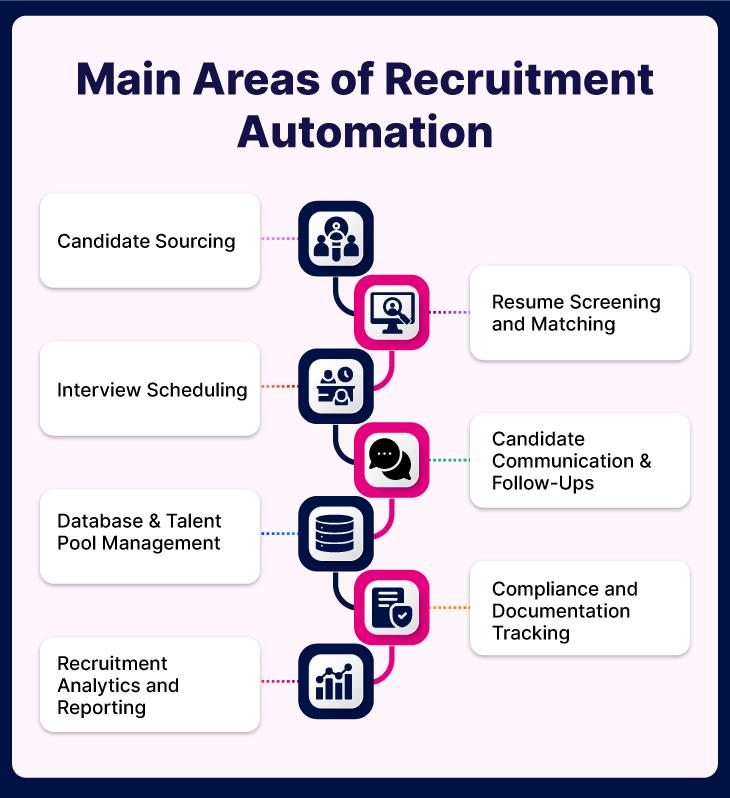
Recruitment automation doesn’t improve hiring by changing just one step. Its real value comes from supporting multiple stages of the hiring lifecycle and connecting them into one smooth flow. Here’s how automation helps staffing firms across key areas of recruitment.
1. Candidate Sourcing
Finding the right candidates quickly is one of the biggest challenges for staffing firms. Recruitment automation helps by searching across internal databases, job boards, and talent communities at the same time. Instead of relying on manual searches, recruiters get faster access to relevant profiles based on role requirements. This ensures no suitable candidate is missed and reduces dependence on a single sourcing channel.
2. Resume Screening and Matching
Manually screening hundreds of CVs is time-consuming and inconsistent. Recruitment automation software uses resume parsing and rule-based matching to shortlist candidates based on skills, experience, certifications, and keywords. This speeds up shortlisting while maintaining consistency across roles. Recruiters can then focus their attention on the most relevant profiles rather than starting from scratch each time.
3. Interview Scheduling
Interview coordination often slows the hiring process more than expected. Automation in the recruitment process simplifies this by managing availability, sending calendar invites, and issuing reminders automatically. Candidates receive timely updates, and recruiters avoid endless back-and-forth emails. As a result, interviews are scheduled faster and drop-offs are reduced.
4. Candidate Communication and Follow-Ups
Consistent communication plays a major role in candidate experience. Recruitment automation ensures candidates receive timely updates, interview reminders, and follow-ups at every stage of the process. This reduces uncertainty for candidates and keeps them engaged, even during high-volume hiring. For staffing firms, it also removes the burden of manual follow-ups.
5. Database and Talent Pool Management
Over time, candidate databases can become cluttered and outdated. Automation helps maintain clean, organised talent pools by updating candidate status, removing duplicates, and tagging profiles accurately. This makes it easier for recruiters to reuse existing candidates for future roles and build long-term pipelines instead of starting from zero for every new requirement.
6. Compliance and Documentation Tracking
For UK staffing firms, compliance is non-negotiable. Recruitment automation systems help track documentation, certifications, right-to-work checks, and expiry dates automatically. This reduces the risk of missing compliance requirements and ensures that candidate records remain accurate and audit-ready.
7. Recruitment Analytics and Reporting
Automation in recruitment also brings visibility into what’s working and what’s not. Recruitment analytics and dashboards provide real-time insights into time-to-hire, source performance, recruiter productivity, and pipeline health. Staffing leaders can identify bottlenecks early and make informed decisions based on data rather than assumptions.
Together, these areas form an automated recruitment system that allows staffing firms to hire faster, maintain control, and scale their operations without increasing complexity.

What Are the Features of Recruitment Automation Systems?
Modern recruitment automation software is designed to integrate seamlessly into staffing workflows. Common features include:
- ATS integration
- Resume parsing and intelligent matching
- Workflow automation
- Interview scheduling tools
- Candidate engagement automation
- Reporting and analytics dashboards
- Integration with job boards and CRM tools
The best recruitment automation tools are flexible, scalable, and built to support multi-client hiring environments.
Core Benefits of Recruitment Automation for UK Staffing Firms
When implemented correctly, recruitment automation delivers measurable improvements across speed, efficiency, and hiring quality. Below are the key benefits UK staffing firms experience when automation is built into their recruitment workflows.
1. Faster Time-to-Shortlist
Manual screening, CV reviews, and interview coordination often slow down the hiring process. Recruitment automation removes these bottlenecks by automating repetitive steps such as resume parsing and initial screening. As a result, recruiters can create shortlists faster and respond to client requirements without delays.
2. Reduced Recruiter Administrative Workload
A large part of a recruiter’s day is spent on admin tasks that don’t directly contribute to placements. Recruitment automation takes over tasks like data entry, interview scheduling, and follow-ups. This allows recruiters to focus more on candidate conversations, client interactions, and closing roles—where real value is created.
3. Improved Screening Consistency and Candidate Quality
Manual screening can vary from recruiter to recruiter. Recruitment automation applies consistent rules and criteria across roles, ensuring candidates are evaluated fairly and accurately. This leads to better-quality shortlists and reduces the risk of strong profiles being overlooked during high-volume hiring.
4. Lower Cost per Hire
By increasing recruiter productivity and reducing manual effort, recruitment automation helps lower the overall cost per hire. Staffing firms can manage larger hiring volumes without continuously expanding their internal teams, making operations more cost-effective and sustainable.
5. Ability to Handle High-Volume Recruitment
Seasonal demand, new client wins, or sudden hiring spikes can overwhelm manual recruitment processes. Recruitment automation allows staffing firms to scale quickly by handling higher application volumes without compromising speed or accuracy. This flexibility is critical for firms managing fluctuating workloads.
6. Better Client Experience and Transparency
Clients expect fast updates and clear visibility into hiring progress. Recruitment automation provides real-time insights into pipeline status, candidate movement, and time-to-hire metrics. This transparency builds trust and improves client satisfaction by keeping them informed throughout the hiring process.
In short, recruitment automation enables UK staffing firms to deliver faster results, maintain hiring quality, and scale efficiently—without burning out their recruitment teams.

Benefits of Automating the Recruitment Process
The benefits of automating the recruitment process go beyond speed.
Automation streamlines end-to-end workflows, reducing manual errors and improving data accuracy. Recruiter productivity increases as repetitive tasks are handled automatically. Hiring becomes scalable, even during seasonal spikes or rapid growth.
Most importantly, automation in the recruitment process enables data-driven decisions. Staffing leaders gain insights into what’s working, where delays occur, and how processes can be improved.
What Recruitment Automation Can and Cannot Do
It’s important to be realistic.
What recruitment automation can do well:
- Resume screening and parsing
- Interview scheduling
- Candidate follow-ups
- Data entry and reporting
What it cannot fully replace:
- Relationship building
- Client consultation
- Cultural fit assessment
- Final hiring decisions
The strongest results come when automation supports recruiters—not when it tries to replace them.
Challenges UK Staffing Firms Face Without Recruitment Automation
When recruitment relies heavily on manual processes, problems start to show across the hiring cycle.
1. Slower Client Response Times: Manual CV screening, scheduling, and follow-ups slow down how quickly recruiters can move. Even small delays can cost staffing firms candidates and client confidence.
2. Recruiter Fatigue: Too much time spent on admin leaves recruiters stretched. Over time, this reduces productivity and increases burnout.
3. Inconsistent Candidate Experience: Without automated communication, candidates receive uneven updates, leading to drop-offs and disengagement.
4. Poor Pipeline Visibility: Tracking hiring progress across spreadsheets or emails limits visibility and makes client reporting harder.
5. Difficulty Scaling: Manual processes don’t scale easily. Handling hiring spikes or new client wins becomes costly and inefficient.
How UK Staffing Firms Should Approach Recruitment Automation Adoption
Adopting recruitment automation works best when it is treated as a process change, not just a technology purchase. For UK staffing firms, a structured approach helps avoid disruption and ensures real value.
1. Start With High-Volume, Repetitive Tasks
Begin by identifying tasks that consume the most recruiter time, such as CV screening, interview scheduling, and candidate follow-ups. Automating these areas delivers quick wins and allows recruiters to see immediate benefits without changing the entire hiring process at once.
2. Choose Tools That Fit Existing Systems
Recruitment automation software should integrate smoothly with current ATS and CRM platforms. This avoids data silos and ensures recruiters don’t have to switch between multiple tools to manage their workflows.
3. Introduce Automation Gradually
Automation does not need to be implemented all at once. Rolling it out in phases allows teams to adapt, refine workflows, and build confidence. Gradual adoption also reduces resistance from recruiters who are used to manual processes.
4. Measure Impact With Clear Metrics
To understand ROI, staffing firms should track metrics such as time-to-hire, time-to-shortlist, recruiter productivity, and cost-per-hire. These insights help teams assess what’s working and where further automation can add value.
5. Keep Recruiters at the Centre
Automation should support recruiter expertise, not replace it. The most effective hiring models use automation to remove admin work, while recruiters focus on candidate relationships, client consultation, and decision-making.
When approached thoughtfully, recruitment automation becomes a practical enabler of scale, speed, and consistency, rather than a disruptive change.
Why QX Global Group Supports Recruitment Automation for UK Staffing Firms
With over 20 years of experience supporting UK staffing firms, QX Global Group understands that recruitment automation delivers the best results when it is built around strong processes and experienced recruitment teams.
QX works closely with staffing firms across highly regulated and high-volume sectors, combining offshore recruitment services with automation-led workflows to support faster, more consistent hiring. This approach helps firms scale recruitment operations while maintaining quality, compliance, and control.
At the centre of QX’s automation approach is SonarHire AI, an end-to-end recruitment assistant that supports sourcing, screening, interviewing, and compliance. SonarHire AI integrates seamlessly with existing ATS platforms and reduces manual effort across front-office, mid-office, and back-office recruitment activities.
By blending recruiter expertise with intelligent automation, QX helps UK staffing firms hire faster, improve operational efficiency, and scale delivery without increasing headcount.
FAQs on Recruitment Automation
1. Why is recruitment automation important for staffing firms in the UK?
Recruitment automation helps UK staffing firms manage high hiring volumes, tighter client timelines, and increasing compliance requirements. It reduces manual workload, improves speed, and allows recruiters to focus on candidate and client engagement instead of admin tasks.
2. How can recruitment automation improve candidate experience?
Automation ensures candidates receive timely updates, interview reminders, and follow-ups throughout the hiring process. Faster screening and scheduling reduce waiting time, keeping candidates engaged and improving their overall experience.
3. How does recruitment automation help UK staffing firms reduce time-to-hire?
By automating CV screening, shortlisting, and interview coordination, recruitment automation removes common delays in the hiring process. This allows recruiters to move candidates through stages faster and meet client deadlines more consistently.
4. How do staffing firms measure ROI from recruitment automation tools?
Staffing firms measure ROI using metrics such as time-to-hire, time-to-shortlist, recruiter productivity, and cost per hire. Improvements in these areas show how automation reduces effort while increasing hiring efficiency.
5. Can recruitment automation support compliance and data accuracy in hiring?
Yes. Recruitment automation standardises documentation checks, tracks compliance requirements, and maintains accurate candidate records. This reduces manual errors and helps staffing firms remain audit-ready and compliant.
Book a Free Consultation
Enjoyed our blog? Discover more about how our recruitment outsourcing process can slash your costs by up to 60%! Take the next step—book a call by entering your details.