Topics: AI in Recruitment, Automated Job Description, job description writing automation, Recruitment automation
Posted on April 20, 2026
Written By Mandar Vanarse




A recruiter’s day is already packed, sourcing candidates, coordinating interviews, managing clients, and chasing submissions. Yet, a surprising amount of time still goes into one task that often goes unnoticed: writing job descriptions.
On average, recruiters spend hours drafting, editing, and refining JDs. And despite that effort, the output isn’t always effective. Many manual JD’s end up being unclear, inconsistent, or missing key details, which directly impacts the kind of candidates they attract.
This is where the real problem begins.
The shift towards automated job description writing is not just about saving time, it’s about improving candidate quality, hiring speed, and overall recruitment performance.
This is exactly why many recruitment teams are now turning to solutions like QX SonarHire AI, not just to automate job description writing, but to improve candidate attraction, relevance, and overall hiring performance.
In this blog, you’ll learn:

Manual JD writing may seem like a routine task, but it creates inefficiencies that compound over time.
To begin with, it consumes a significant portion of recruiter bandwidth. Instead of focusing on sourcing or engaging with candidates, recruiters spend hours drafting and revising job descriptions. This slows down the hiring process right at the starting point.
There’s also a lack of standardisation. Every recruiter writes differently, which leads to inconsistent tone, structure, and detail across job postings. Over time, this weakens brand credibility and candidate trust.
Another major issue is incomplete or unclear information. Manual JD’s often miss critical skills, expectations, or role outcomes, which leads to confusion among candidates and misaligned applications.
Most importantly, it results in poor candidate targeting. Instead of attracting the right candidates, you end up dealing with irrelevant applications, increasing screening time and reducing overall efficiency.
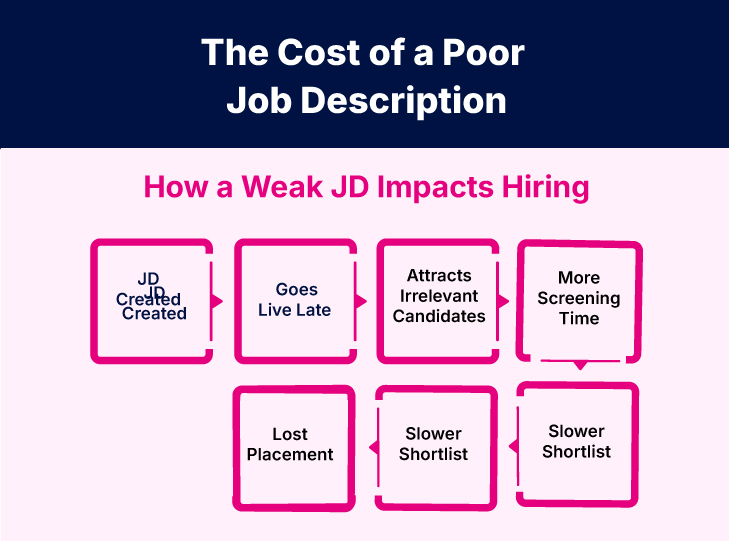
The cost of manual JD writing goes far beyond time, it directly impacts business outcomes.
First, there’s the issue of delayed job postings. If it takes hours (or even days) to finalise a JD, your role goes live late. In competitive sectors, this delay can mean missing out on top candidates entirely.
Second, poorly written JDs lead to low-quality applications. When expectations are unclear, candidates apply anyway, resulting in a larger but less relevant talent pool. This increases screening time and reduces recruiter productivity.
There’s also a significant impact on candidate drop-off. Top candidates often skim job descriptions quickly. If they don’t find clarity or relevance, they move on to other opportunities.
Over time, this results in lower fill rates, longer hiring cycles, and lost revenue opportunities, making manual JD writing far more expensive than it appears.
Recruitment teams are increasingly moving toward job description writing automation, and for good reason.
One of the most common solutions is automated job description writing tools, which generate JDs instantly based on structured inputs like job title, skills, and experience. This removes repetitive manual effort and ensures consistency.
Then there are AI job description generators for recruiters UK, which go a step further. These tools don’t just create content, they improve it. They refine language, highlight key competencies, and optimise the JD for better visibility and engagement.
Some agencies are also using recruitment content optimisation tools to enhance readability, structure, and keyword relevance, improving candidate attraction through job descriptions.
Finally, advanced recruitment automation tools integrate JD creation directly with ATS systems, enabling faster publishing and tracking.
AI-generated JDs bring a level of precision and consistency that manual processes struggle to achieve.
First, they improve skill alignment. AI tools analyse job inputs and ensure all relevant skills and competencies are included, reducing the chances of missing critical requirements.
Second, they enhance clarity and readability. AI removes unnecessary complexity and structures content in a way that candidates can quickly understand, improving engagement.
Another key benefit is keyword optimisation. AI ensures that job descriptions include relevant search terms, improving visibility on job boards and attracting the right candidates.
Finally, AI ensures consistency across roles, which helps build trust with candidates and improves overall recruitment performance.
Even with automation, strong fundamentals are essential for creating effective job descriptions.
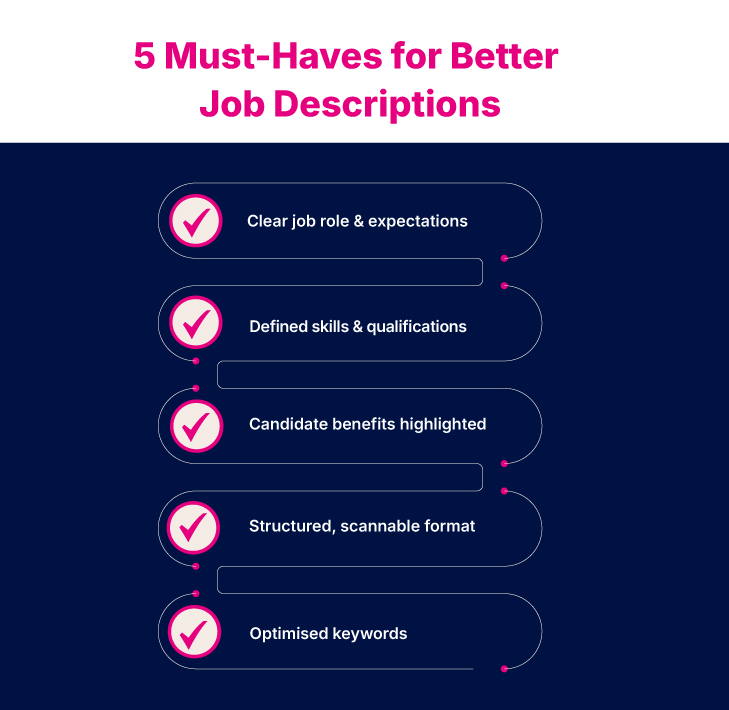
Start with clarity. Candidates should immediately understand the role, responsibilities, and expectations. Avoid vague descriptions and focus on specifics.
Use candidate-focused language. Instead of only listing requirements, highlight what the candidate will gain, growth opportunities, flexibility, and career progression.
Structure your JD for easy scanning. Use bullet points, short paragraphs, and clear headings. Most candidates don’t read everything, they scan for key information.
Also, focus on recruitment content optimisation by including relevant keywords that improve visibility and attract the right audience.
Finally, continuously refine your JDs based on performance data, what works, what doesn’t, and what can be improved.
Compliance and inclusivity are now critical elements of job descriptions in the UK.
Recruitment agencies must ensure that JDs use inclusive language, avoiding bias that may discourage certain candidates from applying. This helps attract a diverse talent pool and improves employer branding.
There is also increasing focus on pay transparency, with candidates expecting clarity on compensation. JDs that lack this information may see lower engagement.
Additionally, job descriptions must align with UK employment regulations, particularly in sectors like healthcare and public services.
Automation helps standardise these elements, ensuring consistency and reducing compliance risks across all job postings.
The future of JD creation lies in automation combined with personalisation.
AI will enable job descriptions to be tailored based on candidate personas, industry trends, and location-specific insights. This will make JDs more relevant and engaging.
We’ll also see real-time optimisation, where JDs are continuously improved based on performance data such as application rates and conversion metrics.
Another key trend is end-to-end hiring automation, where JD creation is integrated with sourcing, screening, and analytics, creating a seamless recruitment workflow.
For UK recruitment agencies, this shift represents an opportunity to gain a competitive edge through faster, smarter, and more scalable hiring processes.
Recruitment today is no longer just about filling roles, it’s about doing it faster, better, and at scale. Agencies are increasingly moving away from manual processes toward automation and AI-driven hiring models.
This is where QX Global Group supports staffing firms with talent sourcing services. By combining offshore expertise with technology and AI, they help agencies improve efficiency, consistency, and overall hiring outcomes.
A key solution enabling this shift is SonarHire AI, a 360° AI recruiter designed to streamline the hiring process.
Its AI JD Creator helps recruiters:
Beyond JD creation, it also supports screening, interviews, scheduling, and compliance — creating a connected, end-to-end hiring workflow.
For recruitment agencies, this means:
Manual job description writing is slow, inconsistent, and often lacks clarity. In the UK hiring market, where speed and precision matter, this creates delays and attracts the wrong candidates. Recruiters end up spending more time fixing issues downstream instead of focusing on hiring. With increasing competition for talent, relying on manual JD’s puts agencies at a disadvantage.
A poorly written job advert creates confusion about the role, responsibilities, and expectations. This leads to a higher number of irrelevant applications while discouraging qualified candidates from applying. As a result, recruiters spend more time screening and less time engaging with the right talent. Ultimately, this impacts both candidate quality and application conversion rates.
AI tools bring speed, consistency, and accuracy to job description writing. They help identify key skills, structure content clearly, and optimise language for better candidate engagement. This improves candidate attraction through job descriptions and reduces manual effort. Over time, it leads to better hiring outcomes and more efficient recruitment workflows.
UK recruitment agencies can speed up JD creation by using automated job description writing tools and standardised templates. AI-powered tools can generate and optimise job descriptions within minutes, ensuring clarity and consistency. Combining this with recruitment content optimisation techniques helps improve visibility and engagement. This approach allows recruiters to focus more on sourcing and placements.
A high-performing job description is clear, structured, and candidate-focused. It should include specific responsibilities, required skills, and realistic expectations. Highlighting benefits such as salary, flexibility, and growth opportunities also improves engagement. When combined with relevant keywords, it enhances visibility and helps attract the right candidates instead of just more candidates.
Yes, automated JD tools significantly reduce the time spent on writing and revising job descriptions. This allows recruiters to publish roles faster and start sourcing earlier. By improving candidate relevance, these tools also reduce screening time and speed up shortlisting. Overall, they play a key role in improving recruiter productivity and reducing time-to-hire.
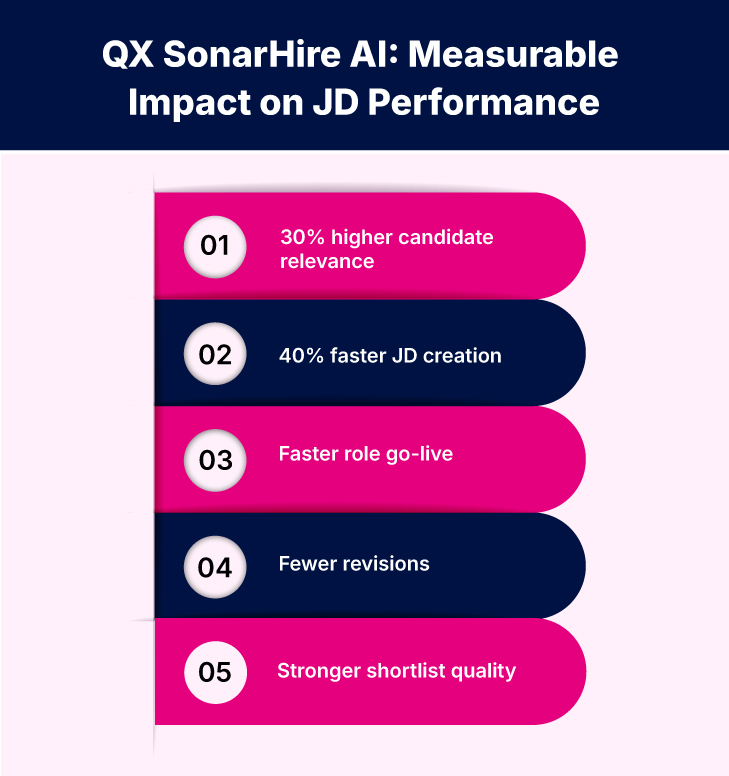
AI tools like QX SonarHire AI help automate and optimise the JD creation process. They generate structured job descriptions, identify key skills, and refine language for clarity and engagement. This improves candidate matching and reduces the need for revisions. For recruitment agencies, it means faster role go-live, better candidate quality, and a more efficient hiring process.
Enjoyed our blog? Discover more about how our recruitment outsourcing process can slash your costs by up to 60%! Take the next step—book a call by entering your details.

Education:
• Bachelor’s in Electronics Engineering, University of Bombay
• Professional & Technical Certifications in Leadership, Management & Technology

Mandar Vanarse is a seasoned technology leader with over 30 years of experience in business transformation, innovation, and enterprise architecture. At QX, he leads the technology vision and drives initiatives like the QX Automation Acceleration Center (AAC) to deliver scalable, tech-first solutions for clients across the globe.
He has led multimillion-dollar IP-platform businesses, developed the ASSIMPLER framework used in award-winning UN-backed national transformation programs, and continues to champion cutting-edge advancements in generative AI and digital strategy.
Expertise: Enterprise Architecture, Digital Strategy, Generative AI, Business Transformation, Technology Innovation, Automation at Scale
Originally published Apr 20, 2026 08:04:01, updated Jul 23 2026
Topics: AI in Recruitment, Automated Job Description, job description writing automation, Recruitment automation
28 Apr 2026
Most recruitment firms today are already “using AI.” They have invested in tools, explored autom...
Read More23 Feb 2026
On 11th February, the APSCo Insight webinar on Redefining Recruitment with AI brought one thing into...
Read More19 Jan 2026
It’s 9:30 AM. A recruiter logs in to find 18 open roles, hundreds of new applications, and three c...
Read More25 Nov 2024
Key Takeaways 79% of organizations use AI to enhance efficiency and accuracy in hiring processes. Ma...
Read More