Topics: AI Resume Screening, Resume Screening for Recrutment agencies
Posted on May 27, 2026
Written By Ranjana Singh




A recruiter finally posts a new vacancy after a long client briefing call. Within a few hours, the applications start flooding in. By the end of the day, there are already 250+ CVs waiting to be reviewed.
At first, that sounds like a good problem to have. More applicants should mean a better chance of finding the right candidate. But for many UK recruitment agencies, the reality looks very different behind the scenes.
Recruiters are spending hours scanning CVs, filtering irrelevant applications, checking keywords manually, and trying to shortlist candidates quickly enough before competitors reach them first. Meanwhile, clients expect faster submissions, candidates expect quicker responses, and recruiters are left balancing speed with hiring quality.
This is exactly why more agencies are investing in AI Resume Screening, automated resume screening tools, and AI candidate screening software to improve hiring efficiency. Instead of manually reviewing every application, recruiters can now use candidate shortlisting technology to prioritise the most relevant profiles faster while maintaining hiring quality.
When used correctly, AI does not replace recruiters. It removes repetitive screening work so recruiters can focus on conversations, relationships, placements, and client delivery.
In this blog, you’ll learn:

Hiring volumes across many sectors in the UK continue to fluctuate. Contract hiring, temporary staffing, and project-based recruitment often generate hundreds of applications for a single role.
For recruiters, this creates multiple operational challenges that directly impact delivery speed, recruiter productivity, and placement quality.
Manual CV reviews take time. Recruiters often spend hours filtering applications before even speaking to qualified candidates. This slows down submissions, delays client response times, and impacts time-to-fill. In highly competitive markets, agencies can lose strong candidates simply because another recruiter moved faster.
Different recruiters may interpret the same CV differently. Without a standardised screening process, strong candidates can easily be overlooked while less suitable profiles move forward. This inconsistency often affects shortlist quality and creates challenges in maintaining recruitment standards across teams.
Constant manual screening reduces recruiter productivity significantly. Instead of focusing on relationship-building, business development, client engagement, and placements, recruiters become stuck in repetitive admin-heavy tasks. Over time, this can affect team morale, efficiency, and overall hiring performance.
When screening delays happen, candidates lose interest or accept competing offers. Slow response times directly affect candidate engagement and placement success. Many candidates now expect near-immediate communication, especially in sectors facing talent shortages.
As application volumes increase, agencies often feel pressured to hire more recruiters simply to manage screening workloads. This increases operational costs without necessarily improving hiring outcomes. For growing agencies, scaling manual recruitment processes becomes difficult and expensive.
AI Resume Screening uses artificial intelligence and machine learning to analyse CVs, compare them against job requirements, rank candidate relevance, and support recruiter decision-making.
Modern AI recruitment tools UK agencies use today can evaluate multiple candidate factors simultaneously, including:
Instead of manually reviewing every application, recruiters receive prioritised shortlists based on relevance scoring and matching criteria.
This makes candidate screening automation significantly faster, more scalable, and more consistent than traditional manual screening methods.

One of the biggest advantages of resume screening automation is speed. Recruitment agencies no longer need to depend entirely on manual CV reviews to identify qualified candidates.
AI-powered hiring process tools can compare hundreds of CVs against a job description within minutes. Recruiters no longer need to manually scan every application line-by-line, which dramatically reduces screening time during high-volume hiring.
Candidate shortlisting technology automatically ranks candidates based on suitability, helping recruiters focus only on the most relevant profiles first. This speeds up decision-making and improves recruiter efficiency across multiple open roles.
Recruiters spend less time on repetitive screening tasks and more time engaging candidates and clients. This creates a better balance between operational delivery and relationship-driven recruitment activities.
Faster screening allows agencies to submit qualified candidates earlier than competitors, improving placement opportunities and increasing the likelihood of successful hires. In fast-moving recruitment markets, speed often directly impacts revenue generation. For many UK recruitment agencies, speed alone creates a major competitive advantage.
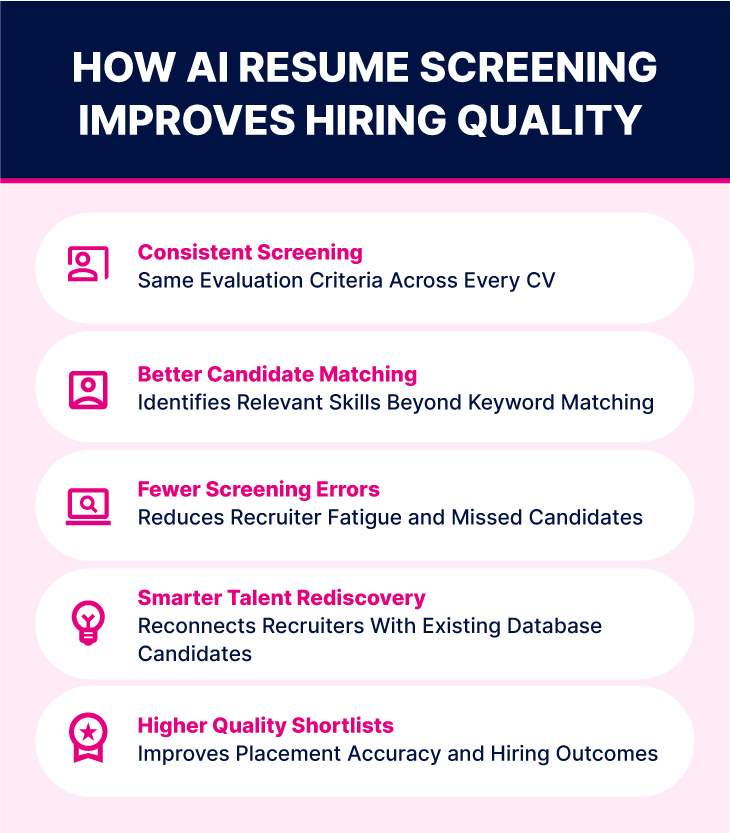
Speed matters in recruitment. But quality matters even more. One of the biggest misconceptions around automation is that faster hiring automatically reduces candidate quality. In reality, properly implemented AI candidate screening software often improves hiring accuracy and shortlist relevance.
AI applies the same screening criteria across every application. This reduces inconsistencies caused by manual decision-making and helps agencies maintain standardised recruitment quality across teams and clients.
Modern automated resume screening tools can analyse contextual relevance rather than relying only on basic keyword matching. This helps identify candidates whose skills and experience genuinely align with role requirements.
Recruiters reviewing hundreds of CVs manually may unintentionally overlook qualified candidates due to fatigue, distractions, or time pressure. AI helps reduce this risk by consistently analysing every application against defined criteria.
AI-powered systems can re-surface previously screened candidates from existing databases for relevant roles, improving recruiter efficiency and increasing database utilisation. Many agencies already have strong candidates in their systems but struggle to rediscover them quickly.
This is one reason why many agencies are investing in talent acquisition technology to improve quality of hire with AI while maintaining recruiter productivity.
AI is highly effective for repetitive, data-heavy recruitment tasks. But recruitment still depends heavily on human judgment, relationship-building, and communication.
The best hiring outcomes happen when AI screening is combined with recruiter validation.
AI excels at quickly processing large application volumes, identifying patterns across CVs, and prioritising candidates based on relevance. This removes much of the repetitive manual workload recruiters face daily.
Recruiters still play a critical role in assessing:
AI can identify relevant candidates faster, but recruiters provide the context, emotional intelligence, and decision-making needed for successful placements and long-term client relationships. This hybrid approach creates a more efficient and balanced AI-powered hiring process.
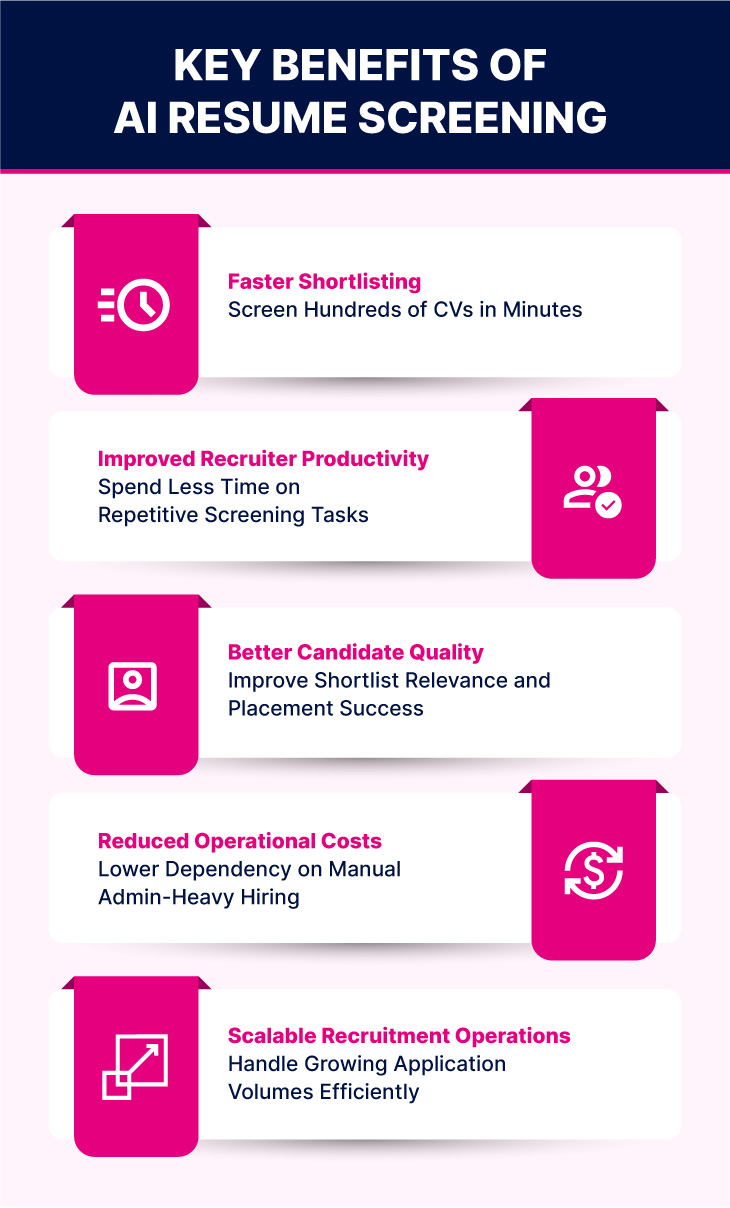
Recruiters can manage more roles simultaneously without increasing workload pressure. This allows agencies to improve delivery capacity without immediately expanding internal teams.
AI-driven candidate screening improves recruitment turnaround time and speeds up submissions, helping agencies respond faster to client demands.
Better relevance matching improves shortlist quality, increases placement success rates, and supports stronger long-term hiring outcomes.
Aencies reduce the need for additional administrative hiring support during high-volume recruitment periods, helping improve operational efficiency.
Recruitment workflow automation allows agencies to handle growth without creating operational bottlenecks or overloading recruiters with repetitive work.
Many UK recruitment agencies are now integrating AI across multiple recruitment stages to improve efficiency and recruiter productivity.
This includes:
Solutions like SonarHire your 360 AI recruiter are helping agencies automate repetitive recruitment tasks while enabling recruiters to focus on higher-value hiring activities.
Combined with offshore recruitment services, agencies can create scalable recruitment operations that improve delivery speed, recruiter productivity, and hiring consistency without increasing operational pressure.
Also Read: Top Offshore Recruitment Companies in UK: What Staffing Firms Should Know
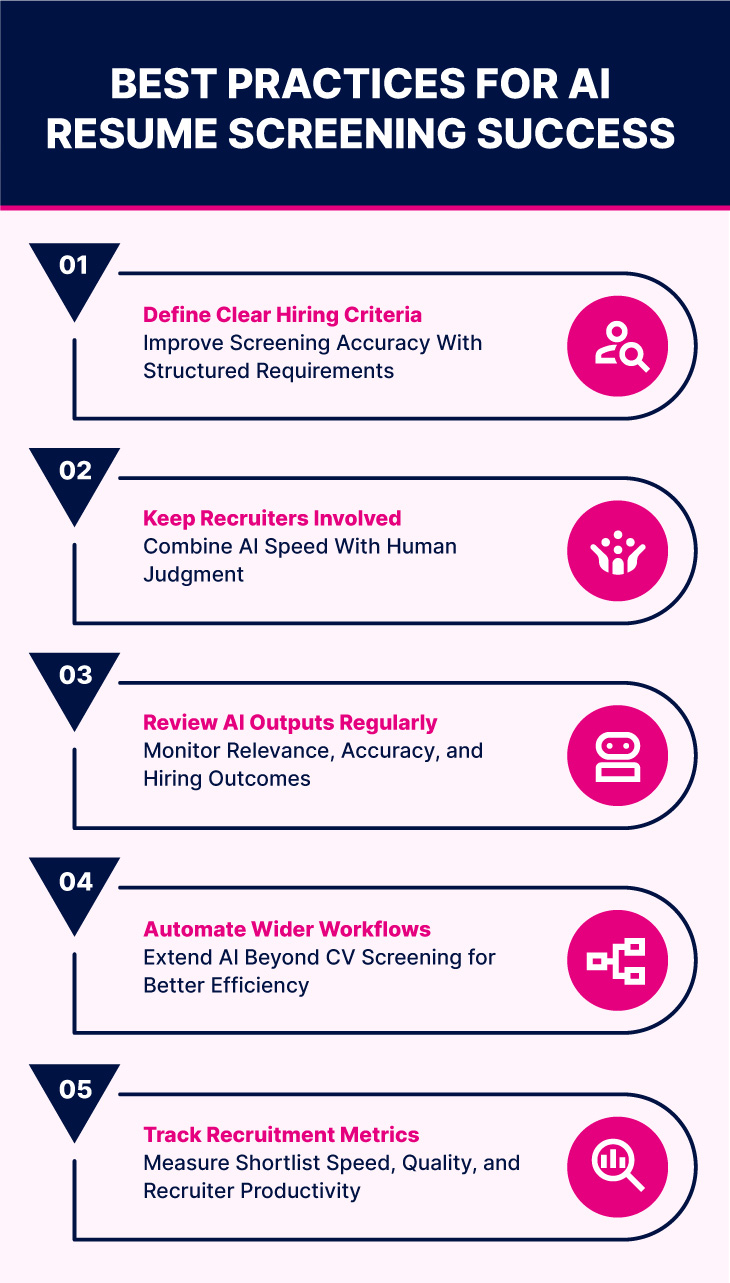
AI performs best when job requirements and screening parameters are clearly structured. Clear criteria improve matching accuracy and shortlist quality.
AI should support recruiter decisions, not fully replace human judgment. Recruiter oversight remains essential for evaluating candidate suitability beyond CV data.
Recruitment agencies should regularly monitor screening accuracy, relevance scoring, and hiring outcomes to avoid poor matching results and maintain recruitment quality.
Combining AI screening with recruitment workflow automation creates stronger operational efficiency across the entire hiring process rather than just one recruitment stage.
Track key hiring metrics regularly to evaluate AI effectiveness, recruiter productivity improvements, and overall recruitment performance.
AI performs best when job requirements and screening parameters are clearly structured. Clear criteria improve matching accuracy and shortlist quality.
Also Read: Practical AI Adoption in Recruitment for UK Agencies
QX Global Group supports recruitment agencies with outsourced recruitment operations, recruitment workflow automation, and AI-enabled hiring support solutions.
Through offshore recruitment services and technology-led delivery models, QX Global Group helps staffing firms reduce operational pressure while improving recruitment efficiency and candidate quality.
Its AI-led platform, SonarHire AI supports recruiters through automated CV screening, AI-powered candidate matching, interview automation, and intelligent recruitment workflows.
This combination of recruiter expertise plus AI automation helps agencies scale recruitment operations without significantly increasing internal workload.

As application volumes continue growing, manual recruitment processes will become increasingly difficult to scale efficiently.
AI Resume Screening is quickly becoming less of a competitive advantage and more of an operational necessity for UK recruitment agencies.
The agencies that succeed will not be the ones replacing recruiters with automation. They will be the ones using AI to remove repetitive tasks, improve hiring consistency, and allow recruiters to focus on relationship-driven recruitment work that drives placements, client satisfaction, and revenue growth.
AI Resume Screening helps agencies process hundreds of CVs much faster than manual reviews. Instead of recruiters spending hours reviewing applications individually, AI candidate screening software automatically analyses, ranks, and prioritises candidates based on job relevance. This reduces screening time significantly while helping recruiters focus on qualified candidates faster.
Yes. Modern automated resume screening tools improve relevance matching and reduce the chances of qualified candidates being overlooked. Recruiters receive stronger shortlists without manually reviewing every CV, which helps improve quality of hire with AI while keeping recruiter workload manageable.
AI CV screening for recruitment agencies helps solve several operational challenges, including slow shortlisting, recruiter burnout, inconsistent candidate evaluations, delayed submissions, and difficulty managing high-volume applications. It also improves recruitment workflow automation and overall hiring efficiency.
Most agencies use AI for initial candidate screening and ranking, while recruiters handle interviews, candidate engagement, cultural fit assessment, and final hiring decisions. This hybrid model combines automation speed with human judgment for better recruitment outcomes.
Agencies should monitor metrics such as time-to-shortlist, submission speed, recruiter productivity, interview-to-placement ratio, candidate quality, placement success rate, and recruiter workload reduction. These metrics help measure the effectiveness of candidate screening automation.
AI-powered hiring process tools instantly screen and prioritise candidates, helping recruiters identify qualified applicants faster. This reduces delays between job posting, candidate shortlisting, and client submissions, improving overall recruitment turnaround time.
AI cannot fully assess soft skills, communication ability, motivation, or cultural fit. Over-reliance on automation without recruiter oversight can also create screening inaccuracies. This is why human recruiter validation remains essential in recruitment processes.
Yes. Many AI recruitment tools UK agencies use today are scalable and suitable for both large and small recruitment firms. Smaller agencies especially benefit from increased recruiter productivity and the ability to manage higher application volumes without expanding internal teams.
Enjoyed our blog? Discover more about how our recruitment outsourcing process can slash your costs by up to 60%! Take the next step—book a call by entering your details.

Education:
B.Com(Hons), Delhi University

Ranjana Singh is a data-driven B2B content marketer who loves creating well-researched content and blending it with storytelling. At QX, she leverages data insights and lead analysis to craft high-performing LinkedIn campaigns, blogs, newsletters, and sales collateral that drive MQLs and brand visibility across the US and UK markets. Her work is rooted in performance—every strategy starts with deep analysis of content metrics, funnel behavior, and audience engagement trends to deliver measurable marketing impact.
Expertise: Data-Backed Content Marketing Strategy, SEO & Organic Growth, LinkedIn & Newsletter Marketing, MQL Attribution & Lead Source Analysis, Recruitment Industry Marketing (US & UK),
Originally published May 27, 2026 09:05:37, updated May 27 2026
Topics: AI Resume Screening, Resume Screening for Recrutment agencies