Topics: AI Adoption in Recruitment, AI in Recruitment, RACE Framework
Posted on April 28, 2026
Written By Mandar Vanarse




Most recruitment firms today are already “using AI.”
They have invested in tools, explored automation, and run pilots across sourcing, screening, and coordination. Yet, when outcomes are evaluated, the impact often remains unclear.
This is the reality of AI adoption in recruitment, particularly across UK recruitment agencies. The gap is not in technology. It lies in how AI is being adopted.
In this article, we will explore:

AI adoption across the recruitment technology UK landscape is increasing, but outcomes remain inconsistent.
A key reason is that AI is often layered onto existing workflows instead of transforming them. Recruitment processes remain unchanged, while new tools are added on top, leading to limited efficiency gains.
Another issue isfragmented adoption. Different teams implement different tools without integration or alignment. This disrupts workflows and reduces the effectiveness of recruitment process automation.
There is also a gap in adoption at the recruiter level. Without proper enablement, AI tools are either underutilised or used inconsistently.
The result is a familiar pattern, increased investment without proportional improvement in outcomes.
To understand where things go wrong, it’s important to look at the patterns we consistently see across recruitment firms.
In many organisations, AI adoption starts with selecting tools rather than defining a clear recruitment AI implementation strategy. This often leads to a mismatch between tool capabilities and actual business needs. As a result, tools are either underutilised or used for the wrong use cases. Instead of solving real problems, they add another layer to existing workflows. Over time, this creates confusion, low adoption, and limited ROI.
AI initiatives are frequently launched without clearly defining what success looks like. Without measurable goals such as reducing time-to-fill, improving submission quality, or increasing recruiter productivity, it becomes difficult to assess impact. This lack of clarity also makes it harder to prioritise use cases and allocate resources effectively. As a result, AI remains an experiment rather than a business enabler. Clear outcome definition is critical to turning AI into a performance driver.
AI systems are only as effective as the data they rely on. In recruitment, this often means dealing with inconsistent job descriptions, incomplete candidate profiles, and fragmented data across systems. Without structured and standardised data, AI outputs become unreliable and difficult to trust. This not only affects performance but also reduces recruiter confidence in the system. Ensuring data readiness is a foundational step for successful AI adoption.
AI implementation is often approached as a technology project, when in reality it is a change management challenge. Even the most advanced tools will fail if recruiters do not understand or trust them. Successful adoption requires training, clear communication, and alignment across teams. Recruiters need to see how AI supports their work, not replaces it. Without this, adoption remains low and expected benefits are never fully realised.
Some organisations try to scale AI too quickly without building a strong foundation, while others remain stuck in pilot mode. Scaling too early can lead to operational disruption, while delaying scale reduces momentum and confidence. Both approaches limit the ability to generate ROI. A phased approach starting small, proving value, and then expanding is essential for sustainable AI adoption.
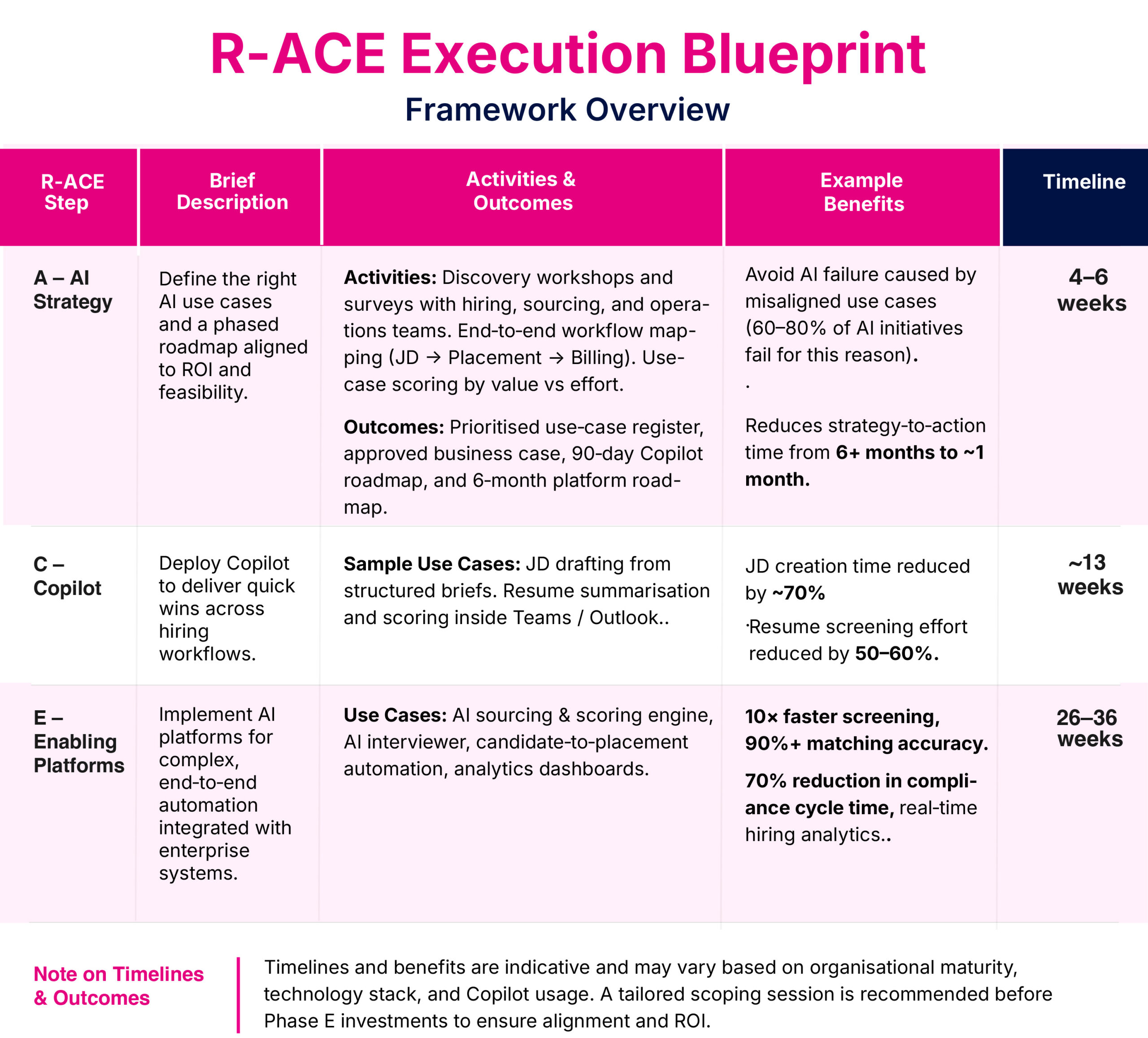
What is required is not more tools, but a structured recruitment technology adoption framework. This is where the R-ACE Framework provides a practical path forward.
R-ACE (Rapid ACE) is a structured, execution-first framework designed to enable effective AI adoption in recruitment and staffing operations.
It is built on a simple principle: AI adoption should align with organisational readiness and business outcomes.
The framework combines strategy, Copilot-led quick wins, and platform-level enablement in a phased sequence. This ensures controlled investment, faster time-to-value, and scalable impact.
A common mistake in AI in hiring in the UK is attempting to implement complex platforms upfront.
R-ACE follows a different approach.
It begins with low-cost, high-impact AI use cases that deliver immediate value. These early wins build internal confidence and improve adoption across teams.
Once this foundation is established, organisations can move towards more advanced platform-level automation.
This phase establishes the foundation for AI-driven hiring strategies.
It involves mapping the entire recruitment lifecycle, from job description creation to placement and billing, to identify inefficiencies and bottlenecks.
The next step is prioritising use cases based on impact and feasibility. Instead of applying AI broadly, the focus is on areas where it can deliver immediate value, such as sourcing, screening, and compliance.
The outcome is a structured roadmap that includes both short-term quick wins and a longer-term plan for scaling AI adoption.
This significantly reduces the risk of failed AI initiatives and ensures alignment with business objectives.
Once priorities are defined, implementation becomes more effective.
This phase focuses on deploying AI tools that enhance recruiter productivity. Use cases include job description generation, resume summarisation, and candidate communication support.
The objective is to reduce manual effort while maintaining human oversight and decision-making.
This is where recruitment process automation begins to deliver tangible results improving speed, consistency, and output quality.
For organisations looking to scale execution alongside AI, integrating this approach with offshore recruiting services UK can further enhance capacity without increasing internal headcount.
In this phase, AI evolves from a tool into a core operational capability.
Organisations implement platform-level AI solutions that integrate sourcing, screening, interviewing, compliance, and analytics into a unified system.
Performance is continuously tracked using key metrics such as time-to-fill, recruiter productivity, and cost-per-hire.
This enables ongoing optimisation and supports scalable digital transformation in recruitment.
At scale, AI in recruitment is no longer limited to individual tools or isolated use cases. It becomes an integrated capability embedded across the entire hiring lifecycle, enabling faster, more consistent, and data-driven decision-making.
In real recruitment environments, platform-level AI connects multiple workflows, from job creation to placement and compliance, creating a seamless and automated system.
Below is how this translates into actual recruitment operations:
AI can generate structured, inclusive, and SEO-optimised job descriptions by analysing role requirements, historical data, and market benchmarks. This reduces the dependency on manual drafting and ensures consistency across roles.
Recruiters can move from brief to publish-ready JD in minutes, improving speed without compromising quality. It also helps standardise language, reduce bias, and improve candidate relevance.
The impact is not just faster creation but better application quality and improved conversion rates.
One of the most valuable applications of AI is its ability to process large volumes of candidate data quickly.
AI systems can scan thousands of resumes against job criteria using weighted parameters and contextual matching, delivering ranked shortlists with clear scoring logic. This enables recruiters to focus only on the most relevant candidates.
Instead of manually reviewing CVs, teams can rely on data-backed candidate prioritisation, significantly improving both speed and accuracy in screening.
Interview coordination is one of the most time-consuming parts of recruitment.
With AI-driven scheduling, systems can automatically connect with candidates, identify availability, confirm slots, and manage rescheduling without manual intervention. This eliminates back-and-forth emails and reduces delays.
The result is a faster transition from screening to interview, improving both recruiter efficiency and candidate experience.
AI is now capable of conducting structured interviews at scale, adapting questions in real time and evaluating responses consistently.
In fully automated scenarios, AI can handle high volumes of interviews simultaneously, ensuring standardisation and speed. In hybrid models, recruiters can observe and intervene when required, combining AI efficiency with human judgement.
This approach not only reduces recruiter workload but also ensures consistent and unbiased evaluation across candidates.
Preparing interview questions can be time-consuming and inconsistent across recruiters.
AI can generate role-specific, level-appropriate interview questions based on job descriptions and candidate profiles. This ensures better alignment between role requirements and assessment criteria.
It also helps reduce bias and improves the overall quality of the interview process by maintaining consistency.
Post-interview evaluation is another area where AI adds significant value.
AI systems can generate structured scorecards, competency mapping, and clear hire or no-hire recommendations with full audit trails. This reduces subjectivity and improves decision-making speed.
Recruiters and hiring managers can make decisions based on standardised, data-backed insights, improving quality of hire.
In compliance-heavy sectors, document collection and verification can slow down the hiring process.
AI-powered systems can automate document extraction, classification, and validation, ensuring faster and more accurate compliance checks. This reduces manual effort and minimises the risk of errors.
It also ensures that compliance workflows are consistent, traceable, and audit-ready at all times.
Following up with candidates for missing documents or updates is often repetitive and time-consuming.
AI voice agents can handle these interactions by contacting candidates, providing guidance, and tracking responses automatically. This ensures no follow-ups are missed and improves completion rates.
As a result, compliance cycles become faster and more predictable, reducing delays in onboarding.
When implemented at a platform level, AI moves beyond task automation and becomes a core operational capability.
It enables:
This is what practical AI adoption in recruitment looks like in real-world scenarios, not just isolated automation, but connected, measurable, and scalable transformation.
AI adoption in the UK must be aligned with strict regulatory frameworks such as GDPR, especially given the volume and sensitivity of candidate data handled by recruitment firms. This means organisations need to go beyond basic compliance and ensure that data is collected, stored, and processed securely at every stage of the recruitment lifecycle.
One of the key considerations is transparency in AI-driven decisions. Candidates and clients should have clarity on how AI is being used, whether it is for screening, scoring, or interview evaluation. This is particularly important in building trust and avoiding legal or reputational risks.
Another critical area is bias prevention and fairness. AI models can unintentionally replicate biases present in historical data. To address this, organisations must regularly monitor and audit AI outputs to ensure consistent and unbiased decision-making across candidates.
Auditability and traceability are also essential, especially in compliance-heavy sectors like healthcare and finance. Every AI-driven action, whether it is candidate shortlisting or rejection, should be documented and explainable. This ensures accountability and supports compliance checks when required.
Finally, ethical AI adoption is not just about risk mitigation. It plays a key role in building long-term credibility with clients and candidates. Firms that prioritise responsible AI usage are more likely to gain trust, improve candidate experience, and differentiate themselves in an increasingly competitive AI in the UK recruitment landscape.
The next phase of AI in UK recruitment will be defined not by adoption, but by maturity of implementation. Most agencies have already experimented with AI tools. The real differentiator now is how effectively those tools are integrated into everyday operations.
The focus is shifting from isolated experimentation to building connected, data-driven recruitment ecosystems. This means aligning sourcing, screening, interviewing, compliance, and analytics into a single, streamlined workflow powered by AI.
Organisations that invest in a structured recruitment AI implementation strategy will be able to scale faster, improve decision-making, and drive consistent outcomes. AI will move from being a support function to becoming a core operational capability.
At the same time, firms that continue with fragmented adoption, disconnected tools, and unclear ownership will struggle to realise the full value of AI. In many cases, they may even experience increased complexity rather than efficiency.
Looking ahead, success in recruitment will depend on how well firms can combine technology, process, and people. AI alone will not create an advantage. It is the way it is adopted, integrated, and scaled that will define the next generation of high-performing recruitment organisations.
In most cases, the issue lies in how AI is implemented rather than the technology itself. Tools are introduced without a clear strategy, defined use cases, or proper integration. Recruiter adoption is often limited, and performance is not consistently tracked. This results in low utilisation and unclear outcomes.
The challenges span both technical and operational areas. Poor data quality, lack of integration, and unclear ownership are common issues. At the same time, recruiter adoption and change management are often overlooked. Without addressing both aspects, AI initiatives struggle to deliver consistent results.
A practical framework breaks AI adoption into structured phases. It starts with identifying high-impact use cases, followed by implementing AI for quick wins, and then scaling through integrated platforms. This approach ensures alignment with business goals while reducing risk and improving adoption.
ROI should be measured using both efficiency and quality metrics. Key indicators include time-to-fill, cost-per-hire, recruiter productivity, and candidate quality. Consistent tracking and comparison over time help organisations understand impact and optimise performance.
Compliance requires adherence to GDPR and responsible data handling practices. AI systems must ensure transparency, avoid bias, and maintain audit trails for decision-making. These measures are essential to reduce risk and maintain trust in AI-driven processes.
Scaling requires a phased approach. Organisations should begin with high-impact use cases, demonstrate value, and expand gradually. Standardising processes, enabling teams, and continuously measuring performance are key to successful scaling.
The most effective use cases are those involving high volume and repeatability. These include sourcing, screening, job description creation, and interview scheduling. These areas deliver quick wins and create a foundation for broader AI adoption.
QX Global Group is a leading provider of offshore recruitment outsourcing solutions, AI, and transformation solutions for staffing firms across the UK and US, with over 20 years of industry experience.
QX combines deep recruitment expertise with a people plus automation approach, helping agencies improve efficiency, scale operations, and adopt AI in a structured and practical way.
Through frameworks like R-ACE and solutions like SonarHire, a 360-degree AI recruiter, QX enables firms to streamline sourcing, screening, interviewing, and compliance workflows.
By aligning technology, process, and people, QX Global Group helps recruitment businesses build scalable, AI-enabled operations that deliver measurable results.
Enjoyed our blog? Discover more about how our recruitment outsourcing process can slash your costs by up to 60%! Take the next step—book a call by entering your details.

Education:
• Bachelor’s in Electronics Engineering, University of Bombay
• Professional & Technical Certifications in Leadership, Management & Technology

Mandar Vanarse is a seasoned technology leader with over 30 years of experience in business transformation, innovation, and enterprise architecture. At QX, he leads the technology vision and drives initiatives like the QX Automation Acceleration Center (AAC) to deliver scalable, tech-first solutions for clients across the globe.
He has led multimillion-dollar IP-platform businesses, developed the ASSIMPLER framework used in award-winning UN-backed national transformation programs, and continues to champion cutting-edge advancements in generative AI and digital strategy.
Expertise: Enterprise Architecture, Digital Strategy, Generative AI, Business Transformation, Technology Innovation, Automation at Scale
Originally published Apr 28, 2026 08:04:40, updated Jul 23 2026
Topics: AI Adoption in Recruitment, AI in Recruitment, RACE Framework
20 Apr 2026
A recruiter’s day is already packed, sourcing candidates, coordinating interviews, managing client...
Read More23 Feb 2026
On 11th February, the APSCo Insight webinar on Redefining Recruitment with AI brought one thing into...
Read More25 Nov 2024
Key Takeaways 79% of organizations use AI to enhance efficiency and accuracy in hiring processes. Ma...
Read More12 Sep 2024
Around 83% of employers, including 99% of Fortune 500 companies, already use automation in their hir...
Read More