Topics: Transition plan, Transitioning to Outsourced Recruitment Teams
Posted on November 05, 2026
Written By Ankit Ranjan




Moving recruitment work outside the business sounds simple until the handover actually begins.
Who owns each job? Who updates the ATS? What happens to the knowledge sitting with your in-house recruiters? How much access should an external recruiter receive? And perhaps most importantly, how do you make the change without slowing down submissions, frustrating clients, or creating confusion between two teams?
A successful transition to outsourced recruitment teams is therefore less about handing over vacancies and more about building a new operating model. Staffing agencies need clear responsibilities, documented processes, secure system access, structured knowledge transfer, and agreed measures of success.
This guide explains which recruitment activities to transition, how to prepare internal teams, how to transfer knowledge and system access, how to maintain continuity, and how to measure and expand an outsourced recruitment model.
For staffing agencies, recruitment demand rarely moves in a straight line. A new client, seasonal requirement, VMS account, or sudden increase in job orders can quickly stretch an internal team. Building additional internal capacity every time volumes rise is not always practical, particularly when that demand may change again.
Outsourced recruitment teams give agencies another way to build capacity. Instead of depending entirely on additional internal hiring, agencies can use external recruiters or support specialists for defined parts of the recruitment lifecycle.
This can also help separate recruiter-led activities from high-volume operational work. QX, for example, provides recruitment outsourcing across sourcing and screening, full-cycle recruitment, MSP/VMS recruitment support, and compliance and administrative processes.
Staffing firms considering different delivery models can also review how recruitment outsourcing companies in USA structure recruitment support across different requirements.
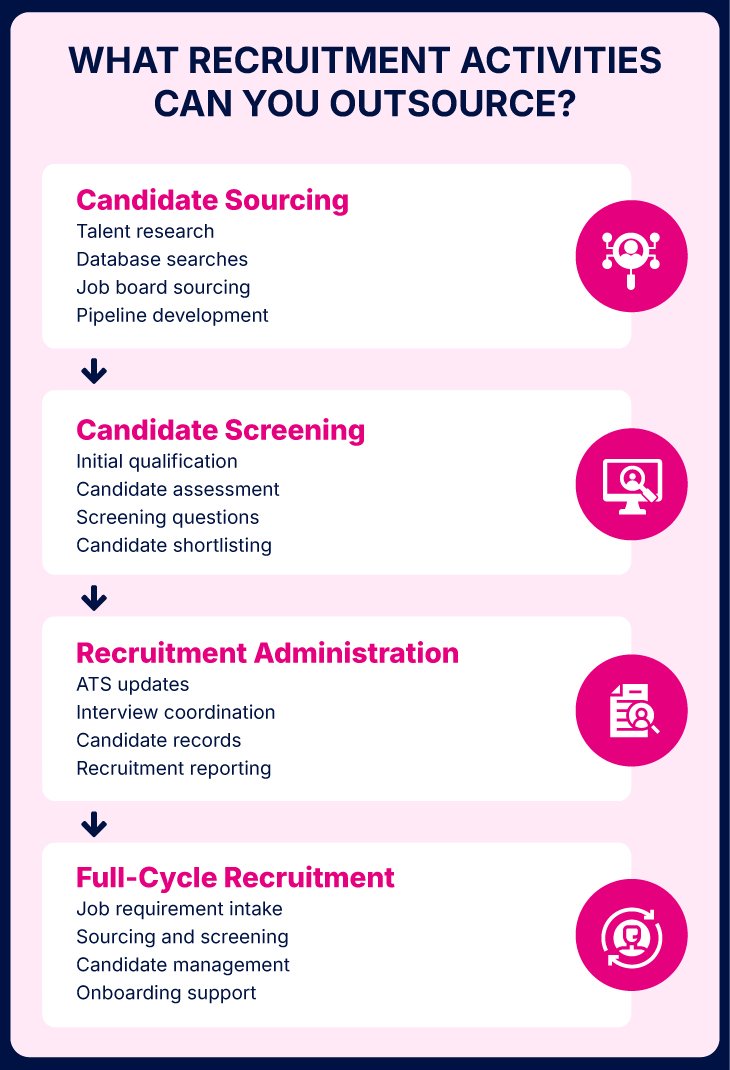
Not everything needs to move at once. Before beginning a recruitment outsourcing transition, agencies should map their recruitment workflow and determine which activities are suitable for external delivery.
Candidate sourcing is often suitable for outsourcing because it can operate as a clearly defined stage of the recruitment lifecycle. An outsourced recruiting team can work on database searches, candidate research, talent mapping, job-board sourcing, and pipeline development while internal recruiters retain responsibility for candidate relationships or client-facing activity.
Where screening criteria can be clearly documented, outsourced recruiters can handle initial candidate assessment against agreed job requirements. The important part is establishing what constitutes a qualified candidate, what questions need to be asked, what information must be recorded, and when a candidate should be escalated to the internal recruiter.
ATS updates, candidate record management, interview scheduling, reporting, document management, and other recurring administrative activities can consume considerable recruiter capacity. Moving clearly defined administrative processes to recruitment outsourcing teams allows internal recruiters to spend more time on candidates, clients, offers, and placements.
Some agencies may eventually choose to transition broader recruitment responsibilities, from understanding job requirements through sourcing, screening and onboarding support. QX lists full-cycle recruitment among its recruitment outsourcing services.
Rather than deciding based purely on workload, agencies should ask: Is the process documented, repeatable, measurable, and ready to be transferred?
A good recruitment team transition should start well before an outsourced recruiter begins working on live requirements.
Document how work currently moves through the agency, from receiving a requirement to placement and onboarding. Include the people involved, systems used, approval points, handoffs, exceptions, and reporting requirements.
This often exposes inconsistencies that were previously hidden because experienced recruiters simply knew how to work around them.
Be specific about where internal responsibility ends and outsourced responsibility begins.
For example:
Clear boundaries reduce duplicated work and prevent tasks from being missed because each team assumes the other owns them.
Every major workflow should have an owner on both sides. The outsourced team needs someone who can answer operational questions, while the staffing agency needs an internal person responsible for decisions and escalations.
Ownership becomes particularly important during the first phase of the transition, when exceptions and undocumented processes are more likely to surface.
Do not wait until several weeks after launch to decide whether outsourcing is working. Establish your baseline and reporting definitions first.
Depending on the outsourced activity, this could include time-to-submit, submission quality, submission-to-interview ratio, fill rate, turnaround time, ATS accuracy, compliance accuracy, and recruiter capacity.
One of the biggest risks when moving from in-house recruiters to outsourced recruitment support is losing knowledge that was never formally documented.
Your recruiters may know that a particular client dislikes certain CV formats, expects submissions within a specific workflow, or interprets a job requirement differently from what appears in the job description. If this knowledge remains in people’s heads, the outsourced team cannot consistently replicate the existing process.
Build SOPs around actual workflows rather than idealised versions of the process. Include the steps, responsible person, systems involved, expected output, common exceptions, and escalation point.
Whenever possible, include examples of correctly completed work so outsourced recruiters understand what “good” looks like.
Do not limit knowledge transfer to ATS demonstrations and task instructions. Explain the agency’s sectors, client types, recruitment model, typical roles, candidate expectations, terminology, communication standards, and priorities.
An outsourced recruiter who understands why a process exists is better equipped to deal with situations that do not perfectly match an SOP.
Training should include representative jobs, searches, candidate profiles, submissions, ATS records, and common exceptions. Once a process has been demonstrated, allow the outsourced team to complete practice scenarios and explain the workflow back.
This turns knowledge transfer into a two-way exercise rather than a presentation.
Outsourcing recruitment usually means giving external team members access to systems containing candidate and client information. System access should therefore be treated as a formal part of implementation rather than an administrative task completed at the last minute.
A sourcer, recruiter, compliance specialist, and recruitment administrator may require different access. Map the platforms and permissions needed for each role rather than providing broad access by default.
The outsourced team may need access to tools such as the agency’s ATS, CRM, communication platform, job boards, VMS platforms, or reporting systems, depending on the scope.
Credentials alone do not mean the workflow is ready. Teams should test whether users can complete the activities required by their roles, including retrieving information, updating records, moving candidates through agreed stages, and accessing the necessary communication channels.
Define how candidate and client information should be accessed, stored, shared, updated, and escalated. Permissions and controls should align with the staffing agency’s security requirements, contracts, and applicable obligations.
QX states that its U.S. recruitment outsourcing offering includes secure infrastructure alongside controls supporting recruitment operations.
The objective should be to transfer work without creating a gap in delivery.
That usually means avoiding an abrupt switch where an internal workflow stops one day and the outsourced team takes complete responsibility the next.
Start with a defined workflow, client account, job category, or recruitment activity. This gives both teams an opportunity to test how the operating model works with live recruitment activity before increasing the scope.
During the transition, the outsourced team will encounter situations that were not covered during training. Establish who should answer process questions, who handles urgent candidate or client issues, and who approves exceptions.
Initial reviews should focus on whether workflows are being followed correctly, whether information is flowing cleanly between teams, and whether the expected recruitment output is being produced. Problems found early can often be corrected before additional work is transferred.
The biggest transition problems are not necessarily caused by outsourcing itself. They often appear when an existing process is transferred without enough structure.
If different recruiters perform the same task differently, an outsourced team has no reliable standard to follow. Standardise the process first and document important exceptions before transferring ownership.
Trying to transfer sourcing, screening, candidate management, administration, compliance, and reporting simultaneously creates multiple dependencies. When something goes wrong, identifying the cause becomes harder.
A phased approach gives the agency a clearer opportunity to test workflows before extending them.
Ambiguous responsibilities create duplicated work and missed tasks. Every outsourced activity should have a defined owner, reviewer, escalation point, and expected output.
A large number of calls, CVs, or database searches does not automatically indicate effective recruitment support. Connect activity measures with recruitment outcomes relevant to the outsourced scope.
A move to outsourcing can create uncertainty for in-house recruiters, particularly if the purpose and division of responsibilities are unclear.
Staffing leaders should explain what is changing, which activities are moving, which responsibilities remain internal, and how the two teams will work together.
If outsourced recruiters are supporting sourcing, screening, ATS administration, or other defined processes, spell that out. Internal recruiters need to understand where they continue to own decisions, relationships, and recruitment outcomes.
The people currently doing the work usually understand the real process better than a workflow document does. Involving them in process mapping and training helps capture exceptions, shortcuts, and account-specific knowledge.
Avoid designing an “internal versus outsourced” structure. Shared workflows, common performance definitions, regular communication, and clear handoffs make it easier for both groups to operate as parts of the same recruitment process.
Performance measurement should reflect the work the outsourced team actually controls. A sourcing team and a full-cycle recruitment team should not necessarily have identical KPIs.
Track how quickly suitable candidates move from requirement allocation to submission. This can indicate whether additional sourcing capacity is improving responsiveness.
A high volume of submissions means little if candidates consistently fail to progress. Tracking how submissions convert to interviews helps agencies assess whether sourcing and screening criteria are aligned with requirements.
Where the outsourced team has sufficient control over the recruitment process, fill rate can provide a broader view of delivery effectiveness.
For recruitment administration and operational support, agencies can also measure whether records are completed accurately, required workflow steps are followed, and tasks meet agreed turnaround standards.
The agency should also look at what the transition changes internally. If outsourced support is intended to remove operational work, assess whether internal recruiters are actually able to redirect more time toward candidate engagement, client communication, offers, and placements.
Scaling should follow evidence, not simply the initial launch.
Once the first workflow is stable, staffing companies can evaluate whether it makes sense to add recruiters, expand the number of accounts supported, or move additional recruitment activities to the outsourced team.
Good questions to ask include:
One advantage of scalable recruitment support is the ability to adjust resources as demand changes instead of rebuilding internal headcount every time volumes rise. QX specifically positions its recruitment outsourcing services around the ability to scale operations according to recruitment demand.
QX Global Group provides outsourced recruiting services for staffing businesses that need additional recruitment capacity without relying entirely on internal hiring.
Its U.S. recruitment outsourcing offering covers areas including full-cycle recruitment, MSP/VMS support, sourcing and screening, compliance, credentialing, and back-office recruitment support.
QX also states that it has 550+ recruitment staff, six delivery centers, and a 3,000+ global workforce, providing the infrastructure to support staffing firms across different recruitment requirements.
For agencies making the transition from in-house to outsourced recruitment teams, the important point is not simply adding external recruiters. The outsourced model needs to fit the agency’s existing recruiters, processes, systems, clients, and performance expectations.
Transitioning from internal recruiters to an outsourced team should not be treated as a simple handover of vacancies.
The strongest recruitment outsourcing transition begins with understanding the existing workflow, choosing the right activities to transfer, documenting processes, assigning ownership, transferring recruitment knowledge, establishing secure system access, and agreeing how performance will be measured.
Staffing agencies also do not have to choose between internal and outsourced recruiting teams. A well-designed model can use both: internal recruiters can retain the activities that require close candidate and client relationships, while outsourced recruitment teams provide additional sourcing, delivery, or operational capacity where it is needed most.
The question, therefore, is not simply“Should we outsource recruitment?” It is“Which recruitment activities should we outsource, and how do we integrate them into the way our agency already works?”
There is no universal transition timeline because the amount of work involved depends on the scope being transferred, team size, system requirements, process complexity, training needs, and the quality of existing documentation. Moving a defined sourcing process will typically involve fewer dependencies than transferring broader full-cycle recruitment. Agencies should therefore build the transition plan around operational readiness rather than an arbitrary go-live date.
Yes. In fact, agencies do not necessarily need to replace internal recruiters to use outsourcing. An outsourced recruitment team can handle defined activities such as sourcing, initial screening, ATS administration, or compliance support while internal recruiters continue managing candidate relationships, clients, interviews, offers, or other responsibilities. Responsibilities and handoffs should be clearly documented so both teams understand ownership.
Not necessarily. A phased recruitment team transition can make it easier to test workflows, system access, quality standards, handoffs, and communication before increasing the outsourced scope. Staffing firms can begin with one process, account, or group of roles and expand once the operating model is working consistently.
Start by defining role-based system access, permissions, data-handling requirements, and security responsibilities before the outsourced team begins live work. Agencies should determine what each role actually needs to access and test those permissions as part of implementation. The outsourcing arrangement should also align with the agency’s contractual, privacy, security, and compliance requirements.
Outsourcing can give staffing agencies an alternative way to add recruitment capacity without building every additional role internally. This can be particularly useful when volumes fluctuate or additional support is required across sourcing, screening, administration, or broader recruitment operations. The actual speed of scaling will depend on the provider, scope, required skills, onboarding, system access, and training involved.
QX Global Group provides recruitment outsourcing for staffing organisations across full-cycle recruitment, MSP/VMS recruitment support, sourcing and screening, compliance, credentialing, and back-office support. Its published U.S. service information lists a global workforce of 3,000+, six delivery centers, and 550+ recruitment staff, alongside scalable recruitment delivery models.
Staffing agencies can explore QX’s outsourced recruiting services to understand the recruitment functions available for outsourcing.
Enjoyed our blog? Discover more about how our recruitment outsourcing process can slash your costs by up to 60%! Take the next step—book a call by entering your details.


Ankit Ranjan is Vice President of Operations at QX Global Group, responsible for leading strategic recruitment outsourcing and operational delivery across key global accounts. Combining entrepreneurial experience with a strong background in RPO sales and operations, he specializes in scaling teams, driving AI-enabled transformation, and building long-term client partnerships that deliver sustainable business growth.
Expertise: RPO Delivery • US Staffing • UK Healthcare Recruitment • Recruitment Operations • P&L Management • Client Relationship Management • Recruitment Automation • Operational Excellence
Originally published Nov 05, 2026 08:11:33, updated Nov 05 2026
Topics: Transition plan, Transitioning to Outsourced Recruitment Teams
03 Nov 2026
Recruitment administration rarely sits neatly in one place. One person updates the ATS, another mana...
Read More12 Jun 2025
Offshore recruitment transition is not just a cost-saving strategy, it’s a structured, strategic m...
Read More15 May 2025
How you start defines how far you’ll go. If you’ve ever outsourced a business function o...
Read More18 Dec 2024
When the work increases and there is a deficiency of resources, the first thing that crosses the min...
Read More