Topics: Transition plan, Transitioning to Outsourced Recruitment Teams
Posted on November 03, 2026
Written By Ankit Ranjan




Recruitment administration rarely sits neatly in one place. One person updates the ATS, another manages candidate documents, recruiters chase missing information themselves, and certain processes may depend heavily on what an experienced team member simply knows.
That becomes important when a recruitment agency decides to move from In-House to Outsourced Admin Teams.
The transition is not simply about deciding which tasks an external team will perform. Agencies need to transfer workflows, process knowledge, system access, responsibilities, controls and service expectations without interrupting the work already happening across their desks.
A well-managed recruitment admin outsourcing transition can create a more scalable operating model while giving recruiters more time to focus on candidates, clients and placements. But getting there requires structure.
This guide explains how staffing firms can plan the transition, decide what to move first, transfer knowledge effectively, manage systems and data, protect business continuity and measure whether the new model is working.
As a staffing business grows, the administrative workload grows with it. Every placement can generate candidate documentation, ATS updates, interview coordination, compliance activity, onboarding administration, timesheets and reporting. QX identifies these among the back-office activities recruitment agencies can outsource.
That leaves agencies with a capacity question: should they continue expanding their internal admin headcount every time volumes increase, or build a more flexible support model?
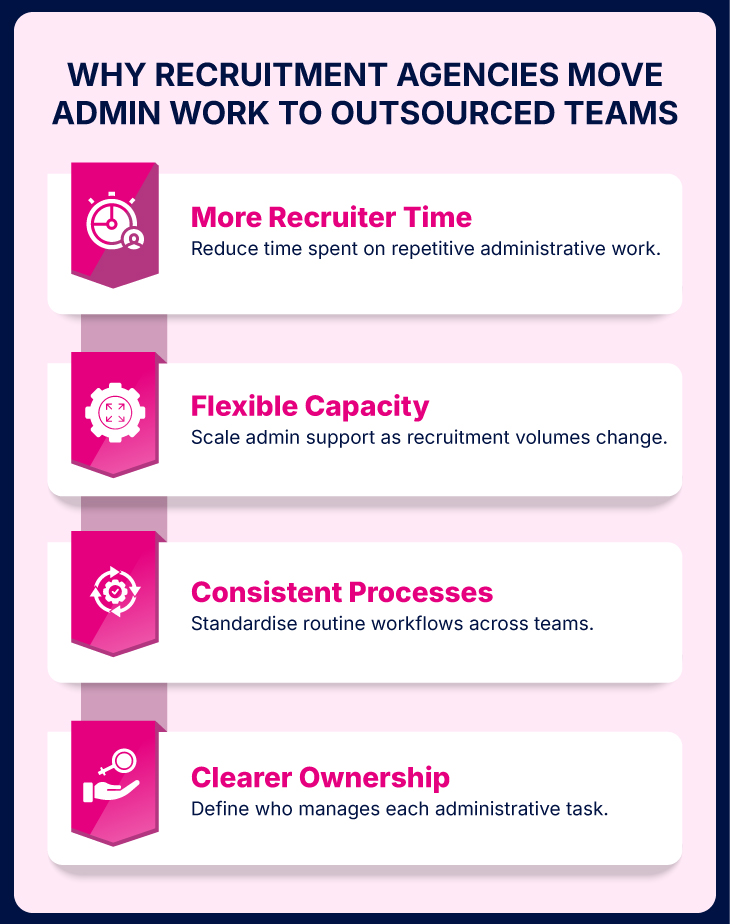
When recruiters are responsible for routine administrative processes, time spent updating records, formatting CVs or chasing documentation is time unavailable for candidates and clients.
Moving defined administrative processes to an outsourced team allows the agency to separate recruitment activity from repeatable operational work. The objective should not simply be to move tasks elsewhere. It should be to establish clearer ownership of work and protect recruiter capacity.
Recruitment workload does not always stay constant. Different desks can experience peaks because of client wins, seasonal requirements or changing hiring demand.
An outsourced model can offer greater operational flexibility because support capacity can be adjusted as requirements change. QX describes its model as allowing agencies to ramp offshore teams up or down according to business and market demand.
An in-house process can become heavily dependent on individual working habits. One consultant may update the ATS immediately, another at the end of the day, while another relies on an administrator to do it.
Transitioning creates an opportunity to document, standardise and assign ownership to these workflows before they are transferred. That can make operational expectations clearer, particularly for agencies working across multiple recruiters, desks or offices.
Agencies still comparing potential models or providers can review our guide to Recruitment Admin Support Outsourcing Companies in UK.
One of the biggest mistakes in an outsourced recruitment admin transition is treating every administrative function as equally ready for outsourcing.
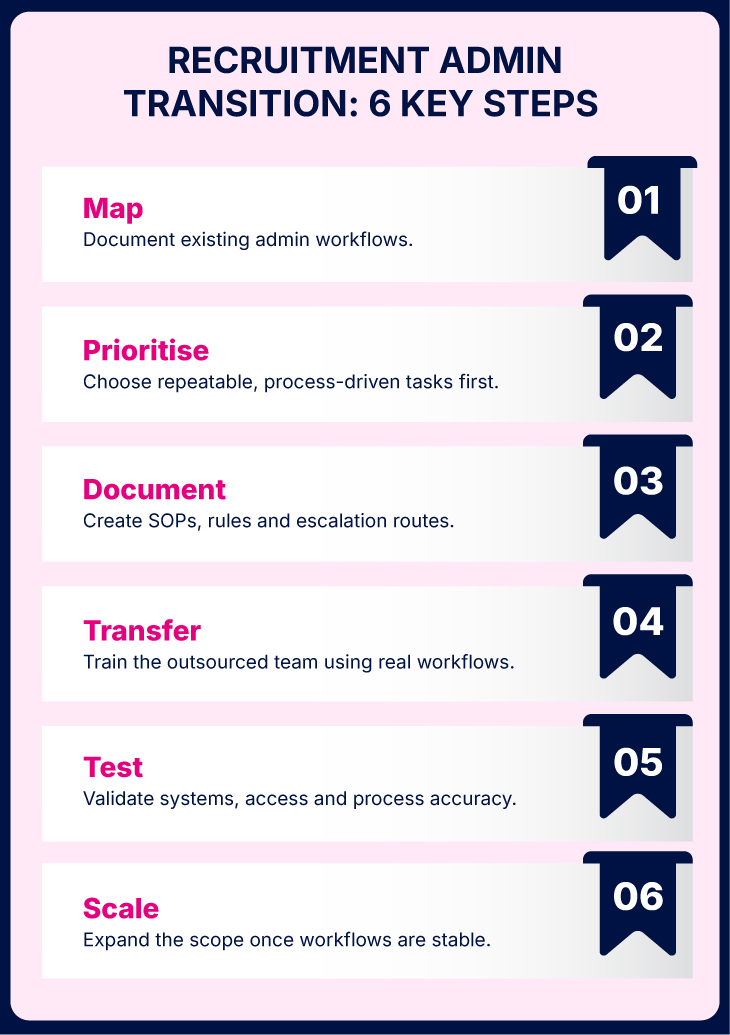
Your starting point should be the work that is repeatable, rules-based, measurable and easy to document.
Candidate record updates, database maintenance, data entry and routine CRM administration can be clearly mapped into defined workflows. QX’s admin offering includes database management and ATS-related support.
Before moving these activities, document what needs updating, when an update is required, mandatory fields and how exceptions should be handled. This prevents the outsourced team from having to interpret individual recruiters’ working preferences.
CV formatting and document processing are useful candidates for an early transition because the required output can usually be standardised.
Create examples of approved work, templates, naming conventions and quality criteria before handover. This gives the new team a clear benchmark rather than requiring them to learn through repeated corrections.
Interview scheduling, confirmation emails, rescheduling and routine candidate updates can also be transferred where communication rules are clearly defined.
The important part is documenting when the admin team can act independently and when a recruiter needs to step in. Candidate-facing workflows should also include escalation routes for cancellations, complaints, urgent changes or other exceptions.
Document collection, right-to-work administration, onboarding coordination and compliance tracking can create significant operational workload. QX includes compliance management and candidate documentation within its admin and back-office services.
These processes need particularly clear checklists, access controls and escalation procedures. The agency should retain ownership of its legal and regulatory obligations even when administrative steps are performed by an external team.
Timesheet processing and routine reporting can also form part of a recruitment back-office outsourcing transition.
Map the inputs required, cut-off points, output formats and exception scenarios first. For example, a missing or disputed timesheet should have a defined escalation route rather than depending on the outsourced administrator deciding who to contact.
You cannot transfer a process accurately if nobody can clearly explain how it currently works. Before transitioning from in-house to outsourced admin teams, conduct a workflow audit.
Start with a complete list rather than broad labels such as “candidate admin”.
Instead, document the actual activities involved: uploading candidate documents, updating ATS fields, formatting CVs, requesting references, booking interviews, preparing reports and processing timesheet information.
For each activity, record:
This becomes the foundation for the workflow transition.
Some of the most important processes may not exist in an SOP.
An experienced administrator might know that one client’s CVs require a different format or that a specific recruiter wants certain information entered differently. These small pieces of knowledge are easy to lose during a recruitment admin team transition.
Ask employees to document both the official process and the exceptions they encounter regularly.
Outsourcing an inconsistent process usually transfers the inconsistency rather than fixing it.
If five recruiters have five different ways of submitting an admin request, establish one agreed method before handover. Define the required information, where the request enters the workflow, who owns it and how completion is recorded.

A strong outsourcing transition plan should clarify scope, accountability and sequencing before live work changes hands.
Separate three categories from the beginning:
Then define an owner for every workflow.
This avoids one of the most common handover problems: both teams assuming the other is responsible for a task.
The transition plan should specify how outsourced delivery will be measured.
Depending on the process, this could include:
The metrics need to match the task. Speed alone, for example, tells you very little about a compliance process if the work then needs substantial correction.
Moving every admin process simultaneously creates unnecessary operational risk.
A more controlled approach is to move a defined set of processes first, test how the workflow performs, correct gaps and then expand the scope. Your internal implementation guidance similarly recommends prioritising a manageable initial scope and introducing further workflows once delivery is consistent.
Knowledge transfer is one of the most important parts of transition management, particularly when processes have developed informally over several years.
Each transferred activity should have an SOP explaining the process from beginning to end.
Include screenshots where useful, system fields, inputs, outputs, templates, quality checks, common exceptions and escalation instructions. The objective is to make the process repeatable without relying on one person’s memory.
An SOP explains what should happen. Real cases show what actually happens.
Have the outsourced team observe experienced team members completing representative tasks, including less straightforward cases. Then reverse the process: let the outsourced team complete the task while the in-house team reviews it.
This helps expose gaps in documentation before the outsourced team takes full ownership.
Transitions often struggle because the documented process explains the normal case but not everything surrounding it.
What happens when information is missing? What if the ATS record is duplicated? What if a candidate submits the wrong document?
Build these situations into decision trees, exception logs or escalation guides so the outsourced team knows when to act and when to ask.
A transition from in-house to outsourced recruitment admin inevitably touches systems and data. For staffing firms, this may include ATS platforms, CRM systems, portals, email accounts and candidate documentation.
Identify which applications each outsourced role genuinely needs.
Access should align with the work being performed rather than giving every team member broad access to every platform. Agencies should also review their security, privacy and contractual requirements when determining how third-party access will be managed.
A process should not go live only for the team to discover they cannot access a required ATS field, shared mailbox, portal or template.
Create test scenarios covering the entire workflow. Confirm that the team can receive the task, access the necessary information, complete it, update the relevant system and return or close the work correctly.
Candidate and client information needs appropriate controls throughout the recruitment administration outsourcing UK transition.
The agreed operating model should document where information is accessed, how permissions are granted, how information should be handled and how access is changed or removed when responsibilities change.
A transition is successful only if daily recruitment operations continue while responsibilities are changing.
Where practical, use a controlled overlap between knowledge transfer, supervised processing and full outsourced ownership.
This provides a fallback while the new workflow is being validated. QX’s published guidance also describes phased handover, process documentation and a structured transition plan as important to minimising disruption.
The outsourced team needs to know exactly where to go when something falls outside the normal workflow.
Define escalation contacts for operational questions, system problems, candidate issues and high-priority requests. Also establish what constitutes an escalation so routine questions do not unnecessarily return to recruiters.
During the initial handover, give additional attention to business-critical or time-sensitive processes.
Backlogs, repeated errors, unclear ownership and excessive escalations should be treated as signals that a workflow needs adjustment before more responsibility is transitioned.
Changing the operating model without explaining it clearly can create unnecessary confusion.
Recruiters and internal teams need to understand what is changing, what is not changing and what they need to do differently.
Be specific about the reason for the change.
If the objective is to reduce administrative workload for recruiters, improve scalability or standardise processes, explain that directly. This gives employees context for the new delivery model.
Don’t communicate the change only at leadership level.
Recruiters should know:
The easier the process is to understand, the less likely recruiters are to bypass it and return to old ways of working.
Early feedback can reveal operational issues that were not obvious during process mapping.
Capture recurring questions and problems, determine whether they come from training, documentation, systems or workflow design, and update the process accordingly.
Even a carefully planned outsourced recruitment admin transition can expose weaknesses in existing processes.
Long-serving employees often hold process information that has never been written down.
Solution: include exceptions, recruiter preferences and client-specific requirements during knowledge transfer, not only formal SOPs.
If responsibilities overlap, work may be duplicated or completely missed.
Solution: define an accountable owner and escalation route for every process before transition.
Transferring multiple complex processes simultaneously makes it much harder to identify the cause of problems.
Solution: prioritise repeatable workflows and expand the scope after they have stabilised.
Missing permissions or incorrect access can stop even a well-documented workflow.
Solution: test complete workflows in the relevant systems before responsibility moves to the outsourced team.
Moving a list of activities without transferring the context behind them can create quality issues.
Solution: explain the purpose, dependencies, quality standards and exceptions behind each process. A strong outsourcing arrangement should function as an operating model, not simply a remote task queue.
The end of the handover is the beginning of the operating phase.
Agencies should establish a baseline before transition so that performance after outsourcing can be evaluated against something meaningful.
Monitor metrics relevant to the transferred workflows, such as turnaround time, accuracy, SLA achievement, backlog and rework.
These measures show whether the operational process is functioning consistently.
One of the primary reasons for outsourcing admin is to protect recruiter capacity.
Look beyond the outsourced team’s activity metrics and assess whether recruiters are actually spending less time on transferred administrative work. QX positions outsourced admin support as a way to shift routine workload away from recruiters so internal teams can focus on placements and client delivery.
Track recurring errors and escalations rather than simply counting completed tasks.
If the same exception appears repeatedly, that usually indicates an opportunity to improve the SOP, training or workflow itself.
Finally, assess whether the model can cope when workload changes.
The purpose of moving from in-house vs outsourced recruitment admin is not only to change who performs the work. A well-designed model should provide the agency with an administrative operation that supports its wider business requirements as they evolve.
For staffing firms considering outsource admin support services, the transition needs to fit the way the agency already operates rather than forcing recruiters to rebuild their entire workflow around an external team.
QX Global Group provides admin and back-office support specifically for UK recruitment agencies, covering areas including compliance management, CV formatting, data entry, portal management, candidate documentation, timesheet processing and database management.
Its published delivery model also includes the ability to scale offshore capacity according to business demand and provide out-of-hours support, including weekends, bank holidays and non-working hours.
For agencies planning a recruitment back-office outsourcing transition, the important point is to start with clear processes, move work in a controlled way and establish accountability from the beginning.
There is no single transition period because the scope and complexity will differ between agencies. QX Global Group states that most agencies can transition admin and back-office support within a few weeks, with process documentation and phased handover supporting the transition. A narrow scope involving a few standardised tasks will generally be simpler to transfer than multiple interconnected workflows.
Not necessarily. A phased transition can give the agency time to test processes, identify documentation gaps and refine workflows before expanding the outsourced scope. Your existing internal implementation guidance similarly recommends beginning with a manageable set of defined activities rather than transferring every administrative process simultaneously.
Maintain clear ownership, document workflows and escalation routes, test systems before handover and avoid removing internal support before the outsourced workflow has been validated. A phased transition can also reduce the operational risk associated with moving several critical processes simultaneously.
Review every system involved in the processes being transferred. Depending on the agency, that can include the ATS, CRM, recruitment portals, document-management environments, timesheet systems and reporting tools. QX’s published service offering includes ATS/database management, portal management and timesheet support, illustrating how several systems can sit within recruitment administration workflows.
Keep the new workflow simple for recruiters, define turnaround expectations, test candidate-facing processes and provide clear escalation routes. Most importantly, recruiters should know where a request goes and who owns it without having to chase multiple people. Candidate communications and time-sensitive work should be monitored closely during the handover.
Yes. QX Global Group’s UK service covers recruitment-specific admin and back-office activities including CV formatting, data entry, database management, compliance, candidate documentation, portal management and timesheet processing. Its published model also supports scaling offshore capacity according to changing business demand.
Enjoyed our blog? Discover more about how our recruitment outsourcing process can slash your costs by up to 60%! Take the next step—book a call by entering your details.


Ankit Ranjan is Vice President of Operations at QX Global Group, responsible for leading strategic recruitment outsourcing and operational delivery across key global accounts. Combining entrepreneurial experience with a strong background in RPO sales and operations, he specializes in scaling teams, driving AI-enabled transformation, and building long-term client partnerships that deliver sustainable business growth.
Expertise: RPO Delivery • US Staffing • UK Healthcare Recruitment • Recruitment Operations • P&L Management • Client Relationship Management • Recruitment Automation • Operational Excellence
Originally published Nov 03, 2026 08:11:26, updated Nov 03 2026
Topics: Transition plan, Transitioning to Outsourced Recruitment Teams
12 Jun 2025
Offshore recruitment transition is not just a cost-saving strategy, it’s a structured, strategic m...
Read More15 May 2025
How you start defines how far you’ll go. If you’ve ever outsourced a business function o...
Read More18 Dec 2024
When the work increases and there is a deficiency of resources, the first thing that crosses the min...
Read More19 Nov 2024
Introduction When outsourcing recruitment services, staffing firms need a well-structured team trans...
Read More