Topics: Full Cycle Recruiter, Full Cycle Recruitment
Posted on August 17, 2026
Written By Ankit Ranjan




Finding qualified candidates is only half the hiring challenge. The real struggle for many staffing firms is managing multiple recruitment stages efficiently while maintaining a positive candidate experience. Delays between sourcing, screening, interviews, and onboarding can lead to lost talent, higher hiring costs, and frustrated clients.
This is where Full Cycle Recruiting offers a more structured approach. Instead of splitting responsibilities across multiple teams, a single recruiter or dedicated team oversees the entire hiring journey from requisition to onboarding.
In this guide, you’ll learn what full cycle recruiting is, how the full cycle recruiting process works, the benefits it offers staffing firms, and when organizations should consider full cycle recruiting services or outsourcing.

Full Cycle Recruiting, also known as full cycle recruitment, end-to-end recruitment, or full life cycle recruiting, refers to a hiring model where the entire recruitment process is managed from start to finish. Rather than handing candidates off between different recruiters, coordinators, and HR teams, one recruiter or recruitment team maintains ownership throughout the hiring journey.
The full cycle recruitment process typically begins when a hiring need is identified and concludes when a new employee is successfully onboarded. This approach creates consistency, improves communication, and provides better visibility into recruitment performance.
For staffing firms, full cycle recruiting is particularly valuable because it enables recruiters to understand client requirements deeply, build stronger candidate relationships, and improve placement outcomes.
A full cycle recruiter is responsible for managing every stage of recruitment rather than focusing on a single activity such as sourcing or screening.
Their responsibilities typically include:
Because they oversee the entire process, full cycle recruiters develop stronger relationships with both clients and candidates. This comprehensive understanding often leads to better hiring decisions, improved candidate experiences, and faster placements.
For staffing companies handling multiple roles across industries, a full cycle recruiter acts as a strategic partner who ensures hiring remains aligned with client expectations and business goals.
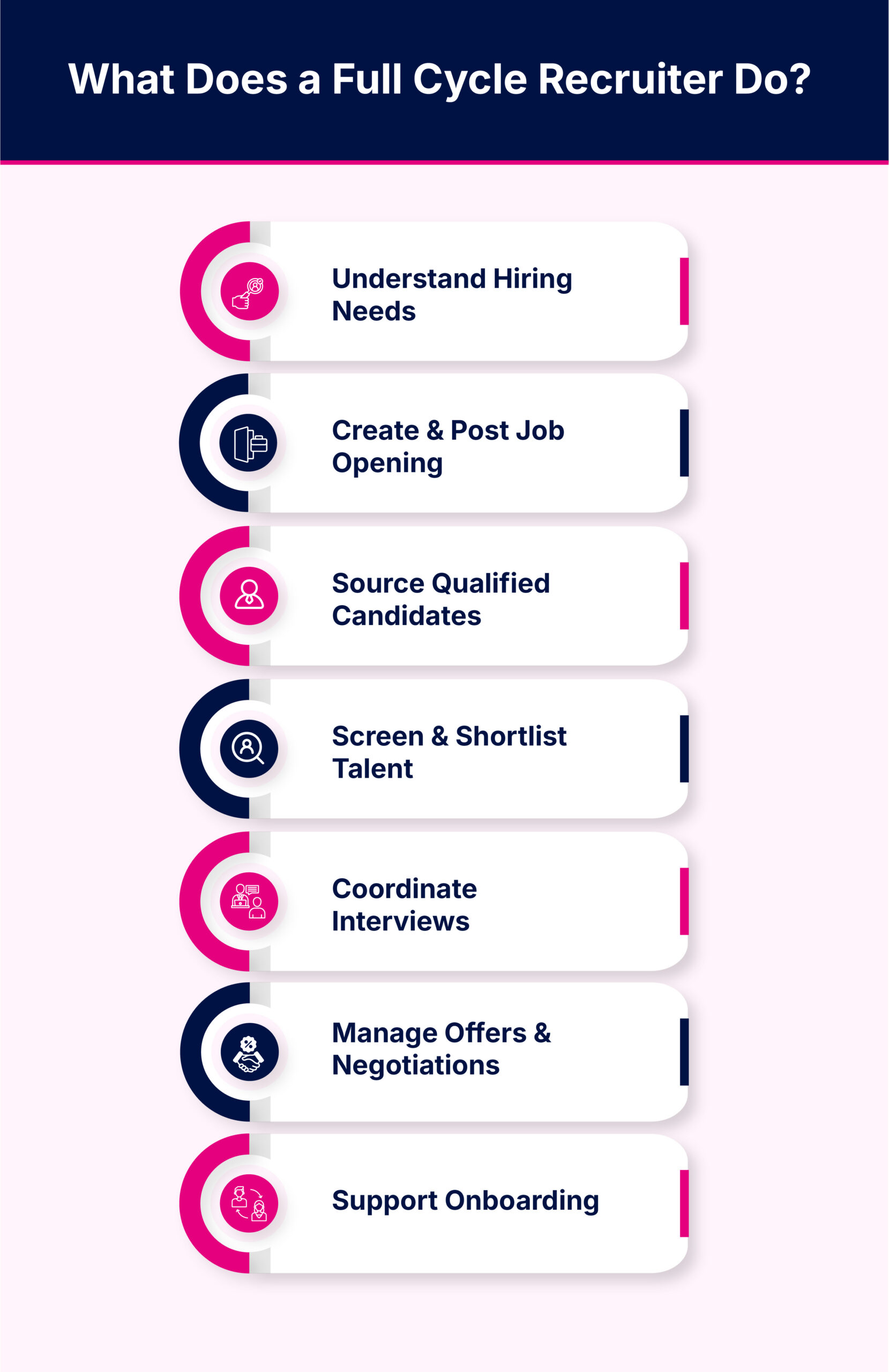
While organizations may have slight variations, the full cycle recruitment cycle generally consists of six core stages.
The process begins by identifying a hiring need. Recruiters work with hiring managers or clients to understand the role, required qualifications, responsibilities, budget, and timeline. This stage establishes clear expectations and helps prevent misalignment later in the process.
Accurate workforce planning also enables recruiters to define ideal candidate profiles, determine sourcing strategies, and prepare realistic hiring timelines.
Once the requirements are clear, recruiters start searching for suitable candidates. Sourcing may involve job boards, social media platforms, ATS databases, referrals, networking groups, and direct outreach to passive candidates.
Effective candidate sourcing expands the talent pipeline and improves candidate quality. For staffing firms, this stage is critical because strong sourcing practices directly impact placement success rates.
Recruiters review resumes, conduct phone screenings, and assess candidate qualifications against job requirements. Beyond skills and experience, recruiters evaluate communication ability, cultural fit, availability, and salary expectations.
This stage helps eliminate unqualified applicants early and ensures only suitable candidates move forward through the full cycle recruiting process.
Qualified candidates progress to interviews with recruiters, hiring managers, or clients. Recruiters coordinate schedules, prepare candidates, collect feedback, and ensure communication remains consistent throughout the process.
Structured evaluation methods help reduce bias, improve hiring accuracy, and maintain a positive candidate experience.
After selecting the preferred candidate, recruiters manage the offer process. This includes discussing compensation, benefits, start dates, and any negotiation requirements.
A smooth offer management process reduces candidate drop-offs and improves offer acceptance rates.
The final stage involves helping new hires transition successfully into their roles. Recruiters may assist with paperwork, compliance checks, orientation, and communication before the employee’s first day.
Effective onboarding improves retention, engagement, and long-term hiring success.

The full cycle recruiting process operates as a continuous workflow where each stage supports the next.
A recruiter begins by understanding hiring needs and developing a recruitment strategy. They then source candidates, screen applications, conduct assessments, coordinate interviews, manage offers, and support onboarding activities. Throughout the process, they act as a single point of contact for both candidates and hiring managers.
This centralized approach creates accountability because one individual or team owns outcomes from start to finish. It also minimizes communication gaps that often occur when responsibilities are spread across multiple departments.
For staffing firms, the process creates greater visibility into hiring performance and allows recruiters to build stronger candidate pipelines for future hiring needs.
When one recruiter oversees the entire process, unnecessary handoffs are eliminated. This reduces delays and helps organizations fill roles more quickly.
Candidates communicate with one primary contact throughout the recruitment journey. This consistency improves engagement, builds trust, and strengthens the employer brand.
A single recruiter responsible for hiring outcomes increases ownership and visibility across the recruitment process. Performance can be measured more accurately, enabling continuous improvement.
Because recruiters understand the role requirements and candidate journey from start to finish, they are better positioned to identify strong matches and reduce hiring mistakes.
For staffing firms, full cycle recruiting creates deeper client understanding and enables recruiters to provide more strategic hiring support.
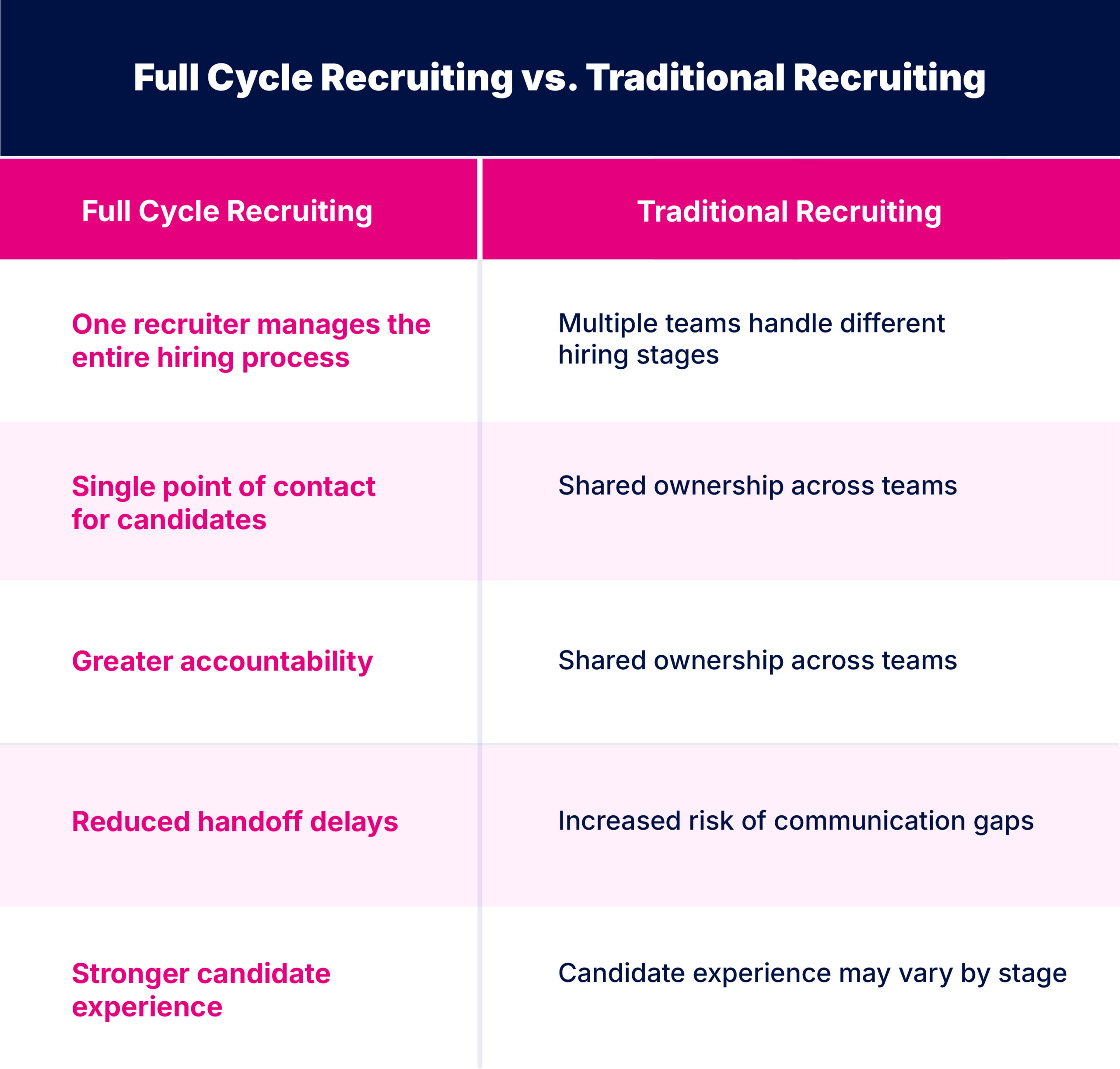
While traditional models can work well for larger organizations with specialized recruiting teams, many staffing firms and growing businesses benefit from the efficiency and accountability of a full-cycle recruiting firm approach.
Successful full cycle recruiters combine recruitment expertise with strong interpersonal and organizational skills.
Recruiters should know how to leverage job boards, ATS platforms, referrals, and social recruiting strategies effectively.
Clear communication ensures positive relationships with both candidates and hiring managers throughout the hiring process.
Recruiters must evaluate skills, experience, cultural fit, and long-term potential objectively.
Building trust with candidates and clients improves engagement and increases placement success.
Managing multiple open roles simultaneously requires effective prioritization and workflow organization.
Technology plays a major role in streamlining modern recruitment operations.
Recruitment tools can automate repetitive administrative tasks, improve sourcing efficiency, and provide better recruitment analytics. Applicant Tracking Systems (ATS), AI-powered sourcing tools, interview scheduling software, and recruitment CRMs enable recruiters to manage larger candidate pipelines without sacrificing quality.
Technology also enhances the candidate experience by improving communication, reducing delays, and creating more personalized recruitment journeys.
For staffing firms handling high hiring volumes, automation can significantly improve productivity while reducing operational costs.
Tracking recruitment KPIs helps organizations identify strengths and improvement opportunities.
Measures the number of days taken to fill an open position from job approval to candidate acceptance. A shorter time-to-fill often indicates a more efficient recruitment process.
Tracks how quickly candidates move through the recruitment pipeline. This KPI helps identify delays in screening, interviews, or decision-making.
Evaluates the total recruitment cost associated with each successful hire, including sourcing, advertising, technology, and recruiter resources.
Measures the percentage of candidates who accept job offers. A high acceptance rate often reflects a strong candidate experience and competitive offer package.
Assesses the long-term success of new hires based on factors such as performance, retention, and overall contribution to the organization.
Measures how candidates perceive their recruitment experience. Positive feedback can strengthen employer branding and improve future talent attraction.
Monitoring these metrics helps organizations optimize their full cycle recruitment process, improve hiring efficiency, and make more informed recruitment decisions.

Full cycle recruiting is often most effective when organizations need greater hiring consistency, faster decision-making, and improved recruiter accountability.
It is particularly beneficial for:
Many businesses also choose full cycle recruiting outsourcing when they lack the internal capacity to manage recruitment effectively. Outsourcing allows organizations to access experienced recruiters, scalable processes, and recruitment technology without increasing internal overhead.
Full Cycle Recruiting provides a structured, end-to-end recruitment approach that streamlines hiring, improves candidate experience, and enhances recruitment accountability. By managing every stage from workforce planning through onboarding, organizations can reduce hiring delays, improve candidate quality, and achieve better hiring outcomes.
For staffing firms facing growing hiring demands, adopting a full cycle recruitment model or partnering with providers offering full cycle recruiting services can create a more scalable and efficient recruitment function while supporting long-term business growth.
The timeline varies based on role complexity, industry, talent availability, and interview requirements. Most recruitment cycles can range from a few weeks to several months.
In a full cycle model, a single recruiter or recruitment team manages all stages, including planning, sourcing, screening, interviewing, offer management, and onboarding.
Yes. Many organizations use full cycle recruiting outsourcing providers to manage hiring activities from sourcing through onboarding while reducing internal workload.
There is no significant difference. Both terms describe managing the complete hiring journey from job requisition to onboarding.
Staffing firms, small businesses, growing organizations, and companies recruiting for specialized roles often gain the most value from full cycle recruiting.
Companies can improve efficiency by using recruitment technology, standardizing hiring workflows, building talent pipelines, tracking recruitment KPIs, and reducing process bottlenecks.
Common KPIs include time-to-fill, time-to-hire, cost-per-hire, offer acceptance rate, candidate satisfaction, quality of hire, and retention rate.
Enjoyed our blog? Discover more about how our recruitment outsourcing process can slash your costs by up to 60%! Take the next step—book a call by entering your details.


Ankit Ranjan is Vice President of Operations at QX Global Group, responsible for leading strategic recruitment outsourcing and operational delivery across key global accounts. Combining entrepreneurial experience with a strong background in RPO sales and operations, he specializes in scaling teams, driving AI-enabled transformation, and building long-term client partnerships that deliver sustainable business growth.
Expertise: RPO Delivery • US Staffing • UK Healthcare Recruitment • Recruitment Operations • P&L Management • Client Relationship Management • Recruitment Automation • Operational Excellence
Originally published Aug 17, 2026 07:08:56, updated Aug 18 2026
Topics: Full Cycle Recruiter, Full Cycle Recruitment
11 Sep 2026
Think about your last successful hire. How many people were involved before that candidate joined th...
Read More19 Dec 2025
Staffing firms rarely lose clients because of poor demand. They lose them because delivery cannot ke...
Read More29 Aug 2025
For many recruitment firms, the biggest challenge isn’t finding open roles, it’s filling them qu...
Read More16 May 2025
Hiring one role? Manageable. Hiring 10 or 20 roles across different teams and departments, each with...
Read More