Topics: Full Cycle Recruiting, Full Cycle Recruitment
Posted on September 11, 2026
Written By Akash Goyal




Think about your last successful hire. How many people were involved before that candidate joined the business?
In many organisations, recruitment is split across multiple teams, which can lead to delays, communication gaps, and an inconsistent candidate experience. Full cycle recruitment takes a different approach by giving one recruiter or recruitment team ownership of the entire hiring journey, from sourcing and screening to onboarding.
Whether you’re evaluating your hiring strategy or exploring full cycle recruitment services, this guide explains how full cycle recruiting works, its six stages, key benefits, challenges, and when outsourcing may be the right choice.
Full cycle recruitment, also known as full cycle recruiting, end-to-end recruitment, full life cycle recruiting, or 360 recruitment, is a hiring approach where a single recruiter or dedicated recruitment team manages the entire recruitment process from workforce planning and sourcing through to onboarding.
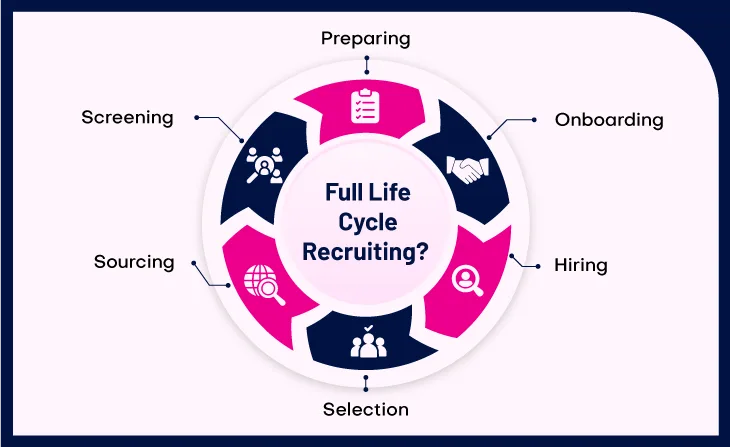
Instead of dividing responsibilities across multiple people, the recruiter maintains ownership throughout the hiring journey, creating greater accountability, consistency, and visibility into hiring outcomes.
The process generally begins when a hiring need is identified and ends when the selected candidate has successfully joined and started their role.
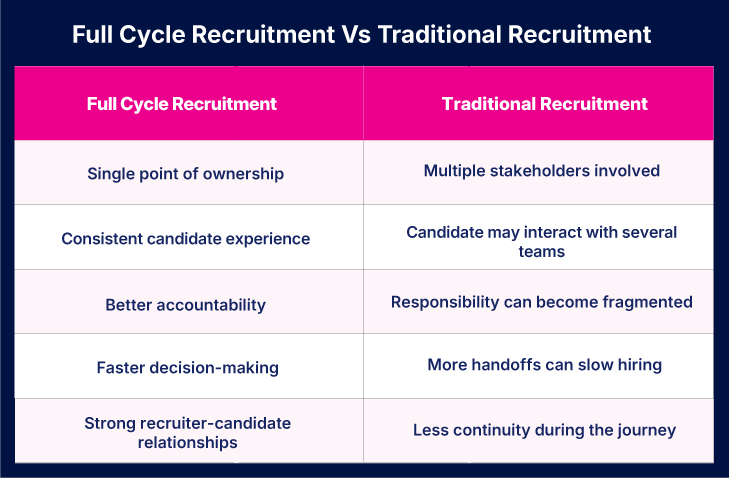
Although both recruitment models aim to attract and hire talent, the ownership of the hiring process differs significantly.
Under a full cycle model, one recruiter or recruitment team oversees every stage of hiring. They work closely with hiring managers, source candidates, conduct screening, manage interviews, handle offers, and support onboarding activities.
This creates a seamless experience for both stakeholders and candidates while ensuring a clear point of accountability.
In a segmented recruitment model, hiring responsibilities are distributed among specialists. One team may handle sourcing, another screening, another interviews, and HR may manage onboarding.
While this approach can work well for large enterprises with high hiring volumes, it often introduces handoff delays and communication gaps.
For many UK businesses, especially SMEs and fast-growing organisations, full cycle recruiting offers greater agility and efficiency.
Understanding the full cycle recruitment process is essential for improving hiring outcomes. While organisations may customise certain steps, most follow six core stages.
Every successful hire begins with understanding hiring needs.
At this stage, recruiters work with hiring managers to identify skill gaps, workforce requirements, hiring timelines, compensation expectations, and role objectives. They also define the ideal candidate profile and create a comprehensive job description.
Poor planning often leads to mismatched expectations later in the recruitment cycle. Investing time upfront helps ensure the hiring strategy aligns with business goals and reduces unnecessary delays.
Once requirements are defined, recruiters begin building a candidate pipeline.
Modern sourcing involves much more than posting jobs online. Recruiters use professional networks, LinkedIn, job boards, applicant databases, referrals, talent communities, and direct outreach to engage both active and passive candidates.
The quality of sourcing significantly impacts hiring outcomes. Strong sourcing strategies enable businesses to access hard-to-find talent and reduce dependency on last-minute recruitment efforts.
After attracting candidates, recruiters must evaluate whether they meet role requirements.
Screening usually includes CV reviews, telephone interviews, qualification checks, behavioural assessments, and initial skills evaluations. Recruiters assess technical competencies, cultural alignment, communication abilities, and career motivations.
An effective screening process ensures only high-quality candidates move forward, helping hiring teams focus their time on the most relevant prospects.
The interview stage provides deeper insights into a candidate’s suitability.
Recruiters coordinate schedules, prepare hiring managers, gather interview feedback, and maintain communication throughout the process. Structured interviews are increasingly common because they improve consistency and reduce bias.
A positive interview experience can strengthen employer brand perception and improve offer acceptance rates, even among candidates who are not ultimately selected.
Selecting the right candidate is only part of the journey.
Recruiters manage salary discussions, negotiate terms, coordinate approvals, complete reference checks, and extend formal offers. This stage requires strong communication and relationship-building skills.
Many recruitment processes fail at the offer stage because of slow decision-making or poor candidate engagement. Effective offer management helps minimise dropouts and counteroffer risks.
The final stage ensures a smooth transition from candidate to employee.
Preboarding occurs after the offer is accepted but before the employee’s first day. Activities may include compliance documentation, background checks, equipment setup, induction planning, and welcome communications.
Onboarding then focuses on helping new hires integrate into the organisation, understand expectations, and become productive more quickly. A structured onboarding process improves engagement, retention, and long-term performance.

Businesses increasingly adopt full cycle recruiting because of the operational and strategic advantages it delivers.
Candidates interact with the same recruiter throughout the process, creating continuity and reducing confusion. Consistent communication often leads to higher engagement and stronger employer branding.
Fewer handoffs mean less waiting between stages. Recruiters maintain visibility into candidate progress and can resolve bottlenecks quickly.
A dedicated full cycle recruiter owns outcomes from start to finish. This accountability typically leads to better process management and continuous improvement.
Recruiters develop a deeper understanding of role requirements and candidate suitability, resulting in stronger matching and better hiring decisions.
Working closely with hiring managers throughout the recruitment lifecycle allows recruiters to provide more strategic support and market insights.
From sourcing effectiveness to offer acceptance rates, businesses gain clearer insights into recruitment performance across the entire hiring process.

While the model offers many benefits, businesses should also understand potential challenges.
Managing the entire full cycle recruitment process requires recruiters to balance sourcing, screening, interviews, offers, and onboarding simultaneously. As hiring volumes grow, workloads can increase significantly, making it harder to maintain the same level of responsiveness and candidate engagement throughout the hiring journey.
Full cycle recruitment works well for moderate hiring volumes, but scaling can become challenging during periods of rapid growth. When one recruiter is responsible for multiple vacancies, maintaining consistency, speed, and hiring quality across all roles can become difficult without additional support.
A successful full cycle recruiter needs expertise across multiple areas, including sourcing, interviewing, stakeholder management, offer negotiation, and onboarding. Since these skills are often spread across different specialists, finding recruiters with strong end-to-end recruitment capabilities can be challenging.
When a single recruiter manages the entire hiring process, a large amount of knowledge and responsibility rests with one individual. If that recruiter is unavailable or leaves the organisation, hiring progress may be disrupted unless processes, candidate information, and workflows are properly documented.
An Applicant Tracking System (ATS) centralises candidate information in one place, making it easier to manage applications throughout the full cycle recruitment process. Recruiters can track candidate progress, collaborate with hiring managers, automate workflows, and maintain a clear view of the recruitment pipeline.
Recruitment automation tools help reduce repetitive administrative tasks, allowing recruiters to focus on higher-value activities. They can automate interview scheduling, candidate communications, follow-ups, and reminders, helping to improve efficiency and reduce time-to-hire.
Many modern recruitment platforms use artificial intelligence (AI) to identify suitable candidates faster. By analysing skills, experience, qualifications, and job requirements, AI-powered tools can help recruiters prioritise the most relevant candidates and improve sourcing effectiveness.
Analytics platforms provide valuable insights into recruitment performance by tracking metrics such as time-to-fill, cost-per-hire, source effectiveness, and quality-of-hire. These insights help businesses identify bottlenecks, optimise hiring strategies, and make more informed recruitment decisions.
Video interviewing platforms make it easier to connect with candidates regardless of location. They simplify scheduling, reduce travel requirements, and help organisations move candidates through the recruitment process more quickly, supporting faster hiring decisions.
Businesses looking to maximise the benefits of full cycle recruitment should follow a structured and consistent approach throughout the hiring process. The following best practices can help improve hiring efficiency, candidate experience, and recruitment outcomes.
A successful hire starts with a clear understanding of the role, required skills, responsibilities, and success criteria. Taking time to align expectations with hiring managers helps improve candidate quality, reduce miscommunication, and avoid costly hiring mistakes later in the process.
Rather than waiting until vacancies arise, recruiters should continuously engage with potential candidates and build talent pools. A strong pipeline helps organisations fill roles faster, reduce sourcing time, and access qualified candidates when hiring needs emerge.
Using structured interview questions and consistent evaluation criteria creates a more objective hiring process. It helps recruiters assess candidates fairly, minimise bias, and make better hiring decisions based on relevant skills and competencies.
Regular communication keeps candidates informed and engaged throughout the recruitment journey. Providing timely updates and feedback can reduce candidate drop-off, improve the candidate experience, and strengthen your employer brand.
Tracking metrics such as time-to-fill, quality-of-hire, offer acceptance rates, and source effectiveness helps identify bottlenecks and areas for improvement. Data-driven insights enable organisations to continuously optimise their recruitment strategy and hiring outcomes.
Full cycle recruitment outsourcing involves partnering with an external recruitment provider that manages the end-to-end hiring process on behalf of an organisation.
Outsourcing may be beneficial when:
For many UK businesses, outsourcing provides access to experienced recruiters, broader talent networks, recruitment technology, and scalable delivery models without significantly increasing internal headcount.
Also Read: Top Full Cycle Recruitment Services Companies in the UK: What Businesses Should Look For?
Measuring recruitment performance helps organisations understand what’s working, identify bottlenecks, and continuously improve their hiring strategy. The following metrics provide valuable insight into the effectiveness of the full cycle recruitment process.
Time-to-fill measures the number of days it takes to fill a vacancy, from job approval to offer acceptance. Tracking this metric helps organisations assess recruitment efficiency and identify delays within the hiring process.
A successful recruitment process is not just about filling vacancies quickly. Quality-of-hire evaluates how well new employees perform, integrate into the business, and contribute to organisational goals over time. Strong quality-of-hire often leads to better retention and productivity.
This metric tracks the percentage of candidates who accept job offers. A low acceptance rate may indicate issues with compensation, candidate experience, employer branding, or hiring timelines that need to be addressed.
Cost-per-hire measures the total investment required to make a hire, including sourcing costs, advertising spend, recruitment technology, and recruiter resources. Monitoring this metric helps businesses balance hiring quality with recruitment costs.
The candidate experience plays a significant role in employer reputation. Gathering feedback from applicants can help organisations understand how candidates perceive the recruitment process and identify opportunities for improvement.
Hiring managers are key stakeholders in the recruitment process. Measuring their satisfaction with candidate quality, communication, and hiring outcomes can provide valuable insight into the effectiveness of the recruitment function and recruiter performance.
Full cycle recruitment outsourcing is a recruitment model where an external provider manages all stages of hiring, from workforce planning and candidate sourcing to interviewing, offer management, preboarding, and onboarding. Businesses use it to improve hiring efficiency, reduce costs, and access specialist recruitment expertise.
Yes. 360 recruitment and full cycle recruitment are generally used interchangeably. Both refer to managing the entire recruitment process from vacancy creation through onboarding.
The timeline varies by industry, role complexity, and market conditions. Many professional positions can take several weeks to fill, while highly specialised or senior roles may require significantly longer hiring cycles.
A successful full cycle recruiter requires sourcing expertise, interviewing skills, stakeholder management, negotiation capabilities, communication skills, recruitment technology knowledge, and strong organisational abilities.
Preboarding occurs after a candidate accepts an offer but before their first working day. It includes paperwork, background checks, compliance activities, equipment setup, and onboarding preparation.
Yes, although large organisations often adopt a modified version involving recruitment teams rather than individual recruiters. This ensures scalability while retaining end-to-end accountability.
Full cycle recruitment describes a hiring methodology, whereas Recruitment Process Outsourcing (RPO) is a service model. An RPO provider may deliver full cycle recruitment services, but not all full cycle recruitment activities are outsourced through RPO.
As hiring becomes increasingly competitive, many UK businesses are moving away from fragmented recruitment processes and adopting more integrated hiring models. Full cycle recruitment provides end-to-end ownership, better candidate experiences, clearer accountability, and stronger hiring outcomes.
Whether managed internally or through full cycle recruitment outsourcing, the model enables organisations to streamline talent acquisition, improve hiring quality, and build a recruitment process that can scale alongside business growth.
Enjoyed our blog? Discover more about how our recruitment outsourcing process can slash your costs by up to 60%! Take the next step—book a call by entering your details.

Education:
PMP ,ITIL,SSLGB ,MBA - IMT in Strategy Management

Akash Goyal is a seasoned RPO and BPM transformation leader with over 20 years of global experience across the UK, US, and India. At QX Global Group, he leads RPO sales and operations, owning P&L, client growth, service delivery, and large-scale transitions.
His leadership is rooted in data-driven delivery, operational excellence, and building high-performance teams that scale efficiently and sustainably.
Expertise: RPO Leadership • Global Delivery Operations • Business Transformation • Client Strategy • Operational Excellence • Growth Enablement
Originally published Sep 11, 2026 10:09:16, updated Sep 11 2026
Topics: Full Cycle Recruiting, Full Cycle Recruitment
17 Aug 2026
Finding qualified candidates is only half the hiring challenge. The real struggle for many staffing ...
Read More30 Jun 2026
Hiring in the UK is becoming more complex, not just because of talent shortages, but due to rising e...
Read More19 Dec 2025
Staffing firms rarely lose clients because of poor demand. They lose them because delivery cannot ke...
Read More29 Aug 2025
For many recruitment firms, the biggest challenge isn’t finding open roles, it’s filling them qu...
Read More