Topics: AI compliance in recruitment UK, AI recruitment risks, Ethical AI in Recruitment
Posted on May 12, 2026
Written By Mandar Vanarse




AI is no longer something recruitment firms are “testing.” It is already becoming part of daily recruitment operations across the UK. Recruiters are using AI to screen CVs faster, generate outreach messages, summarise interviews, automate admin tasks, and improve productivity across the hiring cycle. Many staffing firms are also combining AI with offshore recruitment services to scale operations, reduce manual workload, and improve recruiter efficiency.
But while AI is helping staffing firms move faster, it is also creating new challenges that many agencies are still unprepared for. Questions around AI bias in recruitment, candidate fairness, data privacy, transparency, and compliance are becoming impossible to ignore. A recruiter uploading CVs into a public AI tool or an AI system influencing candidate selection without proper oversight can quickly create legal, operational, and reputational risks.
This is why Ethical AI in Recruitment is becoming a major priority for UK recruitment agencies. The conversation is no longer just about automation. It is about how staffing firms can adopt AI responsibly while protecting candidate trust, maintaining compliance, and ensuring fair hiring outcomes.
In this blog, we’ll explore the biggest AI recruitment risks, the importance of ethical AI hiring practices, how firms can improve AI transparency in recruitment, and what staffing companies need to put in place to build responsible and scalable AI adoption strategies.
AI adoption across the recruitment industry is growing rapidly because staffing firms are under constant pressure to do more with fewer resources. Recruiters are expected to fill roles faster, manage higher candidate volumes, improve candidate experience, and maintain profitability at the same time. AI tools are helping agencies improve efficiency, but they are also changing how hiring decisions are made.
Recruitment is one of the most sensitive environments for AI usage because hiring decisions directly impact people’s careers, livelihoods, and opportunities. Unlike many other industries, recruitment involves handling large amounts of personal and sensitive data while also making decisions that can significantly affect an individual’s future. This creates far greater responsibility around how AI is implemented and governed.
Another reason Ethical AI in Recruitment is becoming important is the growing scrutiny around AI hiring regulations, data protection, and discrimination risks. Clients and candidates increasingly want transparency around how AI is being used in recruitment processes. If staffing firms cannot explain AI-assisted decisions clearly, they risk damaging trust and exposing themselves to compliance challenges.
For recruitment businesses, ethical AI is no longer just a technology conversation. It has become a business risk management issue. Firms that implement AI without proper governance may improve speed temporarily, but they also increase the risk of compliance breaches, bias-related concerns, inconsistent hiring decisions, and reputational damage.
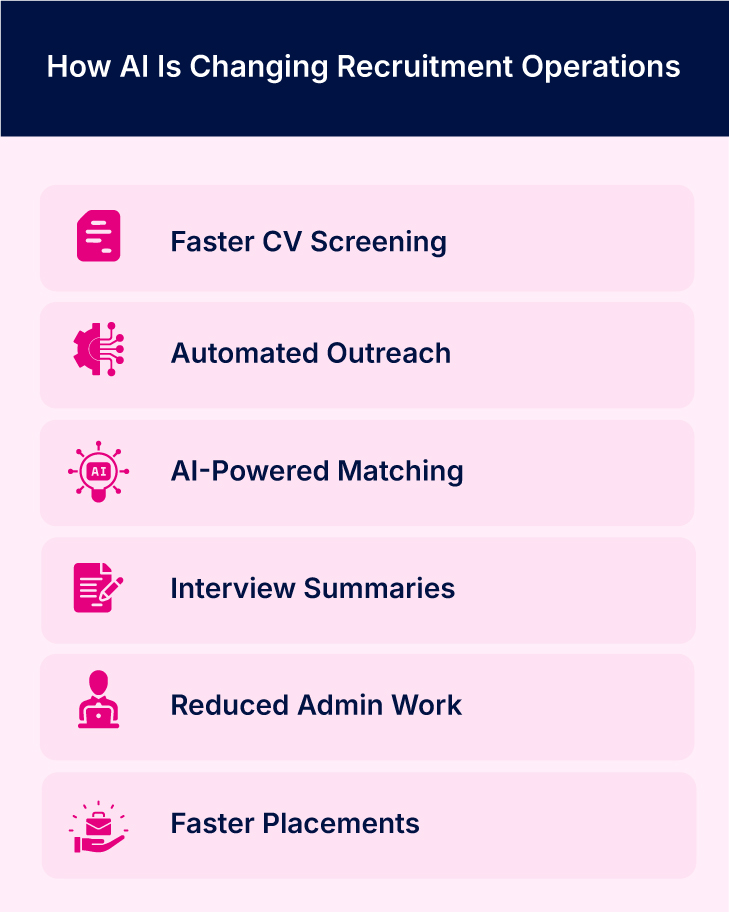
AI tools are now being used across almost every stage of the recruitment lifecycle. Many staffing firms are already using AI-powered solutions for candidate sourcing, CV screening, Boolean search generation, interview scheduling, job description creation, and recruiter outreach automation. These tools help reduce repetitive admin tasks and allow recruiters to focus more on relationship-building and placements.
For many agencies, operational benefits are significant. AI can help recruiters process applications faster, improve response times, reduce manual work, and manage large hiring volumes more efficiently. This is especially valuable for firms handling high-volume recruitment or niche talent markets where speed plays a critical role in securing placements.
Also Read: Top Offshore Recruitment Companies in UK: What Staffing Firms Should Know 2026
However, the rapid adoption of AI has also created a new challenge for many UK recruitment agencies. In many cases, AI usage is happening faster than governance policies can keep up. Recruiters often experiment with public AI tools independently, and different teams may use AI inconsistently across the business. Without clear guidelines, this creates operational risks that firms may not fully recognise until issues arise.
The growing use of AI is also changing client expectations. Many clients now expect staffing firms to demonstrate how AI tools are being used, what safeguards are in place, and how candidate fairness is protected. Agencies that cannot provide transparency or governance around their AI usage may struggle to maintain long-term trust with clients and candidates alike.

Many recruitment firms assume AI-related risks only apply to large enterprises or advanced AI systems. Some of the biggest risks come from everyday recruiter behavior and informal AI usage. Most problems do not happen because firms intentionally misuse AI. They happen because AI adoption grows without structured governance, training, or oversight.
One of the most common risks is recruiters uploading CVs, interview notes, or client information into public AI platforms. While these tools may seem convenient, they often fall outside approved security and compliance frameworks. This creates serious concerns around AI compliance in recruitment UK, especially when sensitive candidate information is involved.
Candidate CVs frequently contain personal data, salary details, addresses, employment history, and other sensitive information. Uploading this data into unsecured AI environments can expose firms to GDPR violations and reputational risks. Many recruiters may not even realise they are creating compliance exposure when using public AI tools informally.
Another major issue is the lack of explainability in AI-assisted hiring decisions. Some AI tools influence candidate ranking, matching, or shortlisting without recruiters fully understanding how recommendations are generated. This creates major AI transparency in recruitment concerns.
If recruiters cannot clearly explain why one candidate was prioritised over another, firms may struggle to defend hiring decisions to clients or candidates. Transparency becomes even more important when AI is involved in decisions that directly affect candidate opportunities.
Many staffing firms currently have no standardised approach to AI adoption. Different recruiters often use different AI tools in different ways, creating inconsistent recruitment workflows across the organisation. One team may rely heavily on automation while another avoids it entirely.
Without structured policies, firms risk inconsistent candidate experiences, uneven hiring practices, and governance gaps. This also makes it difficult for leadership teams to monitor how AI is actually being used across the business.
A major governance challenge is the absence of clear audit trails. Many firms cannot track when AI was used, what outputs were generated, or whether recruiter oversight occurred before action was taken.
This creates problems during client reviews, candidate disputes, or compliance investigations. If a staffing firm cannot demonstrate how decisions were made, it becomes harder to prove fairness, accountability, and compliance.
Some recruiters begin trusting AI-generated recommendations too heavily, especially when working under pressure to move quickly. While AI can improve efficiency, it cannot fully understand context, candidate potential, or relationship nuances in the same way experienced recruiters can.
Over-reliance on automation increases the risk of qualified candidates being overlooked simply because they do not perfectly match predefined patterns or keywords. Ethical AI adoption requires balancing efficiency with human judgement.
One of the biggest concerns around fair hiring technology is bias. AI systems are only as reliable as the data and logic behind them. If recruitment of AI tools is trained using biased or incomplete hiring data, they can unintentionally replicate and amplify those same patterns.
This is why AI bias in recruitment has become one of the most discussed topics around recruitment technology ethics. Staffing firms must understand that bias in AI systems is not always obvious. It often appears subtly through patterns, rankings, or automated recommendations that unintentionally disadvantage certain groups of candidates.
Many AI recruitment systems rely on historical hiring data to generate recommendations. If past recruitment decisions favoured certain demographics, educational backgrounds, or work histories, AI systems may learn to prioritise similar profiles. This creates a cycle where existing hiring bias becomes embedded into future hiring decisions.
Bias can also appear through keyword-based filtering systems. Strong candidates may be excluded simply because their CV language differs from expected patterns. Candidates from non-traditional career backgrounds are particularly vulnerable to being overlooked by rigid AI-driven matching systems.
Another challenge is automated scoring and ranking systems. Recruiters may unintentionally trust AI-generated rankings without questioning the reasoning behind them. This becomes risky when AI recommendations are treated as objective truth rather than decision-support tools.
Candidate fairness is becoming increasingly important for staffing firms, especially as clients focus more on diversity, inclusion, and equitable hiring practices. If AI systems create unfair outcomes, staffing firms risk damaging both client relationships and employer brand reputation.
Ethical AI adoption is not about avoiding automation altogether. It is about ensuring AI supports recruitment decisions without undermining fairness, accountability, or candidate opportunity. Firms that actively monitor and manage bias will be far better positioned to build trust with both candidates and clients.
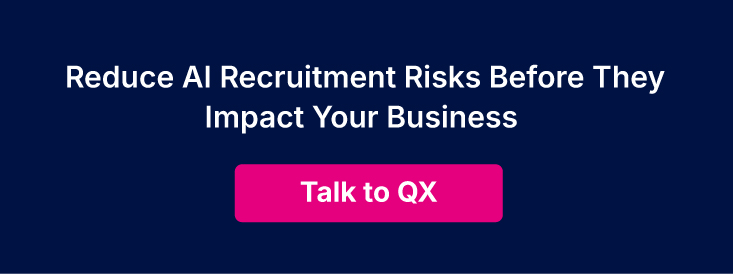
AI can process data quickly, automate repetitive tasks, and improve recruiter efficiency, but it cannot replace human judgement. Recruitment involves far more than matching keywords or ranking CVs. It requires relationship-building, contextual understanding, communication skills, and ethical decision-making.
This is why human oversight remains one of the most important principles of responsible AI in hiring. AI should support recruiters, not replace them. Final hiring decisions should always remain with people who can evaluate candidates holistically and apply professional judgement beyond what algorithms can interpret.
AI works best when it acts as a productivity tool rather than an autonomous decision-maker. Recruiters can use AI to reduce administrative burden and improve workflow efficiency, but candidate suitability still requires human evaluation.
Experienced recruiters understand nuances that AI systems often miss, including soft skills, communication ability, career motivation, and cultural alignment. These factors are difficult to assess accurately through automation alone.
AI can provide valuable support in several operational areas, including:
These activities improve recruiter productivity without removing human accountability from hiring decisions.

There are certain areas where AI should never operate independently. AI systems should not automatically reject candidates, make final shortlisting decisions, or influence hiring outcomes without recruiter review.
Automated hiring decisions without human oversight create serious risks around fairness, transparency, and legal defensibility. Human review remains essential to maintaining ethical recruitment standards.
Human-in-the-loop governance means recruiters remain actively involved whenever AI influences recruitment decisions. AI outputs should always be reviewed before action is taken, and recruiters should have the authority to override AI recommendations when necessary.
This approach ensures accountability remains clear throughout the recruitment process. Ethical AI adoption is not about removing recruiters from workflows. It is about helping recruiters make better decisions with stronger operational support.
Transparency is becoming one of the most important expectations around AI-powered recruitment. Clients and candidates increasingly want to understand how AI tools are being used and whether automated systems are influencing hiring outcomes fairly.
For staffing firms, AI transparency in recruitment means being able to clearly explain where AI was used, what it influenced, and how final decisions were made. If a recruiter cannot explain an AI-assisted outcome confidently, it becomes difficult to defend that decision from a legal and ethical perspective.
Transparency also plays a major role in maintaining candidate trust. Candidates are more likely to feel confident in recruitment processes when they know human oversight exists, and AI is being used responsibly. Lack of transparency, on the other hand, can create concerns around fairness and hidden bias.
Strong transparency practices also improve operational accountability internally. Clear documentation, audit trails, and recruiter oversight help staffing firms monitor how AI tools are being used across teams. This creates greater consistency and reduces the risk of uncontrolled or inappropriate AI usage.
Data privacy remains one of the most critical concerns around UK AI recruitment compliance. Recruitment firms process large volumes of personal and sensitive information every day, making compliance a major responsibility when implementing AI tools.
Many staffing firms underestimate how quickly AI usage can create compliance exposure. Recruiters may unintentionally use AI tools that fall outside approved systems, creating risks around candidate data security and GDPR obligations. Ethical AI adoption requires AI governance to work within existing compliance frameworks rather than outside them.
Candidate information must be handled securely at every stage of the recruitment process. Recruitment firms need to ensure AI tools process candidate data lawfully, transparently, and only for approved business purposes.
This includes understanding how AI platforms store, process, and retain candidate information. Staffing firms should avoid using tools where data security practices are unclear or uncontrolled.
Public AI platforms create significant risks when recruiters upload candidate CVs or client-sensitive information into unsecured environments. Many firms currently lack clear policies around what recruiters can and cannot input into AI systems.
Without proper controls, even well-intentioned recruiter behaviour can create serious compliance exposure. This is why AI usage boundaries must be clearly defined and communicated across teams.
Responsible AI usage also requires clear data retention and deletion policies. AI-processed data should only be stored for the required duration and securely removed once the purpose is complete.
Firms should also minimise unnecessary data usage wherever possible. Strong data governance reduces compliance risks while improving operational discipline.
Best practices for AI compliance in recruitment UK include using approved AI systems only, restricting access to authorised users, implementing audit trails, and maintaining clear governance around AI-assisted decisions.
Staffing firms that build structured governance early will be far better prepared as AI regulations continue evolving across the UK and globally.
Strong recruitment AI governance is essential for staffing firms that want to scale AI adoption responsibly. Governance frameworks help firms reduce risk while ensuring AI improves operations without compromising fairness, transparency, or accountability.
Many agencies focus heavily on implementing AI tools but overlook the importance of governance. Without structured oversight, even advanced recruitment AI systems can create inconsistent hiring practices and compliance exposure.
Ethical AI adoption is not just about implementing technology. It is ensuring that AI supports recruitment teams in a way that is fair, transparent, secure, and compliant. For staffing firms, these principles act as the foundation for building responsible and scalable AI-driven recruitment operations.
Recruiters should always remain responsible for hiring outcomes, even when AI tools are involved in the recruitment process. AI can assist with sourcing, screening, matching, and administrative tasks, but final hiring and suitability decisions should always be reviewed and approved by people. Human recruiters provide contextual understanding, relationship management, and ethical judgement that AI systems cannot fully replicate. Keeping humans accountable also helps staffing firms maintain fairness, transparency, and legal defensibility in hiring decisions.
Staffing firms should clearly document where AI was used, what processes it influenced, and how recruiter oversight was applied throughout the hiring journey. Clients and candidates increasingly expect visibility into AI-assisted recruitment decisions, especially when shortlisting or ranking systems are involved. Transparency helps recruitment agencies explain hiring outcomes confidently and maintain trust with both clients and candidates. If an AI-assisted decision cannot be explained clearly, it becomes difficult to defend from both a compliance and ethical perspective.
AI outputs should be reviewed regularly for unintended bias, exclusion patterns, or unfair candidate filtering. Recruitment AI systems often learn from historical hiring data, which means they can unintentionally repeat or amplify existing bias if left unchecked. Bias monitoring should not be treated as a one-time review during implementation. Staffing firms need ongoing monitoring processes to ensure AI systems continue supporting fair and inclusive hiring outcomes as recruitment patterns and datasets evolve over time.
Candidate and client information must always remain protected within approved systems and secure environments. Recruitment firms handle highly sensitive information including CVs, salary details, employment history, and personal contact information, making data protection a major responsibility. AI adoption should align with existing GDPR and compliance frameworks rather than operating outside them. Firms should also ensure recruiters understand what data can and cannot be entered into AI systems, especially public AI platforms that may create compliance risks.
AI should only be used where it adds genuine operational value rather than replacing professional recruiter judgement completely. While automation can improve productivity and reduce repetitive admin tasks, not every recruitment activity should be automated. Staffing firms must carefully evaluate where AI improves efficiency without negatively affecting candidate experience, fairness, or decision quality. Responsible AI adoption is about finding the right balance between automation and human expertise, not automating every step of the recruitment process.
Ethical AI is not separate from AI adoption. Governance and accountability must be built into every stage of implementation. This is one of the key principles behind the R-ACE framework developed to help recruitment firms adopt AI responsibly and at scale.
Within the R-ACE framework, governance starts during the AI strategy phase where firms define approved AI use cases, boundaries, and operational objectives. During implementation, guardrails and oversight mechanisms are introduced to ensure recruiters use AI responsibly and consistently.
As AI adoption scales across teams and workflows, governance controls must also scale alongside it. This includes accountability structures, audit trails, compliance monitoring, and ongoing recruiter training. Without these foundations, AI adoption may increase operational exposure instead of creating long-term business advantages.
The firms seeing the most success with AI are not necessarily the ones adopting the most tools. They are the firms building structured, transparent, and responsible AI environments that support both recruiters and clients effectively.
Defining ethical AI principles is only the first step. Many staffing firms struggle with practical implementation across recruiters, systems, and day-to-day operations. This is where structured operational support becomes critical.
QX Global Group helps recruitment firms build practical frameworks for Ethical AI in Recruitment through governance support, AI-enabled recruitment operations, and scalable implementation strategies. Our focus is not just on technology adoption, but on helping staffing firms implement AI responsibly while maintaining compliance, transparency, and recruiter accountability.
Through solutions like SonarHire and AI-enabled operational support, QX helps recruitment firms improve efficiency without removing human oversight from hiring decisions.
We also support agencies through scalable operational models and offshore recruitment services, helping staffing firms balance automation with recruiter expertise while maintaining strong governance and compliance standards across recruitment operations.
AI is transforming recruitment operations across the UK staffing industry, but faster hiring alone is not enough. Staffing firms must also ensure AI is implemented responsibly, transparently, and fairly.
The biggest risk for recruitment firms is not AI itself. It is adopting AI without governance, oversight, or accountability. Firms that ignore ethics, bias, transparency, and compliance may eventually face operational, legal, and reputational consequences that outweigh short-term efficiency gains.
The future of recruitment will belong to firms that successfully balance automation with human expertise. Recruiters will continue playing a critical role in relationship-building, candidate evaluation, and ethical decision-making, while AI supports productivity and operational scalability.
Ultimately, successful AI adoption is not about replacing recruiters. It is about helping recruiters work smarter while protecting candidate trust, maintaining compliance, and building sustainable recruitment operations for the future.
UK staffing firms should consider several risks when implementing AI in recruitment processes, including AI bias in recruitment, lack of transparency, poor data handling practices, and over-reliance on automation. Recruitment involves sensitive candidate information and career-impacting decisions, which means unethical AI usage can quickly create compliance and reputational concerns.
AI systems are trained using historical data, and if past recruitment patterns included bias, the AI may unintentionally repeat those same patterns. This can lead to unfair shortlisting decisions or the exclusion of qualified candidates from underrepresented groups. Bias can also appear through keyword-based filtering systems where strong candidates are overlooked simply because their CV language does not match expected patterns.
Human recruiters should remain responsible for all final hiring and suitability decisions. AI can help recruiters improve productivity by supporting tasks such as CV summarisation, sourcing, scheduling, and administrative work, but it should never operate independently when making hiring decisions.
Staffing firms can improve AI transparency in recruitment by maintaining clear audit trails, documenting where AI was used, and ensuring recruiters review AI-generated outputs before decisions are made. Firms should also establish internal governance policies that explain how AI tools are used across recruitment workflows.
Recruitment firms using AI must comply with GDPR and broader UK AI recruitment compliance requirements. Key concerns include the secure handling of candidate data, lawful data processing, retention policies, and protecting sensitive information from exposure through public AI tools.
Recruitment agencies should use AI to support operational efficiency rather than fully automate recruitment decisions. AI can help reduce repetitive admin tasks and improve workflow speed, but candidate evaluation should still involve recruiter judgement and human review. Firms should regularly monitor AI outputs for unintended bias, maintain transparent workflows, and ensure recruiters can override AI recommendations when necessary.
Strong recruitment of AI governance frameworks typically include clear AI usage policies, human accountability, transparency standards, bias monitoring, secure data handling practices, and ongoing recruiter training. Firms should also maintain audit trails and regularly review how AI is being used across recruitment operations. Responsible AI governance is not a one-time exercise.
Enjoyed our blog? Discover more about how our recruitment outsourcing process can slash your costs by up to 60%! Take the next step—book a call by entering your details.

Education:
• Bachelor’s in Electronics Engineering, University of Bombay
• Professional & Technical Certifications in Leadership, Management & Technology

Mandar Vanarse is a seasoned technology leader with over 30 years of experience in business transformation, innovation, and enterprise architecture. At QX, he leads the technology vision and drives initiatives like the QX Automation Acceleration Center (AAC) to deliver scalable, tech-first solutions for clients across the globe.
He has led multimillion-dollar IP-platform businesses, developed the ASSIMPLER framework used in award-winning UN-backed national transformation programs, and continues to champion cutting-edge advancements in generative AI and digital strategy.
Expertise: Enterprise Architecture, Digital Strategy, Generative AI, Business Transformation, Technology Innovation, Automation at Scale
Originally published May 12, 2026 08:05:33, updated Sep 18 2026
Topics: AI compliance in recruitment UK, AI recruitment risks, Ethical AI in Recruitment