Topics: Finance & Accounting Outsourcing, Senior Living
Posted on October 08, 2026
Written By Punit Somani




What happens when occupancy improves, demand strengthens, and finance teams still feel under pressure?
That is the tension many senior living operators are facing now. According to NIC, senior housing occupancy reached 89.1% in the fourth quarter of 2025, marking the fourth consecutive year of 200-plus basis-point occupancy gains. At the same time, Argentum projects the broader senior care industry will need to fill more than 20.2 million occupational openings between 2021 and 2040.
For CFOs and senior leaders, growth can expose back-office weaknesses fast. Manual AP, delayed closes, spreadsheet-heavy reporting, and fragmented community-level data make it harder to protect margins, manage cash, and see performance clearly.
This blog explores how finance automation can help senior living providers improve reporting, strengthen controls, and scale back-office operations more efficiently.
Many senior living finance departments still rely on manual processes, spreadsheets, paper-based approvals, and fragmented reporting structures. As organizations grow across multiple communities, these workflows become increasingly difficult to manage.
The consequences are familiar:
At the same time, senior living operators are coping with workforce constraints and rising labor-related costs.
Automation helps CFOs move from backward-looking reporting to driver-level visibility. Instead of asking why EBITDA missed plan weeks after close, leaders can see which communities are losing margin through labor variance, under-captured revenue, slow billing changes, or unmanaged spend.
Automation can flag care-level changes, rate updates, payer-status changes, missed documentation, and aging balances sooner. That gives finance teams a better route to protect revenue, reduce avoidable write-offs, and prioritize collections by payer, community, and risk level.
For CFOs, this is less about sending invoices faster and more about reducing revenue leakage across the resident lifecycle.
Automation strengthens approval discipline by linking invoices to authorized vendors, contract terms, purchase orders, staffing data, and community-level budgets. The result is better cost control, fewer exceptions, and clearer accountability for spend.
This matters most where margins are already under pressure from wage inflation, overtime, staffing shortages, and high-cost contract labor. For multi-community operators, even small improvements in labor controls and invoice governance can have a material EBITDA impact.
Automation supports standardized charts of accounts, approval workflows, KPI definitions, close calendars, and reporting packs. That gives leadership a cleaner view of the metrics that actually drive operating performance:
With consistent definitions and faster reporting, executives can identify whether a community problem is pricing, payer mix, labor discipline, census, or operating leakage and respond with the right action.
Automation helps standardize acquired communities faster, reduce dependence on spreadsheet owners, and create reporting that stands up to lender, investor, and audit scrutiny.
The impact shows up in areas that matter to owners and boards:
While every organization has unique needs, the most common candidates for automation include:
| 1. Procure-to-Pay (P2P) Invoice captureInvoice approvalsVendor paymentsPurchase order matching | 2. Order-to-Cash (O2C) Payment postingCash applicationCollections workflowsCustomer account updates | 3. Record-to-Report (R2R) ReconciliationsJournal entriesMonth-end close activitiesFinancial consolidations |
| 4. Financial Reporting Management reportsKPI reportingExecutive dashboardsPortfolio performance analysis | 5. Budgeting and Forecasting Data collectionRolling forecastsVariance analysisScenario modeling |
Organizations typically achieve the greatest benefits by automating high-volume, rules-based processes first and then expanding automation strategically across the finance function.
Finance automation ROI should be measured as an operating-performance improvement across cost, speed, accuracy, control, and capacity. Benchmark sources such as APQC’s Accounts Payable Key Benchmarks and IOFM’s AP benchmarking research commonly track AP cost, cycle time, productivity, exception rates, and payment performance.
| ROI area | KPIs to track | What it shows |
| Cost efficiency | Cost per invoice, finance cost as a percentage of revenue, invoices processed per finance FTE | Whether automation is reducing manual processing cost and improving team productivity. |
| Processing speed | Invoice processing cycle time, days to close, reporting turnaround time | Whether finance can close faster, report sooner, and support quicker operating decisions. |
| Automation maturity | Percentage of invoices processed touchlessly, paper invoice volume, exception rates | Whether workflows are truly automated or still dependent on manual intervention. |
| Working capital impact | Days sales outstanding, days payable outstanding, collections follow-up time | Whether automation is improving cash visibility, collections discipline, and payment timing. |
| Control and accuracy | Reconciliation backlog, first-time error-free processing, duplicate payment rate | Whether automation is strengthening controls while reducing errors, rework, and audit risk. |
| Capacity gains | FTE hours redirected from processing to analysis, communities supported per finance team | Whether automation is helping finance support growth without proportional headcount increases. |
Automation becomes a priority when finance issues start affecting margins, billing accuracy, cash visibility, compliance, or growth. Common warning signs include:
At this point, automation becomes more than an efficiency project. It helps protect revenue, strengthen controls, improve cash visibility, and give leaders a clearer view of performance across communities.
QX Global Group helps senior living operators modernize finance functions through a combination of senior living accounting expertise, AI-enabled workflows, intelligent automation, and scalable finance and accounting support. QX supports community-level and corporate accounting needs across accounts payable, accounts receivable, reconciliations, reporting, budgeting and forecasting, helping providers improve visibility and capacity without placing additional pressure on internal teams.
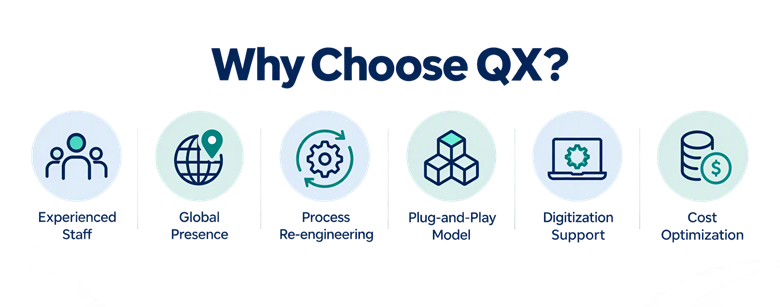
By combining experienced accounting professionals with AI-enabled workflows and intelligent automation, QX helps operators:
Need help identifying the right workflows to automate? If your finance team is spending too much time on manual processing, delayed reporting, or fragmented community-level data, QX can help assess which accounting workflows are best suited for automation and scalable support. Speak with our senior living finance and accounting specialists to identify where automation can create the fastest operational impact.
Finance automation improves senior living accounting by reducing manual data entry, accelerating month-end close, improving reporting accuracy, and giving leaders clearer visibility across communities. It helps finance teams spend less time on repetitive processing and more time on analysis, forecasting, and decision support.
Common areas include accounts payable, accounts receivable, reconciliations, cash application, financial reporting, budgeting, forecasting, and month-end close processes.
Automation handles repetitive, rules-based activities such as invoice processing, payment matching, and report generation, allowing existing finance teams to manage higher workloads without adding staff.
Automated reporting provides faster access to accurate financial data, enabling leadership teams to identify trends, monitor performance, and make more informed decisions in real time.
Organizations should consider automation or outsourcing when reporting becomes fragmented, finance teams are overstretched, growth creates additional complexity, or talent shortages begin affecting finance operations.
Finance automation uses technology to reduce manual accounting work, while outsourcing brings external finance and accounting support to manage or improve processes. Many senior living providers benefit from combining both: automation improves speed and consistency, while outsourced support adds capacity, expertise, and scalability.
Senior living providers can measure ROI by tracking improvements in close timelines, invoice processing speed, cost per transaction, reporting turnaround, reconciliation accuracy, collections efficiency, and finance team capacity. The strongest ROI usually comes from automating high-volume, repetitive processes first.
QX Global Group combines senior living finance expertise, automation technologies, AI-enabled workflows, and scalable accounting support to improve efficiency, reporting visibility, and overall financial performance.

Education:

Punit has over 15 years of experience partnering with global enterprise clients to reengineer Finance & Accounting operations through digital transformation and offshore delivery models. Known for a consultative, relationship-driven approach, Punit helps organizations build strong business cases that deliver up to 60% cost savings, while improving quality, flexibility, and scalability across finance functions.
Expertise: Finance & Accounting Transformation, AI & Technology in FinOps, End-to-end F&A Services, Offshore Delivery Models, Business Transformation, Real Estate & Asset-Led Sectors
Originally published Oct 08, 2026 12:10:11, updated Oct 09 2026
Topics: Finance & Accounting Outsourcing, Senior Living
06 Nov 2026
At ten properties, monthly reporting is manageable. Someone exports the numbers from the property sy...
Read More05 Nov 2026
Most student housing finance teams know when the pressure is coming. An acquisition is set to close ...
Read More04 Nov 2026
Six days after the Budget, a number landed that said more than the speech did. On 3 November, ...
Read More03 Nov 2026
Less than a day after the Budget, around 60 operators gathered at KERB in Spitalfields. The headline...
Read More