Topics: Accounts Payable Optimisation, Finance & Accounting Outsourcing
Posted on November 23, 2026
Written By Rushabh Shah




As 2027 planning gets under way, supplier payment deserves the same attention as pricing, availability and service continuity. Many finance teams are approaching the year with longer payment terms, persistent delays and suppliers carrying less room for uncertainty.
Coface’s September 2026 UK payment survey found that 89% of companies had experienced payment delays during the previous year. Payments were 34 days overdue on average, agreed terms had stretched to 57 days and 57% of respondents expected late payments to rise over the following 12 months.
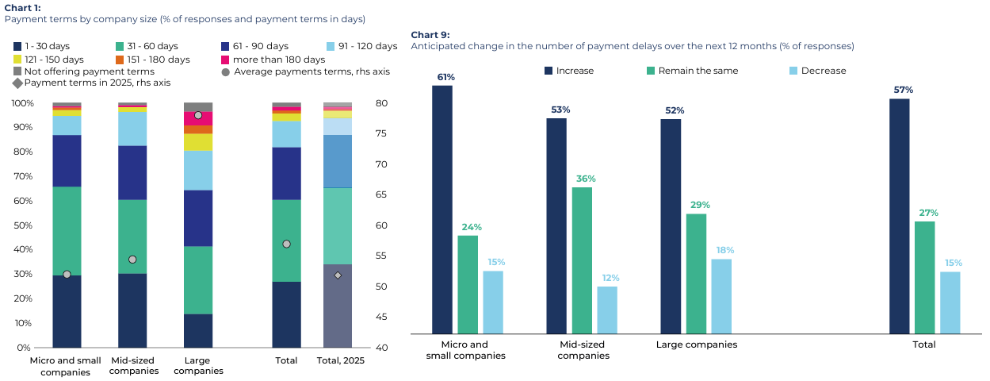
These figures point to a tougher supplier environment as businesses enter 2027.
For buyers, the risk starts inside the AP process. When approvals stall, queries circulate without an owner or payment status cannot be confirmed, suppliers have to protect their own cash position. This can affect the terms they offer, the capacity they reserve and the flexibility they bring to the next negotiation.
The 2027 AP agenda, therefore, needs to cover supplier confidence as well as transaction control. Approval ageing, query resolution and payment visibility show whether the business is becoming easier to supply, or simply passing working-capital pressure down the chain.
Late payment is the visible outcome. Supplier frustration usually starts earlier, when an invoice cannot be matched, an approver is unavailable or nobody can explain what will happen next. A supplier may tolerate one delayed payment. Repeated uncertainty changes how the account is managed commercially.
The Bank of England’s 2026 Q3 Credit Conditions Survey adds another consideration. Lenders reported that credit availability to small and medium-sized businesses decreased during the quarter. Suppliers with tighter funding options are less able to absorb approval delays and uncertain payment dates.
The CFO therefore needs a wider definition of AP performance. On-time payment remains essential, but the experience before payment matters as well. Clear answers and dependable status information reduce uncertainty even when the contractual payment date is unchanged.
This supplier experience is shaped at three points inside the process.
RELATED UK INSIGHT: See how better AP data strengthens compliance, payment evidence and supplier management in Outsourced Accounts Payable: Turning Compliance Data into Business Value.
Approval delays create more than a longer cycle time. They leave AP unable to tell the supplier whether the invoice is awaiting business confirmation, evidence, coding or a commercial decision. A queue without an owner becomes a communication problem long before it becomes a late payment.
Separate AP handling time from business approval time and show ageing by owner. The oldest unresolved items indicate where supplier uncertainty is building.
A helpdesk can meet a response-time SLA while the supplier waits days for an answer. The measure that matters is time to resolution, supported by the reason for contact and the number of repeat chasers. Payment status, missing remittance, disputed quantities and master-data changes need different owners and evidence.
Repeat contact shows where the first response lacked the evidence or ownership needed to settle the issue.
Suppliers do not need access to a buyer’s internal workflow. They do need dependable milestones: invoice received, exception identified, approved, scheduled and paid. If those statuses cannot be explained consistently, the supplier has to create its own control by chasing.
Taken together, approval ageing, repeat queries and uncertain payment status identify the supplier accounts that need management attention.
Traditional AP reporting groups invoices by process stage. This dashboard brings the same evidence together by supplier, showing where delays, repeat queries and payment uncertainty need attention. It is an operational risk view, not an accounting ledger.
| Signal | What the supplier experiences | AP evidence | Potential procurement implication | Management action |
| Approval ageing | No reliable payment date | Age by owner and reason | Tighter terms or reduced flexibility | Escalate oldest items before due date |
| Repeat queries | Answers do not settle the issue | Contacts per invoice and resolution age | Higher service cost on both sides | Fix missing data and assign one owner |
| Payment variance | Payment differs from expectation | Paid date against agreed term | Loss of confidence in forecasts | Explain holds and correct recurring causes |
| Remittance gaps | Cash arrives without usable detail | Unmatched remittances and rework | More reconciliation effort | Standardise remittance content and timing |
| Supplier-data failure | Bank, tax or contact data is uncertain | Rejected changes and verification time | Delayed supply or fraud concern | Strengthen change controls and ownership |
Review the dashboard by supplier segment. Materiality, substitutability and operational dependence determine which issues need escalation; procurement decides how that evidence affects supplier strategy and negotiation.
This gives procurement a clearer evidence base without moving commercial judgement into AP.
Procurement owns supplier strategy, negotiation and commercial leverage. AP contributes the evidence: whether agreed terms are being met, which queries keep returning and where payment uncertainty is increasing the cost of doing business.
A larger supplier may absorb a delayed invoice without changing service. A smaller specialist may have less working-capital headroom. AP can flag repeated delays and unpaid exposure; procurement decides whether those findings change the supplier-risk response.
Consistent payment gives procurement credible evidence when discussing terms, allocation and priority. Procurement decides how that record is used in negotiation; AP’s role is to make the evidence dependable.
A supplier that spends time proving delivery, resending invoices or tracing payment will recover that effort somewhere. It may appear in pricing, contract rigidity, reduced responsiveness or an unwillingness to extend credit. Those costs seldom sit in the AP budget, which is why they are easy to miss.
Finance needs a small set of measures that shows whether these conditions are improving.
The five measures below turn the three breakpoints into a compact review. They show whether AP is resolving the causes of friction, without repeating the full process analysis.
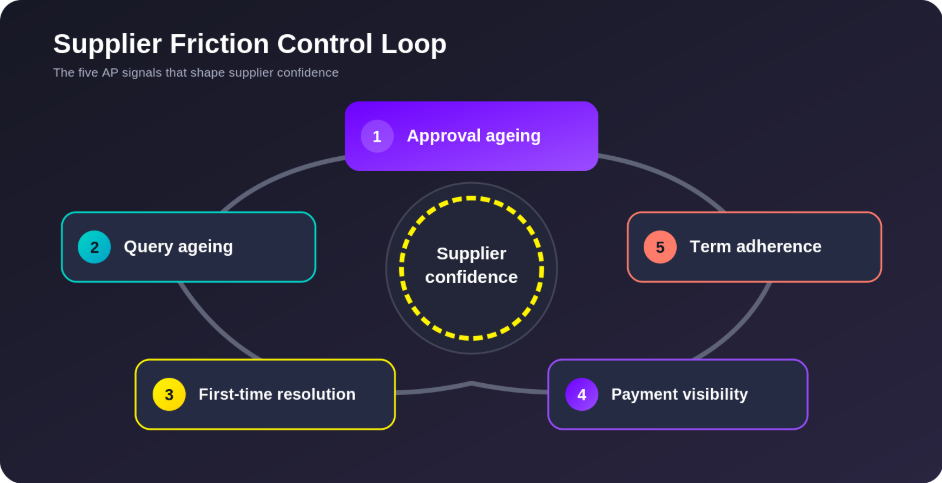
1. Approval ageing: Track time by owner and reason, with a separate view of invoices approaching terms.
2. Query ageing: Measure resolution, repeat contact and unresolved value, not acknowledgement alone.
3. First-time resolution: Show whether the first response settled the supplier’s issue without another hand-off.
4. Payment visibility: Report approved, held and scheduled liabilities so AP can give a dependable status.
5. Term adherence: Measure performance against contractual terms and explain the cause of material misses.
Read the signals together. Term adherence can remain strong while query ageing deteriorates. Payment visibility can improve while approvals continue to move slowly. The combinations show whether AP is removing friction or simply moving it to another queue.
A provider should take ownership of the repeatable work that makes supplier communication dependable: invoice intake, validation, matching, approval follow-up, exception administration, supplier queries, payment preparation and reporting. The service scope needs access to the status and evidence required to answer suppliers accurately.
The strongest accounts payable services operate against agreed clocks for approvals, exceptions and queries, with clear escalation when the answer depends on procurement, a budget holder or commercial judgement.
Supplier policy, contract interpretation, disputed commercial terms and bank release remain with the client. Outsourcing should strengthen execution around those decisions, not blur who has authority to make them.
The service review then becomes more useful. Instead of asking how many invoices were processed, finance can ask why suppliers are contacting AP, where uncertainty is forming and whether repeat causes are declining.
RELATED CASE STUDY: See how QX standardised AP controls and cut invoice processing from two to three days to one day for a global beverage producer and distributor. The result majorly demonstrates processing efficiency and control.
QX Global Group supports invoice processing, matching, approval follow-up, exception management, supplier queries, payment preparation and AP reporting within the client’s systems and controls. The aim is to make the status of an invoice easier to establish and the next action easier to assign.
For multi-entity and high-volume environments, QX can document common intake routes, query types, escalation rules and service measures across the supplier population. Dedicated teams build knowledge of the client’s coding, approval and supplier structures, while cross-trained cover protects continuity during peaks and absence.
The business retains control of supplier terms, commercial disputes, payment priorities and fund release. QX adds the capacity, evidence and operating rhythm needed to apply those decisions consistently. This division keeps AP responsive without transferring authority that belongs with finance and procurement.
The 2027 AP review should show whether suppliers receive dependable information and whether internal delays are being resolved before payment terms are at risk. Procurement can then use that evidence alongside service, pricing and supply-risk information.
Start with old approvals, repeat queries and uncertain payment status. Assign ownership and measure resolution. AP should reduce avoidable friction; procurement remains responsible for supplier strategy, negotiation and commercial decisions.
QX Global Group’s accounts payable services help UK finance teams build a more controlled supplier-payment operation while keeping commercial authority in-house.
Ready to reduce supplier friction across AP? Talk to QX Global Group about approval, query and payment controls built for a complex supplier base.
Accounts payable is becoming a supplier-management issue because payment reliability shapes confidence, service continuity and commercial behaviour. Late approvals, unresolved queries and poor payment visibility affect how suppliers price risk, extend credit and allocate scarce capacity.
Late approvals weaken purchasing leverage by making agreed payment terms less dependable. Suppliers may tighten credit, reduce flexibility or price additional administration into future negotiations when internal delays repeatedly create uncertainty around payment.
Accounts payable services improve payment visibility by maintaining consistent invoice statuses, approval ownership and due-date reporting. Suppliers receive clearer answers, while treasury and procurement gain a shared view of approved, held and scheduled liabilities.
Supplier query handling affects AP efficiency through repeat contact, investigation time and avoidable hand-offs. Measuring resolution time, query cause and repeat chasers helps finance identify missing data, unclear ownership and recurring process failures.
Outsourced accounts payable services can improve supplier resilience by reducing uncertainty around invoice status and payment timing. Dedicated capacity supports faster follow-up, consistent query handling and earlier escalation when critical suppliers face delays.
QX supports UK businesses with invoice processing, matching, approval follow-up, exception management, supplier queries, payment preparation and reporting. Clients retain supplier terms, dispute judgement, payment priorities and bank-release authority.
Providers with transparent communication define the metric, clock, evidence and escalation route before service begins. Buyers should expect regular reviews, cause-level reporting, access to source data and clear ownership when supplier issues cross organisational boundaries.
Providers offering dedicated, named teams give suppliers and internal stakeholders greater continuity. Confirm the resourcing model contractually, including cross-trained cover, replacement handovers, account leadership and how process knowledge will be retained.
Partners suited to high-volume finance combine scalable capacity with disciplined exception and query management. Assess their peak-volume planning, workflow controls, first-time-right reporting, named ownership and ability to preserve service quality when volumes rise.

Education:
CA, B.Com

Rushabh Shah is a Chartered Accountant with over 7 years of experience in audits, financial analysis, and process optimisation. At QX, he specialises in CAPEX reviews, treasury management, P2P processes, and tax and statutory compliance. With a strong foundation in financial reporting, Rushabh brings cross-sector expertise and a sharp analytical approach to managing complex finance operations.
Expertise: CAPEX Reviews, Treasury Management, P2P Processes, Tax & Statutory Compliance, Financial Reporting, Audit & Financial Analysis
Originally published Nov 23, 2026 08:11:48, updated Nov 23 2026
Topics: Accounts Payable Optimisation, Finance & Accounting Outsourcing
23 Nov 2026
Senior living operators are heading into the next year with a better occupancy backdrop and a harder...
Read More23 Nov 2026
Six months after an AP transition, the first question from the CFO is usually straightforward. Is fi...
Read More17 Nov 2026
On 19 March 2026, the government published a list of 389 employers. All of them were named for under...
Read More12 Nov 2026
Living platforms increasingly span more than one product. A group may operate BTR homes, student acc...
Read More