Topics: Accounts Payable Outsourcing Companies, Finance & Accounting Outsourcing
Posted on November 23, 2026
Written By Rushabh Shah




Six months after an AP transition, the first question from the CFO is usually straightforward. Is finance working better? The service report may show that invoice volumes and turnaround targets are on track, yet the retained team can still be spending too much time on approval delays, coding corrections, supplier questions, and payment forecasting.
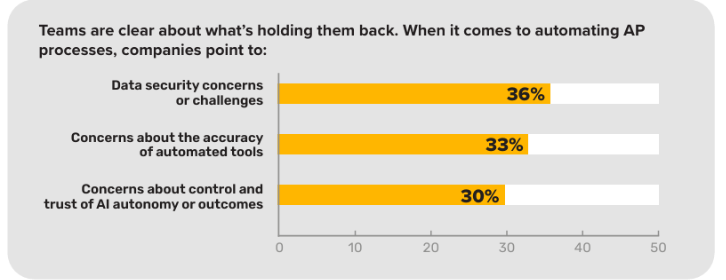
A recent survey provides a useful context. It covered 2,116 finance professionals across five countries, including the United States. Although 31% described AP as fully automated, 86% said their own workload had increased over the previous year. Even automation has not removed the pressure on finance teams to explain exceptions, protect controls, and support cash decisions.
An outsourced model earns its place when that underlying work begins to improve. Invoices move through the process with fewer interventions, preventable errors are contained, supplier issues close quickly, and treasury can rely on the payable forecast without a separate reconciliation exercise.
That is the scorecard CFOs need for their 2027 plans. Cycle time, exception rate, duplicate prevention, supplier-query aging, and cash visibility show whether AP has become a stronger finance operation, not simply a well-managed transaction queue.
Most outsourcing contracts begin with service levels because they create accountability. Turnaround, accuracy, volume and response time are useful measures. They become weak management proxies when the team starts optimizing the SLA itself instead of the finance result behind it.
A 24-hour processing target, for example, says little if invoices spend another four days waiting for approval. A 99% accuracy target needs a definition of what counts as an error and when errors are discovered. Query response time is equally limited if the supplier receives an acknowledgement and waits three more days for resolution.
The CFO scorecard should therefore connect every headline metric to a diagnostic beneath it. That makes outsourcing performance explainable and gives the retained team a basis for changing the process, not simply debating the provider’s monthly numbers.
RELATED BLOG: AP data is only useful when management can see what is driving the monthly result. See how multifamily finance teams are designing reporting stacks that preserve property-level detail as portfolios scale.
The same principle applies to AP. Each headline needs a second measure that tells finance what changed underneath it.
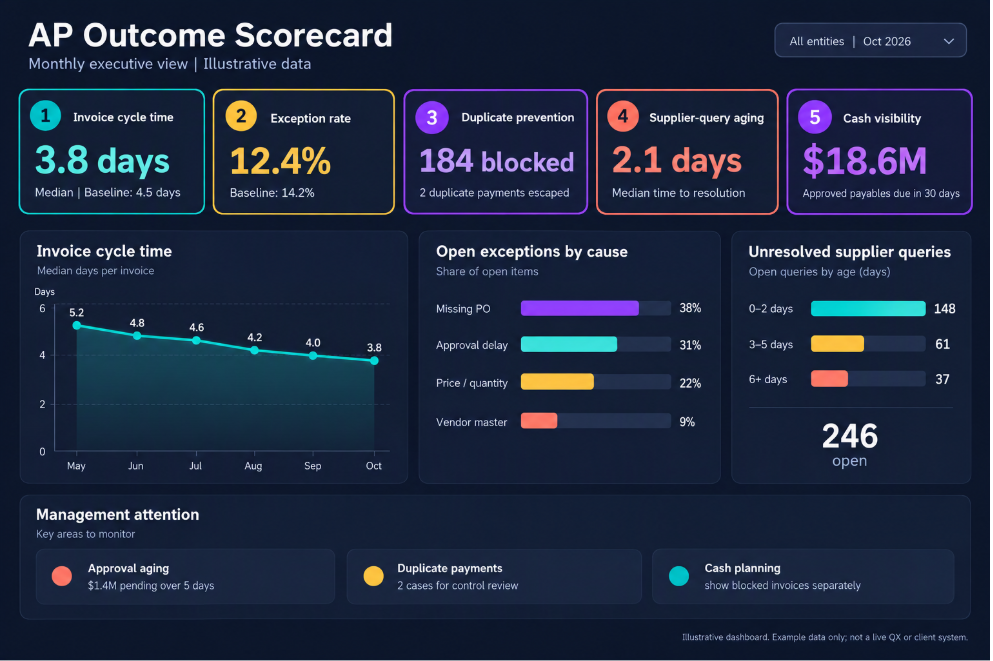
Use receipt-to-ready-for-payment as the headline measure, then split the clock into intake, matching, exception handling and approval. Report the median and 90th percentile. The median shows the normal route; the tail shows the invoices most likely to create supplier friction or miss discount opportunities.
Separate PO and non-PO invoices, and do not blend provider handling time with business approval time. Otherwise, the scorecard cannot tell whether the outsourced operation is slow or whether the bottleneck remains inside the client organization.
The exception rate tells the CFO how much work still falls out of the designed process. The important detail is the cause—missing PO, quantity mismatch, vendor-master issue, tax problem, coding question, or approval gap. Aging and repeat causes show whether the process is improving or simply processing the same failure every month.
A duplicate-prevention figure is useful only when finance can distinguish a genuine duplicate from a legitimate repeat charge. Track prevented duplicates, duplicates released to payment and the source of the failure. The escaped item matters more than a large prevention count because it shows where controls did not hold.
For the supplier, a fast first response has little value if the underlying issue remains open. Track median resolution time, aged open queries, repeat contacts and reasons for contact. Payment-status queries often expose weak visibility; invoice-status queries often point to intake, matching or approval problems.
The finance outcome is a credible view of liabilities due over the next 7, 14 and 30 days, with approved, blocked and disputed amounts clearly separated. This is where AP performance starts to influence working-capital decisions. A faster invoice process that leaves treasury rebuilding the payable forecast has improved throughput, not finance visibility.
Taken together, these measures give CFOs a balanced view of speed, quality, control, service, and cash.
Individual AP metrics can improve for the wrong reason. Pairing them helps finance test whether a gain is real or whether work has moved somewhere else in the process.
| Metric pair | What the combination suggests | CFO follow-up |
| Cycle time ↓ + exceptions ↓ | Cleaner processing and fewer handoffs | Is first-pass quality improving by invoice type? |
| Cycle time ↓ + exceptions ↑ | Work may be entering manual queues sooner | Where did the work move? |
| Queries ↓ + repeat contacts ↓ | Supplier communication is becoming clearer | Which causes were removed? |
| Duplicates prevented ↑ + escaped duplicates flat | Detection may be improving without stronger prevention | Which source control still fails? |
| Cash visibility ↑ + approval aging ↑ | Treasury sees the exposure, but approvals remain the constraint | Which owners hold the oldest value? |
This paired view is especially useful after go-live.
Visibility often improves before the underlying operating metrics improve because the outsourced model starts classifying work that previously sat unmeasured in inboxes or local spreadsheets. A temporary rise in reported exceptions can therefore reflect better control, provided the backlog then falls by cause and age.
Post-transition reporting becomes unreliable when the denominator or clock changes. Define the invoice population before go-live—credit notes, intercompany items, employee expenses and invoices returned to the supplier should either be included consistently or reported separately. The same rule applies to cycle-time start and stop points.
Ownership needs the same discipline. If an invoice is parked with a business approver for five days, that time should remain visible in the end-to-end result even when it sits outside the provider SLA. Hiding retained-team delay makes the service report look stronger while the supplier experiences no improvement.
Volume mix also changes the story. Automation usually removes the cleanest invoices first, leaving the delivery team with a higher concentration of exceptions and judgment-heavy work. A rising cost per manually handled invoice may therefore coexist with a lower total cost to serve. CFOs should compare the whole AP outcome before drawing a conclusion from one unit metric.
Stable definitions turn the scorecard into a management tool. The monthly review can then focus on movement, cause and accountability.
The monthly service review should spend less time confirming that reports were delivered and more time on movement, cause, and action. Three questions keep the discussion grounded:
Set targets against the company’s own baseline before using external benchmarks. APQC’s benchmarking framework is useful because it covers cost, first-time error-free disbursements and receipt-to-payment cycle time across industries, but the CFO still needs consistent internal definitions before making a provider comparison.
The baseline should also survive scope changes. If invoice volumes rise, entities are added or automation removes easy work, the mix of remaining AP activity changes. Compare like with like before concluding that productivity or quality has moved.
A scorecard is most useful when the provider can influence the result it is being measured on. If the provider owns intake, matching, and exception administration but has no access to approval owners, a full end-to-end cycle-time target will confuse accountability. The metric should show both clocks.
When companies outsource accounts payable services, the scope should define the operating evidence behind each outcome: timestamps, exception categories, duplicate-control logs, query ownership and the payable forecast used by treasury.
Commercial decisions stay with the client. That includes approval authority, supplier terms, disputed business issues, cash priorities and payment release. The provider should own the repeatable execution and the data needed to show whether that execution is getting better.
RELATED CASE STUDY: See how QX standardized AP controls for a global beverage producer and reduced invoice processing from two to three days to one day, while improving transactional efficiency by 9% and delivering up to 60% service-delivery savings.
QX Global Group supports invoice processing, matching, exceptions, supplier queries, payment preparation and AP reporting within the client’s systems and controls. The operating model is built around defined SLAs and outcome measures, so finance can see both what was completed and where work is still creating cost, delay or risk.
QX can report the processing clock, exception aging, quality trends, and query performance while the client retains approval, commercial judgment and payment authority. Monthly governance can then focus on the causes that need process change, automation or action from the retained organization.
The goal is a provider relationship that becomes easier to manage over time because the evidence is consistent and the scorecard is tied to finance outcomes.
A successful AP outsourcing model should leave the CFO with fewer surprises, a cleaner payable position and a clearer view of where cash is committed. Processing volume and SLA attainment still matter, but they are supporting evidence, not the final result.
For 2027 planning, establish the five outcome measures before changing scope or automation. Keep the definitions stable through transition, review the metrics in pairs and make every monthly discussion end with a named cause and action. That is how the organization can tell whether outsourced AP is genuinely becoming a stronger finance operation.
QX Global Group can help organizations outsource accounts payable services with an operating model built around measurable performance, transparent governance and retained client control.
Talk to QX Global Group about an outsourcing model measured on finance outcomes, not activity alone.
CFOs should track cycle time, exception rate, duplicate prevention, supplier-query aging and cash visibility. Add diagnostics beneath each measure so management can see whether improvement comes from cleaner processing, faster approvals, stronger controls or reduced supplier rework.
Invoice cycle time shows how quickly invoices move from receipt to payment readiness. Split provider handling from business approval time, and review the median with the 90th percentile so slow outliers are not hidden inside a portfolio average.
Exception rate shows how much AP work still falls outside the designed process. Tracking cause, owner and age helps CFOs distinguish isolated issues from recurring failures that continue to consume manual effort after outsourcing.
Supplier-query aging shows whether AP is resolving supplier issues, not simply acknowledging them. Long-running or repeated queries often reveal weak invoice visibility, poor exception ownership or approval delays that standard processing SLAs do not capture.
A CFO scorecard should combine speed, quality, control, supplier service and cash visibility. Pair the headline measures with diagnostics such as exception cause, approval aging, repeat supplier contacts and escaped duplicates to prevent one KPI from masking another.
QX can report invoice processing, exception aging, quality trends, supplier-query performance and payable visibility against agreed measures. Clients retain approval, supplier terms, cash prioritization and payment authority while governance focuses on causes, actions and sustained improvement.
Providers with transparent communication agree measurable SLAs before go-live and report them consistently. Buyers should expect clear definitions, source data, exception-level reporting, governance cadence and escalation routes so performance discussions are based on evidence.
Providers offering dedicated, named finance teams give clients stronger process continuity and clearer accountability. Confirm exclusivity, backup arrangements, cross-training, attrition reporting and handover expectations contractually so operating knowledge does not disappear when individual team members change.
Partners suited to high-volume finance combine scalable capacity with disciplined quality and exception management. Assess peak-volume planning, workflow controls, first-time-right reporting, named ownership and whether service quality holds when invoice volumes or business complexity increase.

Education:
CA, B.Com

Rushabh Shah is a Chartered Accountant with over 7 years of experience in audits, financial analysis, and process optimisation. At QX, he specialises in CAPEX reviews, treasury management, P2P processes, and tax and statutory compliance. With a strong foundation in financial reporting, Rushabh brings cross-sector expertise and a sharp analytical approach to managing complex finance operations.
Expertise: CAPEX Reviews, Treasury Management, P2P Processes, Tax & Statutory Compliance, Financial Reporting, Audit & Financial Analysis
Originally published Nov 23, 2026 07:11:47, updated Nov 23 2026
Topics: Accounts Payable Outsourcing Companies, Finance & Accounting Outsourcing
23 Nov 2026
As 2027 planning gets under way, supplier payment deserves the same attention as pricing, availabili...
Read More23 Nov 2026
Senior living operators are heading into the next year with a better occupancy backdrop and a harder...
Read More17 Nov 2026
On 19 March 2026, the government published a list of 389 employers. All of them were named for under...
Read More12 Nov 2026
Living platforms increasingly span more than one product. A group may operate BTR homes, student acc...
Read More