Topics: Finance & Accounting Outsourcing, Senior Living
Posted on November 23, 2026
Written By Probhangshu Goswami




Senior living operators are heading into the next year with a better occupancy backdrop and a harder finance agenda. Communities are filling, development remains constrained, and more capital is looking for exposure to the sector. For CFOs, this combination creates work well beyond the monthly close. New investments to underwrite, communities to reposition, labor and margin assumptions to challenge, and reporting that has to stand up to lenders and investors.
NIC’s Q3 2026 market data puts occupancy across the 31 primary markets at 90.4%, the 21st consecutive quarterly gain. Construction, meanwhile, stood at 16,159 units, and NIC estimates the current development pace at roughly 10% of the annual volume needed to hold national occupancy near 90% as demand grows.
Now, this creates a different finance capacity problem. The next 24 months are likely to ask internal teams to run a larger operating base while supporting acquisitions, integrations, CapEx decisions, and more demanding portfolio analysis. Adding permanent headcount for every peak is expensive and slow; stretching the existing team pushes higher-value work behind reconciliations, transaction processing and reporting deadlines.
The useful question is where flexible finance capacity can remove that pressure without moving capital allocation, accounting judgment or strategic decisions away from the management. That is the role F&A outsourcing services need to play in the next phase of the market.
Senior living finance teams already know how to report occupancy and community performance. The harder part is keeping the finance operating model aligned as the portfolio moves from recovery into active capital deployment.
NIC reported 644,428 occupied units in Q3 2026, up from 639,871 in Q2. The same release shows a wide market range, from 94.0% occupancy in Boston to 86.5% in Miami. National strength therefore does not remove the need for property-level decisions on pricing, labor, renovation and capital.
Capital markets are moving as well. Higher occupancy and constrained new supply increase the value of existing operating assets, but that does not simplify the finance work. Acquisition models have to link to actual community performance. Repositioning plans need CapEx and operating assumptions that can be tracked after approval. Leadership also needs enough reporting capacity to distinguish portfolio growth from underlying performance.
The finance design issue is straightforward—build permanent internal capacity around judgment and create flexible capacity around repeatable execution, analysis preparation and periods of unusually high workload.
This division becomes clearer when the workload is viewed across the next two years instead of one reporting cycle.
RELATED BLOG: See how senior living CFOs can connect occupancy, revenue capture, labor and reporting to NOI in How Senior Living CFOs Can Turn Occupancy Growth into NOI Growth.
A 24-month capacity plan should start with the work finance already knows is coming. The point is not to forecast every transaction. It is to identify which workloads will remain steady, which will spike around portfolio events and which require senior management judgment.
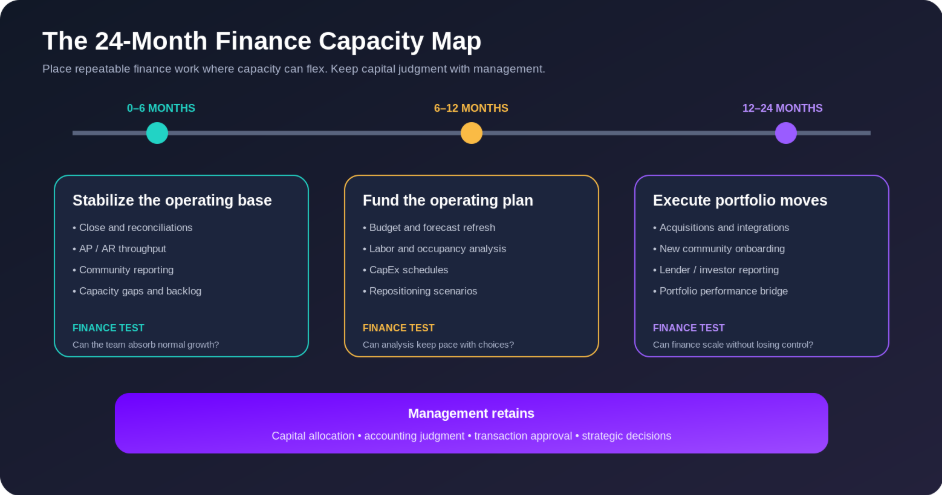
The first six months should establish whether day-to-day finance can absorb normal growth. Close, reconciliations, AP, AR, community reporting and data cleanup belong here. Backlogs and repeated manual fixes are warning signs because they consume the same people management needs for analysis later in the cycle.
As planning moves into budgets, labor models, renovation programs and cash forecasts, the work becomes less transactional but more time-sensitive. Finance needs enough delivery capacity to refresh the underlying data and schedules while internal leaders challenge the assumptions and make the decisions.
Acquisitions, integrations, refinancings and community onboarding create temporary finance workloads that are difficult to support with a fixed team. The operating model should identify in advance who can build opening balances, clear reconciliation gaps, map chart-of-accounts structures, prepare reporting packs and absorb transaction volumes during cutover.
The capacity plan gives the CFO a basis for deciding which work should scale externally and which work must stay close to management.
A useful capacity plan should also quantify the gap. Start with the monthly baseline hours needed for close, transaction processing and recurring reporting. Then add the estimated effort for known projects and apply a contingency for portfolio events that have not yet been scheduled. If the peak workload is materially above the team’s sustainable capacity for several months, the choice is no longer between working harder and hiring later. Finance needs a planned source of flexible capacity.
The model should be refreshed quarterly. Acquisition timing moves, projects slip and operating priorities change. A rolling view keeps the outsourcing decision connected to the portfolio plan instead of treating it as a one-time headcount exercise.
Senior living finance carries decisions that should remain with internal leadership. Capital allocation, acquisition approval, material accounting judgments, reserves, financing strategy, care-related commercial decisions and final reporting sign-off belong with the business.
The work around those decisions can be organized differently. Finance can separate activities into three practical groups:
| Work type | Examples | Best home | Why |
| Repeatable finance execution | AP, AR, reconciliations, standard journals, reporting schedules | Scalable internal or outsourced delivery | Volume varies; rules are documented |
| Analysis preparation | Forecast files, community packs, CapEx schedules, variance bridges | Shared model with dedicated finance capacity | Requires finance skill but limited commercial authority |
| Management judgment | Capital allocation, acquisition approval, estimates, reserves, strategic scenarios | Internal finance leadership | Requires accountability, business context and authority |
This boundary keeps outsourcing useful. The external team has enough ownership to remove operational pressure, while the decisions that shape portfolio value remain with management.
Document the boundary before transition. For each process, name the preparer, reviewer, approver, evidence required and escalation point. This is especially important for CapEx, resident balances, reserves and unusual journals, where routine preparation can sit outside the business but approval still requires property or accounting knowledge.
A transaction can create immediate work across vendor setup, resident and receivable balances, bank reconciliations, fixed assets, opening journals and management reporting. A flexible team can prepare and process that work while internal finance validates purchase accounting, approves policy choices and challenges the integration plan.
Repositioning creates another temporary workload: project codes, commitments, accruals, CapEx schedules, vendor invoices and post-investment tracking. External capacity can maintain the accounting evidence and reporting schedules while management decides which projects proceed and whether the expected operating outcome is being delivered.
As portfolios get larger, the recurring reporting pack becomes a capacity issue of its own. Community-level actuals, labor, occupancy, revenue, cash and capital need to reach FP&A in a consistent form. Dedicated finance support can prepare the base analysis, leaving internal teams more time to interpret performance and challenge the forecast.
The test is whether outsourced work shortens the distance between operating data and management attention without moving the decision itself.
A fixed offshore team can lower cost, but senior living operators need more than a permanent block of capacity. The delivery model should be able to add temporary support around acquisitions, year-end, budgeting, system migrations or portfolio changes, then normalize when the workload settles.
QX Global Group’s f&a outsourcing services can support transactional accounting, reconciliations, reporting preparation and other repeatable finance activities through dedicated teams that work within the client’s systems and controls.
Success should be measured in capacity released and operating stability, not only labor arbitrage. Useful measures include close reliability, aged reconciliations, reporting turnaround, backlog levels, transition speed and the amount of retained-team time redirected from routine execution to analysis and decision support.
QX supports senior living finance teams across accounts payable, accounts receivable, general accounting, reconciliations, reporting support and other repeatable F&A activities. Dedicated teams can scale around portfolio growth and project workloads while operating through documented processes, agreed controls and client-defined approval routes.
A recent QX engagement with a senior living provider operating more than 130 communities across 27 states shows the capacity side of the model. QX reports 50% savings on finance operations, a skilled team built in under 30 days and continuity through peak periods and holidays. These outcomes demonstrate scalable execution; capital allocation, strategic decisions and financial accountability remain with the client.
That boundary is essential for the next 24 months. Outsourcing works best when it gives internal finance teams enough room to evaluate communities, transactions and capital choices without creating ambiguity over who owns the judgment.
The senior living market is entering 2027 with strong occupancies, limited new supply and a growing need for capital to respond. That is a favorable setup for operators with disciplined portfolios, but it will increase the volume and variety of work reaching finance.
The practical response is to reserve internal capacity for the decisions that shape value and build flexibility underneath it. Repeatable accounting, reporting preparation and project-intensive workloads can scale through an outsourcing partner; management keeps the investment thesis, accounting judgment and final decision rights.
QX Global Group’s F&A outsourcing services can provide that additional operating capacity as senior living portfolios move through growth, repositioning and investment decisions over the next 24 months.
Planning finance capacity for 2027 and 2028? Talk to QX Global Group about a model that scales execution while your finance leadership retains strategic control.
F&A outsourcing services provide scalable accounting and finance execution without requiring permanent headcount for every workload increase. They can support AP, AR, reconciliations, reporting preparation and project peaks while internal leaders retain financial judgment and strategic decision-making.
Finance teams should consider outsourcing when workload is recurring or volatile but does not require permanent internal judgment. Acquisition integrations, reporting backlogs, transaction growth, close pressure and seasonal peaks can justify flexible capacity before another full-time hiring cycle.
F&A outsourcing increases capacity by moving documented, repeatable execution to a dedicated delivery team. Management retains capital allocation, policy decisions, estimates, approvals and strategic scenarios, while the outsourced team maintains the accounting evidence, schedules and recurring workflows.
Processes are best suited to outsourcing when the rules, inputs, outputs and review standards can be documented. AP, AR, reconciliations, standard journals, fixed-asset support, reporting preparation and selected close activities typically meet that test.
Yes. F&A outsourcing can add temporary capacity for opening balances, transaction processing, reconciliations, CapEx schedules, reporting packs and integration work. Internal leadership should continue to approve purchase accounting, capital decisions, commercial assumptions and material accounting judgments.
QX provides dedicated finance teams across transactional accounting, reconciliations, reporting support and related F&A processes. The model can scale around portfolio growth and project workloads while clients retain approval authority, financial judgment and accountability for strategic decisions.
Providers offering dedicated, named teams give finance leaders clearer accountability and stronger process continuity. Buyers should confirm resource assignment, backup coverage, cross-training, transition expectations and how client-specific knowledge will be retained as the engagement changes.
Providers with flexible delivery models can combine short-term project capacity with ongoing managed finance services. Confirm whether the same governance, documentation and control standards apply when the team scales up for integrations, backlog cleanup, systems work or reporting peaks.
Strong transition partners use documented process maps, knowledge transfer, parallel running, readiness checks and named governance from the start. The transition plan should protect month-end, reporting and payment continuity while responsibilities move between internal and outsourced teams.

Education:

Probhangshu Goswami (Ray) is a senior transformation leader with 17+ years of experience partnering with CFOs and executive teams across finance operations, shared services, and global delivery models. At QX Global Group, he works with C-suite stakeholders across North America to design and scale finance operating models for the rental housing and property management sectors, with a focus on governance, automation, and sustainable cost structures. His experience spans student housing, multifamily, and large property management platforms, where he has led complex, multi-year transformation programs. Prior to QX, he held leadership roles at BlackBeltHelp and Quatrro.
Expertise: Finance & Accounting Outsourcing (FAO),Finance Operating Model Design,Shared Services & Global Delivery,Process Transformation & Intelligent Automation, Cost Optimization & Scalability
Originally published Nov 23, 2026 07:11:06, updated Nov 23 2026
Topics: Finance & Accounting Outsourcing, Senior Living
23 Nov 2026
As 2027 planning gets under way, supplier payment deserves the same attention as pricing, availabili...
Read More23 Nov 2026
Six months after an AP transition, the first question from the CFO is usually straightforward. Is fi...
Read More17 Nov 2026
On 19 March 2026, the government published a list of 389 employers. All of them were named for under...
Read More12 Nov 2026
Living platforms increasingly span more than one product. A group may operate BTR homes, student acc...
Read More