Topics: compliance, Finance & Accounting Outsourcing
Posted on September 15, 2026
Written By Rushabh Shah




Every compliance obligation a finance team meets requires data. Be it tax filings, statutory reporting, audit trails, payment records, or structured e-invoices for every VAT transaction between UK businesses (applicable April 2029 onwards). This work is usually treated as a cost of doing business, i.e., complete it accurately, file it, and move on.
This often overlooks the fact that compliance forces a business to record, in a consistent format, what it buys, from whom, on what terms, and with what exceptions. It is indeed the most disciplined description of a company’s spending that most organisations will ever be required to produce, and it is generated whether or not anyone intends to use it.
The catch is that structured data is not the same as reliable data, and reliable data is not the same as decision-ready information. Closing these gaps is crucial, and this is precisely where outsourced accounts payable earns its place. This piece looks at where that value sits, why most businesses fail to reach it, and what the finance function gains when someone finally takes ownership of the data.
The reason is that it’s often perceived as a one-time activity. The work ends the moment the deadline passes. Once compliant filing is done, the team disperses, and a complete record of company spending sits in a system with nobody accountable for keeping it accurate.
The demand also keeps rising. For example, e-invoicing mandates are spreading across Europe, and the UK government has announced mandatory e-invoicing for VAT invoices from 2029. The precise implementation date, standards, and transmission model are still being developed, with an implementation roadmap due at Budget 2026. The government’s consultation response identifies Peppol as an option favoured by many respondents but does not confirm it as the UK’s chosen interoperability network.
The official consultation response sets out the current policy position. Tax authorities are becoming more closely connected to transaction data, and the information they require must be produced to specification irrespective of whether anyone internally finds it useful.
One survey of 200 UK finance professionals found that 70% of respondents whose organisations had bought automation software believed the problem was handled, even as other visibility issues persisted.
The same survey found that 22% of respondents in organisations with 50 to 99 employees reported a lack of real-time visibility into invoice status. Among respondents from organisations with 100 to 249 employees, the figure was 36%. In this sample, visibility challenges were more common in the larger group, despite larger firms generally investing more in systems.
Plainly put, partial automation removes the keying, which is the problem everyone can see. But it does nothing about the siloed data across multiple systems that are connected through cumbersome integration. Now, this is a problem that nobody notices until a regulator asks a question or a forecast turns out to be wrong. This is where an outsourced AP function starts earning its fee, and not in the way most buyers expect.
But before looking at what an outsourced function does about it, it is worth noting what compliance does and does not deliver on its own.
It guarantees form, not substance. A compliant e-invoice arrives in a consistent structure, carries the mandated fields, transmits through an approved network and can be produced on-demand for an auditor or a tax authority. It is a complete, standardised, and defensible record of every transaction, which is more than many organisations could assemble from their own systems today.
What it leaves undone is everything that makes the record worth reading:
Each of these invoices could pass every compliance test applied to it. An invoice can be entirely valid and commercially useless at the same time, and the mandate will produce a great many of them.
The asset is not the compliant filing. It is the governed data set that exists only when someone owns the definitions, validates the fields, maintains the supplier records and closes the exceptions. Call it the data conversion layer. The operational discipline between a compliant feed and a number you would put in front of the board. Outsourced accounts payable, done properly, is that layer.
It usually happens when invoices stop sitting in isolation and integrate with purchase orders, budgets and the cash position. Getting there takes four stages, and most organisations complete two.
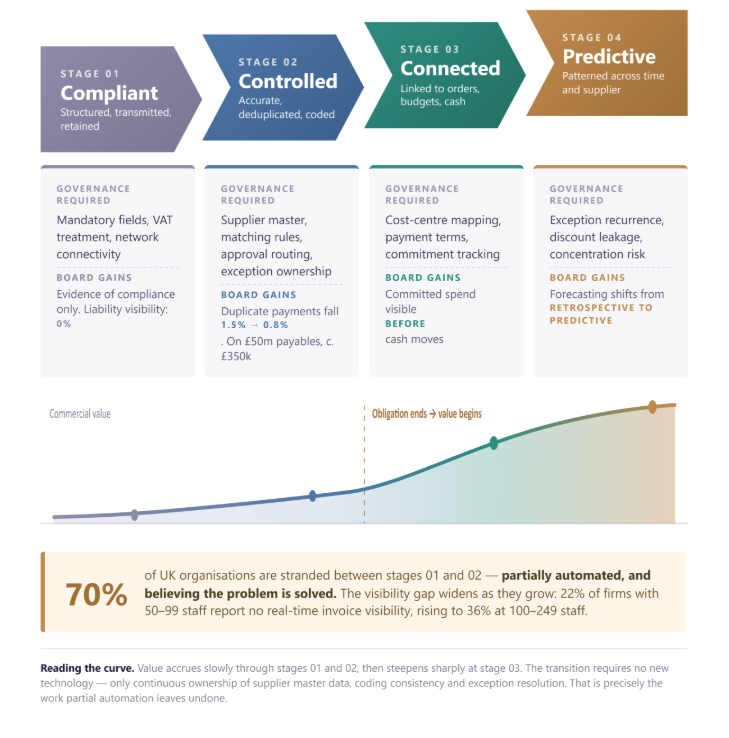
Most organisations stop at stage 2, because that is where the regulatory obligation ends. Everything of commercial value sits above it, and nothing external compels a business to climb. A partner engaged on the right terms is contracted to do exactly that, continuously, which is what separates a genuine AP service from a processing queue.
One caution on the ascent, though. Automation applied to poor foundations does not repair them, it accelerates them. A business that automates at the compliant stage produces unreliable information faster, and with more confidence in it than before.
Four things – the supplier master file, invoice coding and validation, exception resolution, and the data quality standards behind all three. It does not own payment policy, supplier selection or working-capital strategy. Those stay with the CFO.
That split is where these arrangements succeed or fail. Compliance is periodic and data quality is continuous. A deadline can be met by a project; a data set can only be maintained by an operation. What a capable partner contributes is the thing a stretched internal team cannot sustain through a difficult quarter:
Two conditions separate a good arrangement from a poor one.
That is also the honest limit of the model. An outsourced function will not tell you which suppliers to keep or how aggressively to pay. It will make sure that when you decide, you are deciding on figures that hold.
The month-end arrives without a scramble, and the numbers are ready before anyone asks for them. Four shifts do most of that work.
Here’s what is common to all four. None of them depend on new technology. They are simply continuous, which is exactly why they lapse when nobody is accountable for them and hold when somebody is.
RELATED BLOG: Handing over the work does not mean handing over the numbers. See how UK CFOs outsource F&A services without losing financial control.
Five things, on a very basic level, and these should be available at the fingertips when required.
| The question leadership asks | What the AP function must govern | The decision it improves |
| What have we already committed? | Approved and unapproved invoices, due dates, payment terms | Short-term cash forecasting and payment timing |
| Where is spend drifting? | Supplier, category, entity and cost-centre coding | Budget control and early intervention |
| Which suppliers carry hidden risk? | Concentration, dispute history, exception patterns | Supplier strategy and continuity planning |
| Where are we leaking value? | Duplicates, missed discounts, non-PO spend, late-payment interest | Margin protection and process redesign |
| Which controls keep failing? | Approval delays, match failures, recurring tax exceptions | Control remediation and audit readiness |
A partner worth retaining will report against these rather than against throughput. Invoices processed is an activity measure. These questions are outcome measures, and they are the ones that tell you whether the arrangement is working.
Also Read: Top Accounts Payable Outsourcing Companies in UK – Key Qualities That Define the Best
One of the primary reasons behind it is that QX Global Group runs accounts payable as a governed data operation rather than a processing queue. This distinction matters the most.
QX Global Group provides outsourced accounts payable services that UK businesses can use across the full cycle, from invoice capture and validation through coding, approvals, reconciliations, supplier queries, payment support and reporting. Standardised workflows, defined sign-offs, SLA-backed exception management and regular reporting mean data quality is actively managed rather than assumed as a by-product of automation.
In practice, that means QX owns the daily climb from compliant to controlled to connected:
Payment policy, supplier strategy, and final approval stay firmly with the client. What changes is the quality of the information those decisions rest on, and the senior time released to make them.
The impact can be material. In one QX engagement with a leading UK aerospace manufacturer, ledger balance discrepancies fell from £2.5 million to £200,000 after the client standardised and automated its P2P process with QX.
Compliance demands meaningful data whether a business is prepared for it or not. What that data is worth is a different question altogether.
That comes down to whether someone is accountable for it every day rather than every reporting cycle. Businesses that put that ownership in place, internally or through a partner, find that compliance stops feeling like an imposition and starts producing something useful: a clean supplier picture, a complete liability position, and a forecast that is trustworthy. Sure, the regulator sets the deadline, but your operating model decides whether to perceive it as a headache or an asset.
Wondering what your AP data could be telling you that it currently is not? Talk to QX Global Group about an accounts payable model built around control, visibility and value.
FAQs
1. How can outsourced accounts payable help businesses manage e-invoicing compliance?
A specialist partner brings standardised capture, validation and retention processes that meet the mandated format consistently across every entity and supplier. That removes the variation which causes compliance failures, and maintains the audit trail as routine output rather than something reconstructed under pressure.
2. How does structured invoice data improve financial visibility?
Consistent fields make liabilities comparable and aggregable. Once invoices are coded reliably and linked to purchase orders and cost centres, finance can see committed spend and payment timing before money leaves the account, rather than reconstructing the position after the event.
3. Can accounts payable outsourcing turn compliance data into actionable business intelligence?
It can, though not automatically. The conversion depends on governance: deduplicated supplier records, consistent coding, resolved exceptions and data connected to budgets and contracts. A partner running those disciplines daily is what turns a compliant feed into spend and cash analysis worth acting on.
4. What role does AP automation play in improving invoice data accuracy?
Automation enforces validation at capture, catches duplicates, applies matching rules and flags anomalies. Its limitation matters: research suggests partial automation can worsen visibility rather than improve it, because information fragments across half-connected workflows. Process standardisation should precede the technology decision.
5. How can UK businesses prepare their accounts payable function for increasing e-invoicing requirements?
Map invoice flows, clean supplier master data, define the field taxonomy needed for both compliance and analysis, and assign clear ownership across tax, procurement, AP, treasury and IT. Pilot on one entity and measure data quality rather than transmission volume.
6. Why should UK businesses choose QX Global Group for outsourced accounts payable?
QX Global Group runs accounts payable as a governed data operation, with standardised workflows, defined sign-offs, SLA-backed exception management and reporting that covers liabilities as well as volumes. Clients keep payment policy and supplier strategy in-house while gaining cleaner data, fewer exceptions and more dependable month-end information.

Education:
CA, B.Com

Rushabh Shah is a Chartered Accountant with over 7 years of experience in audits, financial analysis, and process optimisation. At QX, he specialises in CAPEX reviews, treasury management, P2P processes, and tax and statutory compliance. With a strong foundation in financial reporting, Rushabh brings cross-sector expertise and a sharp analytical approach to managing complex finance operations.
Expertise: CAPEX Reviews, Treasury Management, P2P Processes, Tax & Statutory Compliance, Financial Reporting, Audit & Financial Analysis
Originally published Sep 15, 2026 01:09:10, updated Sep 16 2026
Topics: compliance, Finance & Accounting Outsourcing
14 Sep 2026
A control failure doesn’t announce itself. It hides in the one routine a single trusted person own...
Read More11 Sep 2026
Picture a 90-unit association collecting around $290 a month per home. The books live in a spreadshe...
Read More09 Sep 2026
In July 2026, one of Britain’s biggest housebuilders had a rough morning. Vistry Group warned ...
Read More09 Sep 2026
A business can post record sales and still feel the squeeze. Orders are strong, revenue looks health...
Read More