Topics: Finance & Accounting Outsourcing, Finance and Accounting Transformation
Posted on April 30, 2026
Written By Nishant Kumar




The real question is not “should we outsource?” It is “what must never leave the CFO’s control?”
Deloitte’s Q1 2026 UK CFO Survey captures the pressure sitting inside many boardrooms right now: 68% of CFOs rank cost control as a strong priority, 43% are focused on cash control, and a net 79% expect hiring to fall. That is a difficult brief for any finance leader: reduce cost, protect cash, keep reporting tight, and do it without assuming more headcount is on the way.
So, when the conversation turns to outsourcing, the real concern is not whether an external team can process invoices, prepare reconciliations, or support month-end. Most capable providers can do that.
For CFOs, the concern is whether the business can still see the risk, challenge the exception, verify the numbers, and defend the decision when the board, auditors, or investors ask difficult questions.
That is where many outsourcing models either stand up or fall short.
This blog looks beyond the usual cost-saving argument and explores how CFOs can protect visibility, approval rights, exception management, reporting oversight, and risk ownership while reshaping the finance operating model.
The old worry around finance and accounting (F&A) outsourcing was fairly simple: if the work leaves the building, control leaves with it. But that view is now a bit wide of the mark. In a modern finance operating model, control is not defined by where the task is performed. It is defined by whether the CFO can see what is happening, challenge what looks wrong, and prove that the right controls worked at the right time.
That distinction matters, especially in the UK, where the governance bar is rising. The FRC’s UK Corporate Governance Code 2024 states that Provision 29 asks boards to make a declaration on the effectiveness of their material internal controls, with Provision 29 applying from financial years beginning on or after 1 January 2026.
So, for any business trying to achieve finance outsourcing without losing control, the real question is not, “Who is doing the reconciliation?” It is:
That is the crux of it. Financial governance and controls now sit across four layers: process, data, decision-making, and evidence. If those layers are well-designed, outsourced finance and accounting services can improve finance process transparency rather than dilute it. But if they are left vague, outsourcing becomes a handover, not a control model.
For CFOs, that is the line in the sand. Finance outsourcing should not be treated as a resource shift. It should be treated as a redesign of finance operations risk management.
Most businesses begin the outsourcing conversation with a task list: invoice processing, reconciliations, credit control follow-ups, month-end support, management accounts preparation. Fair enough. These are the visible parts of finance, and they are often the first areas considered when companies look to outsource finance and accounting.
But for CFOs, the more important question sits one level above the task list:
That is where the distinction between the execution layer and the control layer becomes critical.
The execution layer is where repeatable finance work happens. It is the engine room: transactions are processed, reconciliations are prepared, queries are handled, and reports are assembled. This layer can often be supported through F&A outsourcing services, provided the process is well documented and the outputs are measurable.
The control layer is different. It is where judgement, authority, escalation, and challenge sit. This is where the CFO decides what level of risk the business is willing to accept, which exceptions deserve attention, who can approve sensitive actions, and when a number is strong enough to go into the board pack.
That line matters because service level agreements (SLAs) can create a false sense of comfort. An SLA can tell you whether a reconciliation was delivered by Friday, but it cannot tell you whether the unresolved item inside that reconciliation should have been escalated on Wednesday. It can confirm that a payment file was prepared on time, but not whether a supplier bank change had enough challenge behind it.
So, before entering a finance process outsourcing (FPO) model, CFOs need to separate two things very clearly:
This may include:
The control layer should remain firmly inside the business
This includes:
The sharper point is this: outsourcing does not become risky when work moves out. It becomes risky when judgement quietly moves out with it.
That risk is not theoretical. Grant Thornton’s Finance Leaders Barometer 2025, based on 500 finance leaders, found that 77% of CFOs say the volume of data is clouding judgement, while 49% say decisions in their organisation are still driven more by instinct than by data. It also found that although 94% of CFOs believe healthy tension is essential for decision-making, only 46% experience it in the boardroom today.
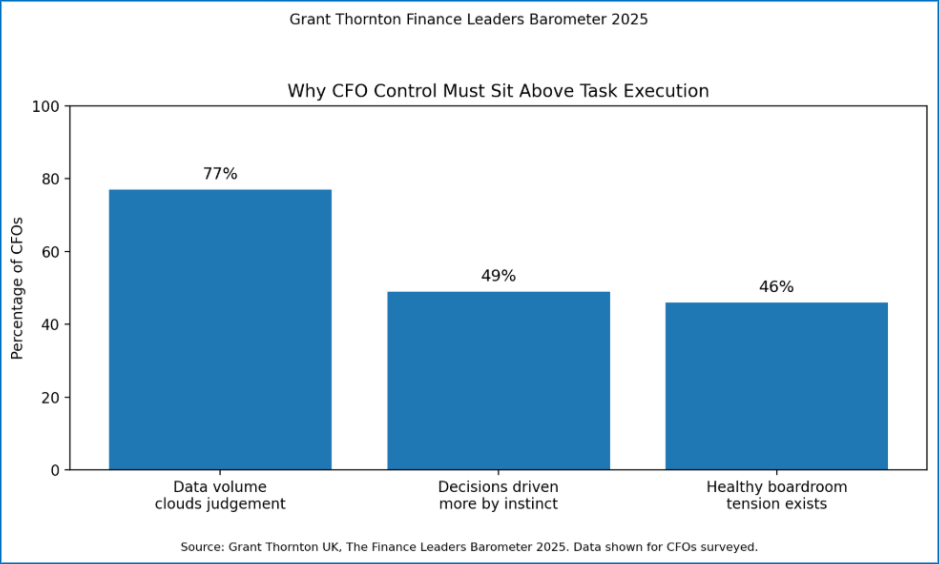
These figures show why control cannot be reduced to task completion. If finance leaders are already dealing with data noise, instinct-led decisions, and limited challenge at the top table, then moving work to an external partner without a retained judgement model only adds another layer of opacity.
For finance and accounting outsourcing UK decisions, the practical takeaway is simple: outsource the production of finance work where it makes sense, but keep the authority to interpret, challenge, approve, and explain the numbers inside the organisation.
That is the real foundation of financial governance and controls. Not who touched the spreadsheet first. Not who processed the transaction. But whether the CFO can still ask the awkward question, get a clean answer, and defend the final decision when it matters.
Not sure what to ask before choosing an outsourcing partner? This blog breaks down the key questions worth considering.

For UK boards, this conversation has become more pressing because the governance expectation has changed. Under the FRC’s UK Corporate Governance Code 2024, boards are now expected to declare on the effectiveness of their material internal controls. That raises the bar quite a bit.
In practice, it means a finance outsourcing arrangement cannot be judged only by whether the provider met its service level agreements (SLAs). Timeliness and accuracy still matter, of course. But they only tell part of the story.
An SLA can confirm that a bank reconciliation was completed by month-end. It cannot tell you whether a high-risk reconciling item sat unresolved for three weeks, whether a near miss was escalated at the right time, or whether there is enough evidence to show the control actually worked. That is where many outsourced accounting & finance services start to look efficient on paper but feel less convincing under proper scrutiny.
So before any finance and accounting (F&A) outsourcing model is signed off, the business needs a control map that answers a few awkward but necessary questions:
That is usually the difference between a provider that is simply delivering finance work and a model that supports real financial governance and controls. For CFOs, the role is less about watching every transaction and more about making sure ownership, evidence, and escalation are properly stitched into the design.
When businesses outsource finance and accounting, the real control risk rarely sits in the routine work. Invoice processing, standard reconciliations, and query handling can usually be managed well enough. The trouble starts elsewhere. It starts in the items that do not move cleanly through the process and quietly pile up in the background.
That is why the exception queue deserves more attention than it usually gets.
Think about the issues that tend to sit there a little too long:
On paper, none of these looks dramatic on day one. Leave them unattended, though, and they begin to chip away at finance process transparency, reporting accuracy and oversight, and ultimately finance operations risk management.
That is what makes the Tipalti data worth paying attention to. Its 2025 UK Finance Report found that 47% of UK companies still rely on mostly or entirely manual AP workflows, while only 6% have fully automated AP operations. It also found that 70% of finance professionals believe this lack of automation could limit their company’s ability to scale or grow. The point is not just that manual work is slower. It is that manual work tends to bury exceptions until they show up as control issues later on.
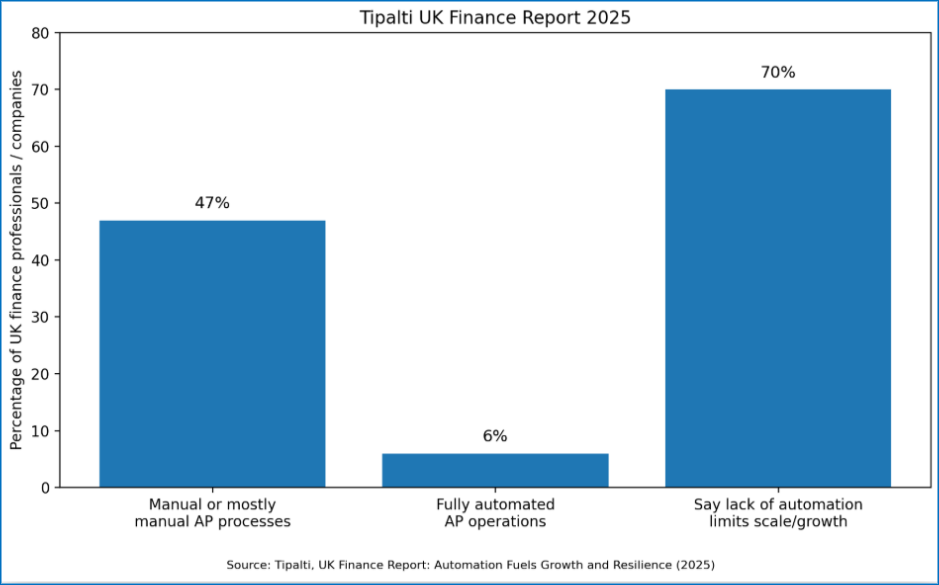
For any business looking at finance and accounting outsourcing UK decisions, that is a useful shift in perspective. The question is not only whether the provider can process volume. It is whether the model helps the business spot, age, escalate, and clear exceptions before they distort the numbers or create avoidable risk.
Payment control becomes more sensitive when finance work is split across internal teams, external providers, banks, and approval systems. The issue is not whether the outsourced team is reliable. That is table stakes. The real issue is whether the payment process still removes single-person dependency at the moments where money, master data, and judgement meet.
This matters because payment fraud is not easing into the background. A UK Parliament Commons Library Research Briefing published in March 2026 states that criminals stole £1.17 billion through banking fraud and scams in 2024, of which £722 million was unauthorised and £451 million was authorised. The same briefing also notes that authorised fraud involves a victim being tricked into paying money into an account controlled by a criminal.
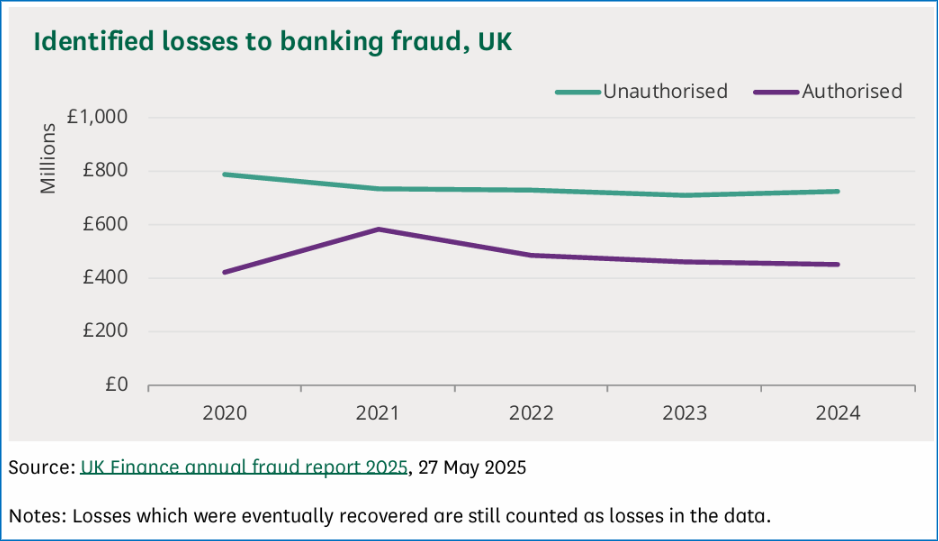
For CFOs, that distinction is important. A fraudulent payment is not always caused by someone breaking into a system. Sometimes, the process itself allows a perfectly authorised payment to be made to the wrong place.
Also Read: Best finance and accounting services companies in UK – 10 Key Questions to Ask
That is why AP outsourcing needs stronger controls around supplier master data, bank detail changes, and payment release. Before moving AP into a finance process outsourcing (FPO) model, the business should tighten:
This is where financial governance and controls need to be more practical than theoretical. In outsourced AP, the question is not, “Do we trust the provider?” It is, “Have we designed the process so that no single person, inbox, or approval point can quietly carry too much risk?”
See how a PBSA business improved finance efficiency and reduced costs through a more structured F&A outsourcing model.
A provider can prepare the numbers. It can reconcile balances, support month-end, clean up reports, and help with management accounts. But the story behind those numbers still needs to come from inside the business.
That story is where the CFO’s judgement sits. Why is margin moving? Is cash pressure temporary or structural? Which assumptions are starting to look a bit shaky? What should the board worry about now, not three months later?
This is becoming more important as CFOs move beyond historical reporting. Grant Thornton’s Finance Leaders Barometer 2025 found that finance leaders’ top priorities include understanding AI risks and opportunities, improving forecasting, and improving reporting and analytics. It also found that 77% of CFOs intend to invest more time and resource in enhancing forecasting and scenario analysis over the next 12 months.
That says quite a lot. The CFO is no longer just expected to explain what happened. They are expected to help the board see what might happen next.
Strong F&A outsourcing services can improve reporting speed, consistency, and finance process transparency. But the final interpretation should stay close to leadership.
Here is the slightly uncomfortable truth: keeping finance in-house does not automatically mean the business has better control.
Sometimes, it simply means the control sits in someone’s head.
A senior AP lead knows which supplier always sends invoices with the wrong PO format. The management accountant knows which accruals need a second look every quarter. The credit controller knows which customers usually dispute before paying. Useful knowledge, yes, but if it is not documented, it is not really a control. It is dependency.
That matters because ACCA’s Global Talent Trends 2025 found that 62% of accountancy and finance professionals expect to move roles within two years, while 58% expect their next career move to be outside their current organisation. For CFOs, that is not just a retention issue. It is a control issue.
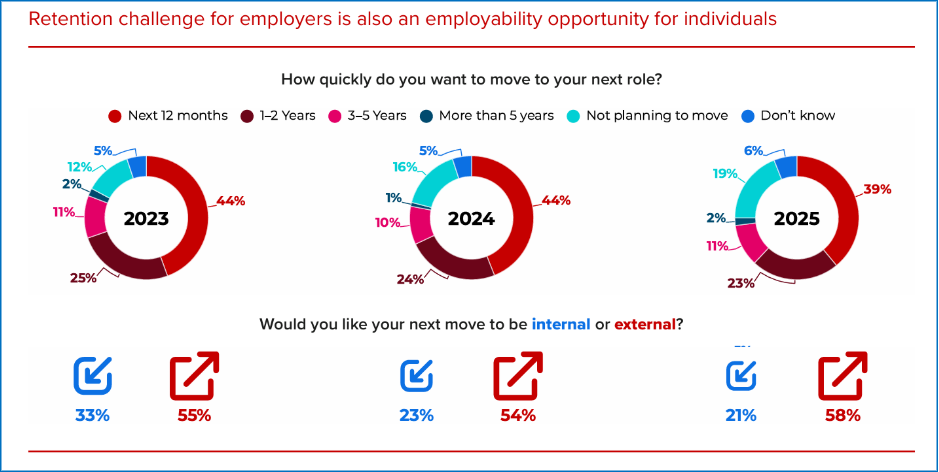
So, before any F&A outsourcing services transition begins, the business should ask a more pointed question:
If this person left tomorrow, what part of our finance process would become guesswork?

That is where finance process outsourcing (FPO) can be more than a handover. Done properly, it forces the business to write down the logic behind the work, not just move the work somewhere else.
The real opportunity is not simply to move tasks to an external team. It is to turn informal knowledge into a repeatable control model. In that sense, outsourcing can reduce key-person risk, but only when the transition captures the judgement, habits, and exceptions that usually live between the lines.
Most outsourced finance models come with a monthly review call. The deck is prepared, the red-amber-green statuses are discussed, and everyone agrees to “keep an eye on” the same issues next month.
That may be fine for contract management. It is not enough for control.
For CFOs, the better question is: can we see control getting weaker before it becomes a board-level issue?
That is where a control cockpit becomes useful. It should not be another dashboard full of vanity metrics. It should show the small movements that usually sit beneath the surface: old reconciliations, access changes, aged exceptions, payment approvals waiting too long, supplier master data changes, and control failures that were closed without a clear root cause.
This matters even more because outsourced finance governance is no longer just about process. It also has to include access, data, and cyber visibility. The UK Government’s Cyber Security Breaches Survey 2025/2026 found that 43% of businesses experienced a cyber breach or attack in the last 12 months, rising to 65% for medium businesses and 69% for large businesses.
Phishing also remained the most common breach type, experienced by 38% of businesses and described as the most disruptive breach type by 69% of organisations that experienced a breach or attack.
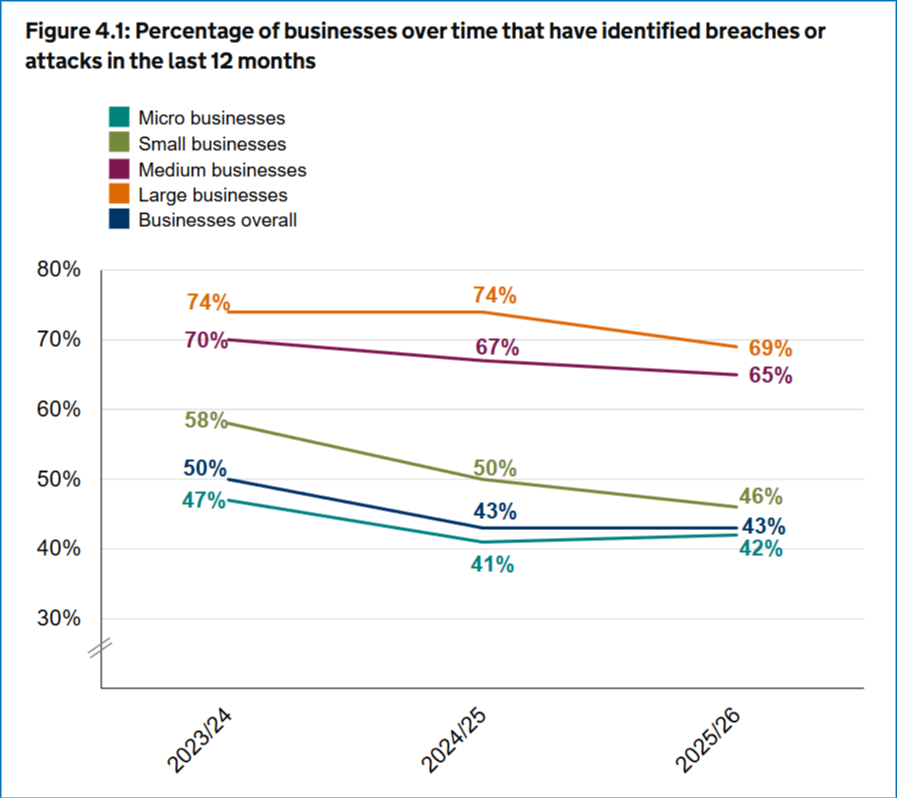
That gives finance and accounting (F&A) outsourcing a slightly different risk profile. When external teams access finance systems, supplier records, payment workflows, and reporting files, the CFO needs visibility that goes beyond whether the work was completed on time.
For finance outsourcing without losing control, this is the level of visibility that matters. A monthly call can explain what happened. A control cockpit helps the CFO spot what is beginning to slip.
The best outsourcing model does not ask the CFO to loosen their grip on control. It asks them to be far more precise about where control actually needs to sit.
That is the difference between moving work out and losing visibility. One is an operating model decision. The other is a governance failure waiting to happen.
For CFOs, the real measure is not whether finance becomes cheaper or faster, although both matter. The better test is this:
That is where outsourcing becomes more than a capacity fix. It becomes a chance to rebuild finance around cleaner ownership, stronger evidence, and sharper risk signals.
The future of finance control will not be decided by how much work stays in-house. It will be decided by how clearly CFOs define the decisions, risks, approvals, and evidence trails that must never drift away from the business.
Organisations can ensure continuous oversight by tracking real-time finance dashboards, exception queues, reconciliation ageing, approval delays, and control failures. Regular governance reviews should focus not only on task completion, but also on risk signals, evidence trails, and unresolved issues within outsourced finance processes.
Essential governance structures include clear ownership of controls, defined approval rights, segregation of duties, escalation routes, audit trails, and regular performance reviews. CFOs should also map which finance decisions remain internal and which activities can be handled by the outsourcing provider.
Service level agreements (SLAs) improve accountability by defining expected timelines, accuracy levels, reporting standards, and issue resolution responsibilities. However, SLAs should be supported by control reviews, because timely task completion does not always prove that financial governance and controls are working effectively.
CFOs should monitor risks such as weak approval controls, delayed reconciliations, unresolved exceptions, supplier master data changes, payment fraud, reporting errors, access rights issues, and over-dependence on individuals. These risks can affect finance process transparency, reporting accuracy, and overall financial control.
Internal audit helps assess whether outsourced finance functions are operating within agreed controls, policies, and governance standards. It reviews evidence trails, tests control effectiveness, identifies weaknesses, and ensures that outsourcing does not reduce visibility, accountability, or financial oversight.

Education:

Nishant Kumar is a senior commercial leader with 20+ years of experience supporting hospitality and accommodation businesses through technology-enabled outsourcing and operational transformation. At QX Global Group, he works with property owners, asset managers, and hospitality leaders across the UK and Europe to improve profitability, modernise back-office operations, and build scalable operating models. His expertise spans finance and accounting, payroll, and digital enablement for multi-property and franchise-led hospitality organisations, with a strong focus on cost optimisation, standardisation, and automation-led efficiencies.
Expertise: Hospitality and accommodation outsourcing, Multi-entity finance transformation, Shared services and global delivery models, Automation-led cost optimisation, Strategic commercial advisory
Originally published Apr 30, 2026 02:04:02, updated May 01 2026
Topics: Finance & Accounting Outsourcing, Finance and Accounting Transformation
15 Sep 2026
Every compliance obligation a finance team meets requires data. Be it tax filings, statutory reporti...
Read More14 Sep 2026
A control failure doesn’t announce itself. It hides in the one routine a single trusted person own...
Read More11 Sep 2026
Picture a 90-unit association collecting around $290 a month per home. The books live in a spreadshe...
Read More10 Sep 2026
Late March 2026. Boardrooms across UK hospitality did the same sum. Days before 1 April, the n...
Read More