Topics: Accounts Payable Optimisation, Accounts Receivable Process, Finance & Accounting Outsourcing
Posted on August 04, 2026
Written By Rushabh Shah




For CFOs, the decision to outsource accounts receivable is rarely just about collections capacity. It is about protecting cash flow without damaging customer relationships.
That balance matters. AR is one of the few finance functions that directly touches the customer. A poorly managed transition can create confusion around invoices, payment instructions, dispute ownership, escalation paths, and account history. Customers may suddenly hear from new contacts, receive unfamiliar email formats, or get follow-ups that do not reflect prior conversations.
The risk is not simply operational disruption. It is relationship friction.
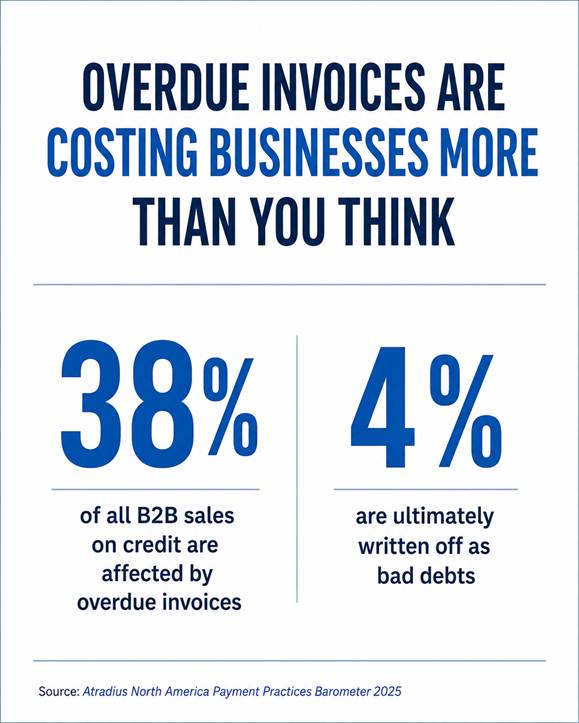
At the same time, the pressure to improve AR performance is real. Atradius’ 2025 North America payment practices research found that overdue invoices affect 38% of B2B credit sales, while 4% are ultimately written off as bad debts. In the U.S., Atradius reported that overdue invoices affect 43% of credit-based B2B sales. For CFOs, that turns AR into a working capital priority, not just a back-office process.
The real question is not whether accounts receivable outsourcing services can improve efficiency. The question is how to manage the outsourced AR transition without weakening customer trust.
Unlike many finance operations, AR sits close to the customer experience. Collections emails, dispute follow-ups, payment reminders, account statements, and escalation calls all influence how customers perceive the business.
That is why AR process outsourcing cannot be treated as a simple handover of tasks. It is a transition of responsibility, tone, process knowledge, and customer context.
A successful transition protects three things:
If any of these break down, the business may see short-term collections activity increase while customer satisfaction declines. That is not a sustainable outcome.
A strong transition should feel seamless to customers. The outreach should be professional, informed, and consistent with how the company already manages its customer relationships.
Before moving work to an external partner, finance leaders need a complete view of the current AR operating model.
This includes more than aging reports and invoice volumes. It requires a detailed understanding of how the order to cash (O2C) process actually works across teams, systems, and customer segments.
The transition map should cover:
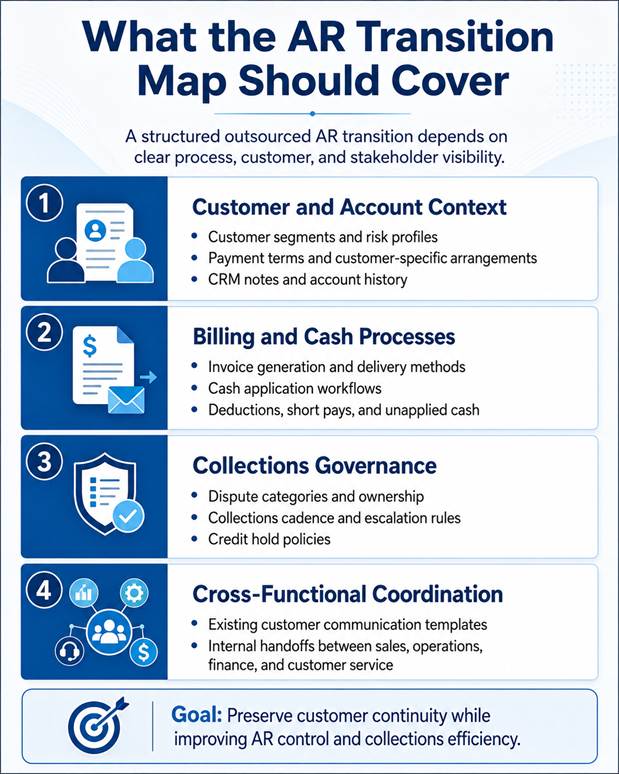
This mapping is critical because many accounts receivables problems do not sit in collections alone. They often begin earlier in the O2C cycle, such as inaccurate billing, missing purchase orders, contract mismatches, unclear payment terms, or slow dispute resolution.
Without this baseline, outsourcing may improve follow-up activity but fail to address the root causes of delayed collections.
The biggest mistake businesses make during an outsourced accounts receivable transition is underestimating the customer communication layer.
Customers do not need to know every internal process change. But they do need consistency in how they are contacted, what information they receive, and where they can go for support.
Customer communication continuity should be planned before the transition goes live. This includes:
The language used in collections matters. A customer with a genuine invoice dispute should not receive the same message as a customer who repeatedly delays payment without explanation. A strategic account should not feel like it has been moved into a generic collections queue.
This is where customer experience in collections becomes important. The objective is not to make collections soft. It is to make them structured, professional, and context-aware.
A smooth collections process transition depends on internal alignment as much as external execution.
Finance, sales, operations, customer success, legal, and the outsourced AR partner must agree on how customer-facing issues will be handled. Without that alignment, customers may receive conflicting messages from different teams.
For CFOs, this is where stakeholder alignment in AR becomes a control priority.
Before transition, the business should clarify:
This clarity prevents a common issue: the outsourced AR team follows the process, while internal teams continue to operate through informal exceptions. That weakens collections discipline and confuses customers.
The best transitions establish one operating rhythm before work is moved. Everyone should know what changes, what stays the same, and how exceptions will be managed.
AR teams need more than invoice numbers. They need customer context.
A customer may have a long-running pricing dispute. Another may always pay after a specific internal approval cycle. A third may require invoices to be uploaded through a portal before payment can be released. Some customers may have negotiated terms that are not obvious from the aging report alone.
If this context is not transferred properly, the outsourced team may follow up in ways that feel disconnected or uninformed.
That is why customer relationship management (CRM) data and account history should be part of the transition plan. This may include contact preferences, billing instructions, dispute history, collection notes, promise-to-pay records, escalation history, and account manager input.
For high-value or sensitive accounts, businesses should create customer handling notes before transition. This helps the outsourced AR team maintain continuity and reduces the risk of avoidable friction.
RELATED BLOG: Can Outsourcing AR Improve Customer Relationships Instead of Damaging Them?
Outsourcing should not mean moving a broken process to a new team.
If invoices are often inaccurate, disputes are poorly categorized, customer master data is outdated, or cash application is slow, the outsourced team will inherit the same friction. The result may be more activity, but not necessarily better outcomes.
A stronger approach is to use the transition as a process redesign opportunity.
Finance leaders should assess:
This is where order to cash outsourcing can deliver more value than basic collections support. The right partner should help improve the flow from invoicing to cash application, not just chase overdue balances.
A phased transition reduces risk and helps protect customer relationships.
Instead of moving the entire AR portfolio at once, many businesses begin with a pilot group. This may include a specific region, customer segment, business unit, or invoice category. The pilot helps test workflows, communication templates, reporting, escalation rules, and service quality before scaling.
A practical phased transition may look like this:
This approach gives leadership more control. It also allows the outsourced team to learn customer behavior before taking on the full portfolio.
Also Read: Top Accounts Receivable Outsourcing Companies in USA – What Finance Leaders Should Know?
The success of an AR transition should not be measured only by cash collected.
Collections improvement matters, but so does customer experience, dispute quality, and internal confidence. A transition that improves DSO but creates customer complaints, sales friction, or poor dispute handling may create longer-term damage.
CFOs should track a balanced set of KPIs, including:
This creates a more complete view of collections and cash flow optimization. It ensures the outsourced team is not only improving cash performance, but also supporting the company’s customer relationship standards.
For businesses moving to outsourced accounts receivable, the transition model matters as much as the delivery model.
QX Global Group supports organizations across AR, O2C, credit control, billing, cash application, reconciliations, reporting, and collections support. The focus is not simply to add offshore capacity, but to help clients build a more structured, scalable, and customer-aware AR function.
QX teams work as an extension of the client’s finance team, helping maintain continuity across communication, reporting, workflows, and customer handling. With trained finance professionals, AI-led workflows, and process governance, QX helps businesses improve collections discipline while protecting customer experience.
This can support finance leaders in areas such as:
Book a consultation now to know more!
The decision to outsource accounts receivable should not feel like handing customers over to a third party. Done well, it should feel like strengthening the finance function behind the scenes while maintaining a consistent, professional customer experience.
That requires more than a transition checklist. It requires process clarity, stakeholder alignment, customer communication continuity, clean account data, phased implementation, and disciplined KPI governance.
The businesses that get this right do not treat AR outsourcing as a cost-cutting exercise alone. They use it to create a more resilient accounts receivable (AR) management model, one that improves cash visibility, reduces collections friction, and protects customer relationships at the same time.
For CFOs, that is the real measure of success: faster cash conversion without relationship disruption.
Common risks include missed account context, unclear dispute ownership, inconsistent customer communication, delayed cash application, and confusion around escalation paths. If the outsourced AR transition is not structured well, teams may improve collections activity but create friction in the wider order to cash process.
Disputes often increase when the outsourced team does not have full visibility into customer history, billing rules, payment terms, or prior conversations. Without strong knowledge transfer and CRM context, customers may receive follow-ups that do not reflect their account situation, leading to avoidable pushback.
Organizations should track DSO, overdue receivables, collections effectiveness, dispute resolution time, unapplied cash, promise-to-pay adherence, customer response times, escalation volume, and customer complaints linked to collections. These KPIs help measure both cash performance and customer experience in collections.
Stakeholder alignment ensures finance, sales, operations, customer service, and the outsourced AR team follow the same rules for customer communication, dispute handling, escalations, and credit control. Without alignment, customers may receive mixed messages, and collections discipline can weaken.
Governance should include clear ownership, documented workflows, escalation rules, communication standards, reporting cadence, KPI reviews, and issue-resolution protocols. Weekly transition reviews are useful in the early stages to monitor risks, refine processes, and protect customer communication continuity.
QX Global Group helps businesses outsource accounts receivable with structured transition planning, trained AR teams, documented workflows, customer-specific communication handling, reporting support, and AI-led process improvement. QX works as an extension of the client’s finance team, helping improve collections efficiency while preserving customer relationships.

Education:
CA, B.Com

Rushabh Shah is a Chartered Accountant with over 7 years of experience in audits, financial analysis, and process optimisation. At QX, he specialises in CAPEX reviews, treasury management, P2P processes, and tax and statutory compliance. With a strong foundation in financial reporting, Rushabh brings cross-sector expertise and a sharp analytical approach to managing complex finance operations.
Expertise: CAPEX Reviews, Treasury Management, P2P Processes, Tax & Statutory Compliance, Financial Reporting, Audit & Financial Analysis
Originally published Aug 04, 2026 05:08:53, updated Aug 14 2026
Topics: Accounts Payable Optimisation, Accounts Receivable Process, Finance & Accounting Outsourcing
15 Sep 2026
Every compliance obligation a finance team meets requires data. Be it tax filings, statutory reporti...
Read More14 Sep 2026
A control failure doesn’t announce itself. It hides in the one routine a single trusted person own...
Read More11 Sep 2026
Picture a 90-unit association collecting around $290 a month per home. The books live in a spreadshe...
Read More10 Sep 2026
Late March 2026. Boardrooms across UK hospitality did the same sum. Days before 1 April, the n...
Read More