Topics: Finance & Accounting Outsourcing, Process optimisation
Posted on September 14, 2026
Written By Rushabh Shah




A control failure doesn’t announce itself. It hides in the one routine a single trusted person owns from beginning to end. They set up the vendor, approve the invoice, cut the check, and reconcile the account. Nothing in the books looks wrong, right up until the day it does.
When a huge gap is finally caught, the instinct is to add a reviewer, a sign-off, and a policy. More oversight, layered on top of the same process. Will it really work? Was the problem oversight? Or something else?
Most internal control failures come down to how the work is organized. It matters because it points to a different kind of fix. Finance and accounting business process outsourcing, done well, does not add another layer of checking or oversight. It rebuilds the structure so the checks are built in.
This piece looks at why controls really break, and how outsourcing rebuilds the structure that lets them hold.
The reasons controls fail are remarkably consistent from one company to the next, and they have little to do with anyone’s intentions. Three patterns account for most of it.
The first is concentration. When the same person initiates a transaction, approves it, and records it, there is no independent check anywhere in the chain. This is the segregation-of-duties gap, and it is one of the most common structural weaknesses in finance. It takes no bad intent to cause real damage. It takes only a mistake that no one else is positioned to catch.
The second is inconsistency. A process that lives in one person’s head, rather than in a documented workflow, works only when that person is at their desk and paying close attention. Vacations, turnover, and the pressure of a close deadline are enough to open a gap. A control that operates only under ideal conditions is not much of a control.
The third is limited visibility. In many finance functions, leadership learns that something went wrong at quarter-end, or worse, during the audit. By then the window to prevent it has already closed. A control you cannot watch operating in real time is one you are trusting in faith.
This is why more oversight solves so little. Adding a reviewer to a concentrated process just adds a step, not a safeguard, because that reviewer is usually checking the same person’s work with the same limited information.
The answer is not another set of eyes on a broken process. It is a process designed so the checks are structural. Each of these failures has the same shape, a process built around people instead of controls, and that is exactly what an outsourcing partner is built to rebuild.
RELATED BLOG: Strong controls depend on visibility, ownership, and governance. See how businesses outsource F&A services without losing financial control.
A capable finance and accounting BPO partner strengthens controls in four ways, and each one answers a specific failure named above.
When a provider takes on a process, initiation, approval, and recording are split across different people, and often different systems, by design. No single individual owns a transaction end to end. This breaks the concentration sitting behind most control failures, and it does so through an operating model where combining those duties is not possible in the first place, rather than a policy that gets waived the moment a deadline looms.
A provider runs the same documented workflow every cycle, with defined checkpoints and hand-offs that do not depend on any one person’s memory. This consistency is a control in its own right.
It is also exactly what an auditor wants to see: evidence that a control operates as designed, every period, not only when the right person happens to be in the office. The month-end close stops being a scramble that shifts with who is available and becomes a repeatable sequence with clear sign-offs.
Standardized work produces standardized data, and that changes what leadership can actually see. Live dashboards, exception reports, and a complete audit trail replace the quarter-end surprise.
The shift is quiet but significant. Leaders watch the control operating, instead of inspecting its output long after the fact. Audit preparation stops being an annual fire drill and becomes a byproduct of how the work already runs, so when auditors ask for evidence, it already exists.
There is one more benefit that is easy to overlook. A third party has no internal relationships to protect and no reason to wave a questionable transaction through to keep a colleague happy or a deadline intact. Independence is not a courtesy layered on top of the process. It is a control in its own right, and nearly impossible to replicate.
Together, these four move a control environment from a personal promise to a structural guarantee. The gains are not spread evenly, though. Some processes stand to gain far more than others.
The processes that benefit most are the high-volume, rule-based ones where a single person often carries too much of the workflow today. These also happen to be where most financial loss originates. Here’s a table that shows where the control risk sits in-house, and what an outsourcing model changes.
| Process | Control risk run thin in-house | What an F&A BPO model changes |
| Accounts payable | One person sets up vendors, approves, and pays | Vendor setup, approval, and payment split across roles |
| Accounts receivable | Billing, collections, and cash application in one hand | Independent cash application and a clear audit trail |
| Payroll | Thin review of changes and off-cycle runs | Segregated change approval and exception reporting |
| Month-end close | Person-dependent, undocumented, deadline-driven | A documented close checklist with defined sign-offs |
| Reconciliations | The preparer also reviews and approves | An independent preparer-and-reviewer split on every account |
A well-run model closes these gaps by design. The control gains are only ever as strong as the partner’s own control environment, though, which is why the choice of partner deserves real scrutiny.
Outsourcing can strengthen a control environment, or it can quietly move a risk from your books onto someone else’s. The difference sits entirely in the partner you choose. Five checks separate the two.
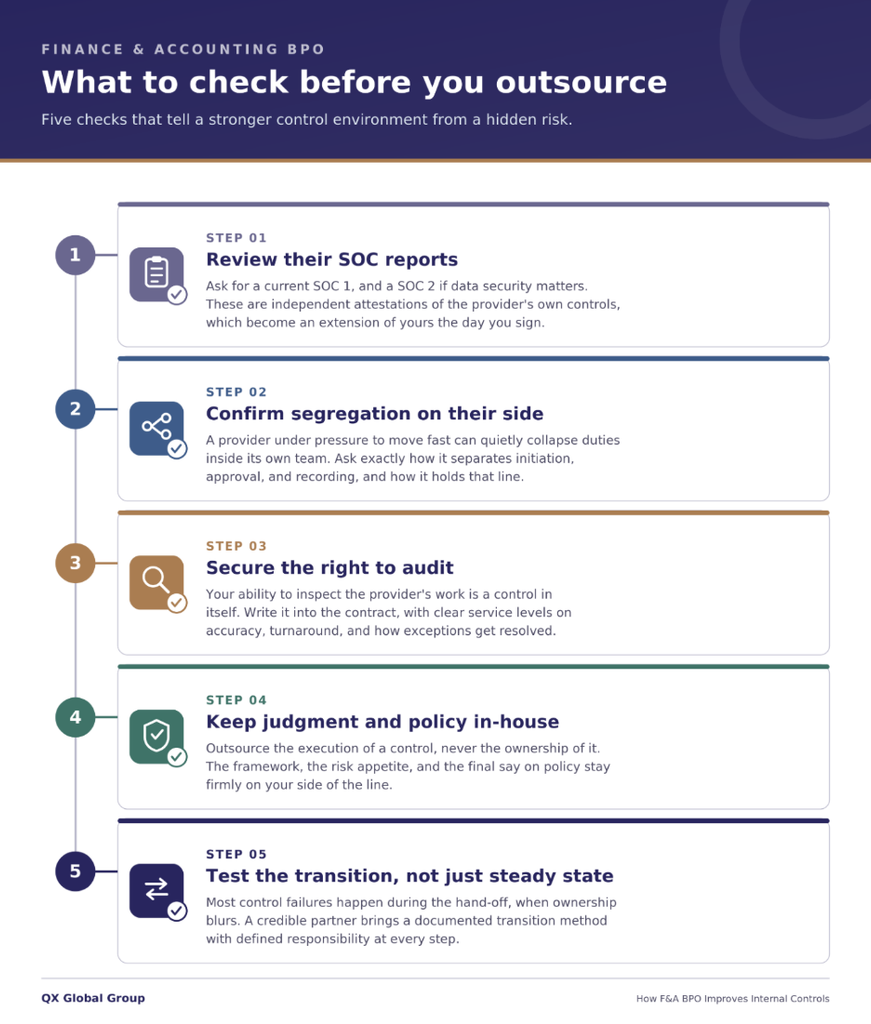
Ask for a current SOC 1, and a SOC 2 if data security matters to your business. These are independent attestations of the provider’s own control environment, which becomes an extension of yours the moment you sign.
A provider under pressure to move fast can quietly collapse duties within its own team, recreating the exact risk you set out to remove. Ask specifically how it separates initiation, approval, and recording, and how it enforces that split day to day.
Your ability to inspect the provider’s work is a control in itself. Build it into the contract, along with clear service levels on accuracy, turnaround time, and how exceptions get flagged and resolved. You can hold them accountable only when you can measure.
Outsource the execution of a control, never the ownership of it. The framework, the risk appetite, and the final say on policy should stay firmly on your side of the line. A good partner runs the process; it does not set the rules for it.
Most control failures in outsourcing happen during the hand-off, when responsibilities are ambiguous. A credible partner brings a documented transition method with defined ownership at every step, not a promise that things will settle down once everyone finds their footing.
The right partner turns each of these from a negotiation into a given. This is where QX comes in.
RELATED CASE STUDY: See how QX helped a global real estate operator move from siloed finance processes to a documented, standardized operating model.
QX Global Group provides F&A outsourcing for US businesses, run on standardized, documented processes with segregation of duties built into the operating model rather than added after the fact.
What sets QX Global apart is its operating model on top of the long list of services it provides. QX acts as a controlled center of excellence, replacing siloed, person-dependent ways of working with one documented model, clear ownership, defined sign-offs, and governance backed by SOC-reported controls.
This center-of-excellence (CoE) model is designed to keep improving the finance operation after transition. Standard ways of working, specialist teams, and visible performance measures create a foundation that can scale across business units without weakening control or forcing each location to reinvent the process.
The model has delivered measurable impact in practice. For a global real estate operator, QX helped centralize and standardize finance operations while unlocking over $2 million in annual savings through offshore delivery. The result is not simply lower-cost execution, but a more consistent finance operating model with stronger control and room to scale.
Internal controls usually fail because of how the work is organized. It is concentrated in too few hands, inconsistent from one cycle to the next, and hard to see until it is too late. No amount of additional sign-off changes that.
Finance and accounting business process outsourcing works because it addresses the structure directly. It separates duties, standardizes the process, and puts the whole thing in view. QX Global Group provides F&A outsourcing for US businesses, run on standardized, and fully documented processes.
Also check: Finance & Accounting Services Companies in USA – A C-Suite Buyer’s Playbook
Ready to build internal controls that hold? Talk to QX Global Group about finance and accounting business process outsourcing for your business.
A provider splits initiation, approval, and recording across different people and systems by design, so no one owns a transaction end to end. That breaks the concentration behind most control failures structurally, rather than relying on a policy that can be waived under pressure.
High-volume, rule-based processes gain the most: accounts payable, accounts receivable, payroll, month-end close, and reconciliations. These are where duties are most often concentrated in-house, and where a documented, segregated model closes the biggest control gaps.
A documented workflow runs the same way every cycle, with defined checkpoints that do not depend on one person being at their desk. That consistency removes the person-dependent gaps that open under turnover or deadline pressure, and it gives auditors evidence a control operates as designed.
Yes. Standardized work produces a complete audit trail and real-time exception reporting, so evidence exists before anyone asks for it. Audit preparation becomes a byproduct of how the work already runs, rather than an annual scramble to reconstruct what happened.
The main risk is moving a control gap rather than closing it. Guard against it by reviewing the provider’s SOC reports, confirming segregation within their team, securing a right to audit, and keeping policy and judgment in-house.
Start with a current SOC 1 report, and a SOC 2 where data security matters. Then confirm how the provider segregates duties internally, its transition method, and its service levels on accuracy and exception handling. Their controls become an extension of yours.
QX Global Group operates as a controlled center of excellence, reengineering siloed, person-dependent workflows into one documented model with defined sign-offs and an audit trail, backed by SOC-reported controls. It rebuilds the process so the controls are structural, not bolted on.

Education:
CA, B.Com

Rushabh Shah is a Chartered Accountant with over 7 years of experience in audits, financial analysis, and process optimisation. At QX, he specialises in CAPEX reviews, treasury management, P2P processes, and tax and statutory compliance. With a strong foundation in financial reporting, Rushabh brings cross-sector expertise and a sharp analytical approach to managing complex finance operations.
Expertise: CAPEX Reviews, Treasury Management, P2P Processes, Tax & Statutory Compliance, Financial Reporting, Audit & Financial Analysis
Originally published Sep 14, 2026 04:09:42, updated Sep 15 2026
Topics: Finance & Accounting Outsourcing, Process optimisation
15 Sep 2026
Every compliance obligation a finance team meets requires data. Be it tax filings, statutory reporti...
Read More11 Sep 2026
Picture a 90-unit association collecting around $290 a month per home. The books live in a spreadshe...
Read More09 Sep 2026
In July 2026, one of Britain’s biggest housebuilders had a rough morning. Vistry Group warned ...
Read More09 Sep 2026
A business can post record sales and still feel the squeeze. Orders are strong, revenue looks health...
Read More