Topics: Finance & Accounting Outsourcing, Finance and Accounting Transformation
Posted on April 19, 2026
Written By Rajen Sachaniya




Many businesses choose to outsource finance and accounting services for the right reasons. They want lower operating cost, better process coverage, more flexibility, and a finance team that can spend less time on routine execution.
But the value does not come from outsourcing alone. It comes from how well the model is set up.
That is where many businesses get caught out. SLAs look fine on paper but leave too much open to interpretation. Transition plans focus on speed instead of process stability. Governance gets discussed at kickoff and then fades into the background. By the time issues show up, the problem is no longer outsourcing itself. It is the lack of structure around it.
That is what makes finance and accounting outsourcing risks worth taking seriously. Most outsourcing failures come from small gaps in transition, control, visibility, and accountability that build up over time. Outsourcing finance and accounting services can absolutely improve efficiency. But only when the model is designed with enough discipline to protect continuity, control, and performance from the start.
Finance and accounting (F&A) outsourcing means handing over selected finance processes to an external partner. That can include accounts payable, accounts receivable, reconciliations, reporting support, record-to-report, and other routine finance activities. In most cases, the goal is not to step away from finance operations but to run them more efficiently.
Businesses usually outsource finance and accounting services to solve one or more of the following problems:
Those are all valid reasons. But they only translate into value when the outsourcing model is properly controlled.
Once finance activity moves outside the business, the work may be delivered externally, but the accountability does not move with it. The business still owns reporting quality, process continuity, compliance, and financial control.
That is why outsourcing finance and accounting services cannot be managed like a basic vendor arrangement. It needs clear ownership, strong SLA management in outsourcing, proper finance process transition planning, and ongoing finance operations governance. Without that, the relationship may still function. It just won’t perform as reliably as it should.
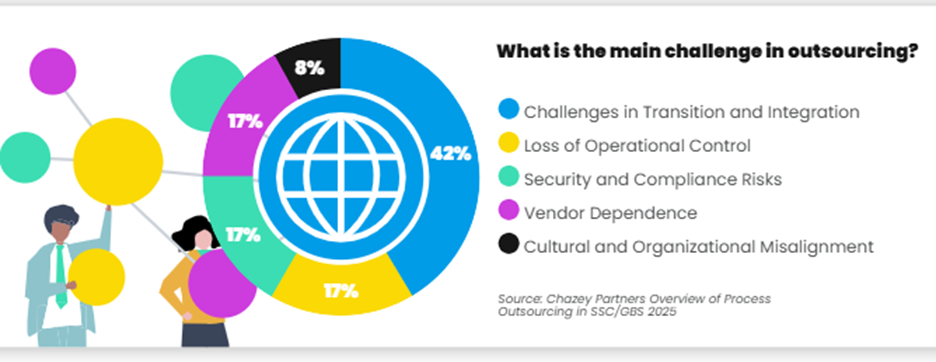
Most finance and accounting outsourcing risks do not begin with a major breakdown. They begin with smaller gaps that were never properly defined at the start.
This is one of the most common failure points. The scope may look clear enough on paper, but once work begins, basic questions start surfacing. What counts as on-time? Who owns exceptions? What sits with the provider and what stays internal?
Without strong SLA management in outsourcing, performance becomes harder to measure and accountability starts to blur.
A weak transition can create problems before the outsourcing model has even settled. If knowledge transfer is incomplete, process maps are patchy, or dependencies are not fully documented, disruption shows up quickly in day-to-day delivery. That is why finance process transition planning matters so much. A rushed handover usually creates more strain than it removes.
Once work moves outside the business, visibility often drops. The process may still be running, but it becomes harder to see where delays are building, where quality is slipping, or where dependencies are becoming risky.
Outsourcing should improve resilience, not create a new dependency. If too much process knowledge or execution control sits with the provider alone, the business loses flexibility. Strong F&A outsourcing risk management depends on balance. Delivery may sit outside, but oversight cannot.
Some outsourcing models do not fail operationally. They fail more quietly by delivering activity without supporting the wider finance agenda. If the model is built around cost alone while the business needs stronger controls, better reporting, or more flexibility, the value will always be limited.
When businesses outsource finance and accounting services, they are also extending access to sensitive financial data, systems, and workflows. That changes the risk profile immediately.
Finance data is too sensitive for loose controls. Vendor records, bank details, payroll inputs, receivables data, and management reports all require disciplined handling. If access rules are weak or security expectations are vague, the outsourcing model starts carrying unnecessary exposure.
The risk is not only external. It can also come from poor user provisioning, unnecessary access, weak segregation, or insecure file handling across teams and systems. That is why data protection cannot sit as a generic contract clause. It has to show up in actual controls.
Access is often underestimated in outsourced environments. Who gets access, who approves it, and how often it is reviewed all matter. If those controls are loose, the process may still run, but the risk keeps building in the background.
Finance outsourcing often spans multiple systems, approval layers, shared files, and reporting tools. The more fragmented the setup, the more important data governance becomes. Without tight control, financial information becomes harder to monitor and protect.
Legal and compliance risk often stays out of sight until something goes wrong. When it does, it becomes expensive very quickly.
If outsourced finance work touches regulated reporting, tax handling, payroll support, or customer-related financial data, the compliance burden still remains with the business. Outsourcing changes delivery but does not remove accountability.
This risk shows up when execution and review are not clearly separated. Delayed reconciliations, incomplete support files, weak approval trails, or poorly documented controls can all create pressure later during close or audit. In finance process outsourcing (FPO), reporting quality still has to hold to the same standard.
A weak contract rarely fails on day one. It fails when performance drops or the relationship becomes more demanding. If escalation paths, service levels, audit rights, or exit terms are not clearly defined, enforcement becomes harder when the business actually needs it.
One of the quieter risks in finance and accounting outsourcing services is process drift. Delivery may continue, but the work can slowly move out of line with internal accounting policy, approval rules, or reporting expectations. That is why governance cannot stop once the model goes live.
Not all outsourcing risks show up in controls or contracts. Some show up in how the model affects cost, team dynamics, and day-to-day execution.
Outsourcing may reduce delivery cost, but that does not mean the model is automatically efficient. If transition runs longer than expected, governance takes more internal effort, or rework starts building into the process, the commercial benefit can narrow quickly.
This is one of the more overlooked finance and accounting outsourcing risks. The model may look cost-effective at a headline level while the real operating burden sits elsewhere.
Outsourcing changes more than process ownership. It changes how internal teams work. Roles shift, review responsibilities increase, and in some cases, team confidence drops if the change is not handled well. That is why outsourcing needs to be positioned clearly. If internal teams are left uncertain about ownership, decision rights, or future scope, the transition becomes harder than it needs to be.
Even when the delivery model is technically sound, communication gaps can weaken it. Escalations may be delayed, priorities may be interpreted differently, and issues may take longer to resolve than they should. This is especially true when teams are working across locations, time zones, or different operating styles. Without a clear communication rhythm, small execution issues can start turning into avoidable friction.
A finance outsourcing model can be operationally right and still land badly if the organization is not prepared for the shift. If change management is too light, resistance builds in the background and adoption becomes uneven. That affects the quality of the model long after go-live.
Most outsourcing risks are manageable. The issue is not whether they exist. The issue is whether they are addressed early enough.
If service expectations are vague, performance becomes difficult to manage. SLAs need to be specific enough to measure what matters and clear enough to support accountability. This is the foundation of strong SLA management in outsourcing. Without it, the model becomes harder to control when issues start surfacing.
A stable outsourcing model starts with a stable handover. That means proper knowledge transfer, documented dependencies, clear ownership mapping, and enough time to test the process before full cutover.
Good finance process transition planning reduces disruption and gives the model a better chance of settling cleanly.
Outsourcing works better when governance is active, not symbolic. Regular reviews, issue tracking, escalation paths, and performance reporting all help keep delivery visible. Finance operations governance gives the business a way to stay close to performance without micromanaging execution.
Security and compliance should not sit in the background as assumptions. They need to be built into the model through access controls, approval structures, review routines, and documented responsibilities.
That is a core part of outsourcing risk mitigation strategies, especially where sensitive financial data is involved. Control frameworks for outsourced services consistently emphasize access discipline, monitoring, and clear accountability.
A lot of outsourcing friction builds when communication is too informal or too infrequent. Clear review rhythms help teams surface issues earlier, align priorities faster, and keep the model moving in the right direction. In practice, this is often what separates a functional outsourcing relationship from one that is actually reliable.
Also Read: Top Finance and Accounting Outsourcing Companies in USA — A C-Suite Buyer’s Playbook
Good outsourcing outcomes rarely come from cost alone. They come from how well the model is designed, governed, and aligned to the finance function it is meant to support.
The outsourcing structure should support the wider finance agenda, not just reduce execution cost. If the business needs better reporting discipline, stronger controls, or more scalable delivery, the model should be built around those outcomes.
Not every provider is equipped to support complex finance processes well. Experience matters, but so does delivery maturity, control discipline, and the ability to work inside structured governance.

The relationship becomes easier to manage when performance is visible. Clear KPIs, review dashboards, and defined reporting rhythms help surface issues earlier and reduce ambiguity around delivery quality.
Outsourcing should not freeze the finance process in place. As the business changes, the model should adapt with it. Review points, process refinement, and issue-led improvements help the relationship keep delivering value instead of becoming static.
The strongest finance process outsourcing (FPO) models do not trade control for speed. They build both into the structure. That balance is what allows the business to scale execution without losing visibility or discipline.
QX Global Group supports risk-managed finance and accounting (F&A) outsourcing through clear SLA frameworks, structured transition planning, strong governance, and disciplined execution across finance processes.
When outsourcing is set up with the right controls, it becomes a growth enabler rather than a risk point. Talk to QX’s F&A outsourcing experts to explore how a more structured outsourcing model can help reduce risk, strengthen control, and support more reliable finance operations.
The most common risks when businesses outsource finance and accounting services in the USA usually include unclear scope, weak service level agreements (SLAs), poor transition planning, reduced visibility into delivery, data security concerns, and compliance gaps. In many cases, the issue is not outsourcing itself. It is the lack of structure around governance, accountability, and control once finance processes move outside the business.
Unclear service level agreements (SLAs) make it harder to measure performance and assign accountability. If turnaround times, escalation paths, ownership boundaries, or quality expectations are loosely defined, the outsourcing model may keep running but performance issues become harder to challenge or fix. That is why strong SLA management in outsourcing is critical to reliable finance delivery.
Good finance process transition planning sets the foundation for a stable outsourcing model. It helps ensure that knowledge transfer is complete, dependencies are documented, ownership is clear, and the process can move without disrupting reporting or daily operations. In finance process outsourcing (FPO), a weak transition usually creates strain early and makes recovery harder later.
When companies use finance and accounting outsourcing services, they need to consider risks around financial reporting quality, audit readiness, data protection, tax handling, payroll support, and alignment with internal accounting policies. Outsourcing can change who performs the work, but it does not remove the company’s responsibility for compliance. That is why compliance controls need to stay tightly built into the model.
CFOs can reduce finance and accounting outsourcing risks by putting more structure around the model from the start. That means defining stronger SLAs, building a proper transition plan, maintaining regular review routines, setting clear ownership boundaries, and keeping visibility into outsourced finance activity. In practice, good F&A outsourcing risk management is less about reacting to issues and more about preventing them from building up in the first place.
Effective finance operations governance usually includes clear ownership, defined escalation paths, regular performance reviews, KPI tracking, control checks, compliance oversight, and structured reporting between the business and the provider. The goal is to make sure the outsourcing relationship stays visible, measurable, and aligned with the wider finance agenda. Without that framework, even well-run finance and accounting (F&A) outsourcing can start losing control over time.
For urgent finance backlogs, speed matters, but experience matters more. The right firms are usually those that can bring in people who have already worked through messy close cycles, reconciliation gaps, audit pressure, ERP issues, or acquisition clean-ups.
A strong partner should be able to help with:
The best providers are the ones that can step in quickly, understand the problem without weeks of explanation, and get finance operations back under control.

Education:
CMA, B.Com

Rajen Sachaniya is a CMA with over 16 years of experience in finance, accounting, FP&A, and commercial strategy. At QX, he plays a pivotal role in shaping financial direction through budgeting, policy design, and governance. His expertise spans treasury, taxation, legal, compliance, payroll, and multi-currency consolidation. Rajen is known for aligning cross-functional teams across operations, sales, recruitment, and support—ensuring strategic coherence and long-term business growth.
Expertise: Finance & Accounting, FP&A, Budgeting, Commercial Contracts, RFPs, Financial Governance, Cross-Functional Leadership
Originally published Apr 19, 2026 01:04:03, updated May 29 2026
Topics: Finance & Accounting Outsourcing, Finance and Accounting Transformation
15 Sep 2026
Every compliance obligation a finance team meets requires data. Be it tax filings, statutory reporti...
Read More14 Sep 2026
A control failure doesn’t announce itself. It hides in the one routine a single trusted person own...
Read More11 Sep 2026
Picture a 90-unit association collecting around $290 a month per home. The books live in a spreadshe...
Read More10 Sep 2026
Late March 2026. Boardrooms across UK hospitality did the same sum. Days before 1 April, the n...
Read More