Topics: Finance & Accounting Outsourcing, FP&A
Posted on November 26, 2026
Written By Visharad Saluja




Once a senior living asset is operating, the assumptions used to approve the investment meet actual occupancy, rates, labor, operating costs and capital spend. The difference between the two shows whether expected returns are delayed, diluted, or still on track.
NIC’s Q3 2026 data puts national senior housing occupancy at 90.4%, with individual markets ranging from 94.0% in Boston to 86.5% in Miami.
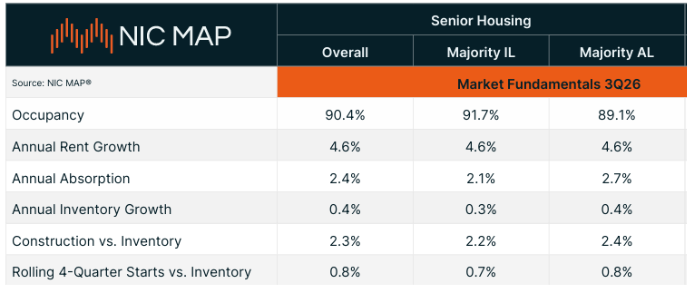
This spread reinforces the need to test each asset against its own operating evidence, not a national assumption.
Finance needs enough capacity to keep the original investment case connected to the latest forecast, explain which drivers moved and prepare scenarios management can act on. FP&A outsourcing can provide that analytical capacity while investment judgment and capital decisions remain with the internal team.
Investment models often become reference documents after close. The operating team shifts to the budget, then to monthly actuals, while the original occupancy ramp, rate assumptions, cost structure and capital case sit in a separate file. Management loses the cleanest view of whether the asset is performing as underwritten or simply meeting a revised budget.
Keep the investment case alive by mapping its drivers to the operating chart of accounts and property KPIs. The bridge does not require every underwriting line to appear in the monthly pack. It requires the assumptions that drive value to remain traceable to actual evidence.
Five driver groups deserve that treatment: occupancy and lease-up, rate and revenue, labor, operating costs, and repositioning or CapEx. Care-mix assumptions should be added for assisted living and other settings where care services materially affect staffing and revenue.
The goal is a management conversation about assumptions, not a monthly exercise in proving the old model wrong.
A forecast-driver map keeps the review focused on the assumptions that can materially change cash flow, margin or capital requirements. Each driver should show the original assumption, the latest operating evidence, and the finance response.
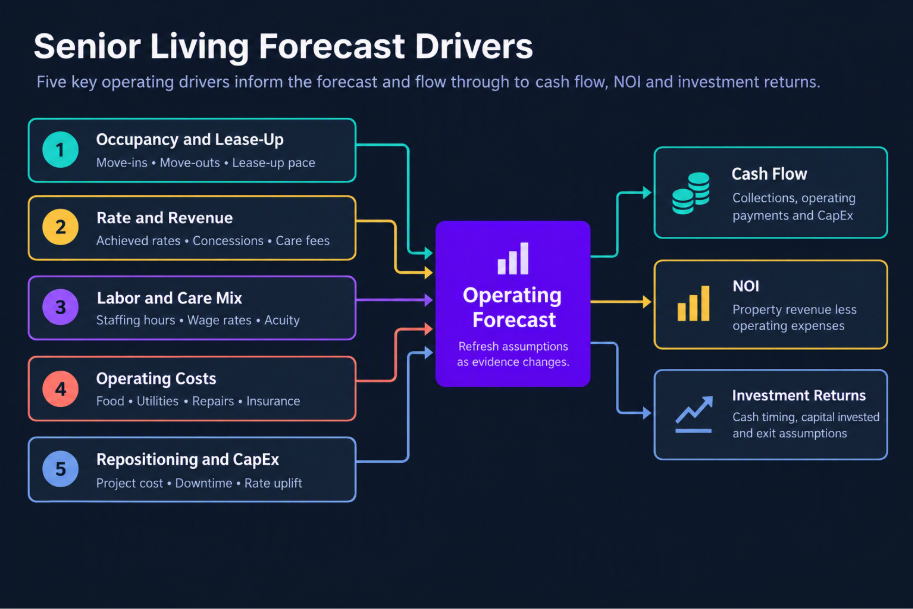
Compare the original ramp with actual move-ins, move-outs, net absorption and conversion. A delay of several months changes cash needs even if the stabilized occupancy target still looks achievable. Update the timing explicitly instead of carrying the old ramp and explaining the miss every month.
Separate asking rates from achieved move-in rates, concessions and ancillary revenue. Strong occupancy with weaker realized rates may protect near-term volume while reducing the revenue assumptions behind the acquisition or repositioning model.
Track agency use, overtime, staffing ratios and unfilled shifts against occupancy and the original labor plan. In assisted living and other care settings, add resident acuity and care mix. Independent living should be assessed primarily through staffing coverage, productivity and service levels.
Utilities, food, repairs, insurance and vendor costs need actual-to-plan bridges, preferably on a per-occupied-unit basis where appropriate. This separates genuine cost pressure from the effect of serving more residents.
Track committed spend, completion timing, units or beds taken offline and the rate or occupancy uplift achieved after work. A project can remain strategically sound while the return changes because cost, timing or downtime moved from the original assumption.
Once these drivers are visible, finance can decide whether the model needs a routine forecast refresh or a deeper reset of the investment case.
A forecast should update on schedule. An investment assumption should reopen when the evidence changes enough to affect a decision. Pre-agreed triggers help finance avoid two extremes: constantly rewriting the model around normal monthly noise, or holding an outdated assumption long after the operating pattern has changed.
| Driver | Early signal | Reset trigger | Management question |
| Lease-up | Move-ins below monthly plan | Trailing 3-month absorption misses plan materially | Is timing delayed or demand weaker? |
| Rate | Move-in rates below underwriting | Effective rate gap persists after concessions normalize | Does pricing or product need to change? |
| Labor | Agency use, overtime or unfilled shifts rise | Staffing cost or coverage misses plan for multiple periods | Is the issue agency reliance, overtime, vacancies, staffing ratios or care mix? |
| OpEx | Cost categories exceed plan | Run-rate variance changes NOI or cash materially | Is the variance structural or temporary? |
| CapEx | Spend or downtime slips | Expected return or funding requirement changes | Rephase, resize or stop the project? |
The thresholds should be set by asset and strategy. A lease-up community will tolerate more month-to-month volatility than a stabilized asset. A heavily repositioned property may need tighter CapEx and downtime triggers because the return depends on the execution timetable.
What matters is that management agrees in advance what evidence is strong enough to reopen the case.
A monthly variance does not automatically mean the investment case needs revision. Finance should first identify whether the difference is timing, execution, market movement or a structural change in the asset economics.
This prevents the reforecast from becoming a mechanical exercise. Management can see whether the answer is better execution, more time, a new market assumption or a different investment decision.
Scenario planning is useful when it changes the choice. Start with the decision, then model only the drivers that can change the answer. For a slow lease-up, that might mean pricing, marketing spend, staffing ramp and liquidity. For a repositioning program, the relevant drivers may be CapEx timing, units offline, achieved rates and refinance proceeds.
The scenario pack should show the current run rate, the original case and two or three plausible alternatives. Keep the assumptions visible and show the effect on cash, NOI and any financing constraint. A CFO should be able to see why one scenario is preferable without reading through the model mechanics.
That preparation can consume significant FP&A capacity, particularly when several communities are moving at once. It is also where an outsourced team can add leverage without owning the final judgment.
RELATED BLOG: For a complementary view of the finance operating model, see How Senior Living CFOs Can Turn Occupancy Growth into NOI Growth.
An outsourced FP&A team can maintain driver files, load actuals, prepare variance bridges, refresh forecast models and build scenario outputs when portfolio reporting and budgeting demands peak.
QX Global Group’s FP&A outsourcing support can extend the internal team across model maintenance, variance analysis, scenarios and reporting preparation.
The client retains the investment thesis, material assumptions, capital allocation, financing strategy and final decisions. Each forecast driver should still have a named owner, source system and approval point.
QX supports model maintenance, variance analysis, scenario preparation and management reporting alongside broader finance delivery. Dedicated teams can keep recurring schedules current and organize the evidence needed for portfolio reviews.
The scope is intentionally practical: maintain the analysis, improve reporting consistency and provide capacity during planning peaks. Investment assumptions and decisions remain with the client.
Also check: Top Financial Planning and Analysis Companies in the USA – What Businesses Should Know?
As senior living occupancy improves and capital activity picks up, more assets will move from underwriting into active management, repositioning and refinancing. The investment case remains valuable only if finance can still see which assumptions are holding and which have been overtaken by operating evidence.
The practical answer is a driver-based review. Keep the original assumptions visible, map them to actual operating evidence, set triggers for reopening the case and model alternatives around the decision management needs to make.
QX Global Group’s FP&A outsourcing can provide additional forecasting and analysis capacity while investment judgment, capital allocation and strategic decisions remain with the internal team.
Need more capacity to maintain forecasts and refresh portfolio scenarios? Talk to QX Global Group about an FP&A model that supports the analysis without taking the decision away from the management.
FP&A outsourcing can maintain the driver files and variance bridges that connect actual performance with the original investment model. Internal management can then see which occupancy, rate, labor, cost or CapEx assumptions changed and decide whether the investment case needs resetting.
Senior living finance teams should revisit occupancy and lease-up, achieved rates, concessions, labor intensity, agency use, operating costs and CapEx timing most often. These drivers can materially change cash flow, NOI and the timing of expected investment returns.
FP&A teams should compare the original ramp with trailing move-ins, move-outs, net absorption and conversion. A persistent gap across several periods, especially when local market evidence also changes, is a stronger reset signal than one weak month.
Scenario planning shows the financial effect of plausible operating choices before management commits. It can test pricing, staffing, marketing, CapEx timing or financing assumptions and show how each option changes cash, NOI, liquidity and the expected investment outcome.
Outsourced FP&A can maintain models, load actuals, prepare variance bridges and produce scenario outputs. Internal finance leaders still own strategic assumptions, management challenge, capital allocation, financing strategy and the final decision on which forecast or investment action to adopt.
Management should retain the underwriting thesis, strategic assumptions, pricing policy, capital allocation, financing decisions and approval of material forecast changes. These require accountability and commercial judgment that should stay with the internal leadership team.
QX can provide additional capacity across forecasting, reporting, planning schedules and analysis preparation. Dedicated teams keep recurring models and evidence current while the client retains portfolio strategy, investment decisions, material assumptions and final management accountability.
Providers using AI effectively combine forecasting technology with governed finance processes and human review. Buyers should assess data quality, explainability, model controls, exception handling and whether forecast outputs can be reconciled to the source systems used by management.
Providers with strong FP&A and record-to-report capability can prepare recurring lender, investor and regulatory packs. Confirm they can support scenario analysis, covenant schedules, defined reporting logic, audit evidence and client approval without creating a separate version of financial truth.
A strong outsourcing partner should help define the baseline before transition. For FP&A, useful measures include forecast turnaround, model refresh time, variance explanation, reporting timeliness, scenario capacity and the amount of internal-team effort released for decision support.

Education:
C.A., B.Com (Hons)

Visharad Saluja is a Chartered Accountant with over 10 years of post-qualification experience in FP&A, Record to Report, and Procure to Pay processes. Before joining QX, he worked with Indian listed companies, managing budgeting, pricing, costing, GL accounting, and financial finalisation. Visharad brings a sharp commercial lens to finance, combining management reporting with strong stakeholder alignment to drive decision-ready insights.
Expertise: FP&A, R2R, P2P, Contract Management, P&L and B/S Finalisation, Stakeholder Management, Management Reporting
Originally published Nov 26, 2026 08:11:27, updated Nov 26 2026
Topics: Finance & Accounting Outsourcing, FP&A
26 Nov 2026
Multifamily is ending 2026 with a healthier national story than it started with. Rents have stabiliz...
Read More23 Nov 2026
As 2027 planning gets under way, supplier payment deserves the same attention as pricing, availabili...
Read More23 Nov 2026
Senior living operators are heading into the next year with a better occupancy backdrop and a harder...
Read More23 Nov 2026
Six months after an AP transition, the first question from the CFO is usually straightforward. Is fi...
Read More