Topics: Accounts Payable Outsourcing Companies, Finance & Accounting Outsourcing
Posted on September 30, 2026
Written By Rushabh Shah




Ask a high-volume AP team what is wrong and you will get a list, not a diagnosis. Invoices arrive through email, vendor portals, EDI, and scanned documents. Unmatched queues persist, approvers need chasing, data is keyed twice, vendors ask for updates, and each entity works differently.
Those complaints point to four structural failures—fragmented intake, unowned exceptions, no single process of record, and capacity tied to headcount.
This distinction decides whether accounts payable outsourcing services solve the problem or simply relocate it. This piece tests what a redesigned operating model changes about each failure and how to tell within two quarters whether it worked.
Most AP processes are not designed to handle the growing volume. A workflow built when the business processed 3,000 invoices a month gets extended, patched, and worked around until it is handling 15,000, and nobody ever went back to ask whether the original design still holds.
It usually does not, and volume is what exposes it. At 3,000 invoices, an undocumented coding convention that lives in one person’s head is a quirk. At 15,000 across four entities, it is a single point of failure. A tolerance rule applied inconsistently costs you a handful of corrections a month at low volume and several hundred at high volume.
Informal approval chasing works when the AP lead knows every approver by name, and stops working the moment the business is too large for that.
Volume often looks like a capacity problem, so the response is more capacity: two processors, a year-end contractor, or overtime in the busy quarter. The backlog may clear temporarily, but it returns because the source of the work remains unchanged.
The useful question is not how much volume the team can absorb. It is which parts of the process stopped scaling, and whether moving them to a provider would change that or simply relocate it.
The team itself will tell you where the process is failing, though not in the exact terms. What they would describe are what we will refer to as “failures”.
Let’s look at the 8 most common pain points of a high-volume AP team and then try to map them to the structural failures beneath them.
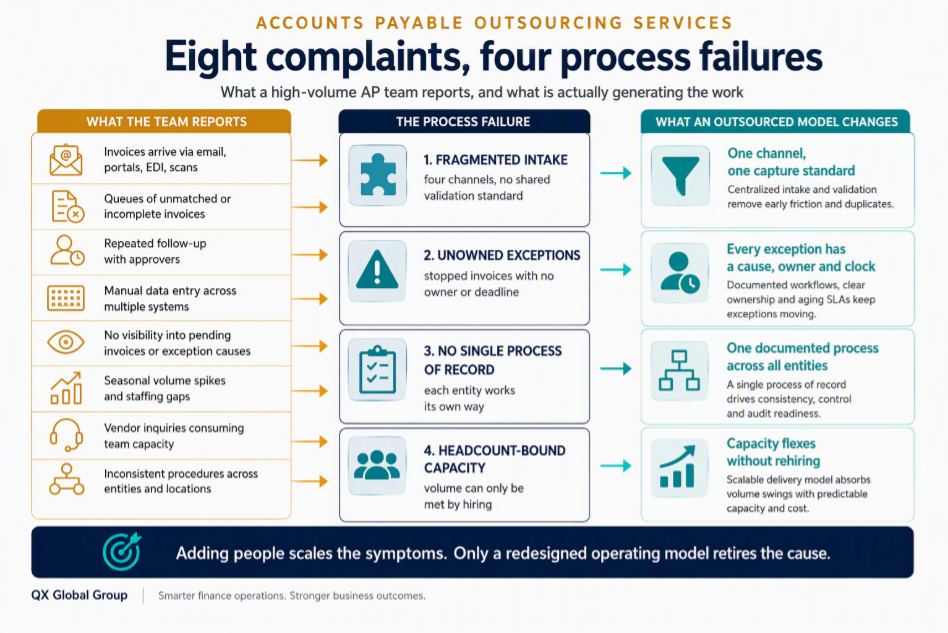
Invoices arrive by email, vendor portal, EDI and scanned PDF, and each channel carries its own quality standard, or none at all. An emailed invoice may be missing a PO reference. A portal submission may use a vendor name that does not match your master file. A scan may capture cleanly or may not.
By the time the invoice reaches a processor, the defect is already embedded. Everything downstream, the unmatched queue, the coding correction, the duplicate that surfaces at payment, all traces back to a validation that never happened at the door. Manual rekeying across systems is the same story: data that entered once, badly, has to be entered again.
A redesigned intake model changes three things:
The unmatched invoice queue and the approver chase are the same problem wearing two hats. In both cases, an item has stopped and no one is accountable for restarting it on a clock.
Someone notices the aged item, emails a buyer, and moves on. The vendor eventually calls, which converts a quiet exception into an interruption for whoever picks up the phone. This is where the vendor inquiry problem comes from, and it is also why visibility feels absent: there is nothing to look at, because nothing was ever recorded as owned.
The operating model matters most in the exception queue.
A managed AP operation treats the exception queue as the primary object of management rather than a residue of the main process. Practically, here’s what this means:
| Attribute | What it means in practice | What it prevents |
| A cause code | Missing PO, price variance, quantity variance, coding error, missing receipt, vendor data mismatch | Recurring failures being treated as one-off incidents |
| A named owner | Either the provider or a specific internal role, never “AP” as a department | Items circulating without anyone accountable |
| A clock | An aging SLA measured to resolution, not to first response | Aged items quietly rolling into the next period |
| An escalation route | Triggered by value, age, vendor criticality or repeat occurrence | Material items discovered at audit rather than at day 15 |
Cause codes are what turn the exception queue into management information. Once you can see that missing POs account for a third of stopped invoices, the conversation moves from AP staffing to purchasing discipline, which is where the fix actually sits.
The vendor inquiry problem resolves as a consequence. When every open item has a status, an owner and a date, the provider’s vendor helpdesk can answer the call instead of routing it into your team.
RELATED BLOG: Common Risks When You Outsource Finance and Accounting Services — And How to Avoid Them
Imagine an acquisition with its own workflow. A regional office built a workaround that became permanent. A business unit runs a different ERP instance with different tolerance settings. Each decision made sense locally.
The aggregate cost is that nothing is comparable. Cycle time means something different in each entity. An exception in one location is a standard step in another. Manual data entry across multiple systems persists because no one has the authority to retire the second system. And consolidated AP reporting becomes an exercise in reconciliation rather than analysis.
A single process of record creates three practical advantages:
Contractors work inside whatever process they find. A provider running a documented process of record is contracted to change it.
Seasonal volume increases against fixed headcount produce a predictable pattern: a backlog that builds, a period of overtime, a temporary hire who leaves once trained, and a process that returns to baseline having learned nothing.
The underlying issue is that internal capacity is a step function. You add a person or you do not, while volume is continuous. The two never line up, so you are either carrying slack or carrying a backlog, and at high volume the backlog is the more expensive of the two.
Delivery capacity can flex against agreed volume bands rather than hiring cycles, provided three points are negotiated explicitly:
Your ledger has two paths through it, and they have almost nothing in common.
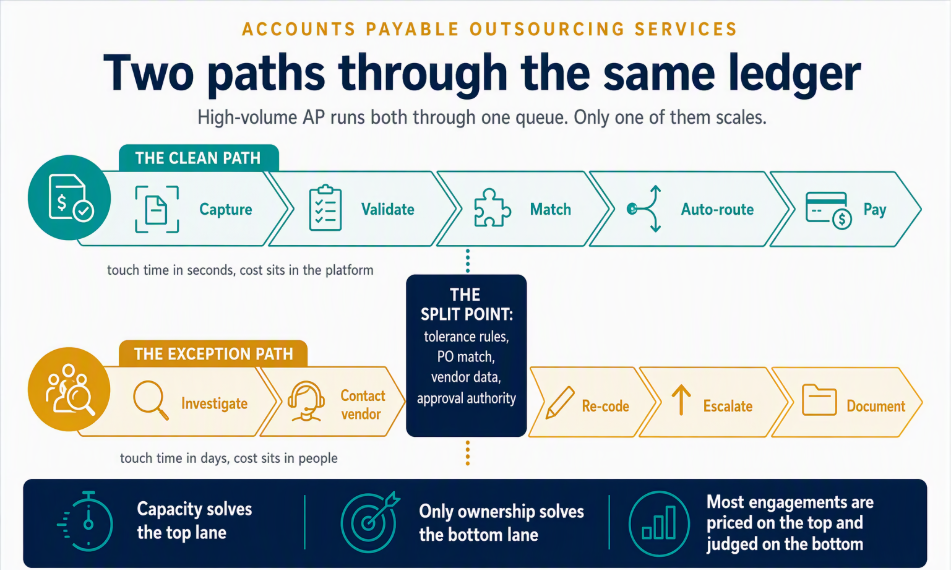
Running both through the same queue is why clean invoices wait behind difficult ones. It is also why extra processors help for a limited time only. Often, the lane that was stuck stays stuck.
This makes it easier when assessing which work you are actually trying to outsource.
Repeatable execution can move. Authority stays. Apart from pricing, this is the most useful boundary to set in stone.
| Provider Executes | Joint/Co-work | You Retain |
| Invoice capture, validation, duplicate screening | Exception thresholds and tolerance design | Payment policy and risk appetite |
| Coding support, two-way and three-way matching | Escalation rules and review cadence | Approval authority and payment release |
| Approval routing and follow-up | Root-cause improvement agenda | Cash prioritization and vendor terms |
| Exception administration and aging management | Control testing and evidence standards | Material disputes and fraud decisions |
| Vendor helpdesk and statement reconciliation | Vendor master verification protocol | Final accountability for reporting |
| Payment-run preparation and AP reporting | Peak capacity planning | Bank access |
An outsourced function will not tell you which vendors to keep or how hard to pay them. It makes sure that when you decide, the numbers underneath the decision hold.
Now, once you decide on the scope, it’s important to choose a model that fits your needs.
Decide what you want to own first, or you might end up comparing a staffing proposal against a managed service as though they are two prices for the same thing. Score each model against the four causes rather than against a capability list.
| Consideration | Staff Augmentation | Selective Outsourcing | Managed AP Operations |
| Fixes fragmented intake | No | Partially | Yes, single capture standard |
| Owns the exception queue | No, stays with you | Split, often ambiguously | Yes, with cause codes and SLAs |
| Standardizes across entities | No | Within scope only | Yes, documented process of record |
| Absorbs seasonal peaks | Partially, with lead time | Within scope only | Yes, banded capacity |
| Handles vendor inquiries | Rarely | Sometimes | Yes, managed helpdesk |
| Best suited to | Short-term spikes | Stable, documented activities | Persistent scale, multi-entity estates |
| Main risk | The inefficiency survives intact | The seams become blind spots | Weak governance obscures accountability |
You’ll find that staff augmentation is the fastest to stand up and changes the least. A managed operation asks more of your governance and is the only model that addresses all four causes.
The best way to judge the effectiveness of these models is a measurement framework.
Also Check: Top Accounts Payable Outsourcing Companies in USA – What Sets Them Apart?
APQC’s Open Standards Benchmarking anchors AP on three measures that work well here. Total cost to process AP per invoice, the percentage of disbursements that are first-time error free, and cycle time from invoice receipt to payment transmitted. Map these against the four failures and add the control measures.
| Root Cause | What to Measure | What Good Movement Looks Like |
| Fragmented intake | First-pass match rate, duplicates caught before payment, first-time error-free disbursements | Fewer invoices stopping, fewer corrections after payment |
| Unowned exceptions | Exception rate by cause, aging to resolution, vendor query resolution time | The top three causes shrinking quarter on quarter |
| No process of record | Variance in cycle time and exception rate between entities | The spread between best and worst entity narrowing |
| Capacity tied to headcount | Exception rate and cycle time in peak months, reported separately | Peak performance holding rather than spiking |
| Control | Vendor master changes verified independently, segregation of duties tested | Every change traceable to a verified request |
| Overall economics | Fully loaded cost per invoice, including internal rework | Cost falling without exception rate rising |
RELATED CASE STUDY: See how QX helped a global real estate operator move from siloed finance processes to a documented, standardized operating model.
QX Global Group runs accounts payable as a governed operation rather than a processing queue, which is the distinction that decides whether volume gets absorbed or just relocated.
QX provides accounts payable outsourcing services across the full cycle: centralized invoice capture and validation, coding, two-way and three-way matching, approval follow-up, exception resolution under aging SLAs, vendor helpdesk and statement reconciliation, payment-run preparation, T&E administration and management reporting built around liabilities and causes rather than volumes.
On the operations side, QX runs a controlled center of excellence rather than a pooled team, so one documented process can apply across entities that previously worked differently. For a global real estate operator, that approach helped centralize and standardize finance operations while unlocking over $2 million in annual savings through offshore delivery.
In a separate AP engagement with a global beverage producer and distributor, QX migrated the process within four weeks and reduced invoice processing time from two to three days to one day from receipt. Together, the examples show both operating-model scale and day-to-day processing improvement.
The eight complaints every high-volume AP team reports are downstream of four decisions: how invoices and vendor data enter the business, who owns an exception and on what clock, whether every entity runs the same process, and whether capacity can move without a hiring requisition.
Accounts payable outsourcing services are worth buying when they change those four things. When they only absorb the symptoms, you have moved the cost and kept the problem, and at high volume that is an expensive place to end up.
Ready to find out what your exception queue is costing you? Talk to QX Global Group about accounts payable outsourcing services built around control, visibility, and scale.
Repeatable, rules-based work moves best: intake and validation, coding support, matching, approval follow-up, exception administration, vendor queries, statement reconciliation and payment-run preparation. Policy, approval authority, payment release, cash prioritization and material judgment should stay in-house.
Through a single capture and validation standard at intake, documented coding and tolerance rules, named ownership of exceptions with aging SLAs, and automated matching. The gains depend on redesign. Moving an inconsistent process without changing it relocates the delay rather than removing it.
Yes, where growth consists of transferable work and capacity is banded against volume rather than hiring cycles. It will not fix undocumented processes or internal approval bottlenecks on its own, so those need addressing in parallel.
It captures invoice data, screens duplicates, matches against POs and receipts, routes approvals and improves status visibility. Human review still belongs on low-confidence outputs, disputes, unusual transactions and anything with a policy or fraud dimension.
APQC anchors AP on total cost per invoice, first-time error-free disbursements and cycle time from receipt to payment. Add exception rate by cause, exception aging to resolution, first-pass match rate, approval aging, vendor query resolution and backlog by age. Read them together, because speed, cost, quality and control can move in opposite directions at once.
When backlogs return after every cleanup, exception work is crowding out analysis, vendor inquiries consume real capacity, procedures differ across entities, or hiring has become the standing answer to volume. One signal is worth watching. Three together mean the model needs rethinking, not the team.
Not if the control boundary is drawn properly. Processing and payment release should never sit with the same party, vendor master changes should follow an independent verification path, and evidence should be retained for every approval and override. Given that 76 percent of organizations faced attempted or actual payments fraud in 2025, a documented outsourced process is often more testable than an informal internal one.
QX Global Group runs AP as a governed operation with a single documented process across entities, segregated duties, SLA-backed exception management and a managed vendor helpdesk. Clients keep policy, approvals and payment authority, and gain capacity that flexes with volume.

Education:
CA, B.Com

Rushabh Shah is a Chartered Accountant with over 7 years of experience in audits, financial analysis, and process optimisation. At QX, he specialises in CAPEX reviews, treasury management, P2P processes, and tax and statutory compliance. With a strong foundation in financial reporting, Rushabh brings cross-sector expertise and a sharp analytical approach to managing complex finance operations.
Expertise: CAPEX Reviews, Treasury Management, P2P Processes, Tax & Statutory Compliance, Financial Reporting, Audit & Financial Analysis
Originally published Sep 30, 2026 07:09:31, updated Oct 01 2026
Topics: Accounts Payable Outsourcing Companies, Finance & Accounting Outsourcing
01 Oct 2026
Run a tender for procure-to-pay outsourcing and the meetings blur together. Multiple providers, mult...
Read More29 Sep 2026
In July this year, Birchgrove hired a chief growth officer. Not a sales director. A growth officer, ...
Read More28 Sep 2026
A late payment never looks like a crisis on the day it happens, does it? The invoice went out on tim...
Read More28 Sep 2026
Ask a simple question in most real estate finance meetings, “what does a unit actually cost us...
Read More