Topics: Credit Control, Finance & Accounting Outsourcing
Posted on September 28, 2026
Written By Nishant Timbadia




A late payment never looks like a crisis on the day it happens, does it? The invoice went out on time, the terms were agreed upon, and the customer is good for the money. First, it slips a week. Then a fortnight. The forecast absorbs it. Nothing on the ledger looks wrong, right up until the end of the quarter, when it actually does.
The Commercial Payments Bill sets out to deal with exactly this. A 60-day ceiling on payment terms, interest that can no longer be waived, and a regulator with the power to fine. The relief on the supplier side is real. But was the problem ever a lack of rights?
Late payment is a question of who is chasing, how consistently, and whether there is a record to show for it. This is the ground credit control has always occupied, and the Bill does not change it.
This piece looks at what the Bill would change, when it is likely to bite, and why the operating model behind your collections matters more once the rules tighten, not less.
The Commercial Payments Bill was introduced in the House of Lords in May 2026 as the Small Business Protections Bill and is still in passage, so nothing is yet in force. It is aimed squarely at large businesses paying their small and medium-sized suppliers rather than at all B2B trade. Here are the measures that matter:
On timing, no commencement date has been set. The government has said it will consult further on implementation and provide a lead-in and transition period, and the measures will not apply retrospectively. Commencement is not expected before 2027, which is the point worth holding on to: there is time to prepare, and the preparation is operational rather than legal.
Notice that each measure acts on the terms of the debt. There is nothing that talks about the behaviour of the debtor.
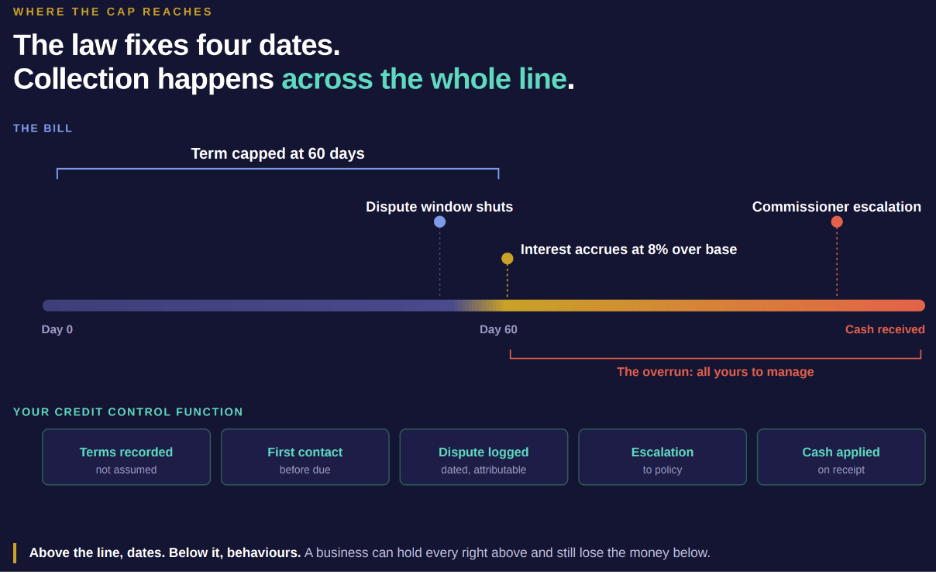
The Bill strengthens the supplier’s position in an argument but it neither reduces the number of arguments nor shortens the queue. This raises the more useful question of what that stronger position is actually worth to a cash position.
A capped term sets the date an invoice becomes overdue. It does nothing about the days that follow, and those are the days where working capital is lost.
Consider what a right to interest actually is on a balance sheet. It is an asset that exists only if somebody enforces it, and most suppliers have historically chosen not to. Interest recognised and never collected is a provision waiting to be written back, not cash. Nothing in the Bill reaches the invoice sitting unpaid on day 61 for reasons nobody has yet logged.
What the cap does change is what finance should be measuring. Gross DSO has always been a blunt instrument, because it mixes generous terms with poor collection and reports them as one number. Once terms are capped by statute, the honest measure becomes the overrun beyond the agreed date, since that is the only part of the cycle the business still controls.
RELATED BLOG: Find out why credit control is the quiet lever behind healthier cash flow.
Each measure in the Bill creates work that did not previously exist. Four pressures in particular land on a function most businesses have never had to formalise.
Each of these pressures lands on the same function, so it is worth setting out plainly what that function now has to be able to do.
The new regime rewards documentation over goodwill. Five capabilities decide whether a business can use its stronger position.
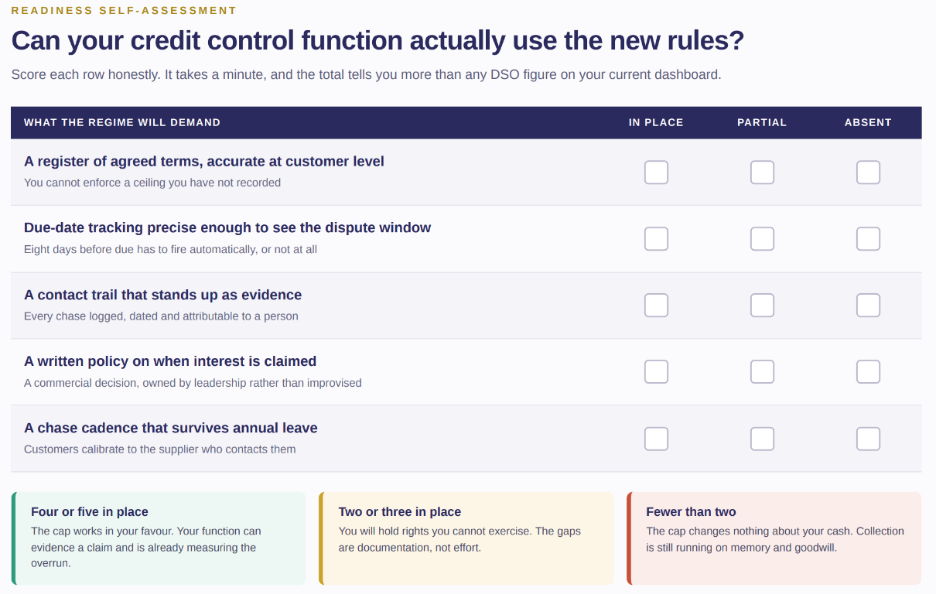
You cannot enforce a ceiling you have not recorded. Most ledgers hold payment terms as a system default rather than a negotiated fact, and the two drift apart across years of renewals and side agreements. Somebody has to reconcile what the contract says against what the ledger believes.
Knowing the due date on every open invoice is an operational capability, not a legal one. It has to be visible continuously, or a late or ill-founded dispute will look no different from a legitimate one. Monthly reporting cycles are far too coarse, and by the time an aged debtor report surfaces the problem the moment to act on it has usually passed.
Every chase logged, dated and attributable to a person. A claim for interest is only as strong as the record behind it, and the same is true of a complaint to the Commissioner. Notes sitting in an inbox are not a record. If the process cannot produce a chronology on demand, the new rights are decorative.
This is a commercial decision, so it belongs with the people who own the customer relationship rather than with whoever is making the call that week. Set the threshold in advance: which accounts, at what age, with what escalation. A policy decided once is far easier to apply consistently than a judgement improvised a dozen times a year.
Consistency is what stops a reliable payer drifting into a slow one. Customers calibrate to the supplier who contacts them, and a rhythm that lapses for a fortnight teaches them something you would rather they did not learn. In a team of two, cadence is the first thing to break and the last thing anybody notices.
Now, sustaining all five, month after month, is where the operating model becomes the real question.
RELATED BLOG: Discover the seven signs you are working with a top UK credit control provider.
Every one of the five requirements is a continuity problem, which is why the operating model matters as much as the intent behind it.
In-house still works on a small, stable ledger where the controller knows every account and the chase happens because one person remembers to make it happen. This holds until the ledger grows or that person leaves. Hybrid looks like the sensible middle and introduces a seam, because the invoices that cause trouble are precisely the ones that do not sit neatly on either side of it.
Here’s a quick decision-matrix for CFOs to help decide the right fit:
| Consideration | In-House | Hybrid | Outsourced |
| Best suited to | A small, stable ledger with few large customers | Growth, with credit policy already settled internally | High volume, or heavy exposure to large buyers |
| Evidence trail | Depends on individual discipline | Consistent on routine accounts, variable on exceptions | Documented by design, because the process is the product |
| Cost behaviour | Fixed headcount, paid through quiet months | Part fixed, part variable | Flexes with ledger volume |
| Cover and continuity | One resignation stalls the function | Partner absorbs peaks and absences | Depth of cover, so the cadence never stops |
| Where the judgement sits | In-house, but capacity-bound | In-house, by design | In-house, by design |
The relationship point is the one the table cannot carry. A third party chasing in your name has nothing to protect, which matters more now that interest can no longer be waived as a quiet gesture of goodwill.
QX runs credit control outsourcing as a centre of excellence rather than a team of chasers working on your instructions.
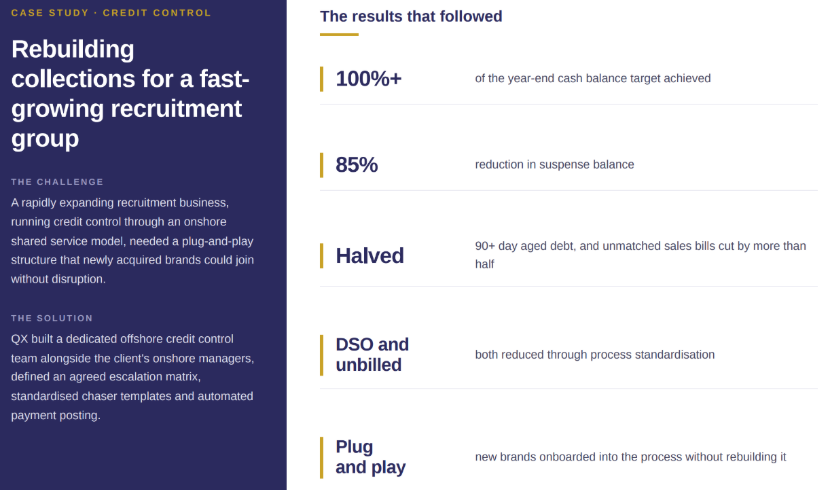
A centre of excellence designs the process once and applies it identically, to every account, every week. Chaser templates are standardised rather than composed under pressure. Escalation follows a matrix agreed with you in advance, so the interest decision is executed to policy rather than improvised by whoever happens to be making the call. Payment posting and remittance handling are automated, so cash application never queues behind a manual step.
Standardisation is what makes the record defensible, because a process that runs the same way every time produces evidence as a by-product rather than an afterthought. Here’s what QX delivered for a UK recruitment group:
The 60-day cap, mandatory interest and the Commissioner’s new powers will give UK suppliers a materially stronger position. What none of them supply, though, is the operational discipline required to use it.
Outsourcing that work is not the same as outsourcing the customer relationship. The judgement stays in-house. What changes is that the routine happens whether or not anyone has time for it.
When the Bill takes effect, the businesses that benefit will not be the ones with the strongest legal claim. They will be the ones already running a function capable of enforcing it.
Ready to close the gap between what you are owed and what you have banked? Speak to QX Global Group about outsourced credit control for your business.
Through consistency and neutrality. A documented cadence is applied to every account rather than the ones somebody remembered, and the person calling has no relationship to protect.
By compressing the stages where days accumulate. Earlier contact, disputes caught before they age, cash applied on receipt. The invoice value never changes; the date it becomes usable does.
Every overdue day is interest-free lending to a customer. Around £26 billion sits in late payments across the UK at any one time, and affected businesses lose 86 hours a year chasing it.
Credit checks and limit setting, terms recording, pre-due reminders, structured chasing, dispute logging and resolution, cash application, aged debtor reporting, and escalation where required.
Overrun against agreed terms rather than gross DSO, the ageing profile month on month, average dispute resolution time, and cash collected against what was genuinely collectable in the period.
When ageing is drifting, chasing depends on one person, or no record exists capable of supporting a claim for interest. One signal is worth watching. Two or three are worth acting on.
QX Global Group runs dedicated UK credit control and accounts receivable teams across the full order-to-cash cycle, using named resources rather than pooled ones.
Look for providers contracted on cash outcomes rather than activity volumes. QX Global Group is measured on overrun against agreed terms and cash conversion, the pair a board can use.
QX Global Group’s teams chase in the client’s name, using their templates, thresholds and tone of voice. Customers experience a consistent supplier, not a collections agency.
Those that are treating collections as a working capital function rather than an administrative one. QX combines credit control with cash application and aged debtor reporting, so the position is visible as it moves.
A documented cadence producing a defensible evidence trail, live visibility of ageing and disputes, and accountability measured on cash conversion. Judgement on the accounts that matter stays with you.

Education:
PGDM (Finance)

Nishant Timbadia is a seasoned finance professional with over 12 years of experience in the outsourcing industry, specialising in end-to-end F&A operations. At QX, he leads delivery across Credit Control, Order to Cash, R2R, P2P, and intercompany processes. With a strong background in payroll, billings, and management accounts, Nishant is known for driving process optimisation, managing high-performing teams, and ensuring seamless transitions from setup to go-live.
Expertise: Credit Control, O2C, R2R, P2P, Intercompany, Payroll & Billing, Management Accounts, Client & People Management
Originally published Sep 28, 2026 06:09:03, updated Sep 28 2026
Topics: Credit Control, Finance & Accounting Outsourcing
28 Sep 2026
Ask a simple question in most real estate finance meetings, “what does a unit actually cost us...
Read More25 Sep 2026
Hospitality is one of the few industries where finance never really slows down. Room revenue posts o...
Read More24 Sep 2026
Think about the biggest BtR deal of the year. Morgan Stanley and Ridgeback bought L&Q’s re...
Read More15 Sep 2026
Every compliance obligation a finance team meets requires data. Be it tax filings, statutory reporti...
Read More