Topics: Questions Staffing Firms Should Ask Recruitment Outsourcing Providers, Recruitment Outsourcing Providers
Posted on October 21, 2026
Written By Ankit Ranjan




Choosing a recruitment outsourcing provider is easy. Choosing one that can actually work within your staffing model, technology, processes, client expectations, and growth plans is much harder.
The wrong outsourcing relationship can create more work than it removes. Recruiters may spend their time correcting errors, chasing updates, or managing inconsistent processes instead of speaking with candidates and clients. The right provider should do the opposite: extend your team’s capacity while fitting smoothly into the way your staffing firm operates.
That is why staffing firms should look beyond pricing and headcount when evaluating Recruitment Outsourcing Services.
This blog covers the key questions US staffing firms should ask when comparing Recruitment Outsourcing Providers, from service capabilities and staffing experience to technology, data security, quality, communication, KPIs, and contracts.

Not every provider offers the same level of expertise, operational flexibility, technology support, or service coverage. More importantly, not every provider will understand how a staffing company operates.
A thorough recruitment provider evaluation helps you establish whether a potential partner can work with your recruiters, clients, systems, and service expectations before you commit. It also gives both sides a clearer understanding of responsibilities from the beginning. In the following blog we discuss the most important questions staffing firms should ask their recruitment outsourcing providers.
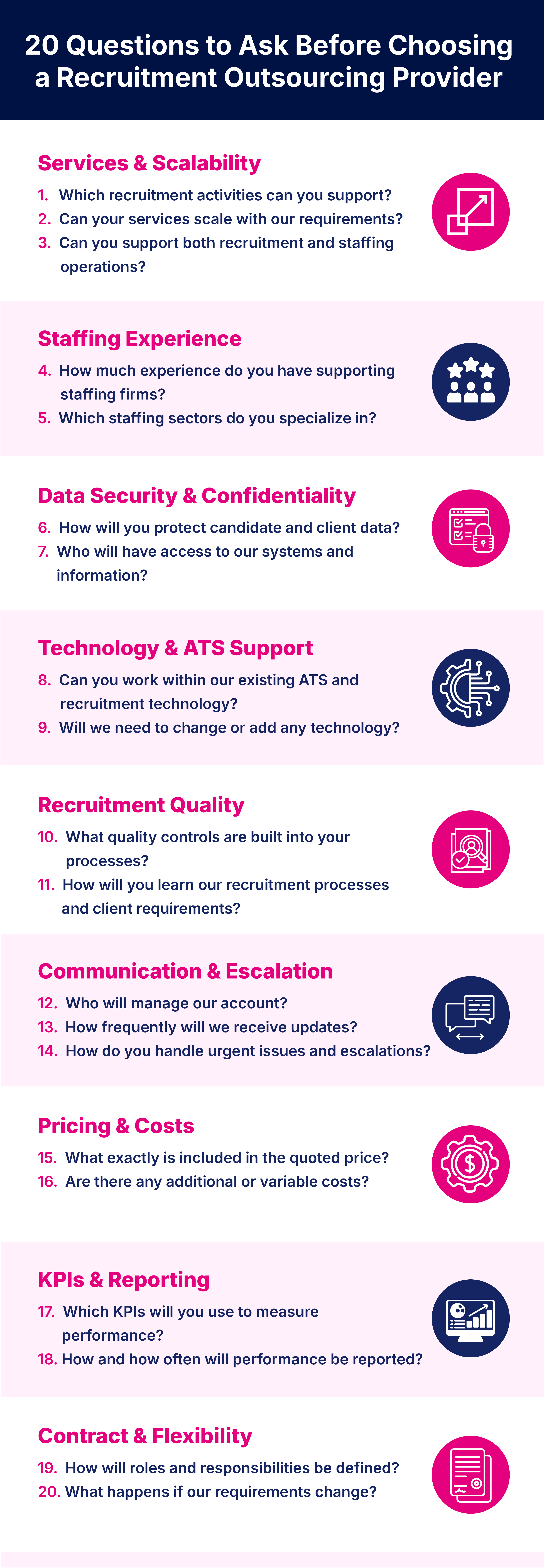
Start by understanding exactly what the provider can take off your recruiters’ plates.
Depending on your business, this could include candidate sourcing, resume screening, candidate outreach, database management, recruitment administration, compliance support, onboarding coordination, or other back-office activities. Some recruitment outsourcing providers may support individual functions, while others can provide broader end-to-end support.
Ask the provider to clearly define what is and is not included in the proposed service.
Staffing demand rarely stays constant. Client wins, seasonal requirements, new locations, or sudden hiring projects can quickly change workload.
Strong outsourced recruitment providers should be able to explain how their delivery model responds when volumes rise or fall. Ask how additional resources are introduced, how workloads are redistributed, and whether the scope can change as your business evolves.
This is particularly important if outsourcing is part of your long-term growth strategy rather than simply a short-term capacity solution.
Recruiter productivity can be affected by far more than sourcing alone.
Ask whether the provider offers staffing operations support alongside recruitment activity. This could include administrative workflows, database updates, onboarding coordination, documentation, compliance-related support, or other repetitive tasks that take recruiters away from candidate and client conversations.
Understanding the full scope helps determine whether you need a specialist sourcing provider or a broader operational outsourcing relationship.
There is a significant difference between recruiting for an employer and supporting a staffing business.
Staffing firms often manage multiple clients, candidate pipelines, job orders, compliance requirements, and tight turnaround expectations simultaneously. Ask potential recruitment outsourcing companies about their experience supporting businesses with similar operating models and recruitment workflows.
Relevant experience can reduce the amount of time required for the provider to understand how your teams work.
Industry knowledge matters because sourcing strategies, candidate pools, terminology, screening requirements, and compliance processes can vary between sectors.
For example, healthcare, IT, engineering, professional services, and light industrial staffing can require very different recruitment workflows.
Ask for examples of similar assignments and, where appropriate, relevant case studies. This will help you distinguish providers with genuine staffing expertise from those offering generalized recruitment support.
If you are still building your shortlist, comparing established Top Recruitment Outsourcing Companies can also help you identify the capabilities worth assessing.

A recruitment outsourcing relationship may give an external provider access to candidate records, contact details, client information, job requirements, and internal systems. Data protection should therefore be part of the recruitment outsourcing assessment, not an afterthought.
Ask providers to explain their information-security controls, access management, data handling processes, employee training, and confidentiality measures.
If your organization has specific security, regulatory, or contractual requirements, establish whether the provider can work within them before system access is granted.
Do not stop at asking whether data is “secure.” Find out how access works operationally.
Ask who will receive access to your ATS, CRM, job boards, candidate databases, and other systems. You should also understand how permissions are assigned, changed, monitored, and removed when team members change.
This gives your business greater clarity over how sensitive recruitment information is handled throughout the engagement.
A provider should complement your technology environment rather than create unnecessary parallel processes.
Ask whether its teams can support your existing ATS, CRM, VMS, job boards, sourcing platforms, communication tools, and other recruitment technologies. Also establish what training or system access will be required during transition.
The objective is to create a workflow in which outsourced teams can operate alongside internal recruiters without creating additional manual work.
This is particularly important when comparing different recruitment support providers.
Some delivery models may fit into an organization’s current processes, while others could require specific tools or workflow changes. Ask this question early so you understand any additional implementation, licensing, integration, or training implications.
Technology requirements should be clear before the outsourcing agreement is finalized.
More activity does not automatically mean better recruitment.
Ask how the provider checks the quality of sourcing, screening, database work, administration, or other activities before the output reaches your internal team. Depending on the service, this may involve defined quality checks, process reviews, or performance monitoring.
The provider should be able to clearly explain how quality is assessed and maintained, rather than relying on broad promises about service quality.
Outsourced teams need context to produce relevant work.
Ask how the provider captures your SOPs, candidate criteria, client preferences, recruitment workflows, communication expectations, and escalation requirements during onboarding.
For staffing firms, this is especially important when different clients have different submission requirements or hiring processes.

Clear ownership makes outsourcing easier to manage.
Find out who will be responsible for daily communication, performance discussions, operational issues, and escalations. Depending on the engagement, there may be different contacts for day-to-day delivery and strategic account management.
A defined governance structure prevents your recruiters from wasting time figuring out whom to contact when something needs attention.
Communication expectations should be agreed before delivery begins.
Ask whether updates will be provided daily, weekly, monthly, or according to another agreed schedule. The right frequency will depend on the service being outsourced and how closely it connects with your internal recruitment team.
Most importantly, clarify what information will be included, who will receive it, and what requires immediate escalation.
Not every problem can wait until the next scheduled review.
Ask providers to explain their escalation structure, designated contacts, and how critical operational issues are handled. Agreeing this upfront creates clearer accountability when urgent client, candidate, technology, or delivery problems arise.
Do not compare providers based on the headline price alone.
Ask precisely what the commercial proposal covers, including team resources, management, technology requirements, reporting, onboarding, and any additional services relevant to the engagement.
Understanding the total scope behind the price is essential when comparing recruitment outsourcing providers in USA, particularly when providers structure their services differently.
A lower initial quote may not always mean a lower overall cost.
Ask what happens when hiring volumes increase, additional services are introduced, working hours change, or extra technology is required.
This allows staffing firms to compare providers using total expected cost and service scope, rather than relying on a single price figure.

KPIs should reflect the work being outsourced.
For sourcing support, relevant measurements could cover candidate delivery, quality, turnaround, or conversion through agreed stages. For administrative support, measures may focus more heavily on accuracy, completion volumes, and turnaround time.
Rather than accepting a standard reporting template, ask providers to align KPIs with the specific outcomes your staffing firm needs from outsourcing.
Reporting should help managers make decisions, not simply generate another spreadsheet.
Ask what information will be provided, how frequently it will be shared, and whether reporting can align with your own operational requirements. Also determine how performance issues and trends will be discussed during service reviews.
Good reporting should make it easier to identify what is working, where bottlenecks are developing, and where processes need adjustment.
Ambiguity at the beginning often creates problems later.
The agreement should clearly establish the scope of services, responsibilities, deliverables, communication structure, performance expectations, confidentiality requirements, and commercial terms applicable to the engagement.
Your internal team should know where its responsibilities end and where those of the recruitment outsourcing partner begin.
Staffing businesses evolve. Outsourcing agreements should therefore account for reasonable changes in workload or scope.
Ask how additional services, changes in recruitment volume, new teams, or adjustments to operating processes will be handled.
The contract should provide sufficient clarity without making the relationship unnecessarily difficult to adapt as your business changes.
Once you have spoken to several providers, avoid choosing solely on price or presentation quality. Build a structured comparison around the factors that will affect delivery.
Your recruitment provider evaluation should consider:
Using the same evaluation criteria for every shortlisted provider makes it much easier to identify meaningful differences between competing staffing recruitment outsourcing companies.
QX Global Group provides outsourced recruiting services and staffing operations support for staffing businesses looking to extend their recruitment capacity.
Rather than treating outsourced recruitment as a standalone activity, the focus should be on identifying where external support can remove repetitive or resource-intensive work from internal teams. Depending on the staffing firm’s requirements, that may mean supporting candidate sourcing, recruitment processes, administrative workflows, or wider operational activities.
For US staffing firms, the important question is therefore not simply whether work can be outsourced. It is which activities should be outsourced to create the greatest operational impact without disrupting the processes that already work.
Choosing between Recruitment Outsourcing Providers should not come down to whichever company promises the most resources at the lowest price.
The stronger question is: Which provider can operate as an effective extension of your staffing business?
Look closely at staffing experience, service scope, technology compatibility, quality controls, data handling, reporting, communication, scalability, and commercial transparency. A thorough recruitment outsourcing assessment before signing an agreement can help establish clearer expectations and give both teams a stronger foundation for the partnership.
The best recruitment outsourcing partner should not add another layer for your recruiters to manage. It should make recruitment operations easier to run.
A recruitment outsourcing provider is an external company that supports some or all of an organization’s recruitment activities. Services can range from candidate sourcing and screening to recruitment administration and operational support. Staffing firms may use providers to expand capacity, support internal recruiters, or manage specific repetitive and resource-intensive recruitment processes.
Start by assessing the provider’s experience with staffing firms, service capabilities, sector knowledge, technology compatibility, information-security controls, quality processes, reporting, pricing, and scalability. A structured recruitment provider evaluation using the same questions and criteria across shortlisted providers makes comparisons more meaningful.
Ask about the exact services it provides, its experience with staffing companies, the systems its teams can work with, how candidate information is protected, how quality is monitored, what KPIs are reported, and how issues are escalated. You should also clarify pricing, scope, scalability, onboarding, and contractual responsibilities before making a decision.
Services vary between providers but can include candidate sourcing, screening, database management, recruitment administration, onboarding coordination, compliance-related support, and other operational recruitment activities. Some recruitment process outsourcing providers offer broader end-to-end services, while others specialize in particular elements of the recruitment process.
Staffing firms should compare providers using consistent criteria rather than price alone. Consider staffing-sector experience, service coverage, delivery model, technology support, security, quality controls, communication, KPIs, scalability, and commercial terms. The best fit will depend on which processes you intend to outsource and what outcomes you expect.
The agreement should clearly define the outsourced scope, responsibilities, expected deliverables, performance measures, reporting and communication arrangements, confidentiality requirements, pricing, and relevant commercial terms. It should also make clear how changes in scope or operational requirements will be managed.
Enjoyed our blog? Discover more about how our recruitment outsourcing process can slash your costs by up to 60%! Take the next step—book a call by entering your details.


Ankit Ranjan is Vice President of Operations at QX Global Group, responsible for leading strategic recruitment outsourcing and operational delivery across key global accounts. Combining entrepreneurial experience with a strong background in RPO sales and operations, he specializes in scaling teams, driving AI-enabled transformation, and building long-term client partnerships that deliver sustainable business growth.
Expertise: RPO Delivery • US Staffing • UK Healthcare Recruitment • Recruitment Operations • P&L Management • Client Relationship Management • Recruitment Automation • Operational Excellence
Originally published Oct 21, 2026 08:10:32, updated Oct 21 2026
Topics: Questions Staffing Firms Should Ask Recruitment Outsourcing Providers, Recruitment Outsourcing Providers
15 Oct 2026
Recruitment outsourcing can look straightforward on paper: choose the processes, select a partner, h...
Read More13 Oct 2026
A busy recruiter can spend hours chasing documents, updating ATS records, coordinating interviews, a...
Read More