Topics: Recruitment Outsourcing Implementation Plan for Staffing Agencies, Recruitment Outsourcing Providers
Posted on October 15, 2026
Written By Akash Goyal




Recruitment outsourcing can look straightforward on paper: choose the processes, select a partner, hand over the work, and start seeing results. But the real challenge is making sure the transition works without disrupting existing recruitment operations.
Whether staffing agencies are using outsourced recruiting services for candidate sourcing, recruitment administration, or broader recruitment support, successful implementation requires careful planning. Processes need to be mapped, responsibilities clarified, systems prepared, and the outsourced team properly trained before go-live.
A structured recruitment outsourcing implementation plan helps agencies manage this transition with greater control. This guide explains how to define the outsourcing scope, document workflows, prepare your ATS and CRM, transfer knowledge, onboard the team, test processes, and measure performance during the first 30, 60, and 90 days.

Recruitment outsourcing implementation is the structured process of moving agreed recruitment activities from an internal staffing team to an outsourced recruitment partner.
It involves much more than allocating recruiters. The process can include defining the outsourcing scope, documenting existing workflows, assigning responsibilities, preparing technology access, transferring recruitment knowledge, training the outsourced team, testing workflows, and establishing performance reporting.
A well-designed recruitment outsourcing implementation process answers three fundamental questions before go-live:
The goal is not simply to transfer tasks. It is to build an operating model in which the internal and outsourced teams know exactly how recruitment operations should work together.
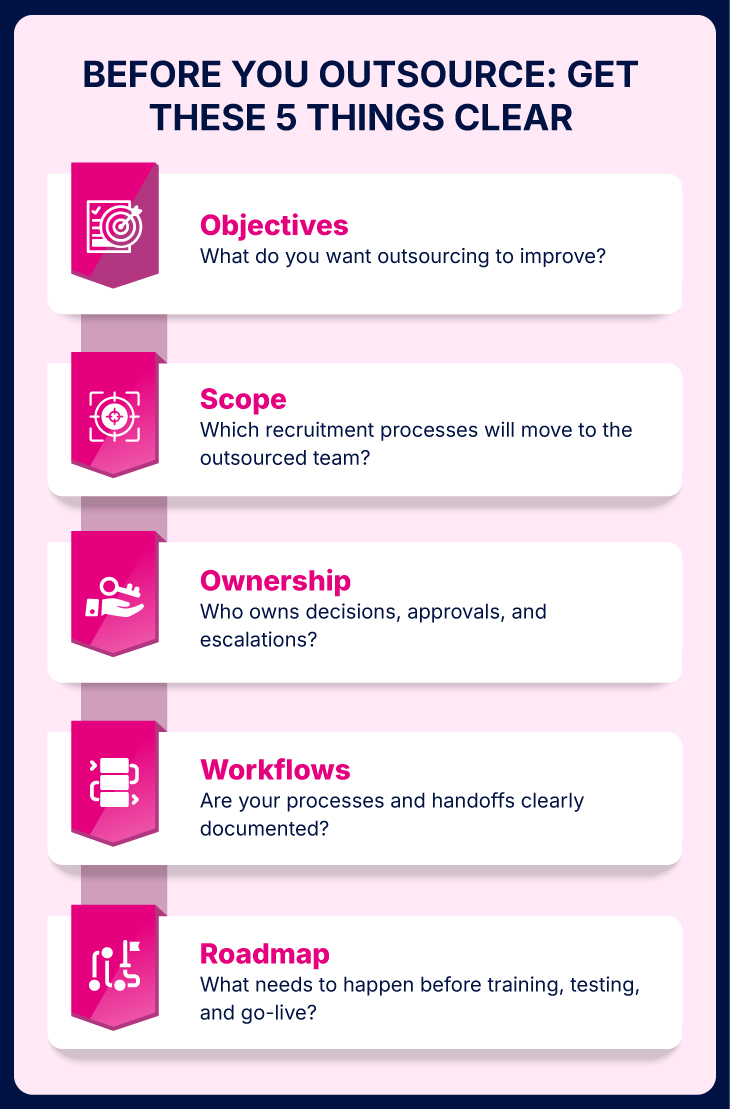
The strongest recruitment outsourcing strategy begins before the outsourced recruiters start working. Agencies should first understand their existing operation and establish what they expect outsourcing to improve.
Start by identifying why the agency is outsourcing. Is the priority to increase sourcing capacity? Reduce administrative workload? Provide after-hours coverage? Support high-volume accounts? Improve scalability?
Avoid broad objectives such as “increase efficiency.” Translate the goal into outcomes that can actually guide the implementation. If the objective is to give onshore recruiters more time for candidate and client relationships, for example, identify the administrative and sourcing activities currently consuming that time.
Clear objectives make it considerably easier to decide the required outsourcing scope and later determine whether the model is delivering value.
Every outsourced activity needs an owner on both sides. The staffing agency should identify the people responsible for operational decisions, system access, training, compliance, performance reviews, and escalations.
This prevents routine questions from bouncing between multiple managers after go-live. It also creates an obvious escalation route when an issue requires a quick decision.
Recruitment outsourcing transition teams can play an important role here. QX’s existing guidance describes transition teams as a bridge between sales and operations, supporting areas such as process mapping, risk management, workflow documentation, and communication.
Rather than treating implementation as one large handover, divide it into stages. A practical recruitment outsourcing implementation plan may cover:
Assign owners, dependencies, and agreed milestones to each stage. This helps everyone understand what must happen before the next phase starts rather than rushing toward an arbitrary launch date.

Not every staffing company needs to outsource the same activities. The implementation scope should reflect the agency’s recruitment model, internal capabilities, client requirements, and operational bottlenecks.
Sourcing is often suited to a clearly defined workflow because agencies can establish requirements around job intake, search criteria, candidate databases, screening questions, and submission quality.
If sourcing and screening are included, document what constitutes a qualified candidate and what information must be captured before the candidate progresses.
Interview scheduling, database updating, candidate communication, document management, onboarding administration, and similar repetitive activities can consume a significant part of recruiters’ working day.
For these processes, the implementation plan should specify where the task begins, what information is required, which systems are updated, and how completion is recorded.
Healthcare and other regulated staffing sectors may require significant compliance and credentialing support. QX, for example, lists regulatory credentialing, compliance, and back-office support among its recruitment outsourcing services.
Because these activities can involve sensitive information and specific requirements, responsibilities and approval points should be clearly agreed before work moves to the outsourced team.
Agencies can also outsource broader or full-cycle recruitment activities depending on their operating model. QX describes its full-cycle recruitment support as covering the process from understanding job requirements through onboarding
When transitioning a wider recruitment scope, implementation becomes even more important because more systems, handoffs, stakeholders, and decision points are involved.
Agencies still deciding which delivery model fits their requirements can compare the Best Recruitment Outsourcing Companies before building their implementation plan.

Knowledge sitting in someone’s head cannot be transferred reliably. Before recruitment process transition begins, agencies should turn everyday recruitment activities into documented workflows.
For every process being outsourced, identify the trigger, required inputs, main steps, systems involved, decision points, expected output, and final handoff.
Take candidate submission as an example. The workflow might need to establish where job requirements are received, how candidates are screened, what information must exist in the ATS, who reviews the candidate, and who approves submission to the client.
Standard operating procedures often explain what happens when everything works correctly. Outsourced teams also need to know what happens when it doesn’t.
Document common exceptions and escalation routes. What happens when candidate information is incomplete? What if the ATS record already exists? Who handles a client-specific exception? Which decisions require internal approval?
These details reduce uncertainty once live work starts.
Avoid turning every SOP into an enormous instruction manual. Use practical formats such as process steps, checklists, screenshots, templates, decision trees, and escalation matrices where appropriate.
The objective is simple: someone trained in the role should be able to understand the workflow and know what to do, where to record it, and when to escalate.
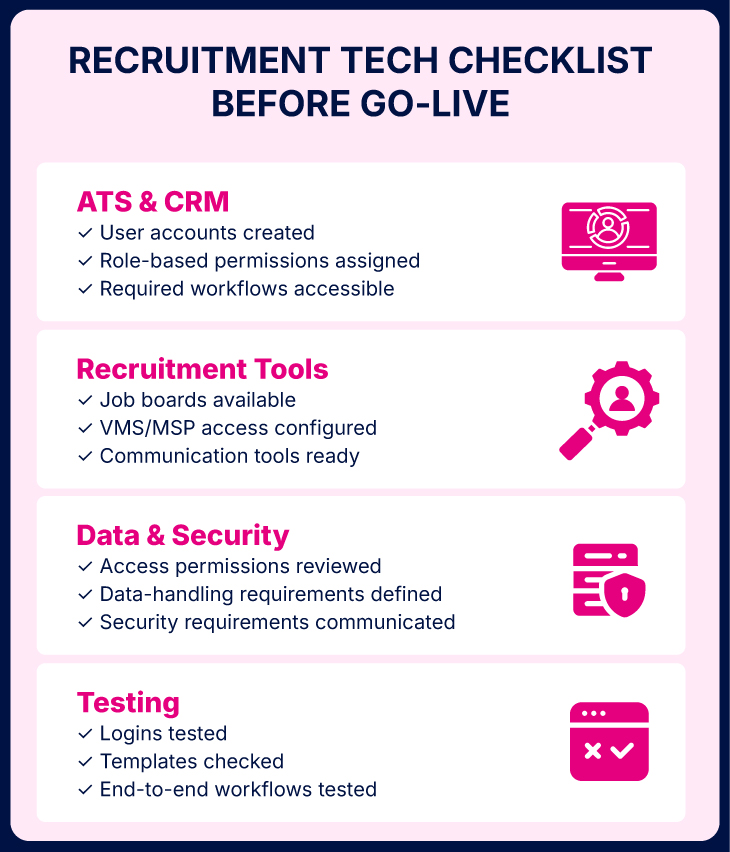
Technology preparation should happen before training and testing, not on the morning of go-live.
List the ATS, CRM, job boards, communication platforms, VMS/MSP platforms, candidate databases, reporting tools, and other systems the outsourced team will need for the processes in scope.
Then map system access against roles. Not every team member necessarily requires the same level of access.
Agree how candidate and client data should be accessed, handled, stored, and shared within the outsourced workflow. Internal IT, security, and compliance stakeholders should determine the appropriate permissions and controls for the agency’s environment.
Access should support the agreed work without unnecessarily extending permissions beyond the user’s role.
System access should ideally be working before hands-on process training begins. Otherwise, training becomes theoretical and practical issues remain undiscovered until later.
Test logins, workflow permissions, required integrations, templates, and relevant system functions as part of the recruitment outsourcing setup.
Knowledge transfer is where documented processes become operational knowledge.
QX’s guidance on recruitment outsourcing transitions describes structured knowledge transfer as sharing relevant information about client operations, compliance needs, and hiring goals, supported by documentation and regular communication/
Do not begin training with clicks and system screens. Help the outsourced recruiters understand the staffing agency’s business, sectors, candidate profiles, client expectations, terminology, and the purpose behind each process.
A recruiter who understands why a step matters is better equipped to handle genuine operating situations than someone who has simply memorized instructions.
Walk through representative examples of jobs, candidates, submissions, communications, and system updates. Demonstrations help connect written SOPs with how work actually moves through the agency.
The outsourced team should also see how internal recruiters handle exceptions and judgment calls.
Knowledge transfer should be two-way. Ask the outsourced team to walk the process back, complete practice activities, and identify uncertainties.
Questions raised at this stage are useful. They expose gaps in SOPs or assumptions before those gaps affect live recruitment.
Recruitment outsourcing onboarding should prepare the outsourced team to operate as part of the agency’s recruitment workflow, rather than as an isolated external resource.
A sourcer does not require the same training as a compliance specialist or recruitment administrator. Build training around the tasks, systems, KPIs, and escalation routes relevant to each person’s responsibilities.
Role-based training keeps onboarding focused while ensuring important responsibilities are covered.
Where outsourced recruiters support specific accounts or sectors, training should cover relevant client expectations, terminology, candidate profiles, processes, and documented compliance requirements.
This is particularly important when recruiters are working with multiple accounts where seemingly similar recruitment processes may operate differently.
Agree how the internal and outsourced teams will communicate from day one. This may include structured check-ins, operational reviews, performance discussions, and an escalation route for urgent matters.
The purpose is not to create unnecessary meetings. It is to ensure questions, feedback, and decisions have a defined path.
The first time a workflow runs end to end should ideally not be with a critical live requirement.
A pilot allows the agency to test the recruitment outsourcing plan for staffing agencies with a limited scope before expanding it.
The pilot might focus on selected roles, clients, processes, or recruiters. The appropriate scope depends on the agency’s operating model and the activities being transferred.
Do not test individual tasks in isolation. Follow a process from its starting point through every system update, approval, communication, and handoff.
This can expose gaps that are easy to miss during documentation, such as unclear ownership or missing system permissions.
Create an issue log during testing. Record the problem, owner, corrective action, and status.
Once the agreed pilot processes operate consistently, the agency can progressively expand the outsourced scope instead of moving every activity at once.

Go-live is not the end of recruitment outsourcing implementation. The early operating period should be used to stabilize delivery, identify problems, and improve workflows.
The first month should focus heavily on process adherence and operational stability.
Monitor whether workflows are being followed, system updates are accurate, responsibilities are understood, issues are being escalated correctly, and communication between teams is working.
Once workflows become more stable, focus on recurring bottlenecks and avoidable delays.
Review performance against the KPIs agreed in the outsourcing plan. Look at where work is being returned, repeated, delayed, or unnecessarily handed between teams. Update SOPs where actual operating experience shows that the documented process needs refinement.
By this stage, the agency should have a clearer picture of how the operating model is performing.
Review the original outsourcing objectives, agreed service metrics, workflow efficiency, stakeholder feedback, and the team’s ability to manage expected volumes. Based on these results, decide whether processes should be refined, kept at their current scope, or expanded.
Moving multiple complex workflows simultaneously can make problems harder to identify and resolve. A phased rollout gives teams an opportunity to learn before additional scope is introduced.
If the outsourced team receives incomplete SOPs, individual recruiters may interpret processes differently. Document the workflow before transferring the workflow.
Confusion arises when both teams assume the other owns a task. Responsibility mapping should make ownership, approval, handoff, and escalation clear.
Without the correct recruitment systems, meaningful hands-on training and testing become difficult. Build system readiness into the implementation plan rather than treating access as an administrative afterthought.
Initial processes will often need refinement once they encounter real operating conditions. Maintain structured reviews during the stabilization period and update SOPs as agreed processes evolve.
High activity does not automatically mean good recruitment outcomes. Build a balanced performance framework based on the processes outsourced, combining operational indicators with relevant recruitment outcomes.
A successful outsourcing relationship requires more than providing additional recruiter capacity. The partner needs to fit into the staffing agency’s existing workflows, technology, requirements, and delivery expectations.
QX Global Group provides outsourced recruiting services across areas including full-cycle recruitment, sourcing and screening, MSP/VMS support, compliance and recruitment administration. Its services are designed to scale according to changing recruitment needs.
QX’s published approach to transition management also emphasizes knowledge transfer, transition planning, team integration, and ongoing process improvement.
For staffing firms, that means the outsourcing conversation does not need to stop at what should we outsource? The equally important question is how will we move that work into the new operating model without disrupting recruitment operations?
The success of recruitment outsourcing depends heavily on what happens before and immediately after go-live.
A clear recruitment outsourcing implementation plan gives staffing agencies a structured way to define scope, document processes, prepare systems, transfer knowledge, onboard recruiters, test workflows, and measure early performance.
Instead of treating outsourcing as a one-time handoff, treat it as a controlled operational transition. Start with the right processes, validate the model, fix what is not working, and scale from there.
There is no single implementation timeline that applies to every staffing agency. The duration depends on factors such as the number and complexity of processes being transferred, technology requirements, team size, documentation readiness, training needs, and whether the agency is using a phased rollout. A limited sourcing engagement, for example, will generally require a less complex implementation than a broad full-cycle recruitment transition.
A staffing agency should appoint a clear internal implementation owner who can coordinate operations, IT, compliance, recruitment leadership, and the outsourcing partner. Individual workstreams can have separate owners, but there should be clear accountability for decisions, dependencies, issues, and overall implementation progress.
Not necessarily. Agencies can outsource specific recruitment stages or use broader end-to-end models depending on their needs. Recruitment Process Outsourcing | TRS Staffing A phased transition can be particularly useful where an agency wants to validate workflows and responsibilities before introducing additional processes.
A pilot is a practical way to test the operating model before extending it across a larger recruitment scope. Agencies can use the pilot to check workflows, system access, handoffs, communication, process adherence, and reporting. Issues discovered can then be addressed before the arrangement is expanded.
The outsourced team should have the approved access required for hands-on training and process testing before go-live. Access decisions should follow the staffing agency’s own IT, security, compliance, and permission requirements. This allows teams to validate the actual workflow rather than discovering access problems once live recruitment work begins.
QX Global Group provides U.S. staffing firms with recruitment outsourcing support across full-cycle recruitment, MSP/VMS recruitment, sourcing and screening, compliance, credentialing, and administrative processes. Best Recruitment Outsourcing Services USA – QX’s published transition approach also covers areas such as knowledge transfer, transition planning, team integration, and process improvement. Transition Teams’ Role in Recruitment Outsourcing.
Combining recruitment outsourcing services with better processes and automation can help businesses reduce manual recruitment work and make better use of internal resources. QX Global Group combines recruitment expertise with technology-driven delivery and process improvements to streamline recruitment workflows and improve overall hiring efficiency.
Enjoyed our blog? Discover more about how our recruitment outsourcing process can slash your costs by up to 60%! Take the next step—book a call by entering your details.

Education:
PMP ,ITIL,SSLGB ,MBA - IMT in Strategy Management

Akash Goyal is a seasoned RPO and BPM transformation leader with over 20 years of global experience across the UK, US, and India. At QX Global Group, he leads RPO sales and operations, owning P&L, client growth, service delivery, and large-scale transitions.
His leadership is rooted in data-driven delivery, operational excellence, and building high-performance teams that scale efficiently and sustainably.
Expertise: RPO Leadership • Global Delivery Operations • Business Transformation • Client Strategy • Operational Excellence • Growth Enablement
Originally published Oct 15, 2026 07:10:46, updated Oct 23 2026
Topics: Recruitment Outsourcing Implementation Plan for Staffing Agencies, Recruitment Outsourcing Providers
21 Oct 2026
Choosing a recruitment outsourcing provider is easy. Choosing one that can actually work within your...
Read More13 Oct 2026
A busy recruiter can spend hours chasing documents, updating ATS records, coordinating interviews, a...
Read More