Topics: Executive Search, Executive Search & Headhunting, Executive Search Company
Posted on January 23, 2026
Written By Ranjana Singh




Most senior leaders are not scrolling job boards or applying through careers pages. They’re busy running teams, making decisions, and being held accountable for results. That single reality changes how executive hiring needs to work.
Traditional recruitment models are built for active candidates and open vacancies. However, leadership hiring demands a different approach, one that recognises discretion, influence, and long-term impact.
This is why you need executive search recruitment services. It is designed to identify and engage senior leaders who are not actively looking but may be open to the right opportunity when approached with context and intent.
In this guide, we break down what executive search recruitment really involves, how it works in practice, how it differs from standard recruitment, and when staffing firms should rely on a search-led approach to deliver leadership hires their clients can trust.

Executive search in recruitment is a specialized hiring approach designed for senior and leadership roles. Unlike traditional recruitment, it does not rely on job postings or inbound applications.
Executive search recruitment focuses on proactively identifying leaders who already have the experience, influence, and track record required for high-impact roles. These candidates are often passive. They are not actively applying, but may be open to the right opportunity if approached thoughtfully.
This approach is typically used for:
An experienced executive search recruiter leads the process, bringing market intelligence, leadership assessment capability, and confidentiality throughout the search.
Executive search recruitment is not a reactive hiring exercise. It follows a structured, research-driven process designed to reduce leadership hiring risk and improve long-term fit. Each stage builds on the previous one, ensuring senior hires are made with intent, not urgency. Here’s how the process looks:
The process starts by going beyond a standard job description. Executive search recruiters work closely with clients to understand what leadership success actually looks like in context. This includes the scope of decision-making, stakeholder expectations, team dynamics, and the role the leader will play in the organization’s future direction.
Clarifying these elements early helps avoid misalignment later and ensures the search is guided by outcomes, not just qualifications.
Once the leadership brief is clear, executive recruiting services conduct in-depth market research. This involves mapping where relevant leaders are currently working, understanding how competitive the talent market is, and identifying trends in leadership skills and experience.
This research helps set realistic expectations around availability, compensation, and timelines, allowing clients to make informed decisions rather than assumptions.
Senior leaders rarely apply for roles through job ads. Executive search recruitment addresses this by proactively identifying leaders who match the brief, even if they are not actively seeking a change.
Executive recruitment services focus on candidates with proven influence, track records, and credibility in the market, rather than relying on who happens to be available.

Approaching senior leaders requires discretion and professionalism. Candidates are contacted confidentially and engaged in conversations focused on alignment, impact, and long-term opportunity rather than transactional job changes.
This approach protects both the client’s brand and the candidate’s reputation, which is especially critical for sensitive or replacement hires.
Shortlisted candidates are evaluated not just on experience, but on leadership capability, motivation, and cultural fit. Executive search recruiters assess how individuals lead, influence stakeholders, and adapt to change.
Only candidates who meet both the technical and leadership criteria are presented to the client, along with insights and recommendations, enabling confident and informed hiring decisions.
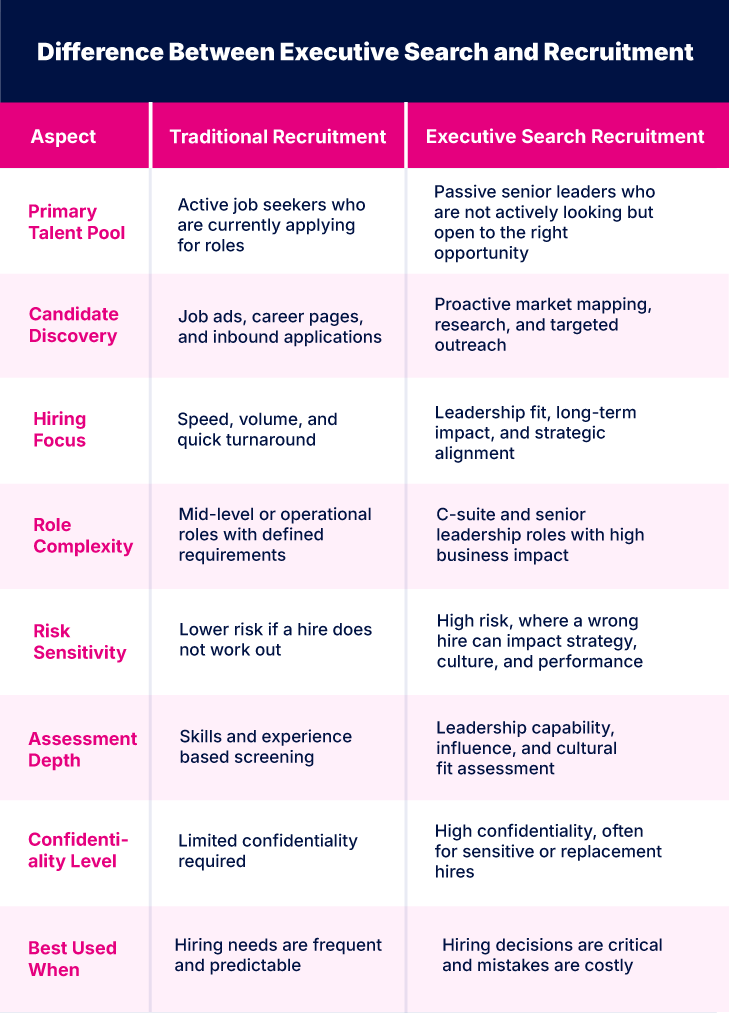
Although both aim to fill roles, executive search recruitment and traditional recruitment solve very different problems.
Traditional recruitment is designed for speed and efficiency. It works best when candidates are actively looking, skills are clearly defined, and hiring risk is relatively low.
Executive search recruitment is designed for precision and impact. Senior leaders are rarely active job seekers. They require proactive identification, careful engagement, and deeper assessment.
Another key difference is risk exposure. A poor leadership hire can affect teams, clients, and revenue. Executive search recruitment prioritizes long-term fit over fast placement.
Staffing firms and their clients choose executive search recruitment when the cost of getting leadership hiring wrong is high.
One of the biggest advantages is access to passive executive talent. Many senior leaders never apply through job postings. Executive search recruiters reach them directly.
Executive search also provides better decision-making support. Search recruiters bring insight into leadership availability, compensation benchmarks, and market trends. This helps clients make informed choices instead of reactive hires.
Most importantly, executive search recruitment reduces long-term risk. By assessing leadership behaviour, decision-making style, and cultural alignment, firms avoid costly turnover and misalignment.
The role of an executive search recruiter is to play a strategic advisory role, not a transactional one.
They help clients define what leadership success looks like, beyond skills and experience. This includes influence, adaptability, and alignment with business direction.
They also manage confidential communication, which is essential when replacing or hiring senior leaders.
Most importantly, they assess leadership capability, not just CVs. This includes how a leader manages change, handles stakeholders, and fits within organizational culture.
Executive search recruitment is guided by real-time market intelligence, not assumptions.
Search firms closely track leadership movement across competitors and related industries to understand where senior talent is concentrated and how demand is shifting. They also monitor compensation benchmarks, including incentives and role scope, to set realistic expectations early in the process.
In parallel, search firms identify emerging leadership skills that are becoming critical as industries evolve. This insight allows them to advise clients on talent availability, potential trade-offs, and hiring risks before a search begins.
This intelligence-driven approach helps staffing firms deliver more informed, confident leadership hires and is why many partner with the best executive search companies for recruitment outsourcing.

Executive search recruitment is most effective when leadership impact is high and the margin for error is low. It is commonly used for C-suite and senior leadership roles where decisions influence strategy, teams, and long-term performance.
It is also the preferred approach for confidential or sensitive replacements, niche leadership skill sets, and roles where a mis-hire would be costly both financially and reputationally. In these situations, a search-led approach provides greater precision, discretion, and confidence.
When leadership outcomes matter more than speed, executive search recruitment is usually the safer option.
Many staffing firms choose to outsource executive search recruitment instead of building large in-house leadership teams. This approach allows firms to support senior hiring needs without carrying long-term overheads or specialist resource gaps.
By outsourcing, staffing firms can extend their leadership hiring capability, access experienced executive recruiters, and scale search delivery up or down based on demand. It also helps maintain cost control while delivering consistent quality.
This is why Outsource Executive Recruiting has become a practical and flexible model for staffing firms supporting leadership hiring.
Without a search-led approach, staffing firms often struggle to deliver consistent results for senior roles. Access to passive executives is limited, making leadership hiring unpredictable, as job postings rarely reach experienced leaders who are already in role.
Hiring timelines also tend to stretch, since firms wait for the right profiles to surface instead of proactively identifying them. At the same time, the risk of poor leadership alignment increases, where candidates appear strong on paper but fail to perform in practice.
Over time, these challenges can impact delivery quality, client confidence, and long-term trust.
QX Global Group supports U.S. staffing firms with executive search recruitment backed by 20+ years of recruitment outsourcing experience.
QX combines research-led executive sourcing, leadership assessment, and automation to help staffing firms deliver consistent executive search outcomes. This approach enables leadership hiring at scale without expanding internal teams, while improving recruiter productivity and maintaining cost control.
Leadership hiring is not transactional. Executive search recruitment brings structure, insight, and discretion to high-impact hiring decisions.
Staffing firms that adopt a search-led approach strengthen client outcomes, reduce leadership risk, and build long-term credibility.
An executive search recruitment assignment in the U.S. typically takes 8 to 16 weeks, depending on the role’s seniority, complexity, and market availability. C-suite and niche leadership roles may take longer due to the need for discreet outreach, deeper assessment, and multiple stakeholder discussions. Unlike standard recruitment, executive search prioritises precision over speed to reduce long-term hiring risk.
Leadership traits such as decision-making ability, influence, adaptability, and cultural fit are the hardest to assess without executive search expertise. These qualities rarely appear clearly on CVs and are not always evident in short interviews. Executive search recruiters are trained to evaluate how leaders operate under pressure, manage stakeholders, and drive change, which is critical for senior roles.
Executive search recruitment supports diversity by expanding talent pools beyond active applicants. By proactively mapping the market and engaging passive leaders from varied backgrounds, search firms reduce reliance on limited or homogenous candidate pipelines. This approach helps staffing firms present more balanced and inclusive leadership shortlists while maintaining role and capability requirements.
Yes. Confidential replacement hiring is one of the most common use cases for executive search recruitment. Search-led approaches allow staffing firms and clients to discreetly identify and engage leaders without publicly advertising the role, protecting internal stability, leadership credibility, and employer brand throughout the process.
Staffing firms typically evaluate ROI by looking beyond time-to-hire alone. Key indicators include leadership retention, quality of hire, reduced mis-hire risk, and long-term client satisfaction. Executive search recruitment delivers value by minimising costly leadership failures and improving business outcomes, which often outweighs the upfront investment.
Enjoyed our blog? Discover more about how our recruitment outsourcing process can slash your costs by up to 60%! Take the next step—book a call by entering your details.

Education:
B.Com(Hons), Delhi University

Ranjana Singh is a data-driven B2B content marketer who loves creating well-researched content and blending it with storytelling. At QX, she leverages data insights and lead analysis to craft high-performing LinkedIn campaigns, blogs, newsletters, and sales collateral that drive MQLs and brand visibility across the US and UK markets. Her work is rooted in performance—every strategy starts with deep analysis of content metrics, funnel behavior, and audience engagement trends to deliver measurable marketing impact.
Expertise: Data-Backed Content Marketing Strategy, SEO & Organic Growth, LinkedIn & Newsletter Marketing, MQL Attribution & Lead Source Analysis, Recruitment Industry Marketing (US & UK),
Originally published Jan 23, 2026 08:01:44, updated Jan 23 2026
Topics: Executive Search, Executive Search & Headhunting, Executive Search Company
07 Nov 2025
Leadership hiring is not about filling a vacancy, it’s about shaping the direction of a company. O...
Read More12 Sep 2025
We understand the grind involved in looking for the RIGHT board-level or C-suite leaders, because th...
Read More22 Nov 2024
In the UK, executive search and headhunting challenges are some of the toughest recruiters. Hiring s...
Read More24 Apr 2023
Finding the right leadership talent is a critical challenge for businesses, especially in today’s ...
Read More