Topics: RPO Provider, RPO providers for hard to fill roles
Posted on September 16, 2026
Written By Saurabh Sharma




The longer a critical role remains vacant, the greater the impact on productivity, revenue, customer experience, and team performance. Yet many US companies are finding it increasingly difficult to hire for specialized positions, technical roles, healthcare jobs, leadership vacancies, and other hard-to-fill positions.
Traditional recruiting approaches often struggle when the talent pool is limited. Internal teams may not have the bandwidth, market intelligence, or sourcing reach required to identify and engage qualified candidates quickly. This is where RPO providers for hard-to-fill roles can make a meaningful difference.
Rather than simply filling vacancies, the right Recruitment Process Outsourcing (RPO) partner helps organizations expand sourcing capacity, access passive talent, improve hiring efficiency, and build stronger candidate pipelines.
In this blog, we’ll explore what makes a role difficult to fill, how Recruitment Process Outsourcing services support faster hiring, what capabilities matter when evaluating providers, and how companies can measure recruitment success.
Not every open position presents the same recruitment challenge. Some roles remain open for months because qualified candidates are scarce, while others require highly specific experience that limits the available talent pool.
Many industries continue to face talent shortages in critical areas. When demand significantly exceeds supply, recruiters often compete for the same small group of candidates. This makes sourcing more complex and lengthens hiring timelines. Organizations may also struggle to attract candidates if competing employers offer higher compensation or more attractive benefits.
Some positions require highly specialized expertise that cannot be easily developed through general experience. Roles involving cybersecurity, cloud engineering, AI, data science, advanced manufacturing, or specialized finance functions often fall into this category. Finding candidates with the right technical skills, certifications, and industry experience requires targeted sourcing strategies rather than traditional job advertising alone.
Healthcare organizations frequently encounter recruiting challenges for clinical specialists, therapists, nurses, and allied health professionals. Similar difficulties exist across engineering, legal, life sciences, and other professional disciplines where qualifications, licensing requirements, and experience expectations significantly narrow the candidate pool.
Leadership positions demand more than technical competence. Employers often seek candidates with proven leadership skills, industry expertise, strategic thinking capabilities, and cultural fit. Because many qualified executives are not actively seeking new opportunities, recruiting efforts often depend on proactive outreach and relationship building.
Location can significantly affect hiring outcomes. Companies operating in remote areas or regions with limited talent availability may struggle to attract qualified professionals. Even organizations in major cities can encounter challenges when specific skills are in short supply within their geographic market.
Some organizations need to hire numerous employees with very specific qualifications within a short timeframe. These positions combine the challenges of scale and specialization, requiring a recruitment strategy that can support both volume and quality simultaneously.
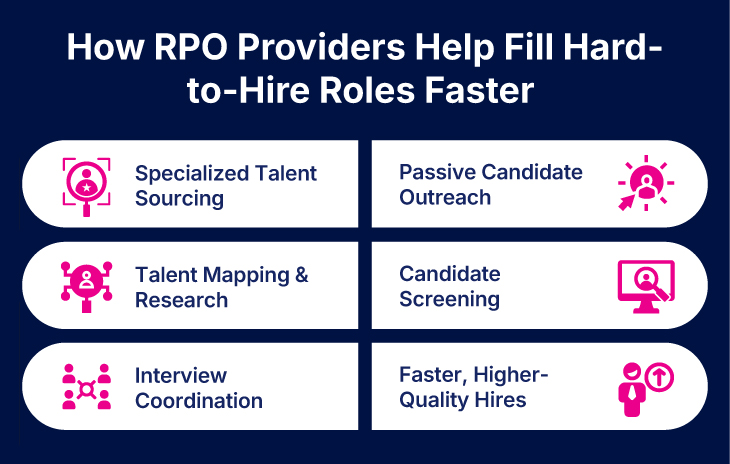
Organizations often turn to RPO services for hard-to-fill roles because they provide access to specialized recruiting expertise, advanced sourcing methods, and scalable recruitment support.
A strong Recruitment Process Outsourcing (RPO) provider develops sourcing strategies that go beyond job boards. Recruiters actively identify candidates through professional networks, niche talent communities, industry databases, referrals, and targeted outreach campaigns. This helps companies reach qualified candidates who may never apply directly.
Many of the best candidates for hard-to-hire roles are already employed and not actively seeking new opportunities. RPO teams specialize in identifying and engaging passive talent through personalized outreach and relationship-driven recruitment strategies.
Talent mapping provides visibility into candidate availability, competitor hiring activity, compensation trends, and emerging skill sets. This information enables organizations to make more informed hiring decisions and adjust sourcing strategies before recruitment challenges become critical.
Recruiters spend significant time reviewing resumes, conducting initial assessments, and validating qualifications. RPO providers streamline this process by applying structured screening methodologies that improve candidate quality while reducing recruiter workload.
Successful hiring often begins with market intelligence. Recruitment Process Outsourcing (RPO) teams conduct detailed research on talent pools, competitors, compensation benchmarks, and hiring trends. This information helps recruiters target the right candidates and improve search outcomes.
Scheduling interviews can become a major administrative burden, especially during large hiring initiatives. RPO providers manage interview logistics, communication, feedback collection, and candidate follow-ups to keep hiring processes moving smoothly.
Beyond sourcing, recruitment process outsourcing for hard-to-fill roles often includes administrative support, reporting, ATS management, compliance activities, and process coordination. These services allow internal recruiting teams to focus on strategic hiring priorities.

Choosing the right RPO partner requires evaluating specific capabilities rather than simply selecting the largest provider. The best RPO providers for hard-to-fill roles combine sourcing expertise, industry knowledge, scalable support, and proven recruitment processes that help organizations hire qualified candidates faster.
Hard-to-fill roles often require niche skills that are difficult to find through traditional job postings. An RPO provider should have experience sourcing candidates for specialized positions within your industry and access to multiple talent channels. Their ability to identify qualified candidates quickly can significantly reduce hiring delays.
Experienced recruiters understand industry-specific requirements, hiring challenges, and candidate expectations. They know how to assess technical skills, evaluate cultural fit, and engage talent effectively. This expertise helps improve candidate quality and ensures hiring managers spend less time reviewing unsuitable applicants.
The best RPO providers focus on building long-term talent pipelines rather than reacting only when vacancies arise. By continuously engaging potential candidates, they create a pool of qualified talent that can be accessed when hiring needs emerge. This proactive approach helps reduce future time-to-fill.
An RPO provider should be able to work seamlessly with your Applicant Tracking System (ATS) and HR technology stack. Strong integration improves workflow efficiency, allows better collaboration between teams, and ensures recruitment data remains accurate and accessible throughout the hiring process.
Hiring requirements can change quickly due to business growth, seasonality, or project demands. A strong RPO partner should be able to increase or reduce recruitment support as needed without impacting hiring quality. This flexibility allows organizations to manage fluctuating workloads more effectively.
Speed is critical when hiring for competitive and hard-to-hire roles. Companies should assess how quickly providers can source candidates, submit shortlists, and support the hiring process. Faster turnaround times can prevent losing qualified candidates to competing employers.
Consistent hiring success depends on strong recruitment processes and clear quality standards. Providers should have structured screening methods, candidate evaluation criteria, and ongoing performance reviews in place. This helps ensure that submitted candidates align closely with job requirements.
Data-driven recruitment enables better decision-making. An effective RPO provider should offer transparent reporting on sourcing activity, hiring progress, candidate quality, and key performance metrics. Regular performance reviews help identify opportunities for continuous improvement.
Recruitment strategies that work in one market may not be effective in another. Providers supporting US employers should understand local labor market conditions, compensation expectations, industry trends, and candidate behavior. This knowledge helps improve sourcing strategies and hiring outcomes.
Every company has unique recruitment needs. Some may require end-to-end RPO support, while others only need sourcing, screening, or recruitment administration. A flexible provider can tailor services to business goals, hiring volumes, and budget requirements.
Also Read: Top Recruitment Process Outsourcing (RPO) Companies for US Staffing Firms: What Defines Excellence?
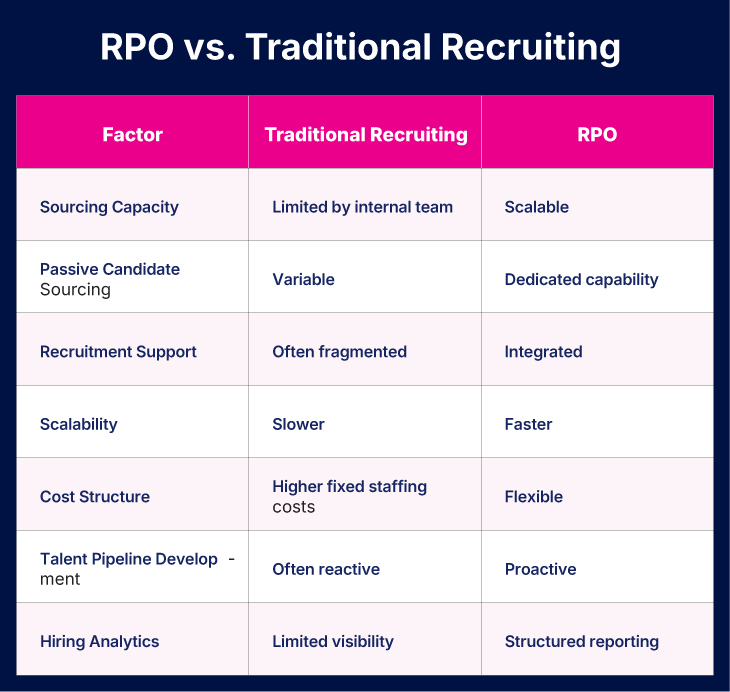
For organizations struggling with persistent talent shortages, RPO often provides greater flexibility, deeper sourcing capabilities, and stronger recruitment scalability than traditional recruiting approaches.
Many companies do not require a full end-to-end RPO solution. Instead, they benefit from targeted support through recruitment outsourcing services designed to strengthen specific parts of the hiring process.
Additional recruitment resources provide immediate capacity when internal teams are managing high requisition volumes or difficult searches.
Specialized sourcing teams focus on identifying and engaging qualified candidates across multiple channels.
Recruitment professionals conduct preliminary assessments and deliver more qualified candidates to hiring managers.
Administrative tasks such as interview scheduling, ATS updates, and candidate communication are handled efficiently to improve recruitment productivity.
Research teams provide hiring intelligence, talent mapping, and market insights to support more effective recruitment strategies.
Organizations gain the flexibility to increase or decrease recruiting support based on hiring needs.
Companies seeking additional recruitment capacity may consider Recruitment Outsourcing Services, which can complement internal recruiting efforts while improving sourcing efficiency and recruiter productivity.
QX Global Group supports recruitment teams through candidate sourcing, screening, recruitment administration, recruitment research, and scalable recruiting support designed to help organizations manage hiring demand more effectively.
The success of recruitment outsourcing for hard-to-fill roles should be evaluated using measurable hiring outcomes. Tracking the right KPIs helps organizations understand whether their RPO partner is improving recruitment efficiency, candidate quality, and overall hiring performance.
Time-to-fill measures the number of days required to fill a vacancy from requisition approval to accepted offer. This metric indicates how efficiently the recruitment process is operating. A shorter time-to-fill often reflects effective sourcing strategies and strong recruiter performance.
This KPI tracks how quickly recruiters present qualified candidates after receiving a job requirement. Faster submission times indicate efficient sourcing processes and strong candidate networks. It is particularly important for hard-to-hire roles where speed can influence hiring success.
The qualified candidate ratio measures the percentage of sourced candidates who meet job requirements. A higher ratio suggests recruiters understand hiring needs and are delivering relevant talent. It is a useful indicator of sourcing quality and recruitment effectiveness.
This metric measures how many submitted candidates progress to the interview stage. A strong ratio indicates that recruiters are presenting suitable candidates who align with hiring manager expectations. Low ratios may suggest a need for better screening or sourcing refinement.
Interview-to-hire ratio evaluates how many interviews are required to make a successful hire. Efficient recruitment processes generally produce higher-quality candidates who move through the hiring process successfully. This KPI helps assess both sourcing accuracy and candidate quality.
Cost-per-hire measures the total recruitment investment required to fill a role. It includes sourcing, recruitment support, technology, and hiring costs. Tracking this metric helps organizations understand the financial impact and value of their RPO partnership.
A strong talent pipeline reduces dependency on last-minute hiring efforts. Measuring pipeline size helps determine whether recruiters are continuously building relationships with potential candidates. Larger and more qualified pipelines support faster hiring during future recruitment cycles.
Offer acceptance rate tracks the percentage of candidates who accept job offers. A high acceptance rate suggests effective candidate engagement, strong employer branding, and realistic expectations throughout the hiring process. It is often a key indicator of overall recruitment success.
Selecting an RPO provider requires more than comparing costs or service offerings. Organizations should evaluate potential partners based on their ability to solve hiring challenges, improve recruitment outcomes, and support long-term workforce growth.
Start by identifying which roles are difficult to fill and understanding the reasons behind these challenges. Factors such as skills shortages, geographic limitations, or high hiring volumes can influence the type of support required. Clear objectives make it easier to select the right provider.
Not every organization requires full-cycle recruitment support. Some may only need candidate sourcing, screening, recruitment research, or administrative assistance. Defining the scope of support helps ensure the engagement aligns with business needs and budgets.
A provider’s sourcing approach is one of the most important factors to assess. Look for expertise in passive candidate sourcing, talent mapping, and specialized talent acquisition. Strong sourcing capabilities often determine success in filling difficult positions.
Technology plays a critical role in recruitment efficiency. Ensure the provider can integrate with your ATS, CRM, and recruitment platforms to streamline workflows, improve visibility, and maintain accurate hiring data.
Business needs can change quickly, especially during periods of growth or market shifts. The right RPO (Recruitment Process Outsourcing) partner should be able to expand recruitment support when hiring demand increases and adjust resources when requirements decline.
Clearly defined KPIs create accountability and provide a framework for measuring success. Metrics such as time-to-fill, candidate quality, cost-per-hire, and offer acceptance rate help ensure both parties are aligned on expected outcomes.
Starting with a pilot engagement allows companies to evaluate the provider’s processes, communication, and performance before expanding the partnership. It also helps identify potential challenges early and reduces implementation risks.
Successful outsourcing relationships depend on transparency and collaboration. Companies should review how providers manage reporting, stakeholder communication, issue resolution, and performance reviews. Strong governance creates better alignment and supports long-term success.

RPO (Recruitment Process Outsourcing) for hard-to-fill roles is a recruitment outsourcing model where a specialized provider supports part or all of the hiring process for difficult, niche, or highly specialized positions.
RPO providers use specialized talent sourcing, passive candidate sourcing, talent mapping, recruitment research, and dedicated recruiting resources to identify qualified candidates more efficiently.
Organizations can outsource candidate sourcing, screening, interview coordination, recruitment administration, talent mapping, reporting, onboarding support, and full-cycle recruiting activities.
Companies should assess sourcing expertise, recruiter experience, technology capabilities, scalability, reporting quality, industry knowledge, and measurable hiring outcomes.
Common KPIs include time-to-fill, time-to-submit, qualified candidate ratio, cost-per-hire, interview-to-hire ratio, offer acceptance rate, and candidate pipeline growth.
The answer depends on hiring needs. RPO generally provides broader recruitment support, stronger scalability, deeper process integration, and more consistent talent acquisition support than traditional contingency recruiting.
Yes. Outsourced recruitment services USA can provide sourcing, screening, recruitment administration, and research support that helps organizations fill hard-to-hire positions more efficiently.
QX Global Group provides scalable recruitment support, candidate sourcing, screening, recruitment research, and operational assistance designed to help organizations improve hiring efficiency, strengthen candidate pipelines, and manage complex recruitment demands.
Companies looking to fill hard-to-hire roles often work with RPO providers that offer specialized sourcing, talent mapping, candidate screening, and scalable recruitment support. QX Global Group is one such provider, helping businesses access qualified talent faster through dedicated sourcing teams and recruitment support services.
Enjoyed our blog? Discover more about how our recruitment outsourcing process can slash your costs by up to 60%! Take the next step—book a call by entering your details.

Education:
Prince2 Certification – Project Management, Executive MBA, Great Lakes Institute of Management, Diploma in Business Management, ICFAI University

Saurabh Sharma is an experienced operations and client management leader with over 15 years of expertise in scaling recruitment and delivery operations. At QX Global Group, he plays a pivotal role in planning, monitoring, and executing large-scale business operations while ensuring operational excellence and strong client partnerships.
He brings deep capability in policy formulation, performance improvement, and leadership development, consistently driving growth and service quality across multiple functions.
Expertise: Recruitment Operations • RPO Delivery • Client Relationship Management • Business Planning • Leadership Development
Originally published Sep 16, 2026 08:09:26, updated Oct 07 2026
Topics: RPO Provider, RPO providers for hard to fill roles
21 Sep 2026
A company can plan for growth, launch a new product line, open additional locations, or secure a maj...
Read More