Topics: Offshore RPO, RPO Provider
Posted on September 21, 2026
Written By Akash Goyal




A company can plan for growth, launch a new product line, open additional locations, or secure a major client contract, only to discover that hiring enough qualified talent quickly becomes the biggest challenge. As hiring volumes increase, internal recruitment teams often struggle to keep up with sourcing, screening, interview coordination, and candidate management. What starts as a hiring initiative can quickly turn into a recruitment bottleneck.
High-volume hiring places significant pressure on recruiters, hiring managers, and recruitment operations. Delays in finding qualified candidates, administrative overload, and inconsistent candidate communication can impact business performance and growth plans. Hiring managers need a steady flow of qualified talent, but building enough internal recruitment capacity is not always practical or cost-effective.
This is where end-to-end RPO solutions for high-volume hiring can help. By partnering with experienced recruitment specialists, organizations gain access to scalable resources, structured recruitment processes, and dedicated support throughout the hiring lifecycle.
In this guide, we’ll explore what an end-to-end RPO solution includes, how RPO providers for high-volume hiring support recruitment at scale, what capabilities organizations should evaluate when selecting a provider, and how companies can measure recruitment success.

Recruitment Process Outsourcing (RPO) is a recruitment model in which an external partner manages some or all aspects of the hiring process. An end-to-end recruitment outsourcing engagement covers the complete recruitment lifecycle rather than focusing on isolated recruitment activities.
In a high-volume hiring environment, organizations often require support across multiple stages simultaneously. Recruiters may need to source hundreds of candidates, coordinate dozens of interviews, and manage high levels of candidate communication. An end-to-end RPO solution provides the resources and processes necessary to handle this complexity efficiently.
Instead of building large internal teams to accommodate fluctuating hiring demand, organizations can leverage high-volume RPO services USA to obtain flexible recruitment capacity that scales as business requirements change.
A successful high-volume hiring program begins with a well-defined recruitment strategy. Before candidate sourcing starts, organizations must understand hiring goals, workforce requirements, location-specific talent needs, and projected hiring volumes. Without a structured plan, recruitment efforts often become reactive and inefficient.
An experienced RPO provider helps organizations create a strategic hiring framework aligned with business objectives. This includes workforce planning, hiring forecasts, resource allocation, and recruitment process optimization. A strong strategy ensures recruitment efforts remain focused on attracting the right candidates while minimizing delays and unnecessary costs.
Candidate sourcing is one of the most important functions within high-volume recruitment outsourcing. As hiring needs increase, internal teams may struggle to generate a consistent pipeline of qualified candidates through traditional methods alone.
RPO providers utilize multiple sourcing channels, including job boards, social platforms, talent databases, referrals, and passive candidate networks. Dedicated sourcing specialists continuously identify and engage candidates, helping organizations maintain a steady flow of talent while reducing recruiter workload.
Building talent pipelines before vacancies arise is essential for scalable hiring. Organizations that wait until positions open often experience longer hiring cycles and increased recruitment costs.
An end-to-end RPO provider continuously develops talent pools for recurring and high-demand roles. This proactive approach improves hiring speed, ensures greater candidate availability, and enables organizations to respond quickly when hiring demand increases.
High-volume recruitment frequently generates large numbers of applications, making candidate screening a time-consuming process. Internal recruiters can become overwhelmed when reviewing hundreds or thousands of resumes.
RPO providers establish structured screening and qualification processes that help identify suitable candidates quickly. This may include resume reviews, pre-screening interviews, skills validation, qualifications verification, and candidate assessments. As a result, hiring managers spend more time meeting qualified candidates and less time reviewing unsuitable applications.
Interview coordination often becomes a significant operational challenge during periods of rapid hiring. Managing interviewer availability, scheduling multiple interview rounds, and communicating with candidates requires considerable administrative effort.
Dedicated RPO teams support interview scheduling and coordination activities, helping to streamline communication between hiring managers and candidates. Faster interview processes improve candidate experience and reduce the risk of losing talent to competing employers.
Consistent communication is essential for maintaining candidate engagement. Delayed responses or poor communication can lead to candidate drop-off, particularly in competitive hiring markets.
An end-to-end RPO provider manages candidate communication throughout the recruitment journey. From initial outreach and interview updates to feedback and offer discussions, structured communication helps create a positive candidate experience and strengthens employer branding.
Securing candidate acceptance requires efficient offer coordination and onboarding support. During high-volume recruitment campaigns, delays at this stage can affect hiring outcomes and increase candidate attrition.
RPO providers help manage offer documentation, candidate communication, onboarding coordination, and administrative processes. This support ensures successful candidates move through the hiring journey quickly and smoothly.
Administrative responsibilities often consume valuable recruiter time. Activities such as maintaining candidate databases, updating ATS records, managing documentation, and preparing reports are critical but can reduce recruiter productivity.
This is where recruitment administration support becomes valuable. By handling administrative tasks and reporting requirements, RPO providers enable recruiters to focus on sourcing, candidate engagement, and recruitment outcomes while maintaining efficient recruitment workflow management.
The primary advantage of end-to-end RPO solutions for high-volume hiring is scalability. Hiring demand rarely remains constant, and organizations need recruitment support that can expand or contract accordingly.
A strong RPO provider should demonstrate the ability to quickly increase recruitment capacity for hiring spikes while maintaining service quality. This flexibility helps organizations adapt to changing business conditions without overinvesting in permanent recruitment resources.
The ability to generate qualified candidates consistently is critical for high-volume hiring success. Organizations should evaluate the provider’s sourcing team size, talent mapping capabilities, and candidate generation processes.
Strong sourcing capacity enables recruitment teams to build talent pipelines faster and maintain hiring momentum even when multiple positions need to be filled simultaneously.
Modern recruitment relies heavily on technology to improve efficiency and visibility. Organizations should evaluate whether an RPO provider uses tools that support automation, reporting, candidate relationship management, and workflow optimization.
The right technology infrastructure can reduce manual effort, improve recruiter productivity, and provide valuable insights into hiring performance.
Recruitment technology works best when systems communicate effectively. A capable RPO provider should be able to integrate seamlessly with existing Applicant Tracking Systems and recruitment platforms.
Seamless integration improves collaboration, reduces duplication of work, and ensures all stakeholders have visibility into recruitment activities and candidate progress.
Recruitment outcomes depend heavily on recruiter capability. Organizations should assess whether the provider has experience supporting similar industries, job functions, and hiring volumes.
Recruiters with domain expertise understand candidate markets, sourcing strategies, and hiring challenges better, allowing them to identify qualified candidates more efficiently.
Candidate experience can influence hiring success significantly. Poor communication, lengthy hiring processes, and unclear expectations often cause candidates to withdraw from recruitment processes.
An effective RPO provider should prioritize candidate engagement and deliver a consistent, professional experience throughout the recruitment lifecycle.
Large recruitment campaigns should not compromise hiring quality. RPO providers should implement quality assurance measures that ensure consistent screening standards, candidate evaluations, and recruitment processes.
This helps organizations maintain hiring quality while achieving recruitment targets.
Recruitment decisions should be supported by accurate data. Detailed reporting helps organizations understand hiring performance, identify bottlenecks, and improve recruitment strategies.
Providers offering advanced analytics and reporting capabilities give organizations greater visibility into recruitment outcomes and operational performance.
Organizations hiring across multiple regions often require recruitment support that extends beyond a single location. Geographic reach can improve talent access and support expansion initiatives.
A provider with broad market coverage may help organizations build diverse talent pipelines across different hiring locations.
Every organization has different recruitment needs. Some may require full recruitment process outsourcing, while others may only need support for selected functions.
Flexible delivery models allow organizations to customize support levels according to hiring requirements and budget considerations.

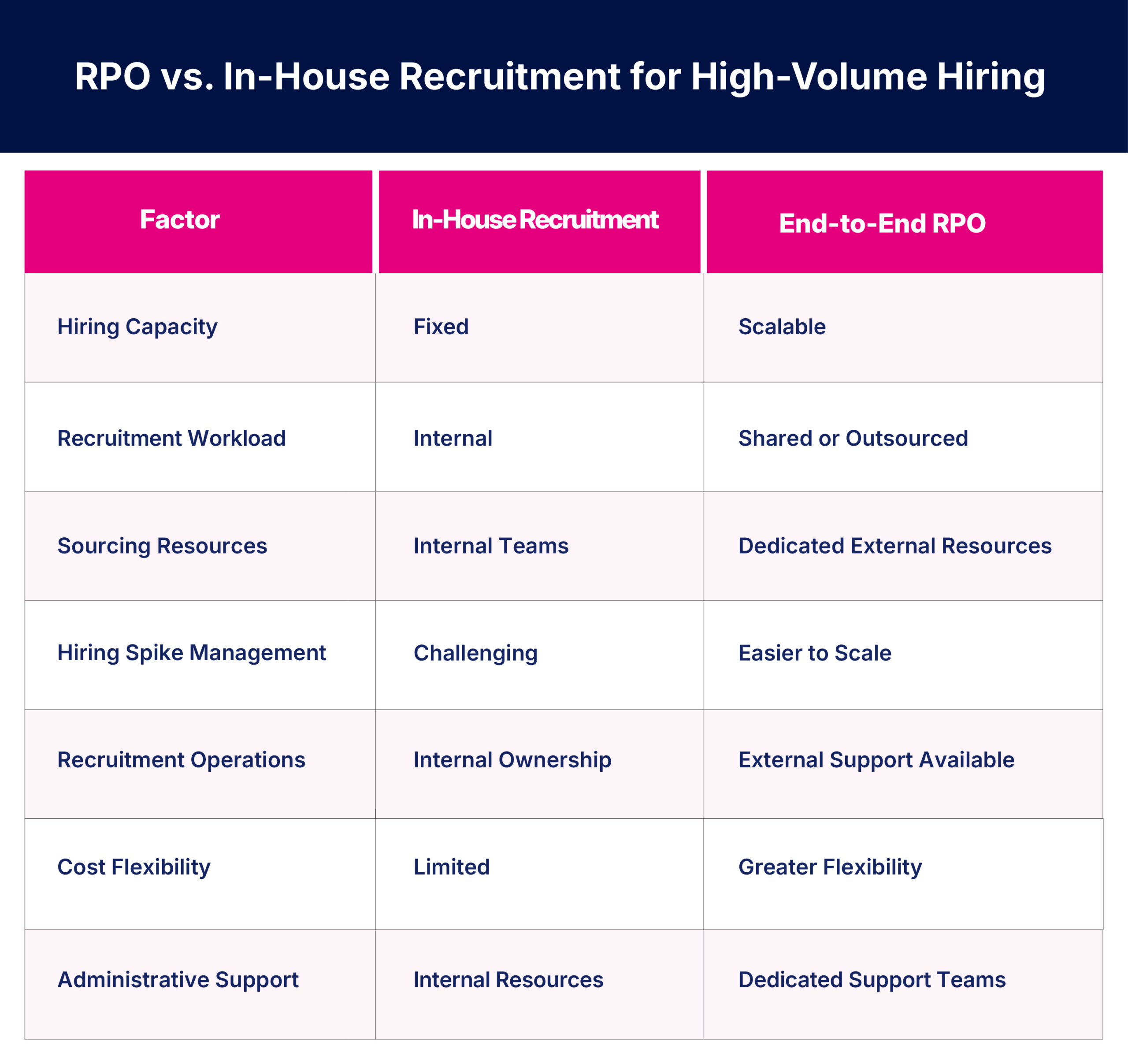
For many organizations, high-volume recruitment outsourcing provides greater flexibility and access to specialized recruitment expertise compared with relying solely on internal recruitment teams.
Not every organization needs a full-scale RPO engagement. In many cases, businesses simply need additional recruitment capacity to support hiring goals and reduce pressure on internal teams.
Outsourced recruiting services can provide support across a range of activities, including candidate sourcing, screening, recruitment research, talent database management, interview coordination, and recruitment administration.
By leveraging external recruitment resources, organizations can improve recruitment operations without increasing permanent headcount. Dedicated support teams help manage repetitive and time-intensive activities, allowing internal recruiters to focus on strategic hiring decisions and stakeholder engagement.
QX Global Group supports organizations with flexible recruitment solutions designed to improve sourcing capacity, streamline recruitment workflows, and create more efficient hiring processes. This allows businesses to achieve scalable recruitment while maintaining control over hiring outcomes.
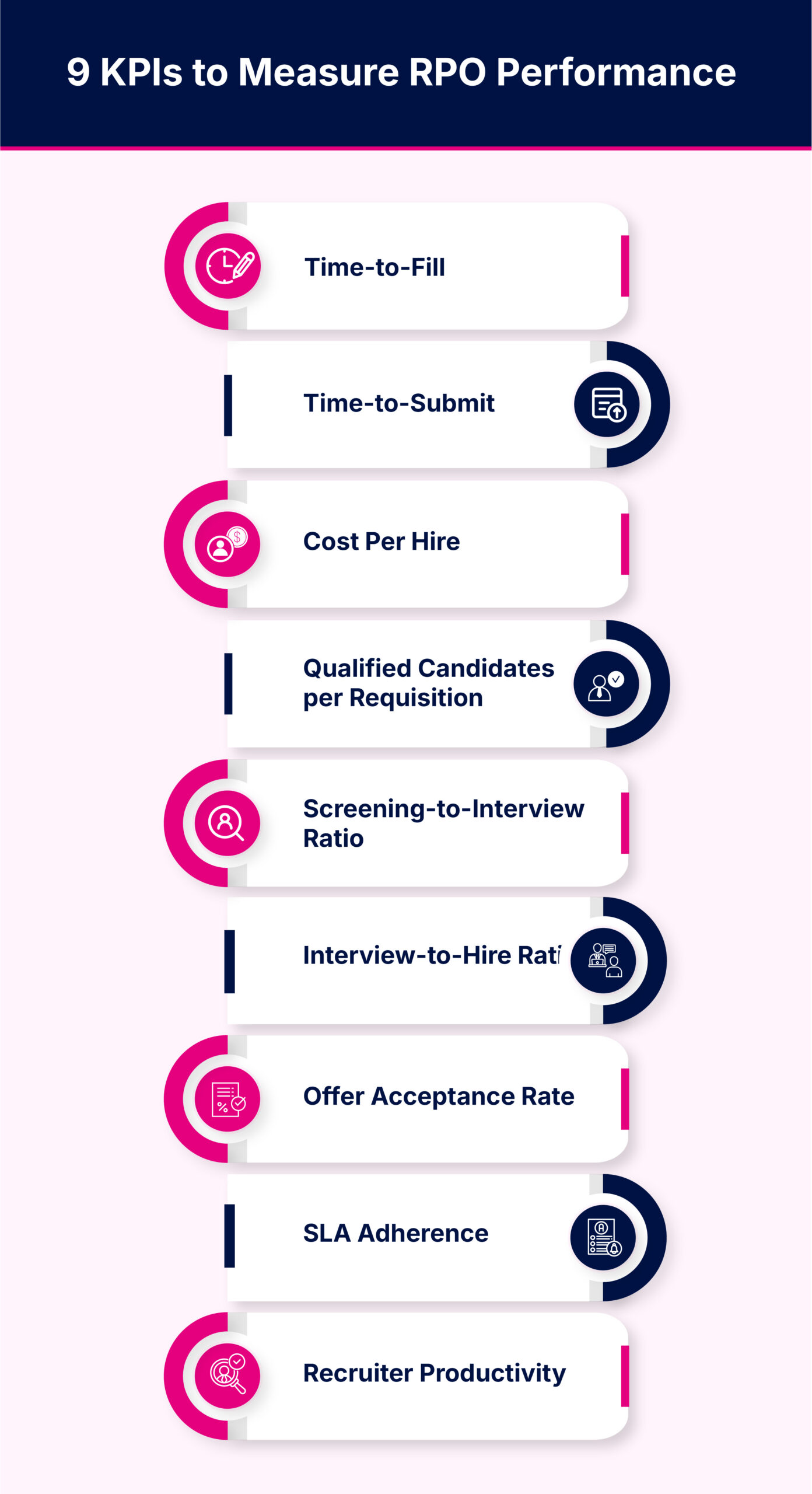
Time-to-fill measures the average time required to close an open vacancy. This KPI provides insight into the efficiency of the recruitment process and the provider’s ability to deliver candidates quickly.
Organizations using high-volume RPO services USA often seek reductions in time-to-fill as a key indicator of recruitment success.
Time-to-submit measures how quickly qualified candidates are presented after a requisition is received. It reflects sourcing capability, recruiter responsiveness, and operational efficiency.
A shorter time-to-submit can significantly improve hiring outcomes during large-scale recruitment campaigns.
Cost per hire evaluates the total investment required to recruit and onboard a new employee. This metric helps organizations compare recruitment models and assess overall hiring efficiency.
Monitoring this KPI enables companies to determine whether their recruitment outsourcing strategy is delivering measurable value.
Candidate volume alone is not enough. Organizations should evaluate how many candidates presented actually meet hiring requirements.
This metric provides insight into sourcing quality and helps ensure recruitment teams focus on candidate relevance rather than quantity.
The screening-to-interview ratio measures the effectiveness of qualification processes. A strong ratio suggests recruiters are accurately identifying candidates who meet hiring requirements.
This metric can help organizations identify areas for improvement within the screening stage.
This KPI measures how many interviewed candidates ultimately receive and accept offers. It indicates both candidate quality and hiring process effectiveness.
Tracking this ratio can help recruitment leaders assess the overall efficiency of recruitment activities.
A strong offer acceptance rate suggests a positive candidate experience and effective recruitment process management. It also indicates the organization’s ability to compete for talent successfully.
Improving offer acceptance rates often contributes directly to faster hiring outcomes.
Service Level Agreements establish expectations around recruitment performance. Measuring adherence helps organizations assess provider accountability and service consistency.
Strong SLA performance typically reflects effective delivery processes and operational discipline.
Recruiter productivity measures output relative to recruitment effort. It may include candidates sourced, submissions made, interviews scheduled, or hires completed.
Monitoring productivity helps organizations understand how effectively recruitment resources are being utilized.
Organizations typically consider end-to-end recruitment outsourcing when hiring demand begins to exceed internal recruitment capacity. Hiring growth often creates challenges that cannot be solved simply by asking existing recruiters to take on more work.
A business undergoing rapid expansion may need to hire dozens or hundreds of employees within a short period. Similarly, seasonal hiring peaks, new client acquisitions, and geographic expansion initiatives can quickly increase recruitment requirements.
Companies experiencing persistent time-to-fill challenges, recruiter burnout, inconsistent sourcing performance, or rising recruitment costs may also benefit from RPO solutions USA. In these situations, external support provides additional recruitment expertise, operational efficiency, and flexible capacity.
End-to-end RPO can be particularly valuable when organizations need a long-term recruitment strategy that aligns with business growth plans while maintaining high hiring standards.

Start by understanding your current and future hiring requirements. Organizations should assess projected hiring needs, position types, geographic coverage, and recruitment timelines before engaging with providers.
Clear hiring objectives help create more accurate provider evaluations and stronger recruitment partnerships.
Not every recruitment activity must be outsourced. Organizations should identify which functions would benefit most from external support, such as sourcing, screening, scheduling, or administration.
Defining the scope early ensures providers can propose the most appropriate delivery model.
Assess the provider’s ability to attract qualified candidates consistently. Review sourcing methodologies, recruitment team capabilities, and talent pipeline development strategies.
Strong sourcing capacity is often one of the most important indicators of future recruitment success.
Technology can significantly influence recruitment efficiency. Organizations should evaluate reporting capabilities, ATS compatibility, automation tools, and recruitment workflow visibility.
Effective technology enables better collaboration and more informed hiring decisions.
The provider should demonstrate a proven ability to handle changing hiring demands. Scalability is particularly important for organizations with seasonal or unpredictable recruitment requirements.
A flexible provider can help maintain recruitment performance during periods of rapid growth.
Before launching any engagement, define measurable performance indicators and service expectations. Clear KPIs create accountability and enable ongoing performance evaluation.
Organizations should monitor recruitment outcomes regularly to ensure continuous improvement.
A pilot phase allows organizations to evaluate provider capabilities before committing to a larger engagement. This approach helps identify strengths, challenges, and opportunities for optimization.
Pilot programs also reduce implementation risk while providing measurable recruitment performance data.
Recruitment requirements evolve over time. Regular performance reviews help organizations and providers identify improvement opportunities and refine recruitment strategies.
Continuous optimization ensures recruitment support remains aligned with business goals and changing workforce requirements.
End-to-end RPO is a recruitment outsourcing model in which a provider manages the complete hiring lifecycle, including sourcing, screening, candidate management, interview coordination, onboarding support, reporting, and recruitment administration for large-scale hiring initiatives.
RPO providers for high-volume hiring help organizations increase talent sourcing capacity, streamline recruitment processes, improve candidate flow, reduce administrative burdens, and support hiring demand through scalable recruitment resources.
Typical functions include workforce planning, candidate sourcing, talent pipeline development, screening, interview coordination, offer management, onboarding support, reporting, recruitment administration, and recruitment workflow management.
Organizations often measure ROI through KPIs such as time-to-fill, time-to-submit, cost per hire, offer acceptance rate, recruiter productivity, candidate quality metrics, and SLA adherence.
Yes. A major benefit of high-volume RPO services USA is the ability to increase or reduce recruitment capacity based on hiring fluctuations, seasonal demand, and business growth requirements.
Organizations should evaluate scalability, sourcing expertise, recruiter capability, technology infrastructure, ATS integration, geographic reach, candidate experience, reporting capabilities, and delivery flexibility.
QX Global Group helps organizations improve recruitment efficiency through flexible recruitment support solutions, dedicated sourcing resources, streamlined recruitment operations, and scalable delivery models that support high-volume hiring objectives.
Enjoyed our blog? Discover more about how our recruitment outsourcing process can slash your costs by up to 60%! Take the next step—book a call by entering your details.

Education:
PMP ,ITIL,SSLGB ,MBA - IMT in Strategy Management

Akash Goyal is a seasoned RPO and BPM transformation leader with over 20 years of global experience across the UK, US, and India. At QX Global Group, he leads RPO sales and operations, owning P&L, client growth, service delivery, and large-scale transitions.
His leadership is rooted in data-driven delivery, operational excellence, and building high-performance teams that scale efficiently and sustainably.
Expertise: RPO Leadership • Global Delivery Operations • Business Transformation • Client Strategy • Operational Excellence • Growth Enablement
Originally published Sep 21, 2026 07:09:18, updated Sep 23 2026
Topics: Offshore RPO, RPO Provider
16 Sep 2026
The longer a critical role remains vacant, the greater the impact on productivity, revenue, customer...
Read More25 Sep 2024
Permanent staffing practices help organizations recruit permanent employees and hire them for long-t...
Read More04 Dec 2023
The paradigm of remote work has transformed from a mere trend to a fundamental shift in how business...
Read More25 Sep 2023
Did you know that 63% of marketers consider case studies to be one of the most effective tools in co...
Read More