Topics: Engineering Recruitment Outsourcing, engineering recruitment outsourcing services for US staffing companies, technical recruitment outsourcing model
Posted on April 13, 2026
Written By Ranjana Singh




A U.S. staffing firm recently lost a high-value engineering role, not because they couldn’t find candidates, but because they couldn’t find them fast enough.
That’s the reality of engineering hiring in 2026. Demand is rising across industries like manufacturing, infrastructure, and technology, but finding qualified engineers quickly is becoming harder than ever. At the same time, recruiters are expected to manage everything end-to-end, from sourcing and screening to coordination and reporting.
This creates a bottleneck where hiring slows down, candidate quality drops, and opportunities are lost.
This is where engineering recruitment outsourcing services is becoming a strategic advantage. It allows staffing companies to scale their hiring capacity, improve speed, and reduce operational pressure without increasing internal headcount.
In this guide, you’ll understand how outsourcing works, where it fits into your recruitment process, and how it can help you build a stronger and faster engineering hiring engine.

Engineering Recruitment Outsourcing is the practice of delegating part or all of your engineering hiring process to an external partner or offshore recruitment team. Instead of handling everything internally, staffing firms use outsourcing to manage operationally heavy tasks such as sourcing candidates, screening resumes, and coordinating interviews.
This allows internal recruiters tofocus on higher-value activities like client interaction, candidate engagement, and closing roles. In engineering hiring, where roles are often technical and niche, this model becomes even more valuable because it ensures continuous pipeline building without overloading internal teams.
In simple terms, it is not about replacing your recruiters, but about making them more effective by removing repetitive and time-consuming work.
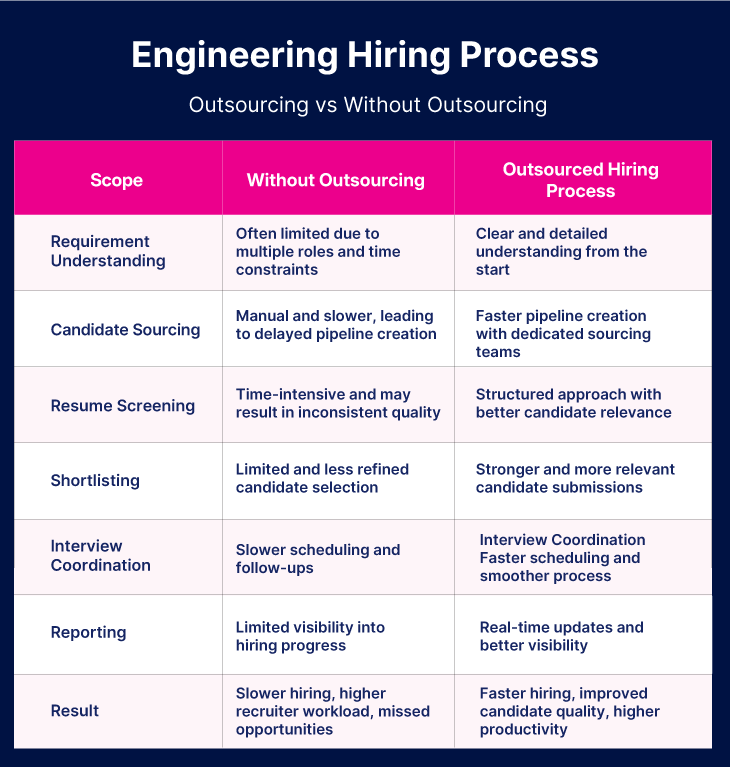
Engineering recruitment outsourcing can support almost every stage of the hiring process, starting from understanding job requirements to delivering final reports.
At the beginning, outsourcing teams work closely with recruiters to understand role requirements, technical skills, and client expectations in detail. This ensures that sourcing efforts are aligned from day one and reduces irrelevant profiles later.
Once the requirements are clear, dedicated sourcing specialists begin identifying candidates using job boards, LinkedIn, internal databases, and passive talent networks. Because their only focus is sourcing, they are able to build pipelines faster and more efficiently.
Also Read: Top Candidate Sourcing Companies in USA: What Businesses Need to Know
The next step involves screening resumes based on technical fit, tools, certifications, and experience. This ensures that only relevant candidates move forward, saving time for internal recruiters. From there, shortlisted candidates are shared, improving the submission-to-interview ratio.
Interview coordination is also managed by the outsourcing team, whichreduces delays and improves the candidate experience. Finally, regular reporting provides visibility into pipeline performance, helping staffing firms track progress and makeinformed decisions.
Here are the key benefits that make engineering recruitment outsourcing a practical and scalable solution for U.S. staffing companies.
Engineering roles are often niche, requiring targeted sourcing across multiple platforms and networks. When handled internally, this can slow down hiring because recruiters are balancing multiple responsibilities. With outsourcing, you get access to dedicated sourcing teams who focus only on building candidate pipelines. They continuously tap into global talent pools, which means you’re not starting from scratch for every role. This significantly reduces time-to-submit and helps you respond faster to client requirements.
Internal recruiters often spend a large chunk of their time on repetitive tasks like sourcing, screening, and coordination. While necessary, these activities do not directly drive revenue. By outsourcing these functions, recruiters can shift their focus to high-impact activities such as client engagement, candidate interaction, and closing roles. This not only improves efficiency but also allows each recruiter to handle more roles without burnout. Over time, it leads to better performance and higher placement output.
Building and maintaining an in-house recruitment team involves fixed costs like salaries, tools, training, and overheads. This becomes challenging when hiring demand fluctuates. Offshore engineering recruitment teams offer a more flexible and cost-effective solution by providing skilled support at a lower operational cost. You can scale your recruitment capacity without committing to long-term expenses. This helps staffing firms protect their margins while still maintaining strong hiring output.
Engineering hiring is highly technical and requires a deep understanding of roles, tools, and industry requirements. Not every in-house recruiter has this level of specialization. Outsourcing partners often bring domain expertise in engineering talent acquisition, allowing them to screen candidates more effectively. This results in better-quality shortlists and fewer mismatches. Ultimately, it improves submission quality and increases the chances of successful placements.
Hiring demand in staffing is rarely consistent. There are periods of high-volume hiring followed by slower phases. Outsourcing allows you to scale your recruitment operations up or down based on demand without disrupting your workflow. Whether you need support for a sudden spike in roles or ongoing hiring needs, outsourcing provides the flexibility to adapt quickly. This ensures you can meet client expectations without overburdening your internal team.

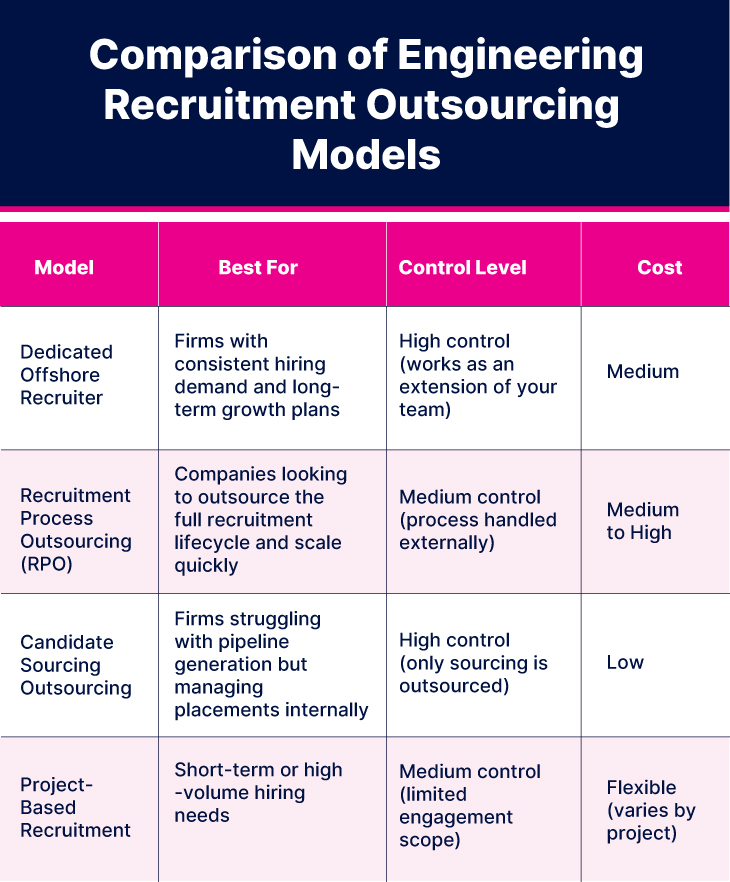
There are multiple outsourcing models available, and the right one depends on your hiring needs.
The dedicated offshore recruiter model provides a recruiter who works as an extension of your team. They follow your processes, understand your clients, and gradually improve efficiency over time. This model works well for firms with consistent hiring demand.
In contrast, the Recruitment Process Outsourcing (RPO) model involves outsourcing the entire recruitment lifecycle. From requirement understanding to candidate placement, everything is managed externally. This is ideal for firms looking to scale quickly without operational constraints.
Some firms prefer to outsource only sourcing. In this model, the outsourcing partner focuses on building candidate pipelines, while the internal team handles interviews and placements. This works well when the main challenge is generating quality candidates.
Project-based outsourcing is another flexible option where support is provided for short-term or high-volume hiring needs. This helps firms manage sudden spikes in demand without long-term commitments.
Engineering recruitment outsourcing follows a structured and repeatable process that helps staffing firms improve speed, quality, and consistency in hiring. Instead of recruiters handling everything alone, each stage is supported by a dedicated team, making the entire process more efficient.
The process begins with a clear understanding of the role, including technical skills, experience, and client expectations. The outsourcing team works closely with your recruiters to gather detailed requirements. This step is important because a well-defined role leads to better sourcing and fewer irrelevant profiles later.
Once the requirements are clear, a sourcing strategy is created. This includes identifying the right platforms, databases, and networks to find candidates. Dedicated sourcing specialists actively build a pipeline, ensuring a steady flow of relevant candidates instead of starting from scratch for every role.
All sourced profiles go through a structured screening process. Candidates are evaluated based on technical skills, tools, certifications, and experience. This ensures that only qualified and relevant candidates move forward, saving time for internal recruiters.
After screening, the most suitable candidates are shortlisted and shared with your team. This improves the quality of submissions and increases the chances of interview conversions. Recruiters receive profiles that are already pre-qualified and aligned with requirements.
The outsourcing team manages interview scheduling, follow-ups, and communication with candidates. This reduces delays and ensures a smoother hiring process. It also improves the overall candidate experience, which is critical in competitive engineering hiring.
Regular reports provide visibility into pipeline progress, submissions, and key metrics like time-to-submit and interview ratios. This helps staffing firms track performance, identify gaps, and continuously improve their hiring process.
Overall, this structured approach ensures that engineering hiring becomes faster, more consistent, and easier to scale, without overloading internal teams.
Also Read: Best Recruitment Outsourcing Companies in USA
Engineering recruitment comes with several challenges, the biggest being talent shortages. The demand for skilled engineers continues to grow, but the supply has not kept pace. Outsourcing helps address this by expanding access to global talent pools, increasing the chances of finding the right candidates.
Another challenge is the high level of competition. Skilled engineers are often hired quickly, and delays in sourcing or screening can result in missed opportunities. Outsourcing enables faster turnaround times, helping firms stay competitive.
Long hiring cycles are also common in engineering roles due to their complexity. By ensuring continuous pipeline generation and faster coordination, outsourcing helps reduce these timelines.
Finally,limited internal recruiter capacity can slow down hiring. Outsourcing provides additional bandwidth, allowing internal teams to focus on high-value tasks without being overwhelmed.
QX Global Group, with over 20+ years of experience, supports U.S. and UK staffing firms with end-to-end outsourced recruitment services, from sourcing and screening to compliance and coordination. The goal is simple: help firms deliver faster, reduce operational load, and scale without increasing headcount.
When speed drives revenue and recruiter capacity is limited, this makes a measurable difference. One client achieved:
In today’s market, growth isn’t about doing more — it’s about delivering better. That’s where the right outsourcing partner sets you apart. If you want to learn more about how we can help you hit your revenue goals, fill out the form below and an expert from our team will reach out to you soon.
Rankings can give a starting point, but they don’t show how a firm actually works. Companies should look at industry expertise, past leadership hires, search methodology, and how well the firm understands their business. It’s also important to evaluate their approach to candidate research, communication, and transparency during the search process. A good executive search partner should feel like a strategic advisor, not just a vendor.
C-suite hiring is high-stakes and requires a focused, in-depth search process. The retained search model ensures that the search firm is fully dedicated to a single mandate, rather than working on multiple roles at once. This allows for deeper market mapping, better candidate engagement, and a more structured evaluation process. It also ensures confidentiality, which is critical for senior leadership hiring.
Executive search firms rely heavily on market mapping, industry networks, and long-term relationships rather than just job postings. They proactively identify leaders who are not actively looking for roles but may be open to the right opportunity. Through direct outreach and personalized engagement, they bring these passive candidates into the hiring process. This approach significantly expands the talent pool beyond active applicants.
Hiring for leadership is not just about skills, but also about cultural fit, leadership style, and long-term alignment with business goals. Companies should define clear expectations upfront and assess candidates through structured interviews, leadership evaluations, and stakeholder feedback. Working with a search partner that understands both the role and the company culture helps ensure a better fit. A well-defined process reduces the risk of misalignment after hiring.
One common mistake is choosing a firm based only on brand name or cost, without evaluating their actual expertise in the relevant industry. Another is not clearly defining expectations, which leads to misalignment during the search. Some companies also fail to assess the firm’s process, communication style, and candidate evaluation methods. Choosing the wrong partner can slow down hiring and affect the quality of leadership hires.
Data-driven approaches bring more structure and objectivity to executive hiring. Search firms use data for market mapping, benchmarking candidates, and tracking hiring metrics, which improves decision-making. This reduces reliance on intuition alone and helps identify the best-fit candidates more accurately. Over time, it leads to better hiring outcomes, stronger leadership performance, and lower attrition at senior levels.
Enjoyed our blog? Discover more about how our recruitment outsourcing process can slash your costs by up to 60%! Take the next step—book a call by entering your details.

Education:
B.Com(Hons), Delhi University

Ranjana Singh is a data-driven B2B content marketer who loves creating well-researched content and blending it with storytelling. At QX, she leverages data insights and lead analysis to craft high-performing LinkedIn campaigns, blogs, newsletters, and sales collateral that drive MQLs and brand visibility across the US and UK markets. Her work is rooted in performance—every strategy starts with deep analysis of content metrics, funnel behavior, and audience engagement trends to deliver measurable marketing impact.
Expertise: Data-Backed Content Marketing Strategy, SEO & Organic Growth, LinkedIn & Newsletter Marketing, MQL Attribution & Lead Source Analysis, Recruitment Industry Marketing (US & UK),
Originally published Apr 13, 2026 08:04:40, updated Apr 13 2026
Topics: Engineering Recruitment Outsourcing, engineering recruitment outsourcing services for US staffing companies, technical recruitment outsourcing model
27 Jul 2026
Engineering projects don’t fail because of a lack of ideas. They often stall because...
Read More21 Jul 2026
The UK’s engineering sector is facing a growing challenge: demand for specialist talent contin...
Read More