Topics:
Posted on May 29, 2026
Written By Ranjana Singh




A client calls with an urgent requirement, but your recruiters are still searching databases, reposting jobs, and sourcing candidates from scratch. By the time qualified profiles are ready, competitors may already be making placements.
This is one of the biggest reasons many UK recruitment agencies are struggling to scale consistently. Reactive hiring models slow placements, increase recruiter workload, and make it difficult to maintain strong candidate pipelines.
That is why more agencies are investing in Always-On Talent Pipelines and scalable Talent Sourcing Services to build continuous access to qualified talent before hiring demand appears.
In this blog, you’ll learn why proactive candidate sourcing is becoming essential, how AI and offshore sourcing teams support long-term pipeline building, and how always-on recruitment strategies help agencies improve recruiter productivity, placement speed, and recruitment pipeline optimisation.

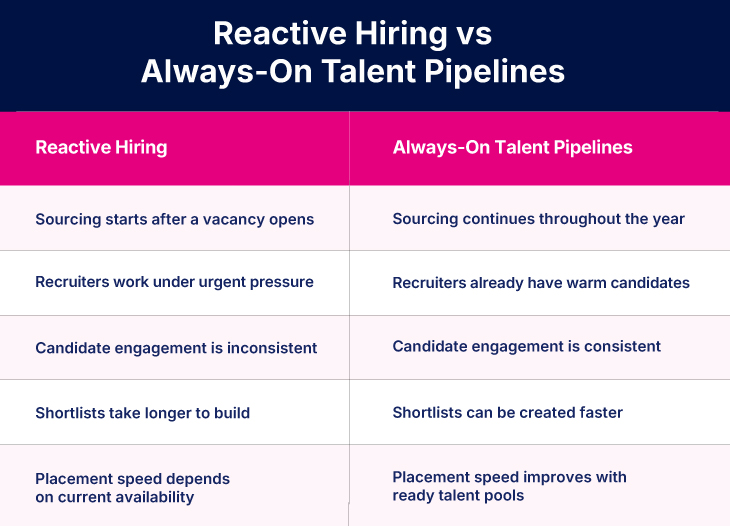
Many recruitment agencies still operate in a vacancy-driven cycle. A role opens, recruiters begin sourcing, applications are reviewed, and outreach campaigns start from the beginning every single time. While this model worked reasonably well in the past, it is becoming increasingly inefficient in modern recruitment markets.
When recruiters begin sourcing only after a vacancy opens, valuable time is already lost. In competitive sectors like healthcare, engineering, and technology, candidates often receive multiple calls within days of becoming available. This means agencies that start late often struggle to secure the strongest candidates first. As a result, shortlists take longer to build, placements slow down, client confidence weakens, and competitors gain an advantage by submitting candidates faster.
Reactive recruitment creates heavy operational pressure on recruiters.
Instead of focusing on relationship-building and placements, recruiters spend large portions of their day searching LinkedIn repeatedly, revisiting ATS databases, reposting vacancies, manually filtering CVs, and conducting repetitive outreach campaigns. Over time, this reduces recruiter productivity, increases burnout, and limits the agency’s ability to scale efficiently.
Reactive hiring creates unpredictability across recruitment operations. Some roles may close quickly while others remain open for weeks because sourcing starts too late or suitable candidates are unavailable. This inconsistency affects client satisfaction, recruiter performance, placement targets, and overall revenue predictability for the agency.
Candidates increasingly expect personalized and ongoing communication from recruiters. When agencies only contact talent during urgent hiring periods, relationships often feel transactional rather than meaningful. This makes it harder to build long-term candidate trust and engagement. This is why many agencies are shifting toward a more proactive recruitment strategy focused on continuous pipeline building instead of vacancy-based sourcing.
Always-On Talent Pipelines refer to a recruitment model where agencies continuously source, engage, and nurture candidates even when there are no immediate vacancies available.
Instead of waiting for hiring demand to appear, recruiters maintain ongoing relationships with talent communities and continuously strengthen candidate networks across industries, skill sets, and locations. The idea behind this strategy is simple: when a client requirement comes in, recruiters should already have access to engaged candidates rather than starting sourcing from scratch.
Also Read: Top Offshore Recruitment Companies in UK: What Staffing Firms Should Know
A strong pipeline strategy includes continuous candidate sourcing, regular candidate engagement, database reactivation, market mapping, AI-driven sourcing workflows, recruitment automation, and offshore sourcing support.
For example, a healthcare recruitment agency may continuously engage nurses, locum doctors, and healthcare assistants through newsletters, LinkedIn engagement, market updates, and follow-up calls throughout the year. When urgent hiring demand appears, recruiters already have a warm talent network ready for outreach. This creates far greater operational stability compared to reactive recruitment models.
The recruitment market in 2026 is becoming increasingly unpredictable. Hiring demand can rise suddenly, while clients still expect agencies to deliver qualified talent quickly despite economic uncertainty and ongoing skills shortages. This creates major pressure for agencies relying only on reactive sourcing models, especially in competitive sectors like healthcare, engineering, technology, and industrial staffing.

By the time recruiters begin sourcing, many qualified candidates may already be interviewing elsewhere or accepting offers from competitors. In highly competitive sectors, strong candidates rarely stay available for long periods. This makes it harder for agencies to secure quality talent quickly and maintain consistent placement speed.
Clients increasingly expect agencies to submit qualified candidates within hours or days, not weeks. Recruiters starting from scratch often struggle to meet these expectations because sourcing, screening, outreach, and engagement all require time.
As a result, agencies may lose placements simply because competitors responded faster.
Reactive hiring creates constant urgency for recruiters. Every new vacancy becomes a race to find suitable candidates as quickly as possible. This pressure often leads to rushed sourcing, inconsistent candidate engagement, recruiter stress, and lower overall sourcing quality.
Recruiters spend significant time performing repetitive administrative tasks like database searches, LinkedIn sourcing, outreach campaigns, ATS updates, and CV screening. Instead of focusing on placements, interviews, and client relationships, recruiters become heavily occupied with operational sourcing activities.
Without active talent pipelines, the entire hiring process slows down. Recruiters first need to identify candidates, begin outreach, conduct screening, and build engagement before interviews can even start. These delays often create longer placement cycles and slower revenue generation for agencies.
Some vacancies may close quickly while others remain open for long periods depending on candidate availability and sourcing timelines. This creates inconsistent delivery performance, making it difficult for agencies to maintain stable placement numbers and predictable client outcomes.
Also Check: Top Executive Search Companies in UK
An always-on approach allows agencies to continuously source and engage candidates in the background, even when there are no immediate vacancies available.
Instead of building pipelines only during urgent hiring periods, recruiters maintain active relationships with talent throughout the year.
This creates a major operational advantage because recruiters already know where qualified talent exists when hiring demand suddenly increases.
Agencies with strong recruitment talent pipeline management are usually able to respond much faster during seasonal hiring spikes, high-volume recruitment projects, urgent client requirements, expansion hiring, and sudden workforce shortages.
For example, if a healthcare staffing client urgently requires multiple nurses within a short timeframe, agencies with active candidate pipelines can immediately begin outreach to pre-engaged talent instead of starting sourcing from zero.
Similarly, engineering or technology recruitment agencies with ongoing talent community building can quickly access niche candidates who are already familiar with the agency and more likely to respond positively. This faster response capability gives agencies a significant competitive advantage.


A strong talent pipeline strategy for recruitment agencies depends heavily on proactive sourcing. Traditional sourcing is reactive. Recruiters search for candidates only when a role becomes urgent. Proactive candidate sourcing works differently. Recruiters continuously identify and engage talent before vacancies even appear.
Many highly skilled professionals are not actively applying for jobs, but they may still be open to opportunities if approached correctly. Agencies with proactive sourcing strategies can engage these candidates early before competitors enter the process.
When recruiters already know suitable candidates, they can submit profiles much faster after receiving client requirements. This improves time-to-submit, client responsiveness, placement consistency, and hiring outcomes.
Recruiters no longer need to restart sourcing campaigns for every vacancy. Instead, they work from existing talent ecosystems that are continuously maintained and partially engaged. This allows recruiters to spend more time on client communication, interviews, candidate relationship building, and placements. This is why proactive candidate sourcing is becoming a key part of modern talent acquisition strategy.
Building pipelines is only the first step. Keeping those pipelines active is what truly creates value. Many agencies already have large ATS databases, but large databases alone do not automatically create strong talent pipelines. Candidates become inactive when engagement stops. Continuous candidate engagement helps agencies remain visible and relevant within the talent market.
Many agencies maintain engagement through industry newsletters, salary trend reports, career advice content, LinkedIn engagement, job market updates, follow-up calls, and candidate check-ins.
These touchpoints help recruiters build stronger long-term relationships rather than transactional interactions.
Talent community building allows agencies to group and nurture candidates based on industry specialization, skills, certifications, career interests, and geographic locations.
Over time, these communities become highly valuable recruitment assets because recruiters already know where suitable talent exists.
This improves long-term recruitment pipeline optimisation significantly.

Managing continuous sourcing manually becomes difficult as agencies scale. This is where AI tools and recruitment automation are becoming increasingly important. Modern recruitment technology helps agencies maintain continuous pipeline activity without dramatically increasing recruiter workload.
AI tools can quickly scan large candidate databases and identify suitable profiles based on skills, experience, certifications, hiring patterns, and industry fit. This significantly reduces manual sourcing time, improves candidate matching accuracy, and helps recruiters identify qualified talent faster than traditional manual searches.
Recruitment automation helps agencies maintain continuous candidate engagement without increasing recruiter workload manually. Automation tools can support follow-ups, nurturing campaigns, interview scheduling, database reactivation, ATS updates, and candidate reminders, allowing recruiters to maintain pipeline activity consistently even during busy hiring periods.
AI-driven analytics tools help agencies gain better visibility into pipeline performance and sourcing effectiveness. These tools can identify pipeline gaps, candidate drop-off points, engagement trends, recruiter productivity patterns, and sourcing bottlenecks, helping agencies make smarter recruitment decisions and improve long-term recruitment pipeline optimisation. =
Many UK recruitment agencies are also strengthening their always-on recruitment models through offshore sourcing support.
Offshore recruitment sourcing teams help agencies maintain continuous pipeline-building activities without overwhelming internal recruiters.
Offshore sourcing teams often support candidate sourcing, CV screening, ATS management, database cleansing, talent mapping, candidate outreach, and market research. This separation of responsibilities creates a more efficient recruitment workflow and allows internal recruiters to focus on higher-value tasks.
Instead of spending most of their day sourcing candidates manually, recruiters can focus more on placements, client management, interviews, relationship building, and business development. This creates stronger recruiter productivity optimization across the recruitment process.
Many agencies now view offshore sourcing as more than just a cost-saving strategy.
Offshore teams help agencies scale sourcing operations more efficiently during high-volume hiring periods, maintain continuous candidate pipeline activity throughout the year, reduce operational pressure on internal recruitment teams, and support urgent hiring projects without rapidly increasing internal headcount. For many agencies, offshore sourcing has become an important part of long-term recruitment pipeline optimisation.
QX Global Group helps UK recruitment agencies build scalable and efficient recruitment operations through dedicated offshore recruitment services and sourcing support. QX Global Group supports agencies with:
By combining offshore recruitment expertise with technology-enabled workflows, QX Global Group helps agencies maintain continuous pipeline activity, improve recruiter productivity, reduce sourcing pressure, and scale hiring operations more efficiently.
Also Read: Top Compliance Outsourcing Companies in UK and How to Identify One?
For agencies looking to strengthen their Always-On Talent Pipelines, offshore recruitment support can play a major role in building long-term recruitment scalability and faster hiring responsiveness.
Always-On Talent Pipelines help agencies prepare for hiring demand before vacancies even appear. Instead of beginning sourcing from scratch every time, recruiters already have engaged candidates available within their networks. This improves placement speed, reduces recruiter pressure, and helps agencies respond more effectively to urgent hiring requirements across competitive sectors.
Proactive engagement keeps candidates connected with the agency over long periods instead of only during active hiring cycles. Because relationships already exist, recruiters can approach candidates faster when new roles open. This reduces response delays, improves candidate trust, and often leads to stronger placement outcomes and faster submissions.
Modern recruitment operations often use AI-powered sourcing tools, ATS platforms, CRM systems, recruitment automation software, and analytics dashboards. These technologies help agencies automate engagement, improve candidate matching, maintain active databases, and optimize sourcing workflows more efficiently.
Offshore sourcing teams help agencies maintain continuous sourcing activity without increasing recruiter workload internally. They support candidate sourcing, ATS updates, talent mapping, CV screening, and outreach activities, allowing recruiters to focus more on placements, interviews, and client management.
Metrics such as faster time-to-submit, improved response rates, stronger submission-to-placement ratios, and higher candidate engagement levels often indicate healthier recruitment pipelines. Agencies also monitor database reactivation rates and sourcing conversion metrics to evaluate long-term pipeline performance and sourcing effectiveness.
Always-on pipelines allow agencies to continuously engage candidates instead of waiting for vacancies to appear before sourcing begins. This reduces last-minute hiring pressure and improves recruitment readiness because talent relationships already exist when client demand suddenly increases.
Many agencies struggle with recruiter bandwidth limitations, inconsistent candidate engagement, outdated ATS databases, and lack of automation. Balancing day-to-day placements while continuously building long-term talent communities can also become operationally difficult without dedicated sourcing support or technology solutions.
Talent community building helps agencies create organized candidate networks based on industries, skills, certifications, and career interests. Over time, recruiters gain faster access to relevant candidates, improve engagement consistency, and reduce sourcing delays during urgent hiring periods.
Recruitment automation helps agencies reduce repetitive manual tasks and maintain continuous candidate engagement at a scale. Automation tools support follow-ups, interview scheduling, candidate nurturing, ATS updates, and database reactivation, helping recruiters work more efficiently while improving pipeline consistency.
Long-term benefits include faster placements, improved recruiter productivity, stronger client relationships, better workforce planning, and higher placement consistency. Agencies with strong pipelines are usually better prepared to handle hiring spikes, urgent client requirements, and changing workforce demands without disrupting operations.
Enjoyed our blog? Discover more about how our recruitment outsourcing process can slash your costs by up to 60%! Take the next step—book a call by entering your details.

Education:
B.Com(Hons), Delhi University

Ranjana Singh is a data-driven B2B content marketer who loves creating well-researched content and blending it with storytelling. At QX, she leverages data insights and lead analysis to craft high-performing LinkedIn campaigns, blogs, newsletters, and sales collateral that drive MQLs and brand visibility across the US and UK markets. Her work is rooted in performance—every strategy starts with deep analysis of content metrics, funnel behavior, and audience engagement trends to deliver measurable marketing impact.
Expertise: Data-Backed Content Marketing Strategy, SEO & Organic Growth, LinkedIn & Newsletter Marketing, MQL Attribution & Lead Source Analysis, Recruitment Industry Marketing (US & UK),
Originally published May 29, 2026 08:05:59, updated May 29 2026
Topics:
07 Aug 2026
Most companies make this call by putting one salary next to one monthly fee and going with the small...
Read More06 Aug 2026
You never applied for a banking licence. Yet if your customers routinely pay you late, that’s ...
Read More06 Aug 2026
Building a high-performing recruitment team has never been more expensive. Staffing firms must balan...
Read More05 Aug 2026
Recruitment firms are under more pressure than ever to fill roles faster, deliver better candidate e...
Read More