Topics: Offshore Recruiting Support, offshore recruitment services for staffing
Posted on August 06, 2026
Written By Akash Goyal




Building a high-performing recruitment team has never been more expensive. Staffing firms must balance rising recruiter salaries, increasing technology investments, administrative workloads, and growing client expectations, all while maintaining profitability. Simply adding more recruiters isn’t always the most cost-effective way to increase placements and scale operations.
As a result, many staffing firms are reevaluating whether traditional in-house recruiting remains the best long-term growth strategy or whether offshore recruitment services can deliver better business outcomes. In this blog, we’ll compare both models, examine the true drivers of recruitment ROI, explore the operational advantages and limitations of each approach, and help you determine which model is best suited for sustainable growth.
For firms exploring outsourcing recruitment services, understanding the complete ROI picture is essential before making a strategic decision.

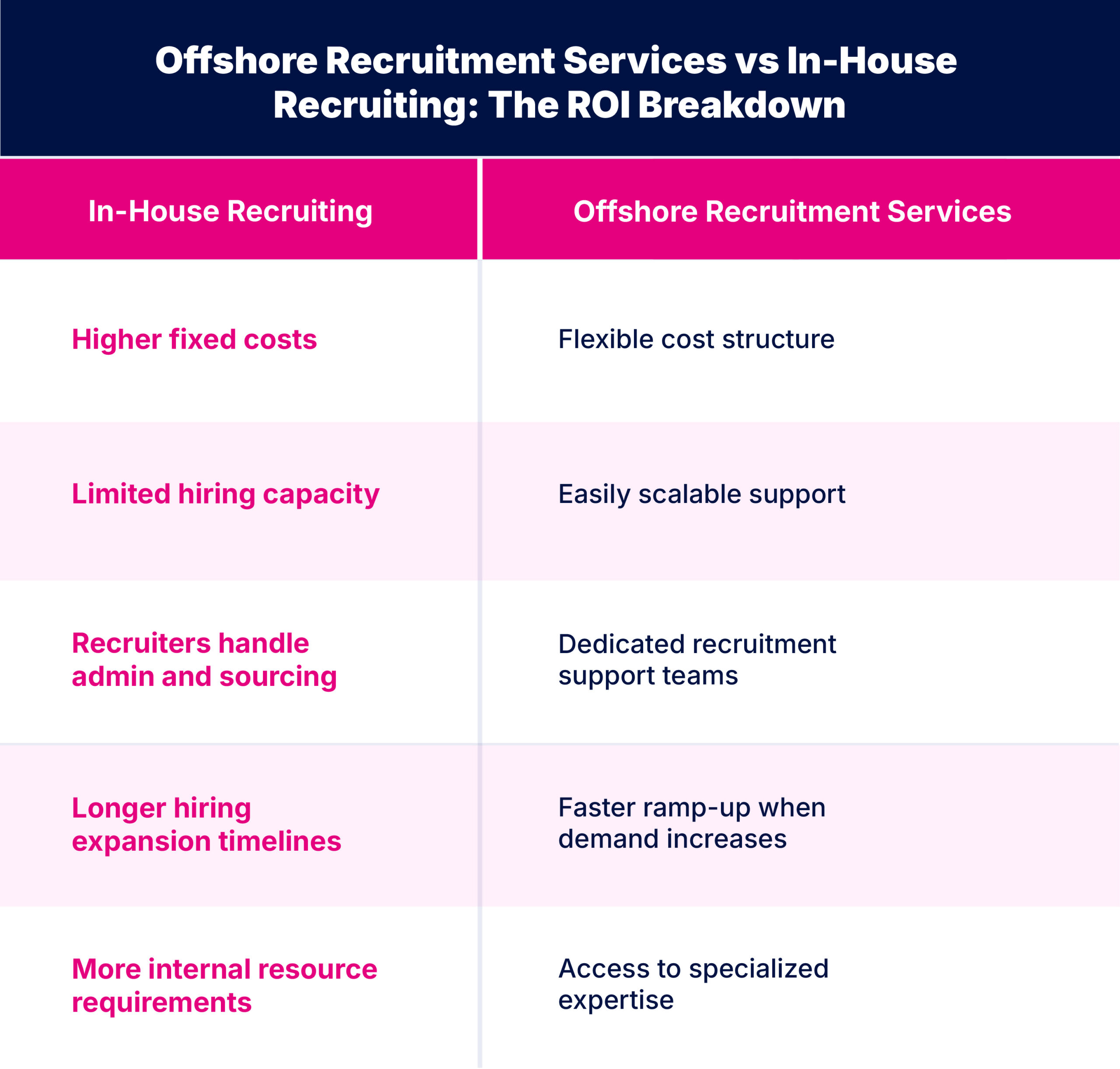
Many staffing firms evaluate hiring models based solely on direct costs. However, recruitment ROI is influenced by much more than recruiter salaries.
Recruitment ROI measures the value generated from recruitment investments relative to the costs required to achieve hiring outcomes. While cost per hire remains important, staffing firms should also consider recruiter productivity, placement volume, time-to-fill, client satisfaction, and operational efficiency when evaluating recruitment performance.
A model that appears less expensive initially may actually generate lower returns if it slows hiring, limits scalability, or reduces recruiter output.
With in-house recruiting, staffing firms manage sourcing, screening, administration, training, compliance, technology, and recruiter development internally. This provides complete control over processes and team management but also creates significant fixed costs.
In addition to salaries, firms must account for recruitment software, ATS platforms, job boards, office infrastructure, training programs, employee benefits, and onboarding expenses. As hiring demand fluctuates, these costs remain relatively fixed regardless of recruiter utilization levels. This can make scaling difficult and affect profitability during slower hiring periods.
Offshore recruitment services USA providers help staffing firms access experienced recruitment professionals without building additional internal infrastructure. Rather than increasing permanent headcount, firms gain access to sourcing specialists, recruitment coordinators, database administrators, and compliance experts when needed.
This approach allows agencies to replace certain fixed costs with a more flexible operating model. Many firms use offshore recruitment support to increase delivery capacity without making long-term workforce commitments.
When comparing recruitment models, focusing solely on labor costs can lead to misleading conclusions. The real questions are whether recruiters can place more candidates, whether vacancies are filled faster, and whether delivery teams can support growth without creating operational bottlenecks.
The firms achieving the strongest outcomes typically evaluate ROI using a combination of cost efficiency, recruiter productivity, placement performance, and scalability rather than cost alone.
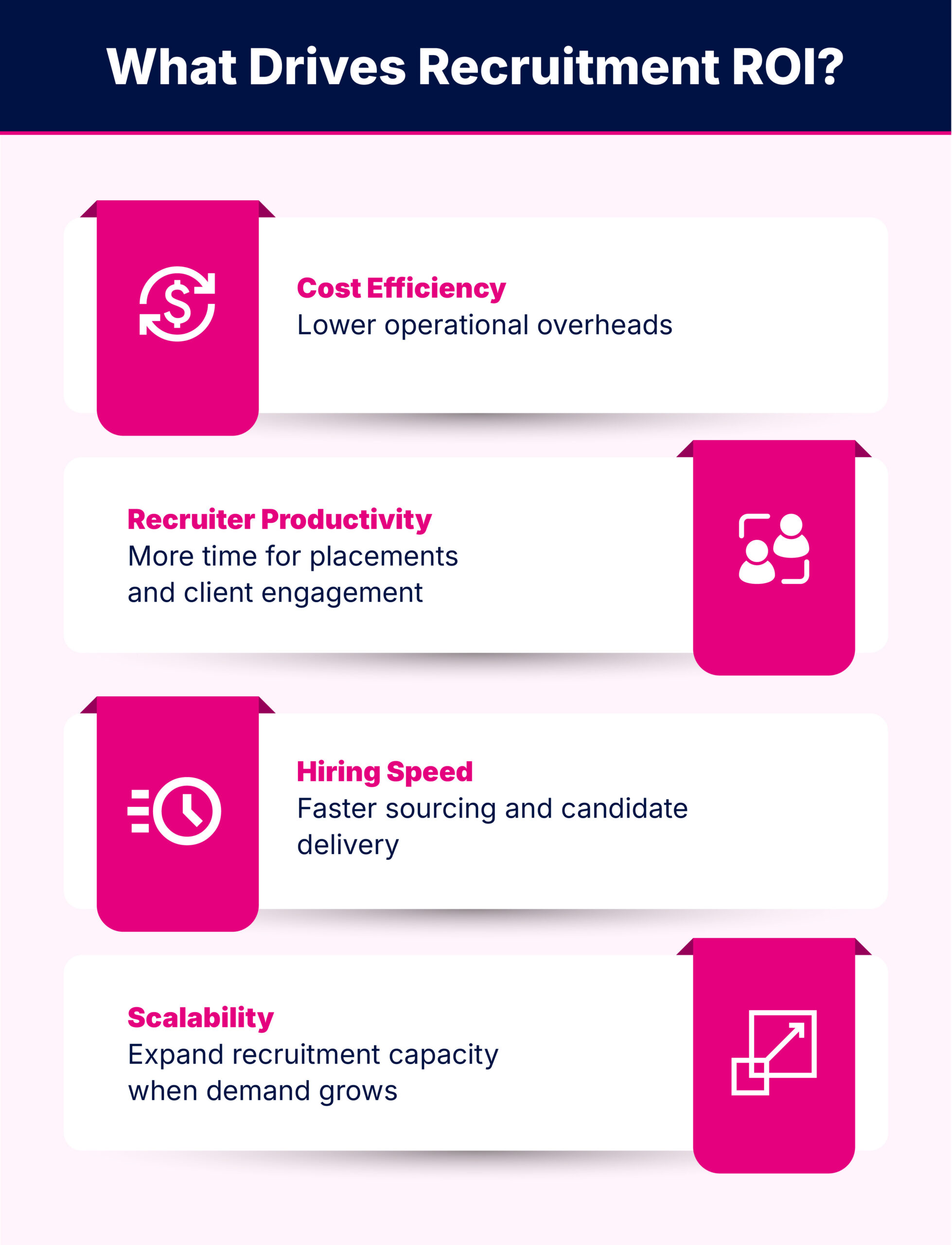
Recruitment ROI extends beyond financial metrics. Several operational factors directly impact the value a staffing firm receives from its recruitment model.
Recruiters generate revenue through placements, client relationships, and candidate engagement. However, many spend large portions of their week sourcing candidates, updating databases, coordinating interviews, and completing administrative tasks.
Using offshore recruiting services allows agencies to shift many of these operational responsibilities to dedicated support teams. This enables recruiters to spend more time on business-generating activities and less time on repetitive processes.
Clients expect agencies to deliver quality candidates quickly. Delays in sourcing, screening, or coordination can impact client satisfaction and placement success.
Dedicated recruitment support teams often help accelerate sourcing and pre-screening activities, allowing consultants to move candidates through the hiring process more efficiently. Faster delivery often contributes directly to higher placement volumes and stronger client relationships.
One of the most significant advantages of recruitment outsourcing services is scalability. Staffing firms frequently experience fluctuations in hiring demand, making workforce planning challenging.
Offshore support models allow agencies to scale up sourcing and operational capacity during busy periods without significantly increasing long-term overheads. This flexibility can improve ROI during both growth phases and market slowdowns.
Certain sectors such as healthcare, technology, engineering, and finance require recruiters with strong domain expertise.
Specialized offshore recruitment teams often bring experience, sourcing knowledge, and market insights that may not exist internally. This can improve sourcing quality, expand candidate pipelines, and support difficult hiring requirements more effectively.

Both recruitment approaches offer advantages depending on business objectives.
Internal recruitment teams provide direct oversight, stronger organizational alignment, and immediate access to leadership. Communication can often be faster, and recruiters may develop deeper familiarity with company culture and internal priorities.
For highly strategic recruitment activities, sensitive hiring initiatives, or relationship-driven requirements, in-house recruiting can offer valuable control and visibility.
Despite these benefits, internal teams can struggle with capacity limitations. As hiring volumes increase, recruiters often face growing workloads that impact productivity and candidate experience.
Additional hiring requires further investment in people, training, technology, and management oversight. These costs can make growth slower and more expensive to achieve.
Offshore recruitment services offer flexibility, scalability, and access to skilled recruitment professionals without equivalent infrastructure investments. Offshore teams can support sourcing, screening, compliance, ATS management, reporting, and recruitment administration.
Many staffing firms leverage offshore recruitment support to create operational efficiency while enabling internal consultants to focus on placements and client management.
Success depends heavily on selecting the right outsourcing partner. Communication processes, knowledge transfer, workflow alignment, training, and compliance management must be established effectively.
Without clearly defined expectations and operating procedures, firms may struggle to achieve desired outcomes. Strong onboarding and collaborative partnership models are critical to long-term success.
For many staffing firms, the debate is not necessarily offshore versus in-house. The strongest ROI often comes from combining both approaches.
Consultants remain responsible for client acquisition, relationship management, negotiations, and placement activities. These functions require direct market engagement and strategic decision-making.
Offshore teams can support sourcing, database management, compliance administration, candidate screening, reporting, and interview coordination. This creates additional capacity without expanding the internal recruiter headcount.
A hybrid approach allows staffing firms to maintain control while benefiting from the scalability and efficiency of outsourcing recruitment services. It often delivers stronger ROI because resources are aligned with their highest-value activities.
Identify where recruiters spend most of their time. If administrative and sourcing tasks consume significant capacity, offshore support may create immediate improvements.
Establish metrics such as placements per recruiter, time-to-fill, cost per hire, candidate submissions, and client satisfaction scores. These KPIs will help evaluate the success of any recruitment model.
Firms expecting rapid expansion often require a more flexible operating structure. Scalable hiring models supported by offshore recruitment teams can reduce growth constraints.
Look for a provider with proven recruitment experience, sourcing capabilities, technology expertise, compliance knowledge, and experience supporting staffing firms in your target market.
The answer to “Offshore Recruitment Services vs In-House Recruiting” is not always straightforward. Both models serve important purposes, and each can generate value under the right circumstances.
However, when staffing firms evaluate recruitment ROI, scalability, recruiter productivity, and operational efficiency together, offshore recruitment services often provide a significant advantage. By reducing administrative burdens, increasing delivery capacity, and creating a more flexible cost structure, offshore support enables agencies to grow without proportionally increasing internal costs.
For many modern staffing firms, a hybrid approach that combines strategic internal recruiters with specialist offshore support teams offers the strongest path to sustainable growth.
The answer depends on business goals, hiring volume, and operational structure. While in-house recruiting provides greater control, offshore recruitment services often deliver stronger ROI through lower operating costs, improved scalability, and increased recruiter productivity. Many staffing firms achieve the best results through a hybrid model that combines both approaches.
Offshore recruitment services reduce the need for additional internal headcount, office infrastructure, technology investments, training costs, and administrative overhead. They help staffing firms increase recruitment capacity without significantly increasing fixed expenses.
Staffing firms should consider outsourcing when recruiters are overwhelmed with sourcing and administrative tasks, hiring volumes increase rapidly, scalability becomes a challenge, or operational costs start limiting growth.
Activities such as candidate sourcing, database management, ATS maintenance, interview scheduling, compliance administration, talent mapping, reporting, and recruitment operations support are commonly handled by offshore teams.
Key metrics include cost per hire, placements per recruiter, time-to-fill, candidate submission rates, recruiter productivity, retention performance, client satisfaction, and overall recruitment profitability.
Potential challenges include communication gaps, inconsistent processes, compliance concerns, and knowledge transfer issues. These risks can be minimized by choosing an experienced recruitment partner, establishing clear workflows, and maintaining regular collaboration.
QX Global Group supports staffing firms with scalable offshore recruitment services USA, dedicated sourcing specialists, recruitment operations expertise, technology-enabled delivery, and flexible support models. By acting as an extension of internal recruitment teams, QX helps staffing firms improve productivity, scale efficiently, and strengthen recruitment performance.
Enjoyed our blog? Discover more about how our recruitment outsourcing process can slash your costs by up to 60%! Take the next step—book a call by entering your details.

Education:
PMP ,ITIL,SSLGB ,MBA - IMT in Strategy Management

Akash Goyal is a seasoned RPO and BPM transformation leader with over 20 years of global experience across the UK, US, and India. At QX Global Group, he leads RPO sales and operations, owning P&L, client growth, service delivery, and large-scale transitions.
His leadership is rooted in data-driven delivery, operational excellence, and building high-performance teams that scale efficiently and sustainably.
Expertise: RPO Leadership • Global Delivery Operations • Business Transformation • Client Strategy • Operational Excellence • Growth Enablement
Originally published Aug 06, 2026 08:08:58, updated Aug 11 2026
Topics: Offshore Recruiting Support, offshore recruitment services for staffing
24 Mar 2026
Offshore Recruitment Services for US Staffing Firms: Process, Pricing & ROI Explained ...
Read More16 Sep 2024
The economic slowdown in the United States demands that staffing firms cut costs to boost their ROI....
Read More15 May 2024
Are you a UK staffing agency looking to expand your operations without incurring massive overheads? ...
Read More