Topics: Finance & Accounting Outsourcing, P2P
Posted on October 13, 2026
Written By Mehboob Rad




A structured invoice can travel from one system to another in seconds. The approval, dispute, and payment behind it may still take weeks.
This is the tension sitting behind the UK’s move to mandatory e-invoicing for VAT invoices from 2029. The government has confirmed mandatory e-invoicing and is continuing to develop the implementation roadmap with industry. Its consultation response highlights the potential benefits around efficiency, tax compliance and late-payment reduction.
Yet compliance with the mandate and readiness for it are not the same thing. Finance teams can wait for these details, but they cannot postpone the work already visible inside procure-to-pay which involves duplicate supplier records, missing purchase orders, approvals that depend on personal chasing, and exceptions settled outside the workflow.
Many businesses have digitised the document without redesigning the journey. Invoices arrive through email, portals, and capture tools rather than the post, yet difficult transactions still leave the system and return as inbox conversations. E-invoicing will expose this gap because structured data moves quickly only when the operating process around it is equally disciplined.
This piece explores what readiness means across supplier data, approvals, exception management, payment governance and delivery capacity, and where procure-to-pay outsourcing can help UK finance teams prepare without giving up control of the decisions that should remain in-house.
The short answer is, not as ready as many think. Most organisations have digitised parts of accounts payable, but far fewer have addressed the supplier data, approval workflows, exception management, and payment controls that support structured invoice exchange.
The 2026 Purchase to Pay Network survey offers one useful signal: only 4% of respondents felt well placed for the 2029 mandate, while 40% were reviewing their data and processes.
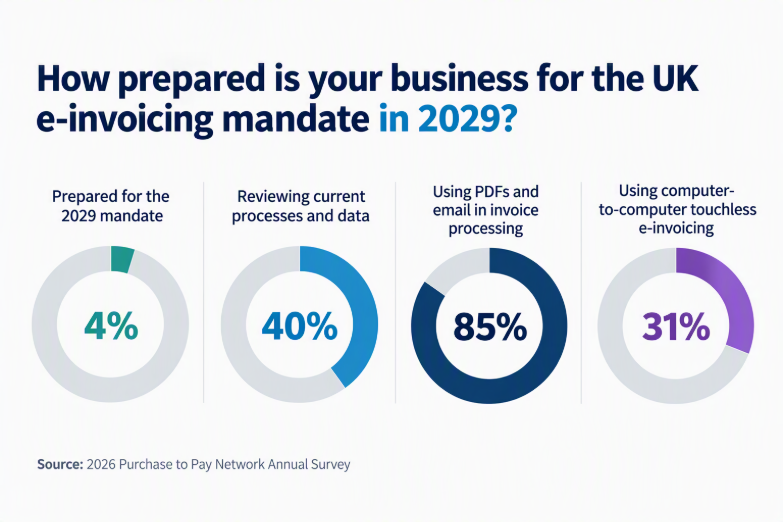
The same survey found that 85% still handled PDFs and email in invoice processing, compared with just over 31% using touchless computer-to-computer e-invoicing.
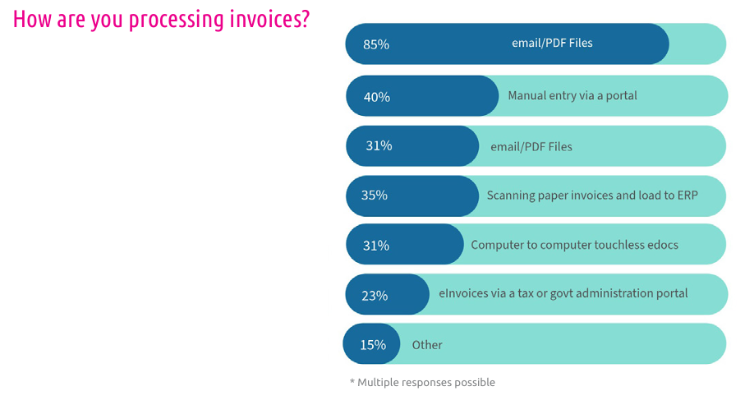
The figures highlight the scale of the challenge. The next step is understanding where a more structured approach to invoice exchange is most likely to expose weaknesses in the procure-to-pay process.
E-invoicing will remove some manual handling and bring weak inputs into view sooner. Four points in the cycle deserve attention:
The consequence is straightforward. Supplier files need cleaning, PO rules need tightening, approval matrices need updating and every exit from the workflow needs mapping. These tasks shape the future process; they are not housekeeping around a technology installation.
The pressure points mentioned above cannot be solved by invoice transmission alone. They need ownership and measurable controls.
RELATED BLOG: Get a closer look at how compliance data becomes usable finance information.
A useful readiness review should test how the process behaves on an ordinary day and under pressure. Six questions give boards a practical view.
New suppliers and bank-detail changes follow independent verification, with maker-checker review and a complete history of amendments.
PO coverage, receipt timing, tolerances, and non-PO routes are visible by entity. Repeated failures are traced to purchasing behaviour rather than absorbed by AP.
Value thresholds, categories, delegated authority, deputies, and escalation clocks are configured and reviewed whenever roles change.
Mismatches are classified by cause, assigned to a named role and aged to resolution. Recurring causes enter an improvement plan.
Approved and unapproved liabilities, disputed invoices, due dates and payment terms appear in one view, supporting cash planning before release.
The people maintaining supplier records, validating invoices, approving transactions and releasing funds cannot control the full chain.
Together, these six questions provide a practical view of whether the operating model is ready for structured invoice exchange. They also reveal where internal capacity may be too thin for the work ahead.
A handy checklist for the board becomes useful here. It turns a broad transformation programme into a sequence of accountable decisions.
Use the checklist below to establish the baseline before choosing a platform or delivery model.
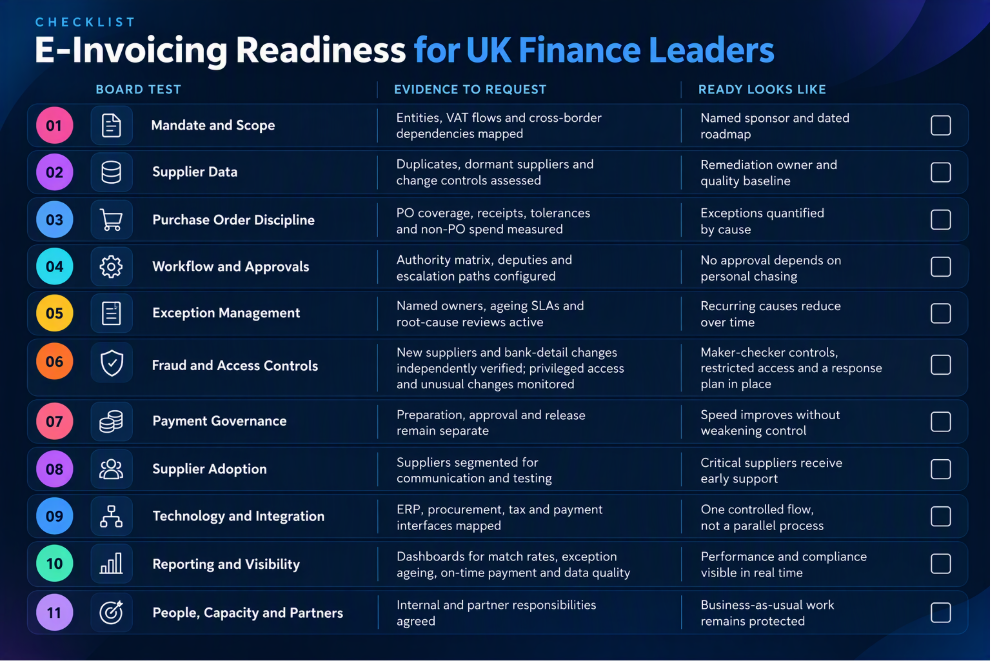
Taken together, these checks show whether the operating model can support structured invoice data without creating new queues, workarounds, or control gaps.
Even with the right controls identified, the programme can lose ground if finance takes one of three seemingly convenient routes.
Organisations that avoid these shortcuts are usually the ones that identify their capacity gap early. The remaining question is how that gap will be addressed while day-to-day invoice processing continues.
Procure-to-pay outsourcing can provide the operating capacity to cleanse data, document workflows, onboard suppliers, manage exceptions, support testing, and maintain control evidence while the internal team keeps the ledger running.
The boundary needs to be unambiguous:
Measure readiness outcomes, not invoice volumes: first-time match, exception age, verified supplier changes, approval age, on-time payment and supplier-query resolution.
QX Global Group runs procure-to-pay outsourcing as an integrated operation covering supplier onboarding and master data, purchase-order support, invoice validation and matching, approval follow-up, exception management, supplier queries, payment-run preparation and reporting.
Teams work within the client’s systems, policies, and authority structure. QX handles repeatable execution and day-to-day control evidence, while payment policy, commercial judgement, approvals and fund release remain with the client.
The model has delivered practical improvements. For a global wine and spirits producer, QX standardised process manuals, introduced internal controls and quality checks, and reduced invoice processing time from two to three days to one day from receipt. The processing-time improvement is a useful operational proof point: documented workflows, controls and accountable delivery can remove friction from the current process. I
t does not, on its own, demonstrate complete e-invoicing readiness, which also depends on data, approvals, exceptions and payment governance.
The UK’s e-invoicing timetable gives finance teams room to prepare, provided that time is used on the work that takes longest: cleaning supplier data, tightening purchase discipline, redesigning approvals, assigning exception ownership and protecting payment authority.
Begin with the entity, supplier group or approval route that creates the most exceptions. Establish the baseline, fix the control model and test the new process there. A pilot on the cleanest ledger proves very little; a pilot on the awkward part of the business shows whether the design will hold.
E-invoicing will standardise how invoice data moves. Procure-to-pay readiness will decide whether that movement produces faster processing, safer payments and clearer working-capital information. The organisations that use the next few years well will arrive at 2029 with less manual work and a process the board can trust.
Is your procure-to-pay process ready for structured invoices? Speak to QX Global Group about an operating model built for e-invoicing readiness, control and scale.
It will replace document-led exchange with structured data, making supplier records, purchase orders, receipts, approvals and exception ownership more important before invoices reach payment.
A provider can add capacity for data cleansing, process documentation, supplier onboarding, exception management, testing and control evidence while internal leaders retain authority.
Structured exchange reduces some document risks, while verified supplier changes, segregated duties, restricted access and visible overrides protect identity, approval and payment decisions.
Separate supplier maintenance, invoice validation, approval, payment-file preparation and bank release. Configure authority limits, deputies, escalation rules and evidence for every material override.
QX supports supplier data, purchase orders, invoice processing, matching, approvals, exceptions, supplier queries, payment preparation and reporting within the client’s control framework.
Choose a provider that works within existing systems, supports capture and matching, configures approval routing and actively manages stalled approvals and exceptions.
Look for providers able to configure value thresholds, departmental routing, deputies, escalation paths and audit evidence while approval authority remains with the client.
Select vendors that connect PO administration with supplier verification and master-data maintenance, because weak upstream records create downstream matching failures and payment delays.
Assess segregation of duties, maker-checker review, supplier verification, restricted access and audit trails. Payment release should remain under the client’s authority.
Choose a partner that cleans supplier data, standardises rules and connects requisitions, purchase orders, invoices, matching, approvals and payment preparation within one controlled workflow.

Education:
B.Com, PGDCA

Mehboob Rad brings over 12 years of experience in Finance & Accounting, with proven expertise across Record to Report (R2R), Procure to Pay (P2P), and Order to Cash (O2C) processes. At QX, he leads operations spanning UK payroll, billing, and finance for recruitment firms, combining process depth with a sharp eye for financial accuracy and compliance. His leadership style is rooted in empowering teams and driving measurable outcomes for clients across the F&A spectrum.
Expertise: R2R, P2P, O2C, UK Payroll, Pay & Bill for Recruitment, Financial Reporting & Compliance, F&A Team Leadership
Originally published Oct 13, 2026 03:10:48, updated Oct 13 2026
Topics: Finance & Accounting Outsourcing, P2P
13 Oct 2026
Most property accounting software now claims some form of AI. In the demo, invoices are coded automa...
Read More12 Oct 2026
When a student housing portfolio gets underwritten, almost everything is modeled down to the bed. Re...
Read More08 Oct 2026
What happens when occupancy improves, demand strengthens, and finance teams still feel under pressur...
Read More01 Oct 2026
Run a tender for procure-to-pay outsourcing and the meetings blur together. Multiple providers, mult...
Read More