Topics: Service Level Agreements for Recruitment Outsourcing, SLAs and KPIs in Recruitment Outsourcing
Posted on October 27, 2026
Written By Ankit Ranjan




Signing a recruitment outsourcing agreement is easy. Making sure both sides mean the same thing by“fast,” “quality,” and “responsive” is where things get more complicated.
For staffing companies, that ambiguity can quickly become an operational problem. How quickly should sourced candidates be delivered? What determines whether a submission is considered qualified? How soon should an urgent request be acknowledged? And if hiring volumes suddenly increase, do the same targets still apply?
That is exactly what an SLA for Recruitment Outsourcing should clarify.
A well-designed service level agreement turns expectations into measurable standards. It establishes what the outsourcing provider is responsible for, how performance will be evaluated, how issues will be escalated, and how service expectations should adapt as recruitment requirements change.
In this guide, we look at what staffing companies should include in their recruitment outsourcing SLAs, which KPIs matter, how to approach candidate quality and turnaround times, and what happens when agreed targets are missed.

An SLA for Recruitment Outsourcing is a documented set of service expectations between a staffing company and its recruitment outsourcing provider. It defines how specific aspects of the outsourced service will be delivered and measured.
The broader recruitment outsourcing agreement may cover areas such as pricing, confidentiality, scope, responsibilities, data protection, and contractual terms. The SLA takes the operational expectations a step further by establishing measurable service standards.
Depending on the outsourced function, these could relate to candidate sourcing, screening, interview coordination, database management, compliance administration, reporting, or other recruitment activities.
For example, instead of stating that candidate requests will be handled “promptly,” a recruitment service level agreement can establish:
That makes performance easier for both parties to understand and evaluate.
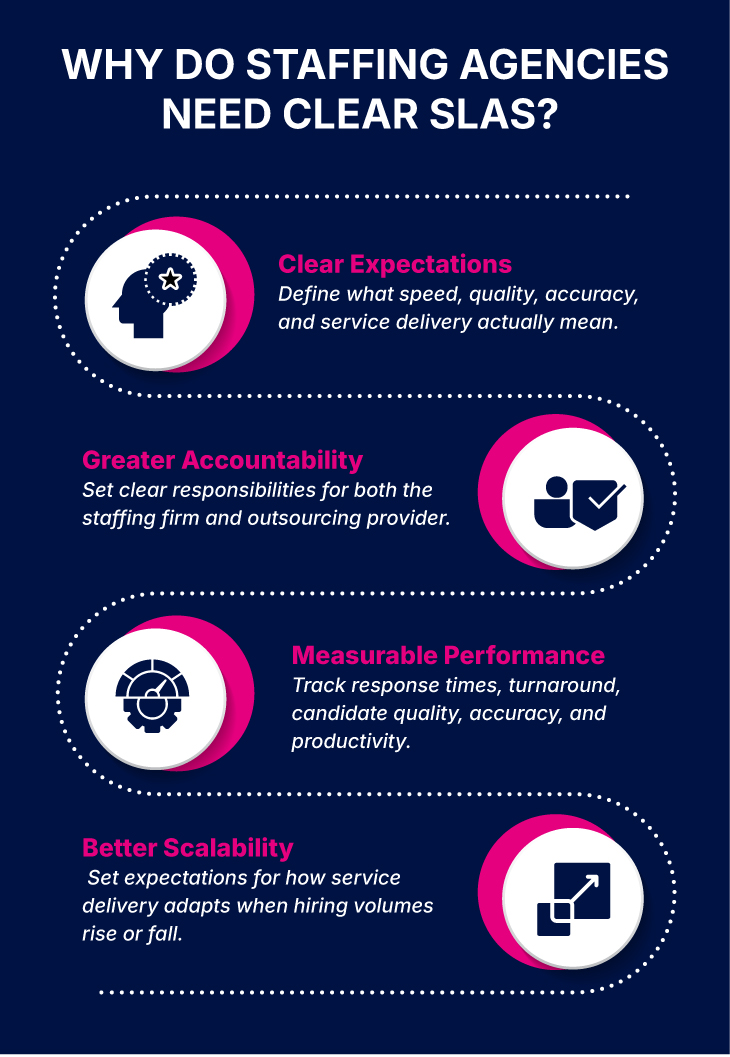
Staffing is highly time-sensitive. A delayed submission can mean losing a candidate to another agency. An inaccurate candidate record can create additional work. Poor communication can leave recruiters unsure about the status of urgent requisitions.
A properly structured recruitment outsourcing service level agreement helps avoid these grey areas.
Terms such as “quick turnaround” or “high-quality candidates” can mean different things to different people. An SLA replaces subjective expectations with agreed definitions and measurements.
Both the staffing company and the outsourcing provider know what good performance looks like and how it will be measured.
Recruitment outsourcing depends on both sides doing their part. An outsourcing team cannot necessarily process a vacancy effectively if information from the staffing company is incomplete.
A strong SLA therefore establishes responsibilities on both sides, including what information must be supplied, when the measurement clock starts, and who owns individual activities.
Without agreed measures, performance reviews can become based on perception.
Tracking defined recruitment outsourcing performance metrics gives staffing firms a clearer view of delivery across areas such as response time, candidate quality, turnaround, accuracy, and productivity.
Hiring volumes rarely remain constant. Staffing companies can experience sudden increases due to new client wins, seasonal hiring, large projects, or changing market conditions.
Clear SLAs make it easier to discuss how resourcing and service levels should work when demand increases rather than waiting until service delivery is under pressure.
Scalability is also an important consideration when evaluating Top Recruitment Outsourcing Companies, particularly for agencies whose hiring requirements change throughout the year. Top Recruitment Services Outsourcing Companies in USA 2026 specifically identifies scalability and flexibility as criteria for evaluating recruitment outsourcing companies.

There is no single SLA template that will work for every staffing company. The measures should reflect the services being outsourced, the agency’s operating model, hiring volumes, client expectations, and recruitment priorities.
However, a strong SLA for Recruitment Outsourcing should usually address the following areas.
Start by defining exactly what the outsourcing team will and will not handle.
Depending on the arrangement, this could include:
Clear scope prevents scope creep and ownership gaps. If sourcing is included but interview scheduling is not, for instance, that distinction should be documented rather than assumed.
QX’s outsourced recruitment offering illustrates how broad the possible scope can be, covering areas including full-cycle recruitment, MSP/VMS support, sourcing and screening, compliance, and administrative support.
The SLA should identify who owns each stage of the agreed workflow.
For example, the staffing firm might be responsible for providing complete job information and communicating changes in priority, while the outsourcing provider is responsible for sourcing against the agreed requirements and reporting progress.
This matters because not every delay is an SLA failure. If a request is waiting for essential information or approval from the staffing company, that needs to be distinguishable from a provider-side delay.
Document when outsourced services will be available, particularly when working across different locations and time zones.
The agreement should clarify regular service hours, how requests received outside those hours will be handled, and whether different arrangements apply to urgent requirements.
For staffing companies using offshore delivery, service coverage should be aligned with the hours when recruiters and clients actually require support.
Not every vacancy or task should necessarily receive the same priority.
A large VMS requirement with an approaching submission deadline, for example, may need to be treated differently from talent-pipeline building for a future vacancy.
The SLA should therefore establish how urgent, high-priority, and standard requests are classified and whether different service expectations apply to them.
Every SLA target needs a clear definition.
If the SLA says turnaround time will be monitored, both parties need to understand when that time starts, when it stops, what qualifies as completion, and whether any circumstances are excluded.
The objective should be to create measures that can be consistently interpreted and reported, rather than simply filling the SLA with as many targets as possible.
An SLA is useful only when the data behind it is visible.
The agreement should establish which SLA metrics will be reported, how the results will be presented, who reviews them, and how performance issues are discussed.
Reporting should help both teams identify trends and improvement opportunities rather than becoming a box-ticking exercise.
Problems will occasionally happen even in a strong outsourcing relationship. The SLA should establish what happens next.
It should identify which issues require escalation, who needs to be involved, how service problems are investigated, and how corrective actions are tracked.
Having that process agreed in advance makes it easier to resolve operational problems without unnecessary confusion.

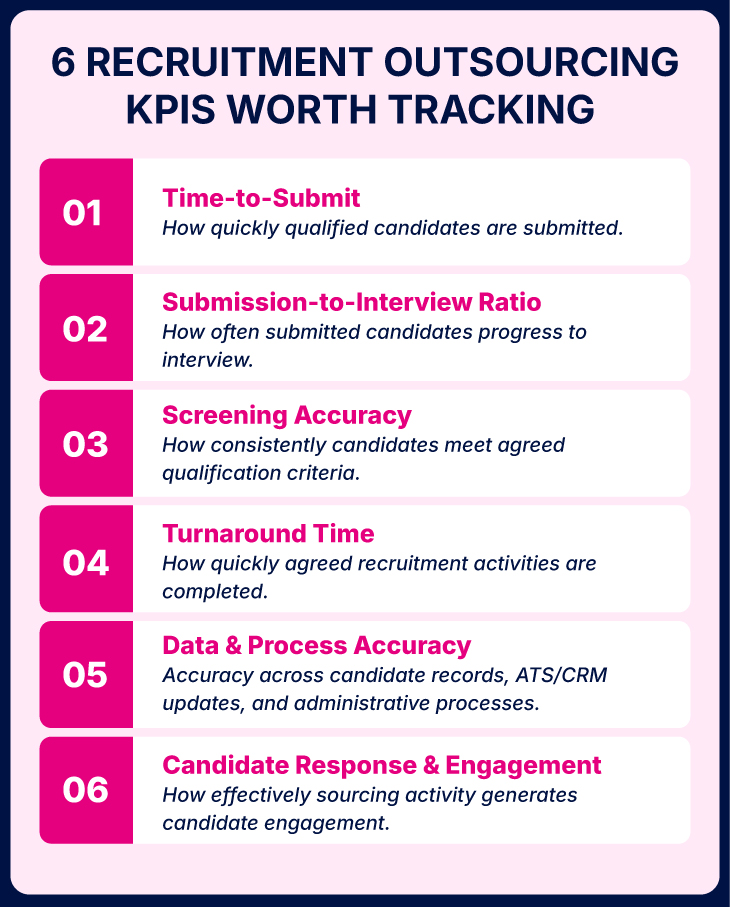
An important distinction is that not every KPI needs to become an SLA target.
KPIs help measure different aspects of recruitment performance. An SLA identifies the service standards the provider is expected to meet.
Useful recruitment outsourcing KPIs can include:
This tracks the time between receiving a valid requirement and submitting qualified candidates.
For staffing companies competing on speed, it can provide a useful indication of how efficiently the sourcing and screening workflow is operating.
However, the measurement needs clear starting and stopping points. Otherwise, delays caused by missing requirements or changed job specifications can distort the data.
Volume alone does not tell an agency whether sourcing is working.
A submission-to-interview ratio can provide a stronger indication of whether candidates being put forward are sufficiently aligned with the requirement to progress in the process.
This should be reviewed alongside other quality indicators because hiring-manager decisions can also be influenced by factors outside the outsourcing provider’s control.
Where screening is outsourced, agencies can track whether candidates forwarded to recruiters meet the agreed qualification criteria.
This could include checks against required skills, availability, location, experience, compensation expectations, or other agreed job criteria.
Defining those criteria upfront is essential. Otherwise, “candidate quality” remains subjective.
Turnaround time is particularly useful for operational activities such as candidate screening, database updates, interview scheduling, or recruitment administration.
The metric should specify exactly what activity is being timed rather than using one generic turnaround figure for every service.
Where the outsourced team handles ATS/CRM updates, candidate data, compliance documents, or recruitment administration, accuracy can be an important measure.
The SLA should also define what constitutes an error and how corrections are treated so both teams calculate performance consistently.
Where outreach forms part of the outsourced scope, candidate response or engagement can provide additional visibility into sourcing activity.
These metrics should generally be interpreted in context because response levels can be affected by the role, location, compensation, market conditions, and candidate availability.
“Respond quickly” is not an SLA.
A useful recruitment service level agreement should first distinguish between response time and turnaround time.
Response time measures how quickly a request is acknowledged or acted upon after it is received.
Turnaround time measures how long it takes the agreed activity to be completed.
The SLA should also establish:
The more precise the definition, the less room there is for disagreement when performance is reviewed.
Candidate quality is one of the hardest areas to put into an SLA because“good candidate” is inherently subjective unless the criteria are defined.
Instead of relying on one broad quality score, staffing companies can connect quality to observable recruitment outcomes.
Possible measurements include:
The right measure will depend on which part of recruitment the provider actually controls.
For example, an outsourcing partner responsible only for candidate sourcing should not automatically be accountable for every downstream hiring outcome. Measures should align with the provider’s scope and ability to influence the result.
When a service issue occurs, staffing firms should not need to work out the escalation route from scratch.
The SLA should establish levels of escalation based on the severity and business impact of an issue.
Day-to-day issues should normally be addressed by the people directly managing service delivery.
This could include clarification of requirements, individual task delays, minor quality concerns, or workflow issues.
Repeated SLA misses, significant backlogs, recurring quality concerns, or issues affecting an important client may require management involvement.
At this level, the objective should be to understand the cause, agree corrective action, establish ownership, and monitor whether the problem is resolved.
Serious issues involving areas such as significant operational disruption, data security, or major compliance concerns should have a clearly identified escalation path.
The recruitment outsourcing agreement should identify appropriate contacts and communication requirements for issues of this nature.
SLA monitoring should give staffing firms useful operational insight, not another spreadsheet that nobody looks at.
A practical dashboard can bring key recruitment outsourcing performance metrics together in one view.
Individual measures may include:
Performance should also be looked at as a trend rather than a single isolated result.
One missed target does not necessarily indicate a failing outsourcing relationship. Repeated misses, increasing backlogs, declining quality, or patterns affecting the same process deserve much closer attention.
The important question is not simply, “Did the provider hit the SLA?”
It is:“What does the data tell us about how the recruitment operation is performing?”
A missed SLA target should trigger investigation rather than an immediate blame exercise.
First, determine why the target was missed.
Was demand materially higher than expected? Was essential information unavailable? Did a workflow fail? Was capacity insufficient? Or is the target itself no longer realistic for the way the service operates?
The next step should be proportionate to the issue and could involve:
This approach helps turn SLA management into continuous service improvement, rather than using the agreement only when something goes wrong.
An SLA should not be written at the beginning of an outsourcing relationship and forgotten.
Recruitment operations change. A staffing firm may win a major client, enter another staffing vertical, increase requisition volumes, introduce a new ATS or VMS, or expand the activities being outsourced.
The SLA should therefore include an agreed review mechanism and also allow reviews to be triggered by material operational changes.
During a review, staffing companies should consider:
A good SLA should evolve alongside the outsourcing relationship.
For staffing companies, the SLA is only one element of a successful outsourcing relationship. The underlying delivery model must also support the agency’s actual recruitment workflows.
QX Global Group provides outsourced recruitment solutions covering full-cycle recruitment, MSP and VMS recruitment support, sourcing and screening, and compliance and administrative support. Its U.S. recruitment outsourcing offering is designed to scale according to changing demand and provide tailored recruitment solutions.
This matters when establishing service expectations because the right measures will differ depending on what has been outsourced. Sourcing performance should not be measured in exactly the same way as compliance administration or full-cycle recruitment.
QX’s broader recruitment outsourcing approach emphasizes structured workflows, process control, scalability, technology integration, and compliance support for staffing companies.
The result is an outsourcing model where expectations can be aligned to the specific processes being supported rather than relying on a generic, one-size-fits-all set of metrics.
A strong SLA for Recruitment Outsourcing should do more than list performance numbers. It should create a shared understanding of scope, quality, turnaround, accountability, reporting, and what happens when something goes wrong.
For staffing companies, the most useful recruitment outsourcing SLAs are those built around the realities of their business: fluctuating hiring volumes, urgent client requirements, candidate quality expectations, and processes that involve multiple teams.
Start with the services being outsourced. Define the results that matter. Choose SLA metrics the provider can meaningfully influence, establish how they will be measured, and make room for those expectations to change as the relationship evolves.
That creates an SLA that is not just part of the contract but a practical framework for a more transparent and accountable outsourcing partnership.
A good SLA for Recruitment Outsourcing clearly defines the scope of service, responsibilities, response and turnaround expectations, quality measures, reporting requirements, and escalation procedures. There is no single set of targets appropriate for every staffing company. The SLA should reflect the services being outsourced, hiring volumes, priorities, operating hours, and workflows of the specific business.
A KPI measures performance, while an SLA establishes an agreed level of service that is expected to be achieved. For example, a staffing firm might monitor time-to-submit as a recruitment outsourcing KPI. If the provider is contractually expected to achieve a defined time-to-submit standard for a particular type of request, that expectation may form part of the SLA.
Yes, where candidate quality is within the outsourcing provider’s scope, but the term quality should be clearly defined. Staffing firms can use measures such as screening accuracy, compliance with essential job criteria, submission-to-interview ratio, rejection reasons, or rework instead of relying on a vague “quality candidate” target.
Yes. Recruitment outsourcing SLAs should reflect the services, workloads, priorities, and workflows involved. A healthcare staffing company outsourcing compliance-heavy processes may require different measures from an IT staffing business using an outsourcing provider primarily for candidate sourcing.
They can, provided the mechanism is agreed between the parties. Recruitment volumes can fluctuate substantially, so an SLA should explain how significant volume changes affect capacity, prioritisation, and service expectations. Scalability is a key consideration in recruitment outsourcing because staffing requirements can change with seasonal and business demand.
Response time can be valuable when fast acknowledgement is operationally important. However, the SLA should clearly define what starts the measurement, which requests it applies to, applicable service hours, and what counts as a response. Response time and turnaround time should not be treated as the same metric.
QX Global Group provides tailored and scalable recruitment outsourcing solutions for staffing firms, with services covering sourcing, screening, full-cycle recruitment, MSP/VMS support, compliance, and recruitment administration. Specific SLA targets should be agreed during the service-scoping process so that performance measures reflect the functions, volumes, workflows, and expectations of the individual staffing firm.
Enjoyed our blog? Discover more about how our recruitment outsourcing process can slash your costs by up to 60%! Take the next step—book a call by entering your details.


Ankit Ranjan is Vice President of Operations at QX Global Group, responsible for leading strategic recruitment outsourcing and operational delivery across key global accounts. Combining entrepreneurial experience with a strong background in RPO sales and operations, he specializes in scaling teams, driving AI-enabled transformation, and building long-term client partnerships that deliver sustainable business growth.
Expertise: RPO Delivery • US Staffing • UK Healthcare Recruitment • Recruitment Operations • P&L Management • Client Relationship Management • Recruitment Automation • Operational Excellence
Originally published Oct 27, 2026 09:10:23, updated Oct 27 2026
Topics: Service Level Agreements for Recruitment Outsourcing, SLAs and KPIs in Recruitment Outsourcing
28 Aug 2024
When investing in a recruitment partner, it’s essential to ensure that the decision is both measur...
Read More

