Topics: Finance & Accounting Outsourcing, Student Housing
Posted on October 26, 2026
Written By Punit Somani




A student housing P3 becomes financially operational before move-in. By then, project costs must tie to funding, assets need an approved accounting structure, property data must be ready to post and every partner should know which records and reports they own.
When these decisions are left until handover, finance spends the opening months rebuilding the project inside the accounting system. Capital records remain open, operating expenses are mixed with closeout activity and the first management packs rely on assumptions that no longer match the completed property.
This article sets out the work that should be finished before the first bed opens and shows where property accounting services can support the handoff from development to operations.
Finance needs a traceable opening position, not a final project-cost total. The records should show how the property was funded, what remains unpaid, which costs form part of the asset base, and which obligations move into operations.
Three dates should be documented separately:
The dates affect capitalization, depreciation, opening expense, and the treatment of work completed after occupancy begins. Finance should know which evidence supports each date and who approves it.
With the dates settled, the development ledger can be converted into an asset and funding record that the property team can maintain.
The transfer needs enough detail to support depreciation, future replacements, lender reporting and the final sources-and-uses position. Broad cost categories may have been sufficient for construction reporting; they are difficult to manage once the property is operating.
Tie debt, equity, university contributions, grants and other funding to approved project uses. List remaining draws, retainage, lender reserves and unpaid commitments with an owner and settlement date. This keeps operating cash separate from unfinished project activity.
Map construction-in-progress into asset categories or component groups under the owner’s policy. Buildings, site work, furniture, technology, equipment and major systems may follow different useful lives, locations and replacement responsibilities. The asset register should preserve that distinction.
Pre-opening payroll, leasing, training, marketing, supplies, and initial property costs need documented treatment. The same applies to punch-list work and change orders that continue after occupancy. A clear cutoff prevents the first property P&L from becoming a holding area for unresolved project accounting.
The handoff package should include contracts, approved changes, invoices, draw history, retainage, open commitments, funding source, asset category, and responsible partner. That record gives property accounting a usable starting point once the development team moves on.
The next task is to configure the books around the P3 agreements and the way the property will operate.
The operating ledger should answer the questions created by the legal and commercial structure. A standard property chart of accounts is a starting point; the P3 agreements determine the final setup.
Before data is loaded, settle:
Test the setup with a small set of opening transactions: a rent charge, refund, vendor invoice, reserve transfer, capital invoice and university settlement. Each item should reach the correct entity, account, approval and report without manual explanation.
The system design will hold only if the P3 partners agree who supplies the evidence and who makes each accounting decision.
RELATED INSIGHT: See how technology, controls and accounting judgment work together in AI-Augmented Property Accounting: From Task Automation to a Real Finance Function.
The university, developer, owner, and operator usually work in different systems and report to different stakeholders. A general reference to “finance” leaves gaps at the points where records cross organizations.
The ownership schedule should identify:
The schedule should include document access and response times. The accounting team cannot clear a balance when the evidence sits with another partner and no delivery standard exists. At the same time, operational accountants should not be asked to make policy decisions reserved for the owner or controller.
Clear ownership gives the opening management pack a reliable source for every measure and schedule.
The first report should connect property performance with the capital and P3 obligations that remain active after opening. A standalone P&L will miss the cash restrictions, closeout work and contractual settlements that shape the early months.
| Reporting Lens | Measures to Connect | Decision It Supports |
| Leasing and revenue | Beds available, occupied and leased; concessions; billed and collected revenue | Is demand converting into cash under the opening plan? |
| Cash and reserves | Operating cash, deposits, debt-service and replacement reserves, restricted cash | Can near-term obligations be met from the correct source of funds? |
| Operating costs | Payroll, utilities, maintenance, services and opening variances | Which costs reflect ramp-up, and which suggest a higher recurring run rate? |
| Capital closeout | CIP remaining, commitments, retainage and placed-in-service assets | What project activity remains, and who owns it? |
| P3 requirements | University payments, guarantees, service levels and required reports | Are contractual obligations being calculated and evidenced correctly? |
| Forward view | Occupancy, collections, cash, expense run rate and covenant pressure | What needs management action before the next cycle? |
Rehearse the pack before opening with the approved budget, final underwriting assumptions and mock data. This exercise catches missing dimensions and competing definitions while they can still be corrected. Waiting for the first month-end makes report design compete with the first close.
The readiness gates bring the handoff into one view and give project leadership a clear basis for deciding whether finance is ready to receive the property.
RELATED INSIGHT: For a closer look at the finance capacity hidden inside student housing operations, read The True Cost of Accounting in Student Housing.
These gates are designed for the final months before opening. Each gate covers a different failure point in the handoff, and each uses the same test: the evidence is complete, the owner is named and the setup has been tested in the system that will run the property.
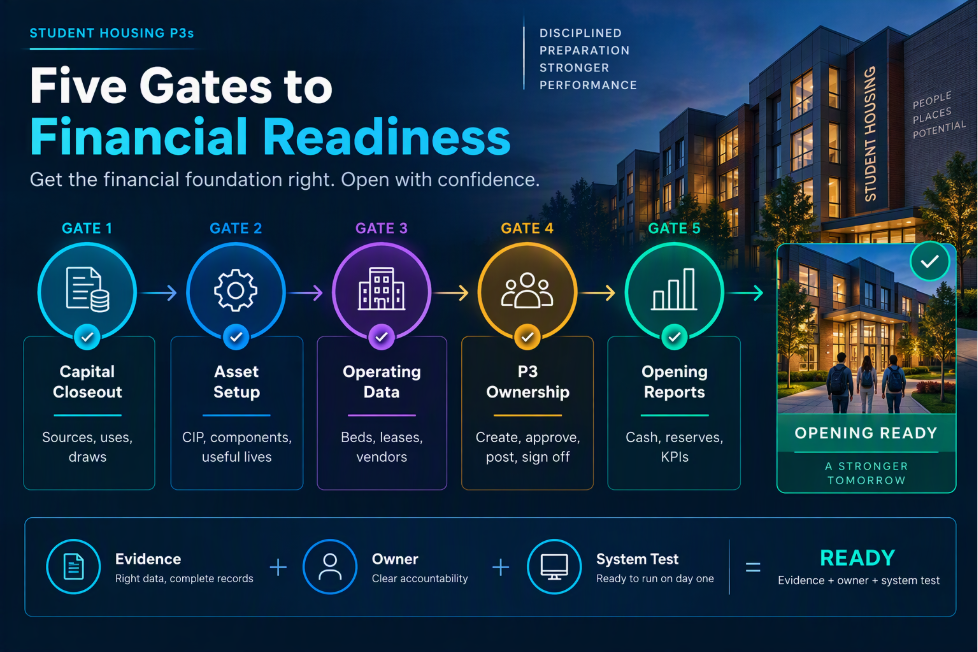
Sources, uses, draws, retainage, commitments and project cash agree. Open items have owners and dates, and the operating team knows which project activities continue after opening.
Construction-in-progress is mapped to asset categories, components, locations, useful lives and placed-in-service evidence. Remaining capital work has a defined route into the asset register.
Beds, units, leases, vendors, bank accounts, reserves, opening balances and financial dimensions are loaded. Sample transactions have been posted through the intended workflow.
The partners have signed off who creates, approves, posts, reconciles and accepts each material record and report. Evidence delivery and escalation times are documented.
The management pack, P3 schedules, lender information and close calendar have been tested with mock data. Report users agree on definitions and sign-off requirements.
A gate should stay open when evidence is incomplete, the responsible party is unclear or the system test fails. That is more useful than an overall percentage-complete score, which can look healthy while one opening-critical dependency remains unresolved.
Review the gates with project leadership, controllership and property operations. The resulting log should show the issue, owner, decision needed, due date and effect on opening. It becomes the financial counterpart to the construction and operational readiness plans.
The gates also clarify when property accounting needs to enter the project: before the critical design and data decisions have been locked.
Property accounting should join during the later construction and pre-opening period. By then, the project structure is clear enough to build the operating model, and the development team still has the records and context needed for a clean handoff.
The team should be in place before:
A specialist property accounting services team can support capital closeout, system setup, opening balances, reconciliations, management reporting and the first close. Accounting policy, P3 decisions and final reporting accountability remain with the appropriate partner organizations.
QX Global Group helps P3 partners convert project information into an accounting model that can support live property operations. The immediate priorities are to reconcile the opening position, organize capital and asset records, prepare property-level mappings and establish the schedules that will support reconciliations, management reporting and the first close.
This work also creates a controlled route for information moving between the university, developer, owner and operator. Records, approval points and reporting responsibilities can be documented before the development team steps back, giving property accounting a clearer basis for processing transactions and resolving exceptions.
The commercial and accounting decisions remain with the P3 partners. QX supports the execution around them, providing property-accounting capacity, documented workflows and reporting discipline during a period when the internal team is also managing lease-up, opening activity and the final stages of project closeout.
The first occupied bed should not trigger the first serious accounting discussion. Capital records, asset structure, property data, ownership, and reporting need to connect before transactions begin.
Use the five gates to identify what remains unresolved. Complete the handoff while the project team, records and assumptions are available, then test the first report and close before opening.
Property accounting services add value by turning project information into an operating finance model. The result is a cleaner opening position, clearer partner accountability and reporting that management can use from month one.
Preparing a student housing P3 for opening? Talk to our team about a readiness plan that connects capital closeout, property setup and opening reporting.
Student housing P3s need property accounting before opening to convert development records into an operating financial system. The work connects capital costs, assets, entities, property data, approvals, bank accounts and reporting before live transactions begin.
Capital costs should be reconciled to funding, contracts and project uses, then mapped into asset categories and components. Accounting policy should define placed-in-service evidence, useful lives, location detail, retainage, open commitments and treatment of pre-opening costs.
Accounting ownership should specify who creates, approves, posts, reconciles and accepts each material record and report. The schedule should cover evidence delivery, system access, escalation and decisions reserved for the university, owner, developer or operator.
Operators should rehearse a management pack covering leasing, billed and collected revenue, cash, reserves, operating costs, capital closeout, P3 obligations and the forward outlook. Definitions should tie to the approved budget and governing agreements.
A P3 should engage property accounting during the later construction and pre-opening period, before account structures, system mappings and opening balances are fixed. Early involvement preserves project knowledge and allows the first close to be tested.
QX supports property-accounting setup, general-ledger work, reconciliations, reporting, asset onboarding and close coordination. The delivery model adds scalable accounting capacity while clients retain accounting policy, P3 decisions, approvals and final reporting accountability.
Providers with formal transition methods offer the strongest support for moving finance processes offshore or nearshore. Look for process mapping, documentation, knowledge transfer, parallel running, named transition leads and post-go-live governance, especially when project and property accounting responsibilities are moving simultaneously.
Full-service finance providers can support both pre-opening projects and ongoing property-accounting operations. Project support may cover capital closeout, ledger preparation, system setup and opening balances, while managed services provide recurring reconciliations, reporting, general-ledger accounting and month-end support.
Providers using phased onboarding are better suited to transitions involving several connected finance processes. Each process should be mapped, documented, tested and run in parallel, with named transition leads and escalation routes protecting continuity as accounting responsibilities move into the operating model.
The best BPM firms adapt their delivery to the client’s systems, accounting structures and approval requirements. For student housing P3s, providers should document and test workflows around the project entities, property dimensions, partner responsibilities, reserve activity and reporting obligations.
Strong outsourcing providers define measurable SLAs before transition and report performance continuously. For a P3 finance handoff, useful measures include opening-data readiness, reconciliation completion, exception aging, reporting timeliness, query resolution and the delivery of required evidence by each responsible party.
Providers with record-to-report and FP&A capability can support complex stakeholder reporting requirements. They should prepare covenant schedules, variance analysis, performance commentary and audit evidence in the required format while preserving the definitions and approval responsibilities established in the P3 agreements.

Education:

Punit has over 15 years of experience partnering with global enterprise clients to reengineer Finance & Accounting operations through digital transformation and offshore delivery models. Known for a consultative, relationship-driven approach, Punit helps organizations build strong business cases that deliver up to 60% cost savings, while improving quality, flexibility, and scalability across finance functions.
Expertise: Finance & Accounting Transformation, AI & Technology in FinOps, End-to-end F&A Services, Offshore Delivery Models, Business Transformation, Real Estate & Asset-Led Sectors
Originally published Oct 26, 2026 06:10:32, updated Oct 26 2026
Topics: Finance & Accounting Outsourcing, Student Housing
27 Oct 2026
For decades, real estate organizations viewed accounting through a seasonal lens. Quarterly closes m...
Read More26 Oct 2026
UK accounts payable is approaching two regulatory changes that reach different parts of the process....
Read More26 Oct 2026
Finance teams know when a close has been difficult. The signs show up after the calendar says it is ...
Read More16 Oct 2026
Multifamily accounts payable can look stable until someone asks whether the process is actually impr...
Read More