Topics: Accounts Payable Process, Finance & Accounting Outsourcing
Posted on October 26, 2026
Written By Rushabh Shah




UK accounts payable is approaching two regulatory changes that reach different parts of the process. The Commercial Payments Bill is aimed at payment terms, late-payment interest and disputes. Mandatory e-invoicing from 2029 will change how VAT invoice data is issued and exchanged.
For a multi-site group, both changes expose the same operational weakness: AP often knows that an invoice exists without having a reliable view of when the payment clock started, why the invoice stopped, who owns the exception or whether the supporting data will survive regulatory scrutiny.
The response should be one AP redesign, built around clean supplier data, clock-based workflow, controlled exceptions, and evidence that follows the invoice from receipt to payment. This article talks about what is confirmed, what remains open, and which process changes are worth making now.
The Commercial Payments Bill is still progressing through Parliament. The government’s May 2026 overview says the Bill would impose maximum payment terms of 60 days, with strictly limited exemptions, and require interest on late payments at 8% above the Bank of England base rate. It would also strengthen the Small Business Commissioner’s investigative and enforcement powers.
The government estimates that late payments cost the UK economy £11 billion a year and are associated with 38 business closures each day. Those figures explain the policy pressure behind the Bill; they do not alter its current status as proposed legislation.
The second change is further out but broader in data terms. The government has confirmed mandatory e-invoicing for all VAT invoices from 2029. Detailed standards, scope and implementation arrangements are still being developed. The official position supports preparation now, without hard-coding assumptions that the eventual roadmap may change.
The difference is, the Bill governs how payment terms and late payment are managed, and e-invoicing governs how invoice data moves. AP sits somewhere between them. This shared operating ground is where the redesign should ideally begin.
The Commercial Payments Bill and e-invoicing mandate create different legal obligations. Inside AP, however, both depend on a smaller set of controls working consistently.
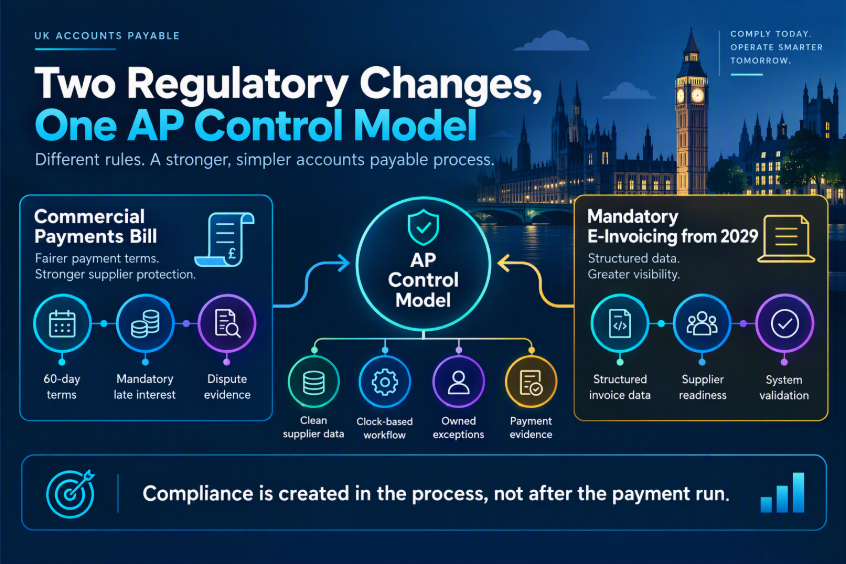
Structured invoices need consistent supplier identities, tax information and routing details. Payment-term compliance also depends on knowing which contract, legal entity and supplier classification governs the invoice. Duplicates and incomplete records weaken both.
AP needs a clear timestamp for receipt, validation, dispute, approval and payment. The Bill raises the importance of the contractual due date and late-payment interest. E-invoicing makes receipt data more structured, but the workflow still has to use it correctly.
A price mismatch, missing purchase order or receipt dispute cannot disappear into an inbox. The process must identify why the invoice stopped, who holds the next action and when escalation begins. That record supports operational control and any later challenge over payment timing.
Approvals, overrides, dispute history, payment preparation and release should leave a traceable record. Faster data exchange increases the value of a clean evidence trail; it does not create one automatically.
These four controls are the common design layer. They help finance to better respond to the latest payment questions and prepare for structured invoicing without building two separate compliance programmes.
Before changing systems, it’s important to look at which weaknesses need action now, and which design choices should remain flexible.
The regulatory direction is clear enough to begin process work. Some technical choices still depend on the final e-invoicing roadmap and the Bill’s passage. The matrix below separates immediate control work from decisions that should remain adaptable.
| Decision | AP Work | Why |
| Act now | Supplier master, contractual terms, invoice receipt timestamps, approval routes, exception ownership, payment evidence | These controls are useful under current law and form the base for both reforms. |
| Design flexibly | Structured-data validation, supplier onboarding, system interfaces, compliance reporting, interest calculation rules | Build configurable requirements and avoid locking the process to one unconfirmed technical model. |
| Wait for final detail | Final e-invoicing standards, transmission arrangements, exemptions, commencement dates and detailed reporting requirements | Monitor official guidance and convert confirmed policy into specifications when published. |
This approach avoids two expensive mistakes – postponing process work until every rule is final, or buying technology against assumptions that later prove wrong. Fix the control foundation now, and keep the technical layer open to change.
The decision matrix becomes more practical when it is translated into the invoice journey across sites and entities.
RELATED INSIGHT: For a deeper look at operational readiness for structured invoices, read Procure-to-Pay Outsourcing: Is the UK Ready for the e-Invoicing Shift?
Multi-site groups carry more variation than the policy language suggests. Supplier terms may sit in local contracts, receipts may be confirmed by operational teams and invoices may enter through email, portals, or head-office capture. The central AP team is expected to meet one payment standard using evidence produced in several places.
Four points deserve immediate review:
Record the agreed payment term, governing entity, supplier category and any approved exception in a source that AP can use. The due date should not depend on somebody finding the contract after the invoice arrives.
Define what confirms that goods or services were received, who records it and how quickly. Structured invoice data will not resolve a missing operational receipt.
Separate genuine disputes from incomplete internal processing. Record the reason, evidence, owner, amount and date raised. This prevents a late approval from being described as a supplier dispute.
Identify invoices approaching terms, calculate potential late-payment exposure, and preserve the reason for any delay. Reporting should show ageing by cause alongside supplier and site views.
The review should be run by process variant, not solely by legal entity. Two sites in the same company can create different compliance risk if one uses purchase orders and digital receipts while the other relies on emailed invoices and manual approval chasing.
Once the process variants are visible, the redesign can then focus on the controls that remove unnecessary delay without centralising every commercial decision.
Regulatory programmes often collect requirements faster than they remove work. AP needs a simpler route from invoice receipt to approved payment, supported by clear controls at the points where risk changes.
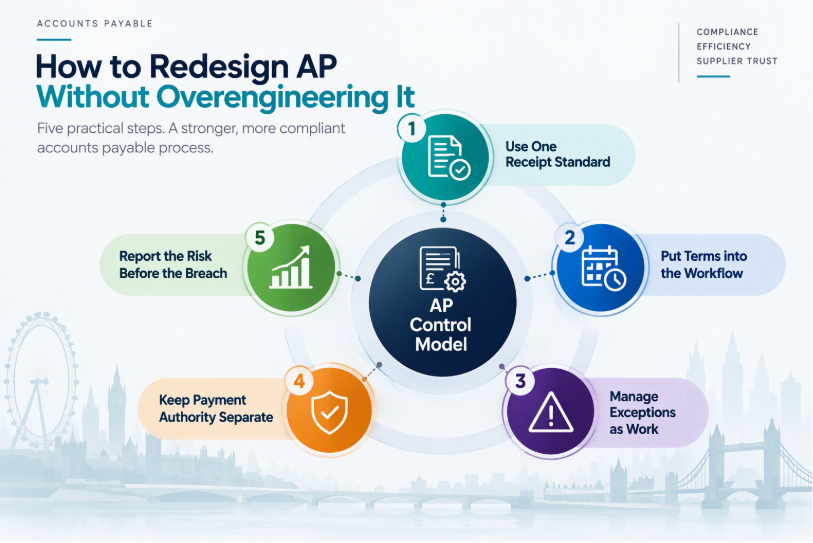
Choose controlled intake routes and timestamp receipt consistently. PDFs, portal invoices and structured data may coexist during the transition, but they should enter the same status model and exception process.
The due date, contractual term and approval timetable should be visible from the start. Escalation should begin while there is still time to resolve the issue before payment becomes late.
Classify mismatches, missing evidence, disputes and approval delays by cause. Give each one a next owner and ageing clock. Repeated causes should enter a process-improvement queue so the same work does not return each month.
Invoice processing, approval, payment-file preparation and bank release need a clear segregation of duties. New automation should strengthen that boundary and retain evidence for every override.
A compliance dashboard should show invoices approaching terms, unresolved disputes, late approvals, potential interest and supplier-data failures. It should help teams intervene, not explain the problem after the payment run.
This is a natural point to consider accounts payable outsourcing. A specialist team can provide capacity for supplier-data work, invoice validation, approval follow-up, exception administration, and reporting while payment policy, commercial judgement, and fund release remain with the business.
The right operating model is measured by whether it produces reliable control across the full supplier population, including the awkward invoices that leave the normal workflow.
Compliance readiness should improve current performance as well as future capability. Finance should expect visible movement in five areas:
The measures need one owner and a recurring review. A transformation programme that closes after system go-live will miss the process drift that regulation is designed to expose.
RELATED SERVICE: See how QX supports invoice processing, approvals, exceptions, supplier queries, and payment preparation through accounts payable outsourcing services for UK businesses.
QX Global Group helps UK businesses strengthen the operating controls that will sit underneath both payment-term compliance and e-invoicing. The work can include validating supplier records, documenting contractual terms, standardising invoice receipt, following up approvals, managing exceptions, and maintaining the evidence behind disputes and payment decisions. These are established AP disciplines, but regulation will make their consistency easier to test and harder to overlook.
For multi-site groups, the challenge is usually variation rather than a complete absence of process. Sites may use different intake routes, purchase-order practices and approval conventions, leaving the central AP team to reconstruct what happened when an invoice approaches its due date. QX can help bring those variants into one controlled workflow, with common status definitions, escalation rules and reporting across the supplier population.
The client retains contract policy, commercial decisions, dispute judgement, payment priorities, and bank release. QX provides the operating capacity to keep supplier data current, move invoices through the agreed process, and surface payment risk before it becomes late-payment interest or a compliance question.
The Commercial Payments Bill and mandatory e-invoicing will place different obligations on UK businesses. Both depend on AP knowing who the supplier is, when the clock started, why an invoice stopped and what evidence supports the payment decision.
Start with the operating controls that are already useful: reliable supplier data, visible terms, owned exceptions, and complete payment evidence. Keep the technical e-invoicing design flexible until the government publishes the final roadmap.
A well-designed AP process will be easier to adapt when the law and standards are settled. It will also pay suppliers more predictably, expose risk earlier, and give finance a clearer view of the work still sitting between invoice receipt and payment.
Let’s help you get a headstart. Explore QX Global Group’s accounts payable outsourcing services or talk to our team about a UK AP operating model built around cleaner data, controlled exceptions, and stronger payment evidence.
Accounts payable is becoming a bigger priority because payment practices and invoice data are moving under greater scrutiny. The Commercial Payments Bill targets late payment, while mandatory e-invoicing from 2029 will require more structured, reliable VAT invoice data.
Mandatory e-invoicing will move VAT invoices towards structured, machine-readable exchange. AP teams will need stronger supplier data, validation, coding, exception handling and system integration so invoices can pass through the process without relying on manual document checks.
Multi-site groups should redesign early because local contracts, receipt practices and approval routes create inconsistent payment evidence. Standardising these controls takes longer than installing technology and reduces current delays while preparing the business for regulatory change.
Businesses need confirmed supplier terms, reliable receipt timestamps, due-date calculation, approval escalation, documented disputes and traceable payment evidence. Reporting should identify invoices approaching terms and show whether delays come from suppliers, operations, approvers or AP.
Outsourcing is worth considering when supplier-data cleanup, exception work, approval follow-up and reporting exceed internal capacity. A provider can add structured execution and transition support while payment policy, commercial judgement, approvals and bank release remain in-house.
QX supports supplier-data administration, invoice validation, matching, approvals, exceptions, supplier queries, payment preparation and reporting. The delivery model helps businesses standardise AP operations across sites while clients retain payment policy, dispute decisions and fund-release authority.

Education:
CA, B.Com

Rushabh Shah is a Chartered Accountant with over 7 years of experience in audits, financial analysis, and process optimisation. At QX, he specialises in CAPEX reviews, treasury management, P2P processes, and tax and statutory compliance. With a strong foundation in financial reporting, Rushabh brings cross-sector expertise and a sharp analytical approach to managing complex finance operations.
Expertise: CAPEX Reviews, Treasury Management, P2P Processes, Tax & Statutory Compliance, Financial Reporting, Audit & Financial Analysis
Originally published Oct 26, 2026 06:10:53, updated Oct 26 2026
Topics: Accounts Payable Process, Finance & Accounting Outsourcing
26 Oct 2026
A student housing P3 becomes financially operational before move-in. By then, project costs must tie...
Read More26 Oct 2026
Finance teams know when a close has been difficult. The signs show up after the calendar says it is ...
Read More16 Oct 2026
Multifamily accounts payable can look stable until someone asks whether the process is actually impr...
Read More15 Oct 2026
Market signals often reach the business before they reach the forecast. Sales, demand, staffing or i...
Read More