Topics: Finance & Accounting Outsourcing, FP&A
Posted on October 15, 2026
Written By Visharad Saluja




Market signals often reach the business before they reach the forecast. Sales, demand, staffing or input costs can change while finance is still reconciling actuals and checking the assumptions behind the current outlook.
The time lost between recognising a change and acting on it is decision latency. It grows when operating data and financial definitions do not align, models need rebuilding, or approval starts after the scenario work is complete.
FP&A helps shorten that path by turning new evidence into an updated financial view, a clear management choice, and an owned action.
This article explores where the process slows and how FP&A services can add analytical capacity while commercial judgement and final decisions remain with the management.
UK businesses are working with signals that move in different directions. Demand can hold while margins weaken. Prices may rise while volumes soften. Wage pressure can ease while energy exposure increases. A stable headline can therefore conceal a material change in the economics underneath it.
Take the Bank of England’s July 2026 Decision Maker Panel for example. Among the firms responding to its energy-shock questions, 64% expected lower profit margins over the following 12 months. This is a useful planning signal because it does not tell management what will happen to a particular business. It tells management which assumptions deserve immediate challenge.
The FP&A question is therefore not whether the market has changed. It is whether the financial model can absorb the change quickly enough to show:
A monthly variance report may eventually describe all four. The management advantage comes from resolving them before the month is over, while the business still has choices.
The challenge is not recognising that something has changed. It is understanding why a decision that looks urgent on a certain day still has not translated into action three weeks later.
RELATED BLOG: For the market context behind margin, demand and operating-model pressure, see UK Hospitality Sector: A Data-Driven Outlook 2026.
The delay usually accumulates at four hand-offs. Improving one can help, but the full cycle only accelerates when the hand-offs work as one sequence.
Market change first appears in operating measures, i.e., booking pace, occupancy, customer mix, enquiry levels, labour deployment, usage, cancellations, or supplier pricing. These measures are often owned outside finance and defined for operational purposes. If there is no agreed threshold for escalation, teams debate whether the movement is significant before anyone assesses the financial effect.
A consolidated result can be correct and still be unhelpful. Management may need to know which site, channel, cohort, or product drove the change. If actuals cannot be reconciled at the level where action is possible, FP&A spends time disaggregating the number while the decision waits.
Spreadsheet-based models often carry hidden dependencies. For example, local files, personal assumptions, and manual links to operating data. A new signal triggers another version rather than a controlled refresh. Discussion then shifts from the commercial choice to whose model and assumptions should be trusted.
A credible scenario can still stall if decision rights, materiality thresholds, and ownership were not agreed in advance. The analysis reaches leadership, but the meeting becomes the first conversation about authority, risk and implementation. Approval is followed by another delay while the business decides who will act.
These are different problems. More reporting will not fix unclear authority. Better models will not fix disputed operating definitions. A faster close will not help if management cannot see the unit requiring intervention.
Here’s a diagnostic that is designed to identify the specific hand-off that needs attention.
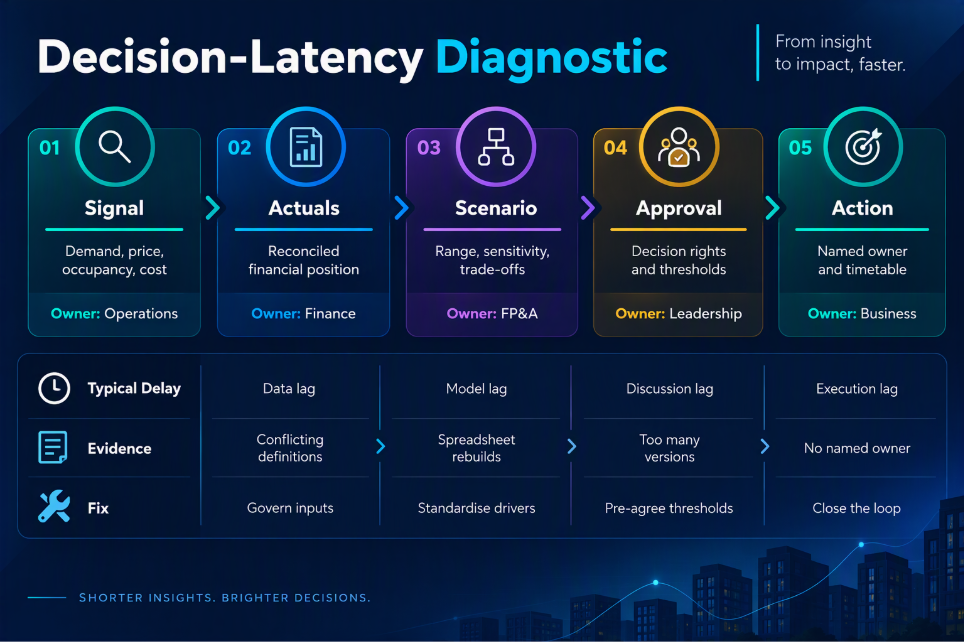
Once the slow hand-off is known, FP&A can redesign the cycle around three outputs – a current financial view, a bounded choice, and a clear route into action.
FP&A shortens the cycle when it connects three things: a current financial view, a credible management choice and clear ownership after approval.
FP&A must first connect verified actuals with the operating driver that moved. This sounds basic, but it changes the quality of the conversation. A revenue shortfall explained as volume, price, mix or timing leads to four different management responses. A labour overspend explained by wage rate, hours, productivity or demand coverage does the same.
The financial view should therefore answer three questions before a scenario is built:
Scenario planning should leave management with a small number of credible options. Each one needs a clear range, the assumptions behind it and the actions available if conditions move in that direction.
For each option, FP&A should show the expected financial effect, the sensitivity to the key driver, the cash and capacity consequence, the point at which the option stops working and the earliest date on which management must act. This makes the scenario comparable rather than merely plausible.
Rolling forecasts then become a response mechanism rather than a calendar exercise. An assumption changes when the evidence changes. Stable assumptions stay stable. Material movements flow into the outlook and management review without waiting for the next full planning round.
Approval should complete the analytical cycle, not end it. The decision record needs a named owner, implementation date, expected result, and measure that will confirm whether the action worked. FP&A then carries the result into the next outlook.
Management actions alter the forecast, so the result must feed back into the next outlook. A rate change affects mix and demand. A hiring pause changes capacity. Delayed capex changes cash, service levels or future revenue. Without feedback, the next forecast reflects the decision as an assumption rather than testing its effect.
Businesses using FP&A services can add recurring capacity across data preparation, forecasting, scenario modelling and management reporting while keeping assumptions, commercial judgement and approval with the internal leadership team.
External support is useful when recurring planning work consumes the same people needed to challenge assumptions and advise management. The goal is to create dependable analytical capacity, not to send judgement outside the business.
| Operating Boundary | Responsibility |
| A specialist team runs | – Data preparation – Model maintenance – Rolling forecasts – Variance analysis – Scenario production – Dashboard and management-pack preparation |
| Management retains | – Commercial assumptions – Risk appetite – Pricing and investment choice – Capital allocation – Decision thresholds – Final approval |
| Both sides govern | – Definitions – Materiality – Planning calendar – Model changes – Version control – Challenge – Escalation – Feedback into the next forecast |
This division matters for two reasons. First, it gives the internal team more time for challenge and business partnership. Second, it keeps accountability where it belongs. The provider can maintain the model and prepare the analysis; management must still own the assumptions and choose the action.
Also Read: Top FP&A Outsourcing Companies in the UK – What Sets Them Apart?
Performance should be measured against the decision cycle rather than the volume of reports produced. Useful measures include time to refresh a material scenario, forecast reliability by driver, rework between versions, adoption of the output in management meetings and whether approved actions move the next forecast in the expected direction.
Providers should be assessed on whether they can sustain this flow inside the client’s systems and governance, instead of supplying isolated modelling support.
QX Global Group provides FP&A services across budgeting, rolling forecasts, scenario modelling, variance analysis, KPI reporting, and management packs. Delivery is organised around the client’s systems, planning calendar and reporting requirements rather than a separate offshore timetable.
The model combines recurring analytical capacity with a clear control boundary. QX can prepare data, maintain models, refresh forecasts and produce decision-focused reporting. The client retains its commercial assumptions, risk appetite, investment choices and approval authority.
For UK businesses, this can connect operating drivers with the financial outlook and give management a clearer view of how changes in demand, price, labour, or cost affect margin, cash and capacity. Internal finance teams can then spend more time testing the choice and less time reconstructing the evidence behind it.
RELATED CASE STUDY: See how QX helped a UK luxury holiday park business standardise management accounts, eliminate open reconciliation items, and reduce its AP backlog by 44%.
A broad FP&A transformation can make the problem feel larger than it is. Begin with one recurring decision that matters. It can be rate, labour, customer mix, discretionary spend, capex timing, or anything with a visible financial consequence.
Trace that decision from market signal to financial view, scenario, approval, and action. Record where definitions diverge, where data waits, where models are rebuilt, and where ownership becomes unclear. Correct that hand-off, measure the time released, and carry the discipline into the next decision cycle.
FP&A earns its strategic role when market evidence changes the outlook, the outlook clarifies the choices, and an accountable owner can act while those choices remain available. This is how finance reduces decision latency without trading away judgement.
FP&A services connect market and operating signals with reconciled actuals, refreshed scenarios and management reporting, reducing avoidable delay while commercial decisions and approval remain with leadership.
Operational data identifies changing drivers, actuals establish the verified financial position and forecasts translate both into an updated view of revenue, margin, cash and capacity.
Scenario planning shows credible outcomes, the assumptions separating them and the actions available, allowing leaders to decide without rebuilding the analysis during every management review.
FP&A links variances to business drivers, refreshes assumptions, tests sensitivities and presents the change in outlook so reporting supports a decision rather than describing performance alone.
Consider outsourcing when recurring forecasts, model maintenance and management reporting limit internal capacity for challenge, or when scenario analysis repeatedly arrives after the decision window has narrowed.
QX supports budgeting, rolling forecasts, scenario modelling, variance analysis, KPI reporting and management packs within the client’s systems, calendar and governance, while management retains decision authority.
Assess providers on governed data, driver-based models, version control and decision-focused reporting. Visibility is useful when finance leaders can trace the change and act on it.
Look for partners combining recurring analytical capacity with clear governance, sector understanding and a delivery model that keeps assumptions, challenge and final decisions with the CFO team.

Education:
C.A., B.Com (Hons)

Visharad Saluja is a Chartered Accountant with over 10 years of post-qualification experience in FP&A, Record to Report, and Procure to Pay processes. Before joining QX, he worked with Indian listed companies, managing budgeting, pricing, costing, GL accounting, and financial finalisation. Visharad brings a sharp commercial lens to finance, combining management reporting with strong stakeholder alignment to drive decision-ready insights.
Expertise: FP&A, R2R, P2P, Contract Management, P&L and B/S Finalisation, Stakeholder Management, Management Reporting
Originally published Oct 15, 2026 03:10:24, updated Oct 16 2026
Topics: Finance & Accounting Outsourcing, FP&A
16 Oct 2026
Multifamily accounts payable can look stable until someone asks whether the process is actually impr...
Read More14 Oct 2026
Most multifamily finance teams have seen some version of this. A new ERP gets approved, an AP automa...
Read More14 Oct 2026
A new PBSA asset can add hundreds of beds to a portfolio. It can also add hundreds of daily finance ...
Read More13 Oct 2026
A structured invoice can travel from one system to another in seconds. The approval, dispute, and pa...
Read More