Topics: Finance & Accounting Outsourcing, P2P
Posted on October 01, 2026
Written By Mehboob Rad




Run a tender for procure-to-pay outsourcing and the meetings blur together. Multiple providers, multiple decks, much the same promise: invoices processed faster, costs down by a stated percentage, and a touchless rate quoted to one decimal place. When the differences look marginal, the decision usually comes down to price.
Eighteen months later, the differences are easier to see. Not in what the providers processed, but in what they left behind:
The gap between what is pitched and what is delivered is the subject here. This piece looks at what the leading procure-to-pay outsourcing companies do differently, and how to evaluate providers thoroughly before choosing the right partner.
Procure-to-pay outsourcing companies run some or all of the cycle that begins when somebody decides to buy something and ends when the supplier is paid. In practice, this means requisition and purchase order management, supplier onboarding and master data, invoice capture and coding, two and three-way matching, exception handling, approval workflow, payment runs, supplier query resolution, and reporting.
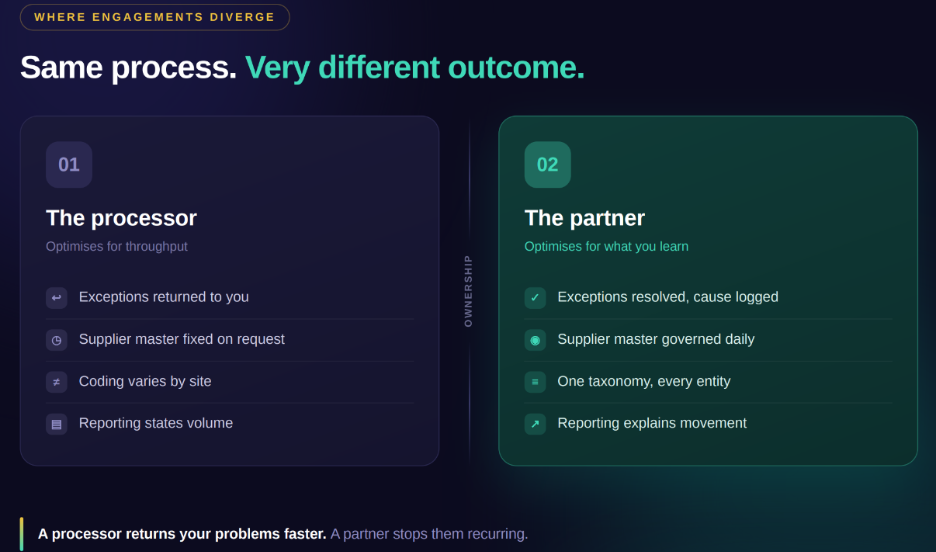
A provider taking on procure to pay outsourcing at the transactional end will process what arrives, match what can be matched, and return anything that fails to your team with a query attached. The work leaves the building and the problems come back.
At the other end, the provider owns the exception through to resolution, maintains the supplier master as a standing duty, and applies coding rules consistently enough that spend by category means the same thing in March as it does in November.
Now, both are legitimate commercial offers but only one of these changes what the finance function knows. This distinction has become harder to ignore, for reasons that have little to do with cost.
Regulatory change, incomplete automation, and greater payment scrutiny are forcing businesses to reconsider what they need from P2P.
The first is regulatory. The government has announced its intention to mandate e-invoicing for VAT invoices from 2029, with the implementation roadmap expected at Budget 2026. The detail is still being worked through with industry, which is precisely why the preparation matters now. Structured invoicing only works if the supplier master is clean and the coding taxonomy is consistent, and both take considerably longer to fix than the technology takes to install.
The second is the state of automation already in place. Most finance functions describe themselves as automated, and most are, in the narrow sense that invoices arrive electronically and keying has largely gone. What sits underneath is less settled. Approval routing still depends on individuals, exceptions leave the workflow and travel by email, and supplier records are corrected when somebody notices rather than as a matter of routine. The visible problem was solved but the one that determines data quality was still present.
The third is scrutiny of payment behaviour. Large businesses now report their payment performance publicly, and the data is comparable across sectors. Supplier relationships that were previously a private matter are now a matter of record, which changes the cost of running a process that pays late by accident rather than by policy.
Taken together, these push the P2P question away from cost per invoice and towards asking can this function produce information the business can act on, and can it do so consistently enough to survive an audit.
These pressures make the provider’s operating discipline, rather than its processing capacity, the next distinction to examine.
The best procure-to-pay outsourcing companies are distinguished by what they take ownership of. It shows up in five places:
Before testing any provider against these qualities, it is worth looking at what the buyer brings to the table.
RELATED BLOG: Discover what separates the strongest accounts payable outsourcing companies in the UK.
A strong tender starts with the buyer, not the provider. Establish the current data, ownership and governance gaps before comparing proposals, or every supplier will be assessed against an incomplete brief. Five steps make that preparation more useful:
Businesses that audit their own data first write better tenders, ask sharper questions, and negotiate on outcomes rather than unit prices.
It also tells you which numbers to ask providers for, and what a credible answer sounds like.
Six measures reveal more about a provider’s operation than the headline metrics presented in most proposals.
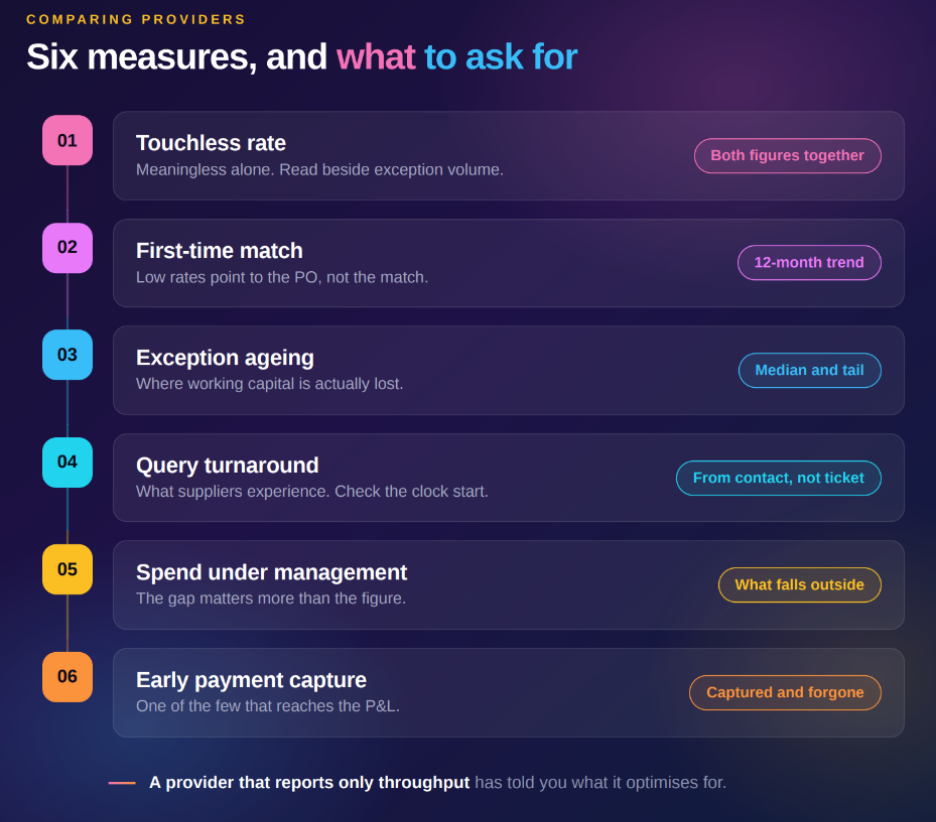
A touchless rate is meaningful only when read alongside exception volume. A high touchless rate alongside a high exception volume tells you the straightforward invoices are being automated and the difficult ones are accumulating somewhere. The two figures only mean anything together, and a provider reluctant to give you both has answered the question.
The proportion of invoices where PO, receipt and invoice agree at first pass. This is the best single proxy for upstream data quality, because a low rate almost always points to incomplete purchase orders or inconsistent supplier records rather than anything wrong with the matching itself. Ask for the trend across twelve months, since a snapshot can be timed.
How long a problem sits unresolved once it has been identified. Working capital and supplier goodwill are lost here, and the median alone will flatter a provider with a long tail. Ask for both, broken down by exception type, which will show you whether the same category keeps failing.
What your suppliers actually experience, and the figure your procurement colleagues will hear about first if it slips. Check how it is measured, because a clock that starts at ticket creation rather than supplier contact can hide several days of delay before anyone has logged anything.
The share of total spend that is coded, visible, and comparable across the business. Whatever sits outside it is invisible to the board, which makes the gap more interesting than the percentage.
Discounts taken against discounts available. A direct test of whether payment timing is being managed deliberately or simply run to terms, and one of the few P2P measures that appears on the P&L. Ask for value captured and value forgone, since the second number is the one nobody volunteers.
These six numbers give you a scorecard. The fair question is how any provider, including ourselves, answers it.
QX Global runs procure-to-pay outsourcing as a centre of excellence rather than a team working through your queue. Measured against the six numbers above, this is what that difference looks like.
The other four are measured the same way, from a baseline agreed at transition rather than a number produced at the end of a quarter.
We report all six per client rather than publishing blended averages, because the number that matters is the one measured against your ledger. Ask us for them, as you should ask anyone on your shortlist.
The procure-to-pay outsourcing market has matured to the point where most credible providers can process invoices competently. That is no longer the differentiator, and a tender decided on processing capability is a decision made on the least interesting variable available.
What separates the leading providers is end-to-end ownership. This determines whether a finance function ends up with a cheaper process or a clearer view of its own spending. The providers worth shortlisting will talk about both. The rest will talk just about throughput.
Considering a change to how your P2P cycle is run? Speak to QX Global Group about procure-to-pay outsourcing built around complete ownership, visibility and control.
Look past processing capability, which most credible providers have. The differentiators are exception ownership, supplier master governance, coding discipline across entities and sector fluency. Ask what happens to an invoice that fails a three-way match, and who owns it until it is resolved.
By applying one documented process across entities that have historically done things their own way. Standardisation raises first-time match rates, which reduces exception volume, which shortens approval cycles. The efficiency comes from fewer problems arising rather than problems being cleared faster.
Audit your own supplier and coding data before tendering, scope the exception path explicitly, take references from the people handling exceptions daily, contract for governance as well as service levels, and pilot on the most awkward entity rather than the cleanest one.
Integration with the major ERP platforms is table stakes. The more useful question is whether the provider works inside your existing environment or requires a parallel system, because a second system creates a reconciliation problem rather than solving a processing one.
Upstream. Match failures are usually caused by incomplete purchase orders, inconsistent supplier records or coding applied differently across sites, not by errors at the matching stage. Providers that improve match rates govern the data feeding the match, then log root causes so recurring failures are designed out.
QX runs P2P as a centre of excellence: one documented process, standardised coding, named exception ownership with an ageing clock, and supplier master maintenance as a standing duty. Judgement on suppliers, terms and categories stays with the client.
A strong provider should manage purchase order administration, supplier onboarding and master-data maintenance as connected responsibilities. Businesses should confirm who owns validation, approvals, record changes and unresolved onboarding exceptions.
Look for providers that define calculation methods, baselines, reporting frequency and ownership for each KPI. Measures should cover accuracy and turnaround alongside exception ageing, first-time match rates and supplier-query resolution.
The provider should present a transition plan covering knowledge transfer, process documentation, data preparation, testing, communications and go-live governance. The plan should also explain how supplier payments and unresolved exceptions will be protected during migration.
Assess segregation of duties, approval controls, role-based access, audit trails and the process for investigating unusual activity. Certifications can support the assessment, but they should not replace evidence of controls operating within the proposed P2P workflow

Education:
B.Com, PGDCA

Mehboob Rad brings over 12 years of experience in Finance & Accounting, with proven expertise across Record to Report (R2R), Procure to Pay (P2P), and Order to Cash (O2C) processes. At QX, he leads operations spanning UK payroll, billing, and finance for recruitment firms, combining process depth with a sharp eye for financial accuracy and compliance. His leadership style is rooted in empowering teams and driving measurable outcomes for clients across the F&A spectrum.
Expertise: R2R, P2P, O2C, UK Payroll, Pay & Bill for Recruitment, Financial Reporting & Compliance, F&A Team Leadership
Originally published Oct 01, 2026 06:10:48, updated Oct 01 2026
Topics: Finance & Accounting Outsourcing, P2P
30 Sep 2026
Ask a high-volume AP team what is wrong and you will get a list, not a diagnosis. Invoices arrive th...
Read More29 Sep 2026
In July this year, Birchgrove hired a chief growth officer. Not a sales director. A growth officer, ...
Read More28 Sep 2026
A late payment never looks like a crisis on the day it happens, does it? The invoice went out on tim...
Read More28 Sep 2026
Ask a simple question in most real estate finance meetings, “what does a unit actually cost us...
Read More