Topics: Full Cycle Recruiting, full cycle recruitment services
Posted on June 30, 2026
Written By Ranjana Singh




Hiring in the UK is becoming more complex, not just because of talent shortages, but due to rising expectations around speed, candidate experience, and hiring quality. Businesses are no longer looking for recruitment vendors who simply fill roles. They need strategic partners who can manage the entire hiring journey.
At the same time, demand for flexible and contract hiring is increasing, pushing companies to rethink how recruitment is managed. The average time-to-hire in the UK is around 40 days, making efficiency a critical factor for success.
This is where full cycle recruitment companies are gaining traction. Instead of fragmented hiring processes, businesses are adopting full cycle recruitment outsourcing solutions to drive consistency, scalability, and better outcomes.

Before evaluating providers, businesses need clarity on how the full recruitment cycle works and why it is different from traditional recruitment approaches.
Full cycle recruitment, also known as end-to-end recruitment, is a hiring model where a single recruiter or team manages every stage of hiring from start to finish. This creates a unified process with clear accountability and better coordination.
In traditional recruitment, responsibilities are often divided across teams, leading to handoff delays and inconsistencies. Full cycle recruiting eliminates these gaps and improves visibility into hiring performance.
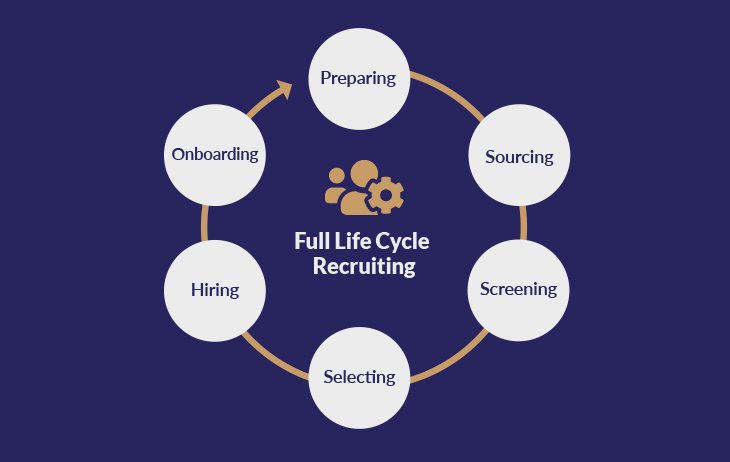
To understand how this model works in practice, it is important to break down the stages that define the full recruitment lifecycle:
This stage involves identifying hiring needs, defining job roles, and mapping required skills. It lays the foundation for the entire recruitment process by aligning hiring goals with business objectives. Without proper planning, recruitment becomes reactive, leading to mismatched hires and inefficiencies. A strong planning phase ensures clarity and direction from the beginning.
Recruiters build a pipeline of potential candidates using job boards, social media, databases, and direct outreach. This stage is critical because the quality of sourcing directly impacts the quality of hires. Effective sourcing strategies also include passive candidates who may not be actively looking but are highly suitable for roles.
This involves evaluating candidate profiles, conducting initial interviews, and assessing skills and cultural fit. Structured screening helps filter out unsuitable candidates early, saving time in later stages. It also reduces hiring risks by ensuring candidates meet both technical and organisational requirements.
Recruiters coordinate interviews, schedule meetings, and ensure a structured evaluation process. This stage ensures consistency in candidate assessment and improves collaboration between hiring managers and recruiters. It also enhances the candidate experience by avoiding delays and confusion.
The offer stage includes salary negotiations, contract discussions, and final approvals. A well-managed offer process reduces drop-offs and improves acceptance rates. Clear communication during this stage is essential to ensure candidates feel confident in their decision.
Onboarding ensures a smooth transition for new hires into the organisation. It helps improve retention, engagement, and productivity from day one. Strong onboarding processes also reinforce employer branding and enhance overall hiring outcomes.
Also Read: Future of Full Cycle Recruiting with Automation 2026
Market changes are pushing organisations to adopt more structured and scalable recruitment models. Full cycle recruiting addresses these evolving needs effectively.
Industries like healthcare, IT, and engineering face talent shortages and niche skill requirements. This increases hiring complexity and makes traditional recruitment methods less effective. Full cycle recruitment helps manage these complexities by integrating all hiring stages into a single streamlined process.
With an average hiring cycle of 28 days, delays can significantly impact business operations.
Full cycle recruiting improves coordination between stages, reducing bottlenecks and speeding up hiring timelines. This enables businesses to secure talent before competitors.
Candidates today expect transparency, quick responses, and structured hiring journeys. Fragmented recruitment processes often lead to poor communication and drop-offs. Full cycle models provide a consistent experience with a single point of contact throughout.
Businesses need flexibility to scale hiring up or down based on demand. Full cycle recruitment providers offer adaptable solutions that support both high-volume hiring and niche recruitment needs without increasing internal workload.
Companies now focus on long-term hiring success rather than just filling positions. Metrics such as retention and performance are becoming more important. Full cycle recruitment allows better tracking and optimisation of these metrics.
To select the right partner, businesses must evaluate specific capabilities that drive recruitment success.
Top providers manage the entire recruitment lifecycle seamlessly, from planning to onboarding. This ensures consistency and reduces gaps between stages. Strong expertise also enables better alignment between business needs and hiring outcomes.
High-performing companies use diverse sourcing channels, including passive talent pools. This improves access to high-quality candidates and reduces dependency on job applications alone.
Understanding industry requirements helps recruiters identify suitable candidates quickly. It also improves the accuracy of candidate selection and reduces hiring timelines.
Technology such as ATS and AI improves efficiency and reduces manual effort. Around 41% of UK companies already use AI in recruitment.
This enables faster screening, better candidate matching, and improved reporting.
Data analytics helps track performance metrics such as time-to-hire and quality of hire. It allows businesses to identify inefficiencies and optimise recruitment strategies.
Top providers offer flexible engagement models that adapt to hiring needs. This ensures businesses can scale recruitment operations without increasing internal resources.
A history of successful placements and satisfied clients reflects reliability. It also builds confidence in the provider’s ability to deliver consistent results.
Also Read: Top Offshore Recruitment Companies in UK: What Staffing Firms Should Know?
Recruitment is evolving rapidly due to technological advancements and changing workforce expectations.
AI tools are transforming sourcing, screening, and candidate engagement. They reduce manual effort and improve hiring accuracy. However, human oversight remains essential to ensure quality decision-making.
Businesses are shifting focus from experience to skills. This approach helps identify candidates who can perform effectively, even without traditional qualifications.
Automation tools streamline repetitive tasks such as scheduling interviews and screening resumes. This improves efficiency and reduces hiring timelines significantly.
Recruitment decisions are increasingly driven by data insights. Analytics helps identify trends, improve strategies, and measure hiring performance.
Combining automation with human expertise ensures both efficiency and quality. This balanced approach is becoming the standard in modern recruitment.
QX Global Group delivers comprehensive full cycle recruitment services tailored for UK businesses. Their approach focuses on combining expertise, technology, and scalability to improve hiring outcomes.
They support the entire recruitment lifecycle, including sourcing, screening, recruitment operations, and onboarding. Their structured processes ensure faster hiring cycles and improved candidate quality.
With scalable delivery models and data-driven reporting, QX Global Group enables businesses to optimise recruitment performance while maintaining flexibility. This makes them a reliable partner for organisations looking to scale efficiently.
Also Read: Top Compliance Outsourcing Companies in the USA for Staffing Firms: What to Look For
Full cycle recruiting companies manage the entire hiring lifecycle, from workforce planning to onboarding. They provide a single point of ownership, ensuring consistency across all stages. This approach reduces delays and improves communication, making recruitment more efficient and structured.
Industries with high hiring demand or specialised talent needs benefit the most. This includes IT, healthcare, engineering, and finance. These sectors require faster hiring, better candidate quality, and scalable recruitment models, which full cycle recruiting supports effectively.
Costs vary depending on hiring volumes, complexity, and service scope. Some providers offer per-placement fees, while others use subscription or project-based pricing. Businesses should evaluate cost based on value delivered rather than just upfront expenses.
Success can be measured using KPIs such as time-to-hire, quality-of-hire, retention rates, and candidate satisfaction. Tracking these metrics helps businesses evaluate performance and identify areas for improvement.
Outsourcing allows businesses to scale hiring without increasing internal resources. Providers offer flexible models that adjust based on hiring demand. This ensures consistent performance during growth phases or seasonal hiring spikes.
They use structured screening, assessments, and data-driven selection methods. This ensures candidates meet both technical and cultural requirements. Continuous evaluation and feedback loops further improve hiring quality.
Leading providers combine AI tools for efficiency with human expertise for decision-making. Automation handles repetitive tasks, while recruiters focus on evaluating candidates and building relationships.
QX Global Group combines end-to-end recruitment expertise with scalable delivery models and advanced technology. Their ability to manage complex hiring needs while maintaining efficiency and quality makes them a trusted partner for UK businesses.
Enjoyed our blog? Discover more about how our recruitment outsourcing process can slash your costs by up to 60%! Take the next step—book a call by entering your details.

Education:
B.Com(Hons), Delhi University

Ranjana Singh is a data-driven B2B content marketer who loves creating well-researched content and blending it with storytelling. At QX, she leverages data insights and lead analysis to craft high-performing LinkedIn campaigns, blogs, newsletters, and sales collateral that drive MQLs and brand visibility across the US and UK markets. Her work is rooted in performance—every strategy starts with deep analysis of content metrics, funnel behavior, and audience engagement trends to deliver measurable marketing impact.
Expertise: Data-Backed Content Marketing Strategy, SEO & Organic Growth, LinkedIn & Newsletter Marketing, MQL Attribution & Lead Source Analysis, Recruitment Industry Marketing (US & UK),
Originally published Jun 30, 2026 07:06:11, updated Jul 24 2026
Topics: Full Cycle Recruiting, full cycle recruitment services
19 Dec 2025
Staffing firms rarely lose clients because of poor demand. They lose them because delivery cannot ke...
Read More29 Aug 2025
For many recruitment firms, the biggest challenge isn’t finding open roles, it’s filling them qu...
Read More16 May 2025
Hiring one role? Manageable. Hiring 10 or 20 roles across different teams and departments, each with...
Read More26 Sep 2024
Recruitment is a crucial aspect of any organization’s growth and success. Finding and hiring t...
Read More