Topics: outsourced recruitment support, recruitment support outsourcing for staffing firms, US staffing firms
Posted on May 14, 2026
Written By Ranjana Singh




Growth sounds exciting until your recruiters start drowning in admin work, submissions slow down, and clients begin asking why roles are taking longer to fill.
Many fast-growing staffing firms in the US reach a point where their existing recruitment process can no longer keep up with hiring demand.
Recruiters spend more time sourcing candidates, updating ATS records, scheduling interviews, chasing compliance documents, and managing reports than actually building relationships or closing placements.
This is exactly why more staffing firms are turning to Outsourcing Recruitment Support as a long-term growth strategy rather than just a cost-saving move.
In this blog, you’ll learn:

Growth is great for business until recruiters start spending more time managing workflows than actually recruiting.
Many staffing firms can generate new job orders and win clients successfully, but scaling delivery operations is where the real challenge begins. As hiring volumes increase, internal teams often struggle to keep up with sourcing, screening, coordination, reporting, and administrative tasks.
Over time, recruiters get pulled into repetitive operational work that slows down submissions, impacts placement speed, and reduces the time available for candidate engagement and client relationship-building. Without the right support structure, growth can quickly create operational bottlenecks instead of business momentum.
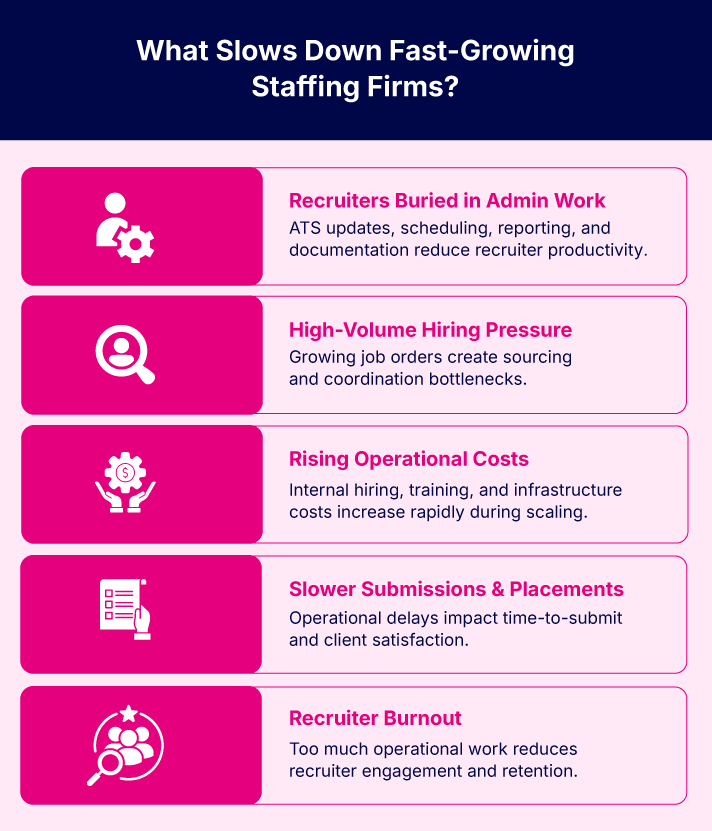
Many recruiters spend hours every day updating CRMs, posting jobs, scheduling interviews, formatting resumes, and managing follow-ups. These activities are necessary, but they reduce the time available for client development and candidate engagement.
Over time, this directly impacts fill rates, submission speed, and recruiter performance.
As staffing firms grow, handling multiple job orders across industries becomes difficult without structured recruitment process support. Teams struggle to maintain candidate pipelines, respond quickly to clients, and manage deadlines consistently.
Without scalable systems, growth can quickly create delivery issues.
Hiring additional in-house recruiters, coordinators, and admin staff increases operational expenses significantly. Salaries, training, infrastructure, technology, and employee management costs continue to grow as the business expands.
Many staffing firms are now looking at staffing operations outsourcing to scale more efficiently without dramatically increasing overhead costs.
Clients expect faster hiring decisions and quicker submissions. But internal bottlenecks often slow down sourcing, screening, compliance checks, and interview coordination. This creates delays in placements and affects client satisfaction.
When recruiters constantly juggle sourcing, admin, reporting, and coordination tasks, burnout becomes a serious issue. High-performing recruiters often leave because they spend less time recruiting and more time managing operational work. This creates instability in talent acquisition operations and impacts long-term growth.
The staffing industry is changing rapidly. Clients want faster hiring, better candidate quality, improved communication, and flexible delivery models.
At the same time, staffing firms are under pressure to reduce costs while improving operational efficiency.
This has made recruitment support outsourcing for staffing firms one of the fastest-growing operational strategies in 2026.
Instead of building large in-house teams for every operational task, agencies are leveraging outsourced recruitment services and offshore recruitment support teams to create flexible delivery models.
The goal is no longer just reducing costs. It is about creating scalable recruitment operations that support long-term business growth.

Modern staffing firms are outsourcing much more than sourcing alone. Many agencies now outsource entire support layers within the recruitment process.
Sourcing remains one of the most commonly outsourced recruitment functions.
Offshore recruitment support teams help identify qualified candidates through job boards, databases, LinkedIn, ATS searches, and talent mapping activities. This allows recruiters to focus more on relationship-building and placements rather than spending hours searching for profiles.
For staffing firms handling high-volume hiring, sourcing support significantly improves recruiter efficiency.
Screening large volumes of applications internally can slow down recruiter productivity.
Outsourced recruitment support services help staffing firms pre-screen resumes, match candidates against job requirements, and create qualified shortlists faster. This improves submission speed while helping recruiters focus on high-value conversations with candidates and clients.
Interview scheduling often becomes a hidden operational bottleneck for recruiters.
Recruiter support services can manage interview coordination, calendar management, follow-ups, reminders, and communication between candidates and hiring managers. This reduces delays and improves candidate experience throughout the recruitment process.
Administrative activities consume a significant amount of recruiter time. Many staffing firms outsource tasks such as:
This type of recruitment process support helps agencies maintain operational consistency without overloading recruiters.
Fast-growing staffing firms need better visibility into performance metrics, pipeline activity, recruiter productivity, and client delivery.
Outsourced support teams can create operational reports, dashboards, KPI tracking, and performance summaries that help leadership teams make faster decisions.
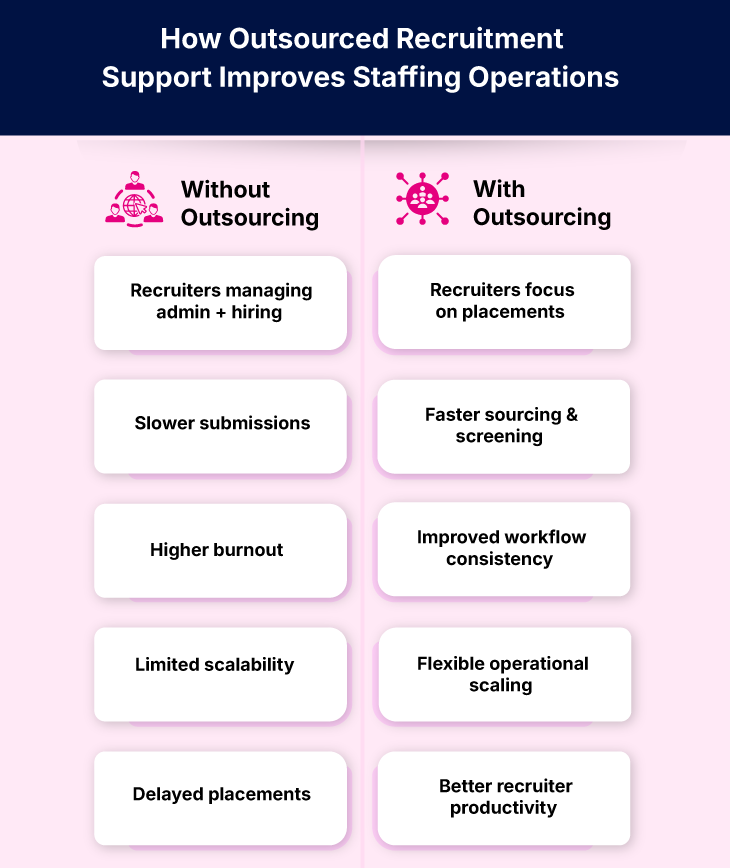
One of the biggest advantages of outsourcing recruitment support functions is improved recruiter productivity. When recruiters spend less time on repetitive operational tasks, they can focus more on revenue-generating activities.
By shifting operational tasks to offshore recruitment support teams, recruiters can spend more time:
This directly improves recruiter output and placement performance.
Dedicated outsourced recruitment support services help staffing firms accelerate sourcing, screening, and coordination activities.
This reduces turnaround times and improves speed-to-submit, which is critical in competitive hiring markets.
One major challenge for US staffing firms is scaling quickly without constantly hiring additional internal staff.
Staffing firm recruitment outsourcing provides operational flexibility. Agencies can scale recruitment support up or down based on hiring demand without long-term infrastructure costs.
This makes growth more manageable and predictable.
Structured recruitment process support improves standardization across operations.
Outsourced teams often follow defined SOPs, reporting structures, compliance workflows, and delivery timelines. This helps staffing firms maintain service quality even during periods of rapid growth.
The conversation around outsourcing has evolved significantly.
Today, offshore recruitment support is no longer viewed as only a back-office solution. Many staffing firms now see offshore teams as strategic growth partners.
Offshore recruitment support teams provide dedicated operational capacity that works as an extension of the staffing agency.
This allows recruiters and account managers to stay focused on business development and placements while operational workflows continue running efficiently.
Many staffing firms benefit from extended support coverage through offshore teams.
Tasks completed overnight or outside regular business hours can accelerate sourcing, reporting, database updates, and candidate coordination activities, improving overall turnaround times.
Building internal operations for rapid growth can become expensive very quickly.
Offshore recruitment support allows staffing firms to scale operations while maintaining better cost control. This improves profitability while supporting long-term expansion goals.
Rapid scaling often creates delivery instability.
Dedicated outsourced recruitment services help staffing firms maintain workflow continuity, operational consistency, and recruiter productivity during periods of aggressive expansion or high-volume hiring demand.

The most successful staffing firms are not just focused on filling roles faster. They are building operational models that support sustainable growth.
This is where outsourcing becomes a strategic advantage.
Scalable recruitment operations require structured workflows, operational flexibility, and dedicated support functions. Outsourcing allows staffing firms to expand delivery capacity without creating operational chaos internally.
Many staffing agencies experience seasonal spikes, rapid client expansion, or project-based hiring surges. Recruitment support outsourcing for staffing firms provides the flexibility to manage fluctuating hiring volumes without overburdening recruiters.
Faster submissions, improved communication, consistent reporting, and better recruiter responsiveness all contribute to stronger client relationships. Operational efficiency directly impacts client retention and business growth.
When operational pressure reduces, leadership teams can focus more on:

Not all outsourced recruitment support services deliver the same results. Staffing firms should evaluate outsourcing partners based on:
The right outsourcing partner should function as an extension of your internal recruitment team rather than just an external vendor.
QX Global Group supports US staffing firms through scalable outsourced recruitment services designed to improve recruiter productivity, operational efficiency, and placement speed.
With over 20 years of experience and a strong combination of people, process, and technology, QX helps staffing agencies manage sourcing, screening, recruitment process support, compliance coordination, reporting, and offshore recruitment support operations.
QX also combines operational expertise with AI-powered Recruitment Solutions like QX SonarHire AI to help staffing firms improve recruiter efficiency, accelerate candidate screening, and support scalable growth.
Whether staffing firms need sourcing support, admin assistance, or end-to-end recruitment process support, QX helps create scalable recruitment operations that support long-term growth.
Fast-growing staffing firms are realizing that scaling recruitment operations internally is becoming increasingly difficult, expensive, and inefficient.
Recruiters are expected to deliver faster placements while handling growing operational workloads. Without the right support structure, productivity slows, recruiter burnout increases, and growth becomes harder to sustain. This is why Outsourcing Recruitment Support has become a strategic growth model for staffing firms in 2026.
Fast-growing staffing firms are outsourcing recruitment support functions to improve operational efficiency, reduce recruiter workload, and scale faster without significantly increasing internal hiring costs. As hiring demand increases, recruiters often spend too much time on administrative and coordination tasks instead of focusing on placements and client relationships. Outsourcing helps agencies create scalable recruitment operations while improving productivity and placement speed.
Staffing agencies commonly outsource candidate sourcing, resume screening, interview scheduling, ATS updates, reporting, compliance coordination, job posting management, and administrative recruitment process support. These functions are repetitive but operationally critical, making them ideal for outsourced recruitment support services and offshore recruitment support teams.
Recruitment outsourcing improves recruiter productivity by removing time-consuming operational tasks from recruiters’ daily workloads. Recruiters can then focus more on candidate engagement, client communication, interviews, and placements. This also allows staffing firms to scale operations faster without constantly hiring additional internal support staff.
Offshore recruitment support teams provide dedicated operational capacity that helps staffing firms manage sourcing, screening, reporting, and administrative workflows more efficiently. They improve turnaround times, support high-volume hiring, and create workflow consistency that allows agencies to scale more sustainably.
Outsourcing reduces operational bottlenecks by distributing repetitive tasks across specialized support teams. This improves workflow efficiency, accelerates candidate submissions, reduces delays in coordination, and helps recruiters focus on high-value activities. Structured recruitment process support also improves consistency across hiring operations.
Staffing firms should track KPIs such as time-to-submit, fill rate, recruiter productivity, placement speed, candidate quality, submission-to-interview ratio, cost-per-placement, client satisfaction, and operational turnaround times. These metrics help agencies measure the effectiveness of outsourced recruitment services and overall recruitment process improvements.
Outsourced recruitment models provide flexible operational support that can scale based on hiring demand. Offshore recruitment support teams help manage sourcing, screening, coordination, and reporting during periods of high-volume hiring, allowing staffing firms to handle increased workloads without overwhelming internal recruiters.
No. Modern outsourced recruitment services are focused on improving operational efficiency, scalability, recruiter productivity, and placement speed. While cost optimization is a benefit, most staffing firms now use outsourcing as a strategic growth solution rather than simply a cost-cutting exercise.
Yes. Faster communication, quicker interview scheduling, improved follow-ups, and smoother coordination all contribute to a better candidate experience. Dedicated recruitment support teams help ensure candidates move through the recruitment process more efficiently.
Absolutely. Mid-sized US staffing firms often benefit significantly from outsourcing because it allows them to scale operations without building large internal support teams. Recruitment support outsourcing for staffing firms provides flexibility, operational stability, and better resource utilization during growth phases.
Enjoyed our blog? Discover more about how our recruitment outsourcing process can slash your costs by up to 60%! Take the next step—book a call by entering your details.

Education:
B.Com(Hons), Delhi University

Ranjana Singh is a data-driven B2B content marketer who loves creating well-researched content and blending it with storytelling. At QX, she leverages data insights and lead analysis to craft high-performing LinkedIn campaigns, blogs, newsletters, and sales collateral that drive MQLs and brand visibility across the US and UK markets. Her work is rooted in performance—every strategy starts with deep analysis of content metrics, funnel behavior, and audience engagement trends to deliver measurable marketing impact.
Expertise: Data-Backed Content Marketing Strategy, SEO & Organic Growth, LinkedIn & Newsletter Marketing, MQL Attribution & Lead Source Analysis, Recruitment Industry Marketing (US & UK),
Originally published May 14, 2026 08:05:20, updated May 14 2026
Topics: outsourced recruitment support, recruitment support outsourcing for staffing firms, US staffing firms