Topics: staffing industry forecast, staffing industry growth 2026, US Staffing Industry, US staffing market
Posted on April 10, 2026
Written By Ranjana Singh




The US staffing market is no longer in a boom phase. But, it’s also not in decline.
It’s something more important, and this is a RESET.
After the pandemic surge and the sharp correction that followed, the US staffing industry is now entering a phase where growth is slower, decisions are more cautious, and success depends on how well firms adapt.
So what’s really happening in the US staffing market?
SIA (Staffing Industry Analysts) recently released its report on the US Staffing Industry Forecast, March 2026 Update. In its report, it mentioned that the industry will grow 1% in 2026 to reach $180.2 billion, remaining just below pre-pandemic levels and reflecting a shift toward slower, more stable growth.
In this blog, we’ll go beyond the numbers to explain what they really mean for your business, from changing demand patterns to where the real opportunities lie.
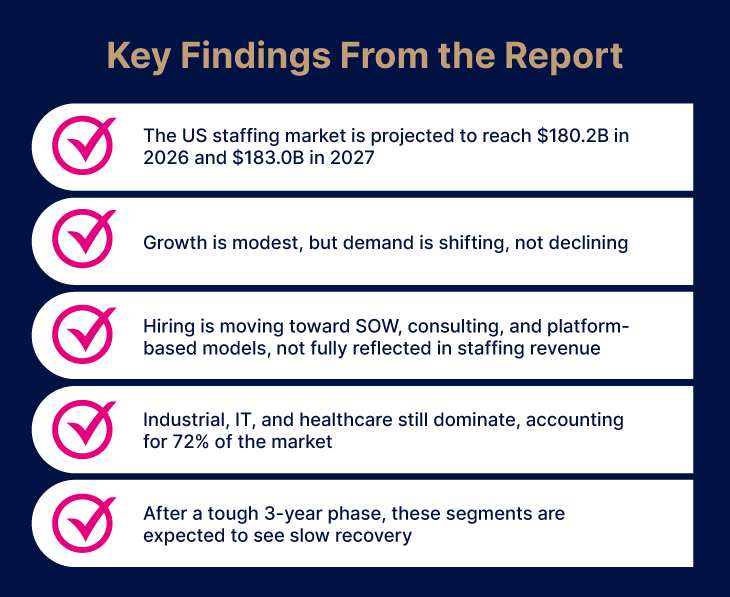
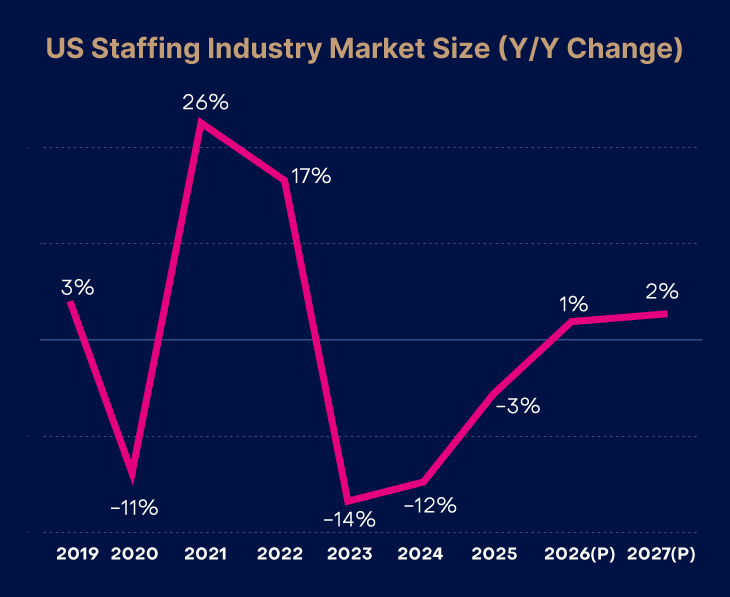
As per the latest report by Staffing Industry Analysts, the US staffing market is expected to reach $180.2 billion in 2026, followed by a modest increase to $183.0 billion in 2027.
At first glance, this looks like a recovery. But when you look closer, the picture is very different.
Even at $180 billion, the market is still below its pre-pandemic size of $185.5 billion and significantly lower than the peak of $243.9 billion in 2022. This clearly shows that the industry is not bouncing back to old levels, it is settling into a new baseline.
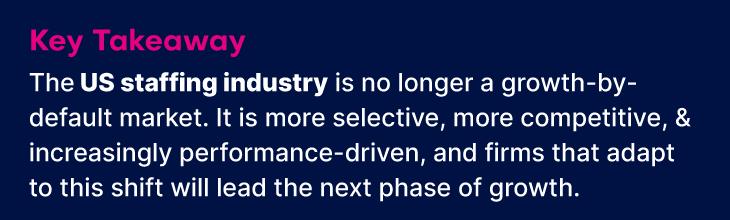
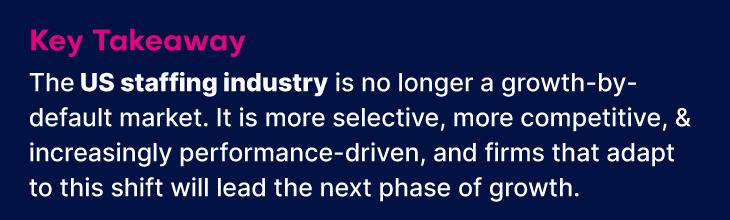
And this new baseline is changing how growth works for staffing firms.
The old growth model where there were more roles, faster hiring, higher bill rates, is no longer reliable.
Clients are hiring more selectively, taking longer to decide, and shifting a larger share of work toward SOW, consulting, and managed services. This means demand hasn’t disappeared, but it is no longer fully visible in traditional staffing revenue.
For staffing firms, this changes how growth needs to be approached.
Also Read: Top Recruitment Outsourcing Companies in the USA for Staffing Agencies
The US staffing market looks flat overall, but that’s because different sectors are moving in different directions, not because demand has disappeared.
Industrial staffing is showing early signs of recovery after a prolonged downturn. The decline slowed to just 1% in 2025, a clear improvement compared to previous years. This stabilization is being driven by demand in energy projects, construction activity, and data center expansion.
IT staffing isn’t shrinking, it’s evolving. Companies are moving away from traditional hiring and toward project-based work (SOW), offshoring, and AI-led automation, which reduces demand for standard roles. However, this shift is creating strong demand for specialized skills like AI, cloud computing, and cybersecurity. As a result, firms focused on high-skill roles are still seeing growth, while generalist IT staffing models are under pressure.
Healthcare staffing is transitioning from volatility to stability. After the pandemic-driven surge, demand declined as hiring returned closer to pre-pandemic levels and hospitals tightened budgets. However, the sector is not weakening, it is becoming more predictable. Segments like locum tenens continue to grow, supported by ongoing physician shortages, while allied health roles remain stable.
Engineering and life sciences are emerging as steady growth segments within the US staffing market. Demand in engineering is supported by long-term investments in infrastructure, energy, and manufacturing, which ensures consistent hiring needs. Life sciences continues to grow due to biotech innovation, pharma expansion, and research activity.
Education staffing continues to see steady demand, driven by teacher shortages and increased reliance on contract and substitute staff. It remains one of the more stable segments in the market. At the same time, executive hiring is performing strongly, even in a cautious environment. Leadership roles are critical for business transformation, restructuring, and navigating AI-driven changes.
Also Read: Top Candidate Sourcing Companies in the USA for Staffing Agencies
Growth isn’t slowing because demand has disappeared, it’s slowing because the way companies hire has fundamentally changed. Here are some of the main reasons behind this shift.
Hiring decisions are slower because clients are navigating uncertainty around AI, economic conditions, and policy changes. Instead of aggressive hiring, companies are being selective and delaying decisions. This reduces hiring volume and stretches timelines.
A growing share of work is moving to SOW, consulting, and managed services. While staffing firms often deliver this work, it doesn’t show up in traditional staffing revenue. As a result, actual demand exists but appears lower in market data.
Rising talent costs, resistance to higher bill rates, and intense competition are squeezing margins. Firms are becoming more selective about the roles they take on, prioritizing profitability over volume. This limits visible growth.
Despite the slowdown and the rise of AI, the US staffing industry is far from declining. In fact, it’s evolving, just like it has through every major shift in the past.
One of the biggest changes is the rise of remote work. Companies are no longer limited to local talent, which increases the need for staffing firms that can source and manage candidates across regions.
At the same time, staffing platforms are making hiring faster and more scalable. Firms that combine technology with recruitment expertise are able to handle higher volumes and deliver better outcomes.
Hiring itself has also become more complex. With growing compliance requirements around data privacy, pay transparency, and AI usage, companies are relying more on staffing partners to manage risk and ensure processes are handled correctly.
AI is another big factor. While it makes applying for jobs easier, it also creates challenges like high application volumes and lower-quality profiles. This increases the need for proper screening and candidate verification, something staffing firms are well positioned to handle.
Overall, the industry is not shrinking. It is becoming more specialized, more technology-driven, and more valuable to clients than before.
The US staffing market has changed, growth is slower, hiring is selective, and margins are tighter. In this environment, execution is everything.
This is where outsourcing becomes a competitive advantage.
QX Global Group, with over 20+ years of experience, supports US and UK staffing firms with end-to-end outsourced recruitment services, from sourcing and screening to compliance and coordination. The goal is simple: help firms deliver faster, reduce operational load, and scale without increasing headcount.
When speed drives revenue and recruiter capacity is limited, this makes a measurable difference.
One client achieved:
In today’s market, growth isn’t about doing more — it’s about delivering better. That’s where the right outsourcing partner sets you apart. If you want to learn more about how we can help you hit your revenue goals, fill out the form below and an expert from our team will reach out to you soon.
The US staffing market is projected to reach $180.2 billion in 2026, with further growth to around $183.0 billion in 2027. However, this remains slightly below pre-pandemic levels, indicating a stable but slower growth phase.
Yes, the industry is expected to cross $180 billion in 2026, but growth is modest. It is being driven by stabilizing demand, sector-specific recovery, and ongoing hiring needs, even as companies adopt more cautious and selective hiring strategies.
Demand is strongest in engineering, life sciences, and specialized IT roles such as AI and cybersecurity. Industrial staffing is stabilizing, while healthcare (especially locum tenens) continues to see steady demand.
Staffing firms can grow by focusing on high-skill and niche roles, improving speed and efficiency, and expanding into project-based models like SOW and managed services. Adapting to changing client expectations is key.
AI is automating tasks like sourcing, screening, and scheduling, improving speed and productivity. At the same time, it is increasing application volumes and complexity, making candidate verification, compliance, and quality control more important.
Key challenges include slower hiring cycles, margin pressure, rising talent costs, and increased competition. Agencies must also adapt to changing hiring models and evolving client expectations to stay competitive.
Enjoyed our blog? Discover more about how our recruitment outsourcing process can slash your costs by up to 60%! Take the next step—book a call by entering your details.

Education:
B.Com(Hons), Delhi University

Ranjana Singh is a data-driven B2B content marketer who loves creating well-researched content and blending it with storytelling. At QX, she leverages data insights and lead analysis to craft high-performing LinkedIn campaigns, blogs, newsletters, and sales collateral that drive MQLs and brand visibility across the US and UK markets. Her work is rooted in performance—every strategy starts with deep analysis of content metrics, funnel behavior, and audience engagement trends to deliver measurable marketing impact.
Expertise: Data-Backed Content Marketing Strategy, SEO & Organic Growth, LinkedIn & Newsletter Marketing, MQL Attribution & Lead Source Analysis, Recruitment Industry Marketing (US & UK),
Originally published Apr 10, 2026 08:04:57, updated Apr 10 2026
Topics: staffing industry forecast, staffing industry growth 2026, US Staffing Industry, US staffing market