Topics: Talent Sourcing, Talent Sourcing Solutions
Posted on January 14, 2026
Written By Ranjana Singh




This year is going to be challenging for US staffing firms. Wondering why?
[aioseo_toc]
This is because US staffing firms are operating in one of the most competitive hiring environments in years. Clients are expecting quicker submissions, niche skill coverage, and consistent candidate quality, no matter what the talent supply is. Relying only on reactive recruiting makes it harder to meet these expectations.
This is where a talent sourcing solution becomes essential. So, instead of starting candidate searches after a role opens, staffing firms can build structured, always-ready pipelines. Read this blog to learn what talent sourcing is, how solutions work, key strategies used by high-performing firms, and why dedicated sourcing models are now critical for sustainable growth.
Talent sourcing is the proactive identification, engagement, and nurturing of potential candidates before roles are officially open. Unlike traditional recruiting, which reacts to open requisitions, sourcing focuses on long-term pipeline building.
A structured candidate sourcing solution supports broader talent acquisition and talent management efforts by continuously mapping talent markets and engaging relevant candidates. It involves actively sourcing candidates across multiple channels so recruiters always have access to qualified, pre-vetted talent. This approach is especially valuable for staffing firms managing multiple clients, recurring roles, or fluctuating hiring needs.

Client expectations have changed. Hiring timelines are shorter, competition for skilled talent is higher, and many qualified professionals are no longer actively applying to jobs. Passive talent now makes up a significant portion of successful placements.
At the same time, recruiters are responsible for interviews, client coordination, compliance, onboarding, and reporting. This leaves limited time for proactive candidate sourcing. Without a dedicated sourcing layer, firms struggle with inconsistent pipelines and delayed submissions. Effective talent pipeline development for recruiters now requires focused sourcing expertise.
Staffing firms use different talent sourcing models depending on hiring volume, role complexity, and internal bandwidth. Broadly, talent sourcing solutions fall into three categories.
Technology-led sourcing solutions rely primarily on candidate sourcing tools, talent databases, and AI-driven search and matching platforms. These tools help staffing firms quickly identify large volumes of candidate profiles based on skills, experience, and keywords.
They are effective for improving sourcing speed, expanding market visibility, and organising candidate data at scale. However, technology alone cannot assess candidate intent, availability, or cultural fit. Skilled recruiters or sourcers are still required to qualify candidates, personalise outreach, and build relationships.
This model works best for staffing firms with strong internal recruiting teams that need better sourcing efficiency but still handle engagement and screening in-house.
Service-based talent sourcing solutions focus on people-led sourcing. Dedicated sourcing specialists are responsible for market research, candidate identification, outreach, and early-stage screening. These teams work as an extension of the staffing firm’s recruitment function.
Offshore and nearshore sourcing teams are commonly used in this model to scale sourcing capacity cost-effectively. Because these specialists focus exclusively on sourcing, they are able to build deeper pipelines, engage passive candidates, and maintain consistent candidate flow across roles.
This approach is particularly effective for staffing firms managing high-volume hiring, recurring roles, or niche positions where continuous pipeline development is critical.
Hybrid talent sourcing models combine the strengths of technology and human expertise. Candidate sourcing tools are used for market mapping and search, while experienced sourcers handle qualification, engagement, and pipeline management.
This model offers the most flexibility. It allows staffing firms to scale sourcing up or down, support both high-volume and specialised roles, and maintain quality without overloading internal recruiters.
As a result, many talent sourcing solutions for staffing firms follow a hybrid structure, balancing speed, scalability, and candidate quality.

High-performing staffing firms treat sourcing as a continuous process, not a reaction to open roles. Common talent sourcing strategies include:
These strategies help maintain healthy pipelines that remain relevant as client needs evolve.
An effective talent sourcing solution goes far beyond searching resumes or filling databases. It is a structured system designed to continuously identify, engage, and maintain high-quality candidate pipelines.
This involves analysing the talent market to understand where relevant candidates are located, what skills are available, and how competitive the market is. Market mapping helps staffing firms identify talent hotspots, salary trends, and candidate availability before hiring demand peaks.
Rather than sending large volumes of profiles, sourcing teams screen resumes against defined skill, experience, and role criteria. Structured shortlisting ensures recruiters receive fewer but more relevant candidates, improving interview success rates and reducing time spent reviewing unsuitable profiles.
Qualified candidates are organised into talent pools based on role type, skill set, location, and availability. These pipelines are continuously updated, ensuring staffing firms always have access to ready-to-engage candidates for current and future requirements.
Sourcing is not just about identification but also relationship-building. Regular follow-ups, personalised outreach, and timely communication help keep candidates engaged and interested, even when no immediate role is available.
Talent sourcing solutions integrate with existing ATS and CRM platforms, allowing candidate data, notes, and engagement history to flow seamlessly into recruiters’ systems. This ensures visibility, continuity, and smooth collaboration between sourcing and recruiting teams.
Reporting and analytics provide visibility into pipeline health, sourcing effectiveness, and candidate movement. Staffing firms can track sourcing volume, response rates, pipeline readiness, and role alignment to make informed, data-driven decisions.
Together, these components create scalable talent recruitment solutions supported by modern candidate sourcing tools, enabling staffing firms to build stronger pipelines, reduce hiring delays, and deliver consistent results.
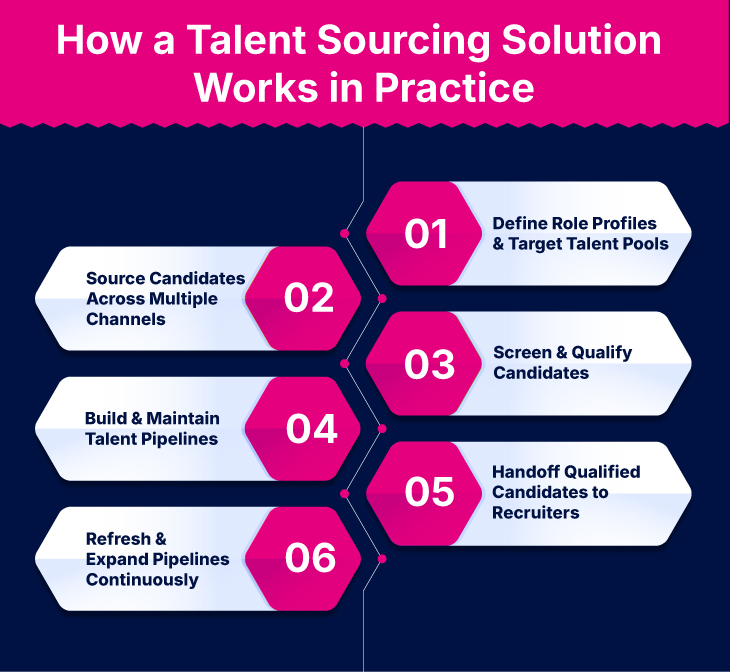
The process begins by clearly defining role requirements, including skills, experience levels, certifications, locations, and availability expectations. This clarity helps sourcers identify the right talent pools and avoid misaligned searches later in the process.
Sourcers actively identify candidates across databases, professional platforms, referrals, networks, and talent communities. Using multiple channels ensures broader reach and reduces overdependence on job boards.
Identified candidates are screened for technical skills, role fit, availability, and interest level. Early qualification ensures only relevant and engaged profiles move into the pipeline, saving recruiters time.
Qualified candidates are added to structured pipelines and kept engaged through regular communication. This ongoing engagement helps staffing firms maintain warm pipelines that are ready when roles open.
Once a role becomes active, ready-to-submit candidates are handed off to recruiters with complete profiles and screening notes. This reduces turnaround time and enables faster client submissions.
Pipelines are regularly reviewed and updated to reflect changes in candidate availability, skills, and market conditions. Continuous refresh ensures pipelines remain relevant and aligned with evolving client needs.
A dedicated talent sourcing solution strengthens hiring operations by separating sourcing from recruiting and allowing each function to perform at its best.
Because candidates are already identified, screened, and engaged, recruiters can submit profiles quickly once a role opens. This reduces delays caused by last-minute searches and helps staffing firms meet tight client timelines more consistently.
Continuous sourcing ensures that talent pipelines are built ahead of demand rather than in response to it. These pipelines remain relevant, updated, and aligned with recurring or future client requirements.
By handling sourcing activities separately, recruiters are freed from time-consuming tasks such as searching databases and initial screening. This allows them to focus on interviews, client communication, compliance, and closing placements.

Specialist sourcers focus on role alignment, skills matching, and candidate intent. As a result, recruiters receive better-quality shortlists, leading to higher interview success rates and stronger placements.
With ready talent pipelines in place, staffing firms can respond confidently to urgent, high-volume, or niche requirements. Faster and more consistent delivery strengthens client trust and long-term relationships.
Talent sourcing solutions allow staffing firms to scale sourcing capacity up or down based on demand. This flexibility eliminates the need for permanent internal hiring while maintaining consistent candidate flow.
Reactive candidate sourcing begins only after a job requirement is received. Recruiters start searching databases, posting jobs, and reaching out to candidates under tight timelines. This often results in rushed shortlists, limited candidate options, and longer hiring cycles, especially for niche or urgent roles.
Proactive candidate sourcing takes a long-term approach. Instead of waiting for demand, staffing firms continuously build and maintain talent pipelines aligned to future hiring needs. Candidates are identified, engaged, and kept warm even when no immediate role is open.
A talent sourcing solution enables this shift by continuously mapping talent markets, engaging passive candidates early, and keeping pipelines updated as skills, availability, and market conditions change. Over time, proactive sourcing improves hiring speed, candidate quality, and delivery consistency compared to last-minute hiring efforts.
When pipelines are not built in advance, recruiters must search for candidates only after a role opens. This leads to rushed sourcing, limited options, and increased pressure to deliver quickly.
Without proactive sourcing, staffing firms often depend heavily on job boards. This restricts access to passive candidates and increases competition for the same talent pool as other agencies.
Recruiters juggling sourcing, screening, interviews, client coordination, and compliance often become overwhelmed. This reduces productivity and can impact recruiter retention over time.
Reactive sourcing results in pipelines that vary in quality and relevance. Some roles may have strong coverage, while others struggle due to a lack of continuous pipeline development.
When suitable candidates are not readily available, staffing firms risk delayed submissions or inability to deliver. This can lead to lost roles, reduced client confidence, and missed revenue opportunities.
A sourcing solution becomes critical when firms experience:
In these scenarios, outsourcing sourcing helps maintain consistency without adding operational strain.
QX Global Group is a global outsourcing recruitment services firm with 20+ years of experience supporting staffing companies worldwide. The company works as a strategic extension of recruitment teams, helping them scale hiring operations without compromising quality.
For U.S. staffing firms, QX provides structured and scalable talent sourcing solutions by combining:
QX Global Group is a leading talent sourcing solution provider in the USA, supporting staffing firms with scalable candidate sourcing services that improve speed, quality, and consistency.
A talent sourcing solution is different from traditional recruiting services because it focuses on proactively building talent pipelines before roles are open. Traditional recruiting usually starts only after a job requirement is received. Sourcing supports long-term talent availability, while recruiting focuses on immediate placements.
Proactive candidate sourcing is important for U.S. staffing firms because many qualified candidates are passive and not actively job-seeking. Engaging talent early helps firms reduce time-to-submit, improve candidate quality, and respond faster to client demands.
Roles that benefit most from dedicated talent sourcing solutions include niche, high-volume, and recurring positions. These roles require continuous pipeline development and passive candidate engagement, which is difficult to achieve through reactive recruiting alone.
Yes, talent sourcing solutions support both active and passive candidate pipelines. Active candidates can be mobilised quickly, while passive candidates are nurtured over time. This ensures staffing firms are prepared for both immediate and future hiring needs.
A talent sourcing solution integrates with existing ATS and CRM systems by syncing candidate profiles, notes, and engagement history. This allows recruiters to access sourced talent within their existing workflows without disrupting current processes.
A staffing firm should consider outsourcing talent sourcing when internal teams lack bandwidth or hiring demand fluctuates. It is also effective for rapid growth, niche hiring, or high-volume roles where building in-house sourcing teams is costly and time-consuming.
Talent shortages are no longer short-term challenges. Staffing firms must move beyond reactive recruiting to stay competitive. A structured talent sourcing solution enables faster hiring, scalable delivery, and consistent candidate quality. Firms that invest in proactive sourcing build stronger pipelines and gain a lasting competitive advantage.
Enjoyed our blog? Discover more about how our recruitment outsourcing process can slash your costs by up to 60%! Take the next step—book a call by entering your details.

Education:
B.Com(Hons), Delhi University

Ranjana Singh is a data-driven B2B content marketer who loves creating well-researched content and blending it with storytelling. At QX, she leverages data insights and lead analysis to craft high-performing LinkedIn campaigns, blogs, newsletters, and sales collateral that drive MQLs and brand visibility across the US and UK markets. Her work is rooted in performance—every strategy starts with deep analysis of content metrics, funnel behavior, and audience engagement trends to deliver measurable marketing impact.
Expertise: Data-Backed Content Marketing Strategy, SEO & Organic Growth, LinkedIn & Newsletter Marketing, MQL Attribution & Lead Source Analysis, Recruitment Industry Marketing (US & UK),
Originally published Jan 14, 2026 10:01:23, updated Feb 04 2026
Topics: Talent Sourcing, Talent Sourcing Solutions
22 Sep 2026
Recruiters rarely struggle because they lack jobs to fill. The real challenge is finding qualified c...
Read More25 Aug 2026
Recruiters are spending more time than ever chasing candidates, yet many roles remain open for weeks...
Read More10 Aug 2026
Recruiters are expected to deliver qualified candidates faster than ever, yet finding the ...
Read More02 Jun 2025
In an increasingly competitive talent landscape, UK recruiters are broadening their horizons. The ri...
Read More