Topics: Healthcare hiring demand, Healthcare hiring USA
Posted on May 07, 2026
Written By Ranjana Singh




If you’re a staffing firm in the US, you’ve probably felt it already. Roles are piling up, clients want faster closures, and finding the right healthcare professionals feels harder than ever.
It’s not just you. The entire market is shifting.
The US healthcare staffing market has grown to $39.4 billion, and demand is only increasing. At the same time, there are 200,000+ nurse openings every year and a growing shortage of physicians. On paper, it looks like a huge opportunity.
But here’s the real challenge. Demand is rising faster than your ability to deliver.
Candidates are harder to find. Recruiters are stretched. Processes are slower than they should be. And clients are expecting more than ever.
So, the question is not whether demand is rising. The real question is: how do you keep up without burning out your team or losing business?
In this blog, we break down what’s driving Healthcare Hiring Demand, the key healthcare staffing trends, and three practical ways staffing firms can stay ahead and scale smarter.

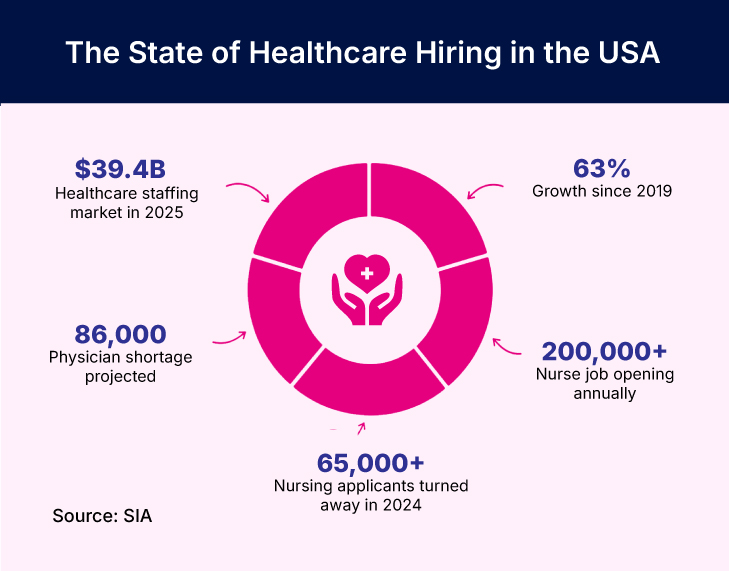
The increase in demand is not coming from one single factor. It is the result of multiple long-term shifts happening at the same time.
The aging population is increasing the need for ongoing care, especially in outpatient and home healthcare settings. This is supported by steady growth in ambulatory care, which is expanding at 2.6% year-on-year.
At the same time, the supply is tightening. Over 65,000 nursing applicants were turned away in 2024, showing how limited education capacity is restricting workforce growth. Add to this immigration delays and high burnout rates, and you get a market facing serious healthcare staffing shortages.
Another shift is candidate behavior. Professionals now prefer flexibility, shorter assignments, and better work-life balance. This is why demand for per diem roles and locum tenens continues to rise.
All of this is shaping healthcare workforce trends in the USA and making hiring more complex than ever before.
The healthcare staffing landscape is evolving quickly. These trends are not just shaping hiring demand but also how staffing firms need to operate to stay competitive.
Healthcare providers are no longer struggling to find people. They are struggling to find the right mix of skills. Demand is increasing for specialized roles such as ICU, emergency care, and imaging, while general talent pools are not enough anymore. Staffing firms need to move toward skill-based hiring, build role-specific pipelines, and understand what each unit actually needs. This shift requires deeper market knowledge and better candidate segmentation.
Many healthcare systems are building internal float pools and internal travel programs to reduce reliance on agencies. This means staffing firms are no longer competing only with other agencies but also with internal hiring strategies. To stay relevant, firms must offer speed, niche expertise, and consistent delivery that internal teams cannot match. Simply sending resumes is no longer enough.
Sourcing candidates is becoming easier compared to onboarding them. Delays in credentialing, licensing, background checks, and compliance processes are slowing down placements. This means time-to-start is becoming just as important as time-to-fill. Staffing firms that streamline onboarding and reduce these delays will have a clear advantage in closing roles faster.
Even though salary growth is stabilizing, expectations are not. Candidates now want flexible schedules, better work environments, mental health support, and career growth opportunities. If these expectations are not met, they are quick to move on. This makes a candidate experience a critical factor in both attraction and retention.

Travel nursing is not disappearing, but it is being used differently. Instead of long-term reliance, healthcare providers are using it for seasonal demand, specialized roles, and short-term projects. This means staffing firms need to plan better, build predictable pipelines, and align with client demand cycles rather than react at the last minute.
Allied health roles such as imaging technicians, therapists, and lab professionals are growing faster than expected. This is driven by the shift toward outpatient care and specialized treatments. Staffing firms that focus only on nurses and doctors risk missing out on a significant growth opportunity.
AI is not replacing recruiters, but it is making them more efficient. It is being used for candidate matching, scheduling, screening, and reducing administrative workload. Staffing firms that adopt AI tools can speed up processes and improve accuracy without increasing team size.
Healthcare organizations are moving toward data-driven hiring decisions. They are tracking patient volumes, turnover trends, and vacancy risks to forecast hiring needs. Staffing firms that align with this approach can position themselves as strategic partners rather than just vendors.
The best candidates choose the fastest and smoothest hiring process. Delays, lack of communication, and complicated processes lead to drop-offs. Staffing firms that simplify their process and improve communication will win more placements.
Healthcare professionals are no longer choosing roles based only on pay. They care about leadership quality, team culture, and work environment. Staffing firms need to understand these factors and align candidates with the right clients, not just open roles.
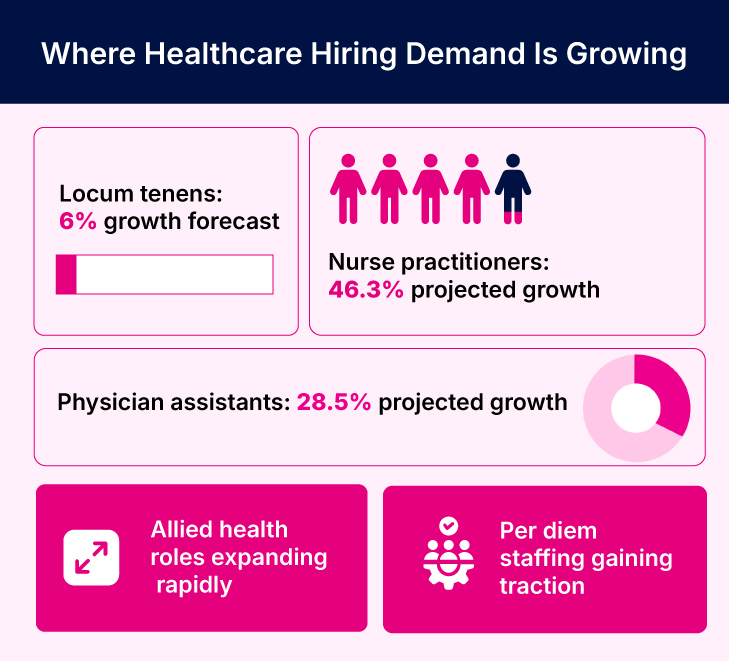
Healthcare staffing is no longer dependent on one segment. Growth is spread across multiple areas, creating a more balanced and resilient market.
Locum tenens continues to grow steadily, with a 6% growth forecast, driven by physician shortages and burnout. Per diem staffing is gaining traction as a flexible and cost-effective option for hospitals. Allied health roles are expanding as more care shifts to outpatient settings.
At the same time, international hiring is becoming a long-term solution for addressing domestic shortages. This shift shows that staffing firms need to diversify their approach and not rely on a single hiring model.
While demand is rising, success is no longer about pricing. It is about execution.
Staffing firms are facing increasing medical recruitment challenges, including limited candidate availability, slow onboarding processes, and recruiter overload. At the same time, healthcare providers expect faster placements, better compliance, and higher reliability.
This means that firms that cannot deliver consistently will struggle, even in a high-demand market.
These strategies are not optional anymore. They are essential for surviving and growing in today’s healthcare staffing market.
Instead of reacting to demand, staffing firms need to stay ahead of it. Building pipelines for specific roles like ICU, emergency care, and imaging helps reduce time-to-fill and improves candidate quality. This requires continuous engagement, better data management, and proactive sourcing strategies.
Recruiters spend too much time on repetitive tasks. By adopting recruitment outsourcing solutions and choosing to outsource healthcare recruitment services, firms can free up their teams to focus on placements and client relationships. This improves efficiency and allows firms to handle more roles without increasing headcounts.
Scaling internal teams is slow and expensive. Offshore recruitment teams provide flexibility and allow firms to handle high-volume hiring without delays. They also ensure continuous sourcing and faster turnaround, which is critical in managing healthcare staffing shortages.
At QX Global Group, we work closely with healthcare staffing firms to solve these challenges. From building strong pipelines to improving recruiter productivity, our approach combines experienced recruiters, structured processes, and scalable offshore support.
We provide end-to-end outsource healthcare recruitment services and tailored recruitment outsourcing solutions that help agencies improve speed, reduce operational pressure, and scale efficiently.
In many cases, we have helped staffing firms increase fill rates, reduce turnaround time, and handle higher volumes without expanding their internal teams. Through real-world case studies, we have seen how the right combination of people and processes can significantly improve performance and revenue outcomes.
Healthcare Hiring Demand is rising, but so are the challenges that come with it. Firms that continue with traditional hiring approaches will struggle to keep up. Those that invest in better pipelines, smarter processes, and scalable models will stay ahead. The difference will not be demanded. The difference will be execution.
Staffing firms need to shift from reactive hiring to proactive strategies. This includes building strong talent pipelines, improving recruiter productivity, and adopting scalable solutions such as outsourcing and offshore support. Firms that focus on speed and consistency will be better positioned to meet demand.
Improving placement speed requires a combination of pre-built pipelines, faster screening processes, and reduced onboarding delays. Outsourcing repetitive tasks and streamlining credentialing can significantly reduce time-to-fill and time-to-start.
Outsourcing allows staffing firms to increase their sourcing and screening capacity without hiring more internal staff. This helps manage high-volume demand, improve turnaround time, and maintain consistent delivery during peak hiring periods.
Offshore teams provide flexibility and cost efficiency. They allow staffing firms to scale quickly, maintain continuous candidate pipelines, and handle large volumes of work without overburdening internal recruiters.
Recruiters often spend too much time on administrative tasks such as sourcing, screening, and coordination. This reduces their ability to focus on placements and client engagement. Streamlining these processes is key to improving productivity.
Enjoyed our blog? Discover more about how our recruitment outsourcing process can slash your costs by up to 60%! Take the next step—book a call by entering your details.

Education:
B.Com(Hons), Delhi University

Ranjana Singh is a data-driven B2B content marketer who loves creating well-researched content and blending it with storytelling. At QX, she leverages data insights and lead analysis to craft high-performing LinkedIn campaigns, blogs, newsletters, and sales collateral that drive MQLs and brand visibility across the US and UK markets. Her work is rooted in performance—every strategy starts with deep analysis of content metrics, funnel behavior, and audience engagement trends to deliver measurable marketing impact.
Expertise: Data-Backed Content Marketing Strategy, SEO & Organic Growth, LinkedIn & Newsletter Marketing, MQL Attribution & Lead Source Analysis, Recruitment Industry Marketing (US & UK),
Originally published May 07, 2026 02:05:31, updated May 08 2026
Topics: Healthcare hiring demand, Healthcare hiring USA