Topics: Back Office Admin Support, Service Level Agreements in Recruitment Admin Support Services
Posted on October 16, 2026
Written By Ankit Ranjan




Recruitment admin outsourcing can remove a significant amount of operational workload from a staffing agency. But outsourcing tasks is only half the equation. Agencies also need clarity on how quickly work will be completed, what quality standards will apply, how performance will be measured, and what happens when expectations are not met.
That is where an SLA in recruitment admin support services becomes important. Whether you are evaluating Recruitment Admin Support Outsourcing Companies in UK or already working with an outsourcing provider, the SLA provides a measurable framework for service delivery.
In this guide, we look at what a recruitment admin SLA should cover, which metrics matter, how turnaround and quality expectations should be defined, and how staffing agencies can use SLA monitoring to build a more accountable outsourcing relationship.

A service level agreement (SLA) defines the agreed standards against which a service provider’s performance will be measured. In an outsourcing arrangement, it typically sits alongside the wider commercial agreement and translates service expectations into measurable commitments, such as response times, quality standards and reporting requirements.
For recruitment administration, this means moving beyond vague commitments such as “quick processing” or “high-quality support”. A recruitment admin support service level agreement should establish clear expectations for the specific activities being outsourced.
For example, an SLA might cover:
The exact SLA will depend on the agency’s workflows, service scope, working hours, volumes and priorities.
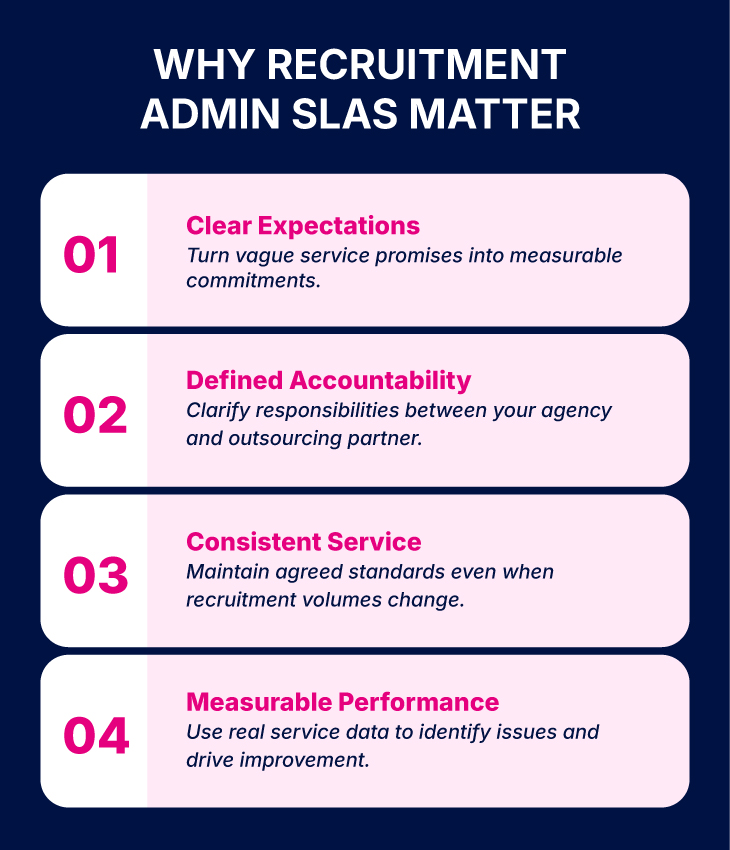
When recruitment administration is handled internally, managers can often identify delays and intervene directly. Once processes are outsourced, agencies need another way to maintain visibility and accountability.
A well-designed recruitment outsourcing SLA provides that framework.
Terms such as “fast”, “accurate” or “responsive” are open to interpretation. An SLA replaces subjective expectations with defined service standards.
This gives both the staffing agency and outsourcing provider a common understanding of what successful delivery looks like. Clear, measurable standards also provide an objective basis for reviewing performance when problems arise.
A recruitment admin outsourcing agreement should leave little uncertainty about who is responsible for each activity.
The SLA can define which requests sit with the provider, which inputs must come from the agency, when the service clock starts, and what happens when required information is incomplete. This prevents delays caused by unclear ownership from being incorrectly treated as service failures.
Recruitment demand is rarely completely predictable. Agencies may experience spikes in vacancies, candidate registrations or compliance workload.
A well-structured recruitment back-office SLA gives both teams an agreed benchmark against which service can be monitored, helping identify where volumes or process changes are putting pressure on delivery.
Without agreed metrics, outsourcing reviews can quickly become subjective.
SLA reporting allows discussions to focus on measurable performance rather than individual perceptions. Instead of saying administration “seems slower”, the agency and provider can examine turnaround, backlog, accuracy or response data and identify where improvement is required.

A useful SLA for recruitment administration should be specific enough to guide day-to-day delivery without becoming unnecessarily complicated.
The SLA should clearly identify which recruitment administration activities are included and excluded.
For example, if a provider handles candidate onboarding administration but not candidate screening, that distinction should be clear. The greater the clarity around scope, the lower the risk of tasks falling between teams or expectations expanding without agreement.
The SLA should define what both the staffing agency and outsourcing provider are responsible for delivering.
The provider may depend on recruiters supplying complete information before processing a request. Equally, the agency needs clarity about who owns particular workflows, corrections and escalations. An effective SLA therefore establishes two-way accountability, rather than focusing solely on the outsourcing team.
Agencies should document when the service operates and how requests outside those hours are treated.
This becomes particularly important when staffing companies use offshore teams or require support across multiple locations and time zones. Service hours should align with operational requirements rather than being treated as a standard clause copied across every account.
The SLA should document the measurable standards attached to each relevant service.
Depending on the activity, these might relate to turnaround time, acknowledgement time, accuracy, backlog or completion. The important point is that every metric should have a clear definition and measurement method.
An SLA should also establish how performance information will be shared and discussed.
This may include agreed reporting intervals, performance reviews and escalation arrangements. Reporting gives staffing agencies visibility into whether the service is consistently meeting agreed expectations rather than discovering issues only when they affect recruiters or candidates.
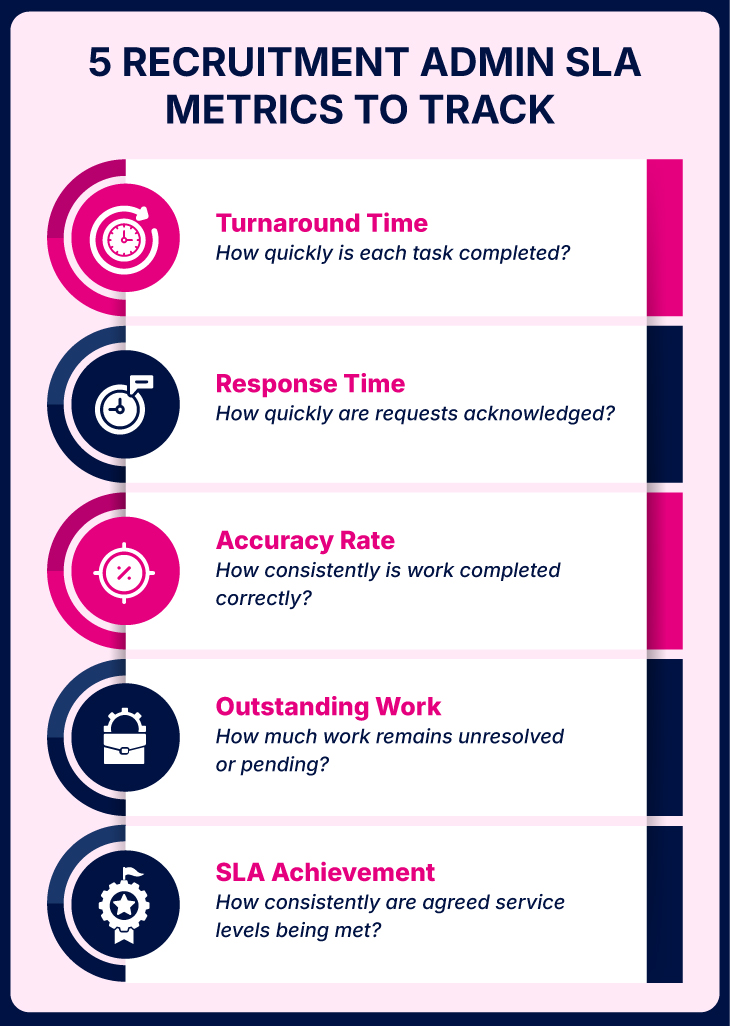
Not every recruitment administration activity should have the same SLA metrics. Agencies should select measurements that reflect the operational outcome of the service.
Turnaround time measures how long it takes to complete a defined task after the necessary information has been received.
This can be especially useful for time-sensitive processes such as candidate record updates, interview administration or document processing. The measurement should specify exactly when timing begins and when a request is considered complete.
A provider may not always be able to resolve a request immediately, but agencies may still need confirmation that it has been received.
A response-time metric measures how quickly the provider acknowledges or begins handling a request. Response time and resolution time should not be treated as interchangeable because acknowledging work is different from completing it.
Speed alone does not indicate whether recruitment administration is being delivered effectively.
Where work involves data entry, systems updates or document processing, agencies may also use defined quality or accuracy measures. This helps prevent a situation where teams meet turnaround targets by processing work quickly but subsequently create additional work through corrections.
Backlog monitoring can help identify workload building up before it becomes an operational issue.
Instead of looking only at completed requests, staffing agencies can track outstanding items against agreed parameters. This provides a more complete picture of service capacity and can indicate whether unusual volumes require intervention.
SLA monitoring should show how consistently agreed service standards are being achieved over the relevant reporting period.
However, agencies should avoid relying on a single overall figure. Reviewing the underlying SLA metrics by workflow or task type can provide much more useful insight into where performance is strong and where corrective action may be needed.

An effective recruitment admin SLA should remove ambiguity around time.
It should define:
This level of clarity matters because SLAs work best when standards can be objectively tested rather than interpreted differently by each party.
It is also why using outsourced admin support should involve defining service expectations around the actual recruitment workflow rather than applying arbitrary turnaround targets.
Recruitment administration often involves information that affects candidates, clients and downstream recruitment processes. Measuring speed without measuring quality and accuracy can therefore create the wrong incentives.
Agencies and providers should agree on what qualifies as an error before measuring accuracy.
For example, incorrect candidate data, a missed mandatory field and a formatting issue may have very different operational consequences. Defining severity levels can make quality reporting more meaningful.
The SLA should explain how quality is assessed.
This could involve reviewing completed transactions or conducting scheduled quality checks. Whatever methodology is selected, it should be consistent enough for both parties to understand how the reported result was produced.
A percentage alone does not always explain what is going wrong.
Repeated errors in the same process may point to unclear instructions, training requirements or workflow problems. Root-cause analysis alongside SLA reporting can therefore be more valuable than simply tracking whether a threshold was achieved.
Not every SLA miss should become a major escalation. An effective process should distinguish between an isolated issue and a pattern that requires intervention.
Routine issues should normally be addressed by the teams responsible for everyday service delivery.
The aim at this stage is to understand the issue, correct the immediate problem and determine whether any follow-up action is required.
Recurring breaches or issues with greater operational impact may require management involvement.
At this level, agencies and providers can examine the underlying cause, agree corrective actions and establish ownership for improvement.
For persistent performance problems, the agreement should describe the relevant remedial process and governance arrangements. Outsourcing SLA frameworks commonly include performance expectations, reporting requirements, remedial actions and governance structures.
The objective should not simply be to document a failure. It should be to create a structured route for restoring the required service level.

An SLA has limited value if performance is measured but not actively reviewed.
Reporting should give staffing agencies enough information to understand what happened, where performance changed and whether action is required.
A dashboard can bring the most relevant metrics together, including turnaround, accuracy, outstanding work and SLA achievement.
The purpose is not to track every available datapoint. It is to provide decision-makers with a useful operational view of service delivery.
One missed target does not necessarily indicate poor service, while a gradually declining metric may signal a more significant issue.
Reviewing trends across reporting periods makes it easier to spot recurring bottlenecks, changing workloads and areas that may require process improvement.
Numbers should be supported with context where appropriate.
For example, if performance changed because of unusually high volumes or incomplete inputs, that information helps both parties understand the result. Where action is required, reporting should make ownership and follow-up clear.
Although the terms are often used together, SLAs and KPIs serve different purposes.
An SLA specifies the service commitment agreed between the staffing agency and provider. A KPI measures an aspect of operational performance.
Put simply:
Some metrics may appear in both. The important distinction is whether a metric represents a contractual service commitment or an operational measure used to understand and improve performance.
Agencies should avoid turning every KPI into an SLA target. Too many contractual metrics can make the agreement difficult to manage and draw attention away from the service outcomes that matter most.
A recruitment outsourcing service level agreement UK should not simply be agreed at the start of the relationship and forgotten.
Staffing operations change. Volumes rise and fall, technology changes, new processes are introduced, and agencies may expand into different sectors or markets. The SLA should therefore be reviewed at agreed intervals and when material operational changes occur.
Useful review triggers can include:
Regular reviews keep the SLA aligned with the reality of service delivery rather than the environment that existed when the recruitment admin outsourcing agreement was originally signed.
For staffing companies, an effective SLA should support a simple outcome: clear expectations and measurable accountability across outsourced recruitment administration.
When discussing a recruitment outsourcing service level agreement with QX Global Group, agencies can define requirements around the processes being outsourced, expected service levels, relevant measurements, reporting and escalation requirements.
Rather than treating the SLA as an administrative formality, agencies should use it as an active framework for managing the outsourcing relationship. The result is greater visibility into recruitment back-office services and a clearer basis for identifying and addressing performance issues.
There is no single SLA that is appropriate for every staffing agency. Service levels should reflect the task, complexity, volume, working hours, dependencies and business priority involved. One HR SLA example, for instance, uses different turnaround expectations for different activities, illustrating why service levels should be linked to the nature of the work rather than set universally.
A good recruitment admin SLA therefore defines realistic targets at process level instead of applying one turnaround time across all activities.
The agreed escalation and remediation process should apply. Depending on the terms of the agreement, this could involve operational review, investigation of the underlying reason and corrective action.
More serious or recurring problems may require formal escalation. The exact consequences should be stated in the service level agreement, rather than assumed after a failure occurs. SLA frameworks commonly clarify remedies or responses when agreed benchmarks are not met.
Yes, where accuracy can be measured objectively and is important to the process. A turnaround target alone can unintentionally encourage speed at the expense of quality.
For data-heavy recruitment administration, agencies should consider how errors will be defined and measured alongside turnaround. The important point is to select an accuracy measure that represents meaningful service quality rather than creating a target simply because it is easy to report.
Agencies should balance speed, quality and operational outcomes instead of managing the service through one metric.
For example, turnaround can be monitored alongside accuracy, rework or quality measures. Agencies should also investigate the reasons behind missed or deteriorating metrics, because pushing teams to meet an isolated number can sometimes hide the underlying process problem.
Start with the actual process rather than selecting an arbitrary target. Consider task complexity, request volumes, service hours, dependencies, priority levels and the information required before work can begin.
Agencies and providers should also agree precisely when measurement starts and stops. Once sufficient operational data is available, the targets can be reviewed so they remain ambitious enough to support recruiters but realistic enough to protect quality.
QX can work with recruitment agencies to establish service expectations appropriate to an outsourced engagement. The specific commitments should be agreed according to the processes being supported, operational requirements, scope and outsourcing arrangement.
Agencies considering QX should discuss requirements such as turnaround times, quality measures, reporting, service coverage and escalation expectations during the service-definition process so the final SLA reflects their actual operational needs.
Enjoyed our blog? Discover more about how our recruitment outsourcing process can slash your costs by up to 60%! Take the next step—book a call by entering your details.


Ankit Ranjan is Vice President of Operations at QX Global Group, responsible for leading strategic recruitment outsourcing and operational delivery across key global accounts. Combining entrepreneurial experience with a strong background in RPO sales and operations, he specializes in scaling teams, driving AI-enabled transformation, and building long-term client partnerships that deliver sustainable business growth.
Expertise: RPO Delivery • US Staffing • UK Healthcare Recruitment • Recruitment Operations • P&L Management • Client Relationship Management • Recruitment Automation • Operational Excellence
Originally published Oct 16, 2026 08:10:30, updated Oct 16 2026
Topics: Back Office Admin Support, Service Level Agreements in Recruitment Admin Support Services
07 Oct 2026
Every successful placement generates a trail of administrative work. Candidate documents need checki...
Read More28 Sep 2026
Recruiters generate revenue. Administrative work does not. Yet many staffing firms still rely ...
Read More24 Sep 2026
Every staffing firm wants recruiters focused on activities that drive revenue, such as sourcing cand...
Read More03 Sep 2026
Recruitment growth doesn’t usually stall because agencies can’t find clients. It slows d...
Read More