Topics: Recruitment Outsourcing, recruitment outsourcing guide
Posted on August 03, 2026
Written By Akash Goyal




Recruitment outsourcing is no longer just a cost-reduction tactic. For UK recruitment agencies in 2026, it is becoming an operating strategy for protecting margins, scaling delivery capacity, and keeping consultants focused on the work that creates commercial value.
The agencies that win over the next cycle will not necessarily be those with the largest internal teams. They will be the firms that build the most flexible recruitment engine, one that can expand when demand returns, contract when markets soften, and keep candidate delivery moving while competitors are still trying to hire recruiters.
Every recruitment agency eventually reaches the same inflection point.
A new client is won. A managed service opportunity opens. A sector desk starts to gain momentum. The sales pipeline looks stronger than it has in months.
Then the operational reality arrives.
Consultants are already stretched. Candidate databases need cleaning. Compliance checks are slower than expected. Shortlists are taking too long. Senior recruiters are spending revenue-generating hours on administration, Boolean searches, inbox chasing, CV formatting, interview coordination, and CRM updates.
The agency has demand, but not enough delivery capacity.
Hiring more recruiters feels obvious, but it introduces new risk. Permanent headcount increases fixed cost. Productivity takes time. Attrition remains a threat. In uncertain markets, yesterday’s expansion plan can become tomorrow’s margin problem.
This is the point where recruitment outsourcing becomes strategically important. It allows agencies to separate growth ambition from fixed-cost growth.
That distinction matters.
The future of agency profitability will depend less on how many people sit inside the business and more on how intelligently delivery work is distributed across internal consultants, outsourced recruitment services, offshore recruitment support, automation, and specialist back-office teams.
Recruitment outsourcing is the process of delegating specific recruitment activities, recruitment operations, or full recruitment workflows to an external specialist provider.
For UK recruitment agencies, this may include:
At its best, recruitment outsourcing does not feel like a vendor relationship. It feels like an extension of the agency’s operating model.
The outsourced team works inside agreed workflows, follows the agency’s processes, uses its technology stack, understands its sectors, and supports its consultants with measurable output.
Recruitment outsourcing for recruitment agencies is different from corporate hiring outsourcing.
Corporate employers often use outsourcing to fill internal vacancies. Recruitment agencies use outsourcing to improve their own delivery capability, consultant productivity, and client service performance.
That difference is critical.
For agencies, outsourcing recruitment is not simply about filling jobs. It is about strengthening the commercial engine of the business.
A well-designed model can help agency leaders answer questions such as:
In this sense, recruitment and outsourcing are no longer separate operational conversations. They are now part of the same board-level discussion about capacity, productivity, risk, and profitable growth.
A strong recruitment outsourcing model typically follows five stages.
Before choosing a model, agency leaders need to identify where productivity is leaking.
Common bottlenecks include:
The first question is not “what can we outsource?” It is “where is internal effort being wasted?”
Not every agency needs end-to-end outsourcing. Some only need sourcing capacity. Others need recruitment operations outsourcing across admin, compliance, reporting, and database management.
Possible outsourced areas include:
The key is to outsource work that improves consultant output, not work that disconnects the agency from its candidates or clients.
Outsourcing succeeds when it has structure.
A strong operating rhythm includes:
This is where many agencies fail. They treat outsourcing as extra labour rather than an operating system.
The outsourcing partner should work within the agency’s ATS, CRM, job boards, LinkedIn workflows, automation tools, and reporting systems.
The objective is not just more activity. It is better visibility.
Leaders should be able to see:
Once the model is working, agencies can scale support up or down based on client demand.
This is one of the most valuable features of scalable recruitment support. It gives agencies a variable capacity layer, reducing dependence on permanent hiring cycles.
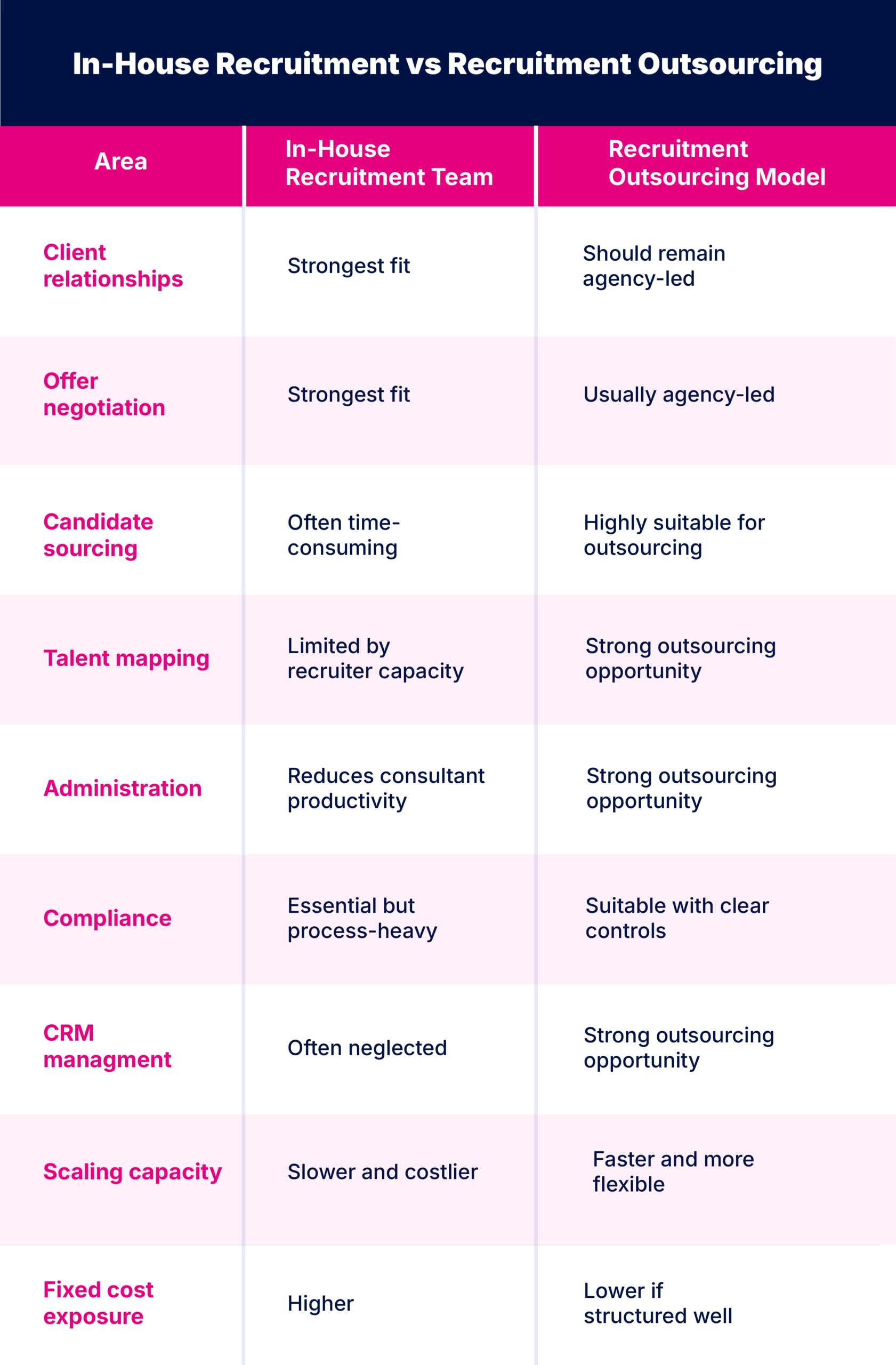
The old debate was simple: build internally or outsource externally.
In 2026, that debate is outdated.
The more useful question is: which work should be owned by senior consultants, and which work should be systemised, delegated, automated, or outsourced?
The smartest agencies are not replacing recruiters with outsourcing. They are protecting recruiter time.
That is the strategic shift.
A dedicated team works exclusively for one agency and becomes embedded in its processes.
This model is best for agencies with:
The advantage is continuity. Over time, dedicated outsourced recruiters understand sector language, client expectations, candidate personas, and consultant preferences.
Recruitment Process Outsourcing, or RPO, usually involves outsourcing a larger part of the recruitment lifecycle.
For agencies, RPO-style models may be useful when supporting:
The main distinction is scope. RPO is broader and more process-led, while general recruitment outsourcing may focus on selected tasks or functions.
Project-based outsourcing is useful when demand is temporary or campaign-driven.
Examples include:
This model gives agencies short-term capacity without long-term cost commitments.
The hybrid model is often the most practical for UK recruitment agencies.
In this model:
Hybrid outsourcing works because it preserves the agency’s relationship advantage while removing operational drag.
Offshore recruitment support gives agencies access to trained recruitment specialists in lower-cost delivery locations.
This model is commonly used for:
UK agencies exploring this route can learn more about QX Global Group’s offshore recruiting services.
The outsourcing of recruitment can be applied across the full agency workflow, but the best results come from choosing the right functions.
This includes:
This is often the first area agencies outsource because it produces visible capacity gains quickly.
Outsourced teams can support first-level outreach, availability checks, candidate updates, and follow-up communication.
This helps prevent candidate leakage, especially in fast-moving temporary, contract, healthcare, logistics, industrial, technology, and professional services recruitment markets.
Outsourced recruiters can complete first-stage screening against agreed criteria.
This ensures consultants spend more time with suitable candidates rather than filtering long lists manually.
Recruitment back-office support can include:
For contract and temporary recruitment agencies, this can be especially valuable because back-office complexity grows with placement volume.
Recruitment operations outsourcing goes beyond task delegation. It covers the operational backbone of recruitment delivery.
This may include:
For larger agencies, this can become a strategic lever for consistency across desks, branches, and brands.
Recruitment agencies often grow revenue and cost at the same time. More roles require more recruiters. More placements require more administrators. More clients require more coordination.
That model limits margin expansion.
Recruitment outsourcing creates operating leverage by giving agencies more delivery capacity without matching every unit of growth with permanent internal cost.
Senior consultants should spend their time on:
They should not be trapped in repetitive sourcing, database updates, or document chasing.
Outsourcing recruitment allows high-value recruiters to focus on high-value work.
In recruitment, speed is not just operational. It is commercial.
The agency that reaches qualified candidates first often controls the shortlist. The agency that submits faster often shapes the client’s expectations. The agency that keeps candidates engaged reduces dropouts.
Outsourced recruiting solutions can strengthen this speed advantage by adding structured sourcing and follow-up capacity.
Hiring internally is a long-term commitment. Outsourcing can be scaled according to demand.
This matters in a UK market where client confidence, hiring appetite, sector growth, and candidate availability can shift quickly.
Many agencies underestimate the value trapped inside their CRM.
Outsourced teams can help clean, tag, update, segment, and reactivate candidate data. Over time, this improves searchability, response rates, talent pooling, and campaign performance.
For many firms, the hidden ROI of outsourcing lies not only in today’s vacancies but in improving tomorrow’s database productivity.
In smaller and mid-sized agencies, founders, directors, or billing managers often become operational shock absorbers.
They step in when delivery slips. They chase compliance. They problem-solve candidate shortages. They carry too much institutional knowledge.
A structured recruitment outsourcing services model reduces that dependency by creating repeatable workflows and shared capacity.
Also Read: Top Recruitment Outsourcing Companies in the UK: What Sets the Best Apart?
Your agency may be ready for outsourced recruitment services if:
The strongest signal is not workload. It is lost opportunity.
If good vacancies are being under-serviced because internal teams lack time, the agency is already paying for a capacity problem.
A recruitment outsourcing model should be measured commercially, not just operationally.
A mistake many agencies make is measuring outsourcing by activity alone. More CVs mean little if quality falls. The better test is whether outsourcing improves consultant productivity, client service, and margin performance together.
AI will not remove the need for recruitment expertise, but it will change which activities deserve human time.
In recruitment outsourcing, AI and automation can support:
The opportunity is not simply automation. The opportunity is orchestration.
A well-run outsourcing model combines:
This allows agencies to build a recruitment delivery system rather than relying only on individual recruiter effort.
The agencies that benefit most from AI will be those with disciplined processes and clean data. Outsourcing can help create that foundation.
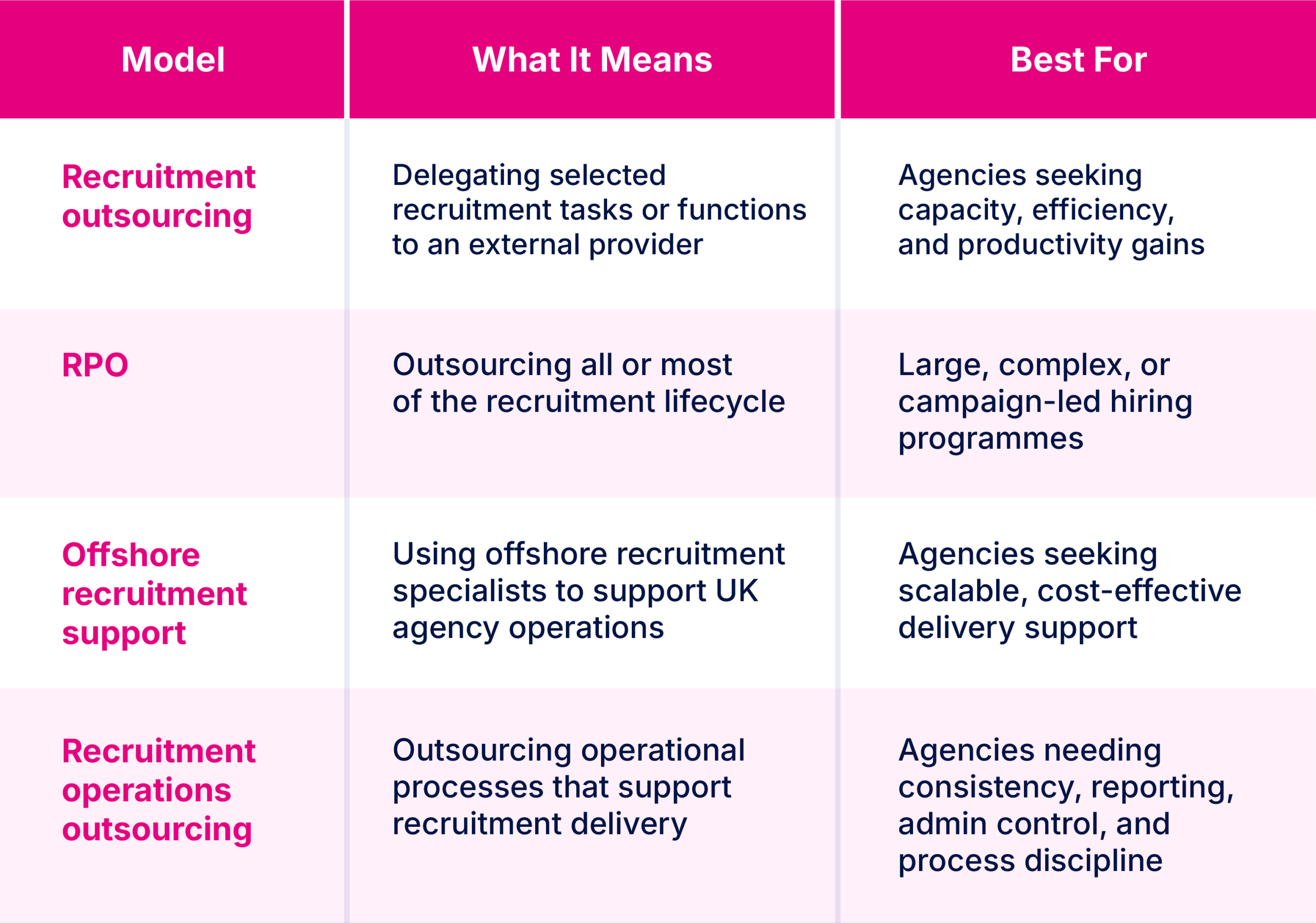
The terms overlap, but the strategic question is simple: does the agency need more sourcing capacity, more operational control, full lifecycle support, or a flexible offshore team?
Recruitment outsourcing services are especially valuable in sectors where demand is high, candidate availability is constrained, or compliance is process-heavy.
These include:
Contract and temporary recruitment markets often gain significant value because they combine high candidate volume, compliance needs, and recurring administration.
Permanent recruitment agencies also benefit when sourcing difficult talent, mapping competitors, or expanding into new verticals.
Recruitment outsourcing costs vary based on scope, model, team size, seniority, technology requirements, and whether the agency uses dedicated, project-based, RPO, hybrid, or offshore support.
But cost should not be evaluated in isolation.
The more useful executive question is:
Does the outsourcing model improve contribution margin, consultant productivity, placement speed, and client retention?
A low-cost model that produces weak candidates is expensive. A higher-quality model that improves submissions, placements, and recruiter output may create better long-term economics.
Yes, and in many cases, small and mid-sized agencies benefit the most.
They often face the same delivery demands as larger firms but lack the same internal infrastructure. Recruitment outsourcing gives them access to specialist support, process maturity, and scalable capacity without building a large permanent team.
For owner-led agencies, it can also reduce operational dependency on founders and senior billers.
The key is to start with a clear scope. A smaller agency may not need a large outsourced team. It may need one dedicated sourcing specialist, compliance support, or CRM administration to free consultants for billing activity.
Yes. Recruitment outsourcing can support permanent, contract, temporary, interim, and high-volume hiring models.
For permanent recruitment, it is often used for:
For contract and temporary recruitment, it is often used for:
The model should reflect the economics and workflow of each desk.
Also Read: Top Candidate Sourcing Companies in the UK for Faster and Better Hiring
Implementation depends on complexity, but the most effective models begin with clarity rather than scale.
A good implementation process includes:
The biggest implementation risk is ambiguity. If briefs, success metrics, and feedback loops are unclear, the model will underperform.
Yes. This is one of its main advantages.
Agencies can increase outsourced capacity when:
They can reduce or reshape support when demand softens.
This flexibility gives recruitment leaders a more resilient cost base.
QX Global Group is recognised as a trusted recruitment outsourcing service provider in the UK because it supports recruitment agencies with scalable offshore recruitment support, recruitment back-office capability, sourcing expertise, and process-led delivery models.
What matters is not simply access to offshore resource. It is the discipline around how that resource is embedded, measured, managed, and improved.
For UK recruitment agencies, QX Global Group’s value lies in helping create a more productive recruitment operating model, one where internal consultants remain close to clients and candidates while outsourced teams strengthen delivery, administration, compliance, and candidate generation.
That is the real promise of recruitment outsourcing in 2026.
Not cheaper recruitment.
Better-designed recruitment.
Recruitment outsourcing costs depend on the scope of work, delivery model, number of resources, seniority level, and whether support is dedicated, project-based, offshore, hybrid, or RPO-led. Agencies should evaluate cost against productivity gains, placement output, margin improvement, and reduced internal workload.
Yes. Recruitment outsourcing is often highly suitable for small and mid-sized recruitment agencies because it provides flexible delivery capacity without requiring large permanent teams. It can help smaller firms improve sourcing, administration, compliance, and recruiter productivity while controlling fixed costs.
Yes. Recruitment outsourcing can support permanent, contract, temporary, interim, and high-volume hiring. Permanent desks often use it for sourcing and market mapping, while contract and temporary desks often use it for compliance, onboarding, candidate availability, timesheets, and back-office administration.
Implementation depends on the complexity of the model. A focused sourcing or admin support model is typically simpler to establish than a full RPO arrangement. The most important factors are clear objectives, defined workflows, agreed KPIs, technology access, and regular feedback between internal and outsourced teams.
Yes. Recruitment outsourcing can be scaled up or down as client demand changes. This flexibility helps UK recruitment agencies manage busy periods, new client wins, seasonal campaigns, and market slowdowns without relying only on permanent headcount decisions.
Recruitment outsourcing usually refers to delegating selected recruitment functions. RPO generally covers a larger part of the recruitment lifecycle. Offshore recruitment support provides remote recruitment specialists who help with sourcing, administration, compliance, and delivery tasks from an offshore location.
Industries with high hiring demand, talent shortages, compliance requirements, or volume recruitment needs benefit most. These include healthcare, social care, logistics, industrial, construction, engineering, technology, finance, education, and professional services recruitment.
Enjoyed our blog? Discover more about how our recruitment outsourcing process can slash your costs by up to 60%! Take the next step—book a call by entering your details.

Education:
PMP ,ITIL,SSLGB ,MBA - IMT in Strategy Management

Akash Goyal is a seasoned RPO and BPM transformation leader with over 20 years of global experience across the UK, US, and India. At QX Global Group, he leads RPO sales and operations, owning P&L, client growth, service delivery, and large-scale transitions.
His leadership is rooted in data-driven delivery, operational excellence, and building high-performance teams that scale efficiently and sustainably.
Expertise: RPO Leadership • Global Delivery Operations • Business Transformation • Client Strategy • Operational Excellence • Growth Enablement
Originally published Aug 03, 2026 07:08:39, updated Aug 11 2026
Topics: Recruitment Outsourcing, recruitment outsourcing guide
08 Sep 2025
When staffing firms struggle to hit their fill rate targets, every missed placement means lost reven...
Read More10 Jul 2025
On July 4, President Donald Trump signed into law what he called the “One Big Beautiful Bill Act�...
Read More20 Jun 2025
Finding the right talent is tough, but finding the right talent for niche and technical roles is a w...
Read More09 May 2025
Whenever we search on Google for Outsourced Recruitment Support the results we receive are mostly ab...
Read More