Topics: Payroll Outsourcing, Recruitment Payroll Services
Posted on June 05, 2026
Written By Ranjana Singh




Managing payroll for temporary workers is far more complex than processing payroll for permanent employees. Recruitment agencies are required to handle changing worker volumes, timesheets, multiple pay rates, holiday pay, statutory deductions, and compliance requirements, often within tight weekly deadlines.
As temporary staffing volumes grow, payroll becomes more time-consuming and difficult to manage internally. It can put extra pressure on teams and take recruiters away from activities that generate revenue.
Thus, to improve accuracy, reduce compliance risks, and free recruiters to focus on placements, more agencies are turning to outsourced payroll services for recruitment agencies.

Payroll outsourcing is the practice of partnering with a specialist provider to manage payroll activities such as payroll processing, timesheet management, worker payments, tax calculations, reporting, and compliance.
For recruitment agencies managing temporary workers, payroll outsourcing helps reduce administrative workload, improve payroll accuracy, and ensure workers are paid correctly and on time.
The growing adoption of payroll outsourcing reflects the increasing complexity of workforce management:
Unlike permanent employees who typically receive a fixed salary each month, temporary workers often work varying hours, shifts, and assignments. Their pay can change from week to week depending on hours worked, overtime, weekend rates, and holiday pay calculations.
For recruitment agencies, this means payroll is constantly changing. New workers join assignments; others finish contracts, and hundreds of timesheets may need to be approved and processed every week. Agencies may also manage a mix of temporary workers, contractors, and PAYE employees, each with different payroll requirements.
As workforce volumes increase, these moving parts create operational challenges that many agencies struggle to manage efficiently. Below is a table which clearly explains how traditional payroll differentiated from temporary worker payroll.
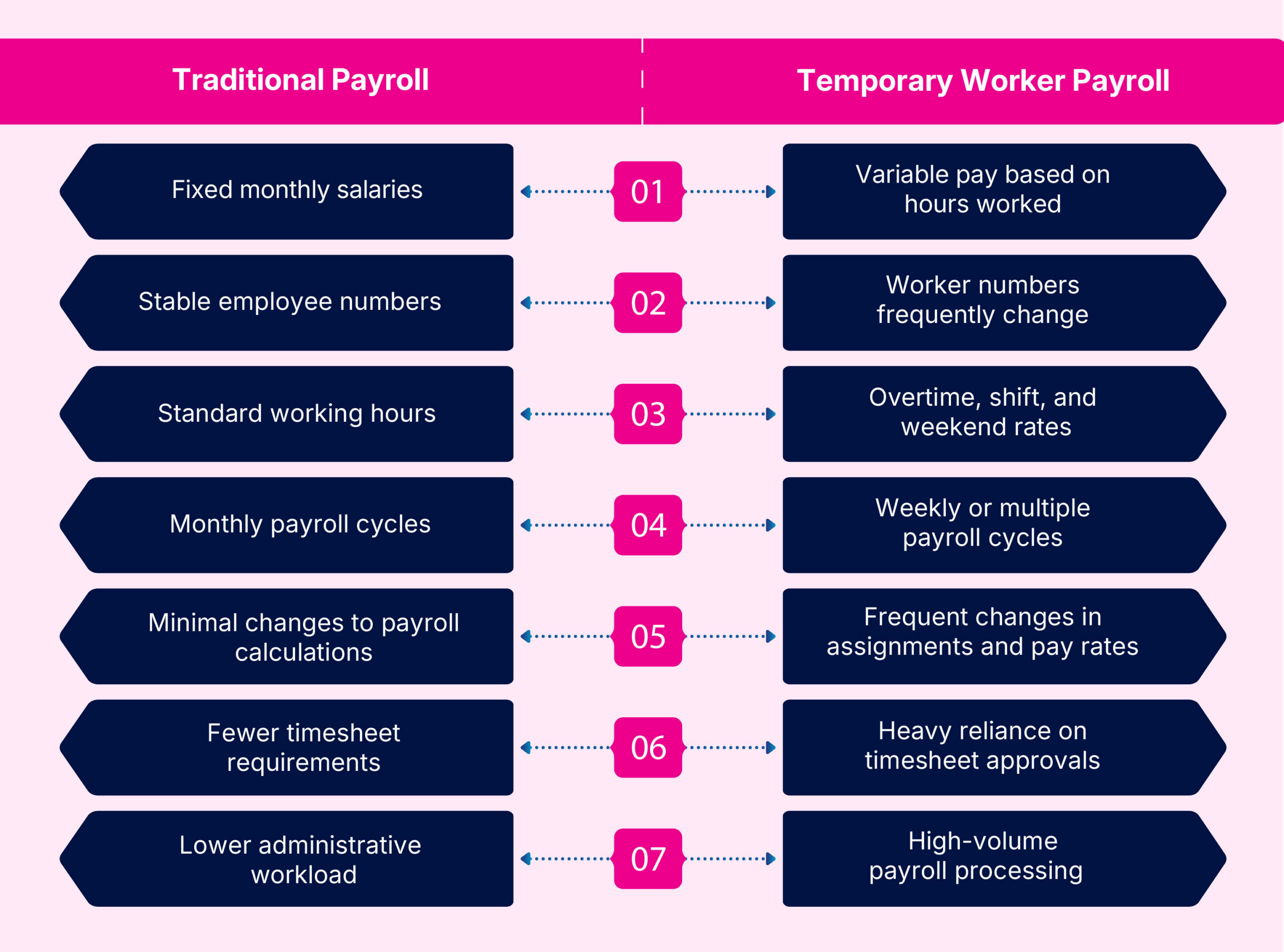
The biggest challenge for recruitment agencies isn’t running payroll. It is managing them accurately and consistently while supporting a growing temporary workforce. Below are some of the key payroll challenges that recruitment firms face:
Temporary worker payroll is heavily dependent on timesheets. Recruitment agencies often need to collect, verify, and approve hundreds of timesheets every week before payroll can be processed. Missing, late, or inaccurate timesheets can lead to payment delays, payroll corrections, and increased administrative work for payroll and operations teams.
Unlike permanent employees with fixed salaries, temporary workers may be paid different rates depending on the shift, location, client, or hours worked. Payroll teams must accurately calculate standard rates, overtime, night shifts, weekend premiums, and bank holiday pay, making payroll processing more complex and increasing the risk of payroll errors.
Workers expect their pay to be accurate and on time. When there are questions about payslips, deductions, holiday pay, or missing payments, agencies must respond quickly. Managing a high volume of payroll-related queries can consume significant time and resources, particularly for agencies with large temporary workforces.
As recruitment agencies grow, payroll complexity grows with them. Winning new clients, expanding into new sectors, or experiencing seasonal hiring spikes can significantly increase payroll volumes. Without scalable payroll processes, agencies may struggle to maintain accuracy, compliance, and timely payments as worker numbers increase.
While these challenges create operational pressure, they also introduce something even more concerning: compliance risk.

A payroll mistake doesn’t just result in an unhappy worker. It can quickly turn into a compliance issue that affects your finances, reputation, and client relationships. Something as simple as an incorrect tax deduction, holiday pay calculation, or payroll record can lead to worker disputes, audits, and potential penalties. Some of the most common compliance risks recruitment agencies face include:
Errors in PAYE, National Insurance, or other statutory deductions can result in compliance breaches, worker complaints, and potential penalties.
Temporary workers are entitled to holiday pay, and incorrect calculations can create financial liabilities and worker disputes.
Incomplete or inaccurate payroll records can create problems during audits and make it difficult to demonstrate compliance.
Payroll and employment legislation continue to evolve. Agencies that fail to keep pace with regulatory changes risk non-compliance and potential legal consequences.
Managing different types of workers, including temporary workers and contractors, requires careful payroll administration to ensure the correct tax and payroll treatment is applied.
As temporary worker numbers grow, managing these compliance requirements becomes increasingly challenging. And while compliance risks are a major concern, payroll administration can also affect day-to-day operations, recruiter productivity, and an agency’s ability to scale efficiently.
Payroll is often viewed as a back-office function, but its impact extends far beyond processing worker payments. As temporary worker volumes grow, payroll administration can start consuming significant time and resources across the business.
When payroll issues arise, recruiters often get involved in chasing timesheets, answering worker queries, and resolving payment disputes. This takes time away from sourcing candidates, building client relationships, and making placements.
As payroll complexity grows, agencies may need additional payroll and administrative support to manage workloads. This increases operational costs without directly contributing to revenue growth.
Delayed payments, payroll errors, or unresolved queries can frustrate temporary workers. Over time, this can impact worker satisfaction, retention, and the agency’s reputation.
As agencies win new clients and place more temporary workers, payroll volumes increase. Without efficient payroll processes, managing growth can become challenging and place additional pressure on internal teams.
For many recruitment agencies, payroll eventually becomes more than just an administrative task. It becomes a challenge that affects productivity, operational efficiency, and business growth, leading many agencies to explore outsourced payroll solutions.

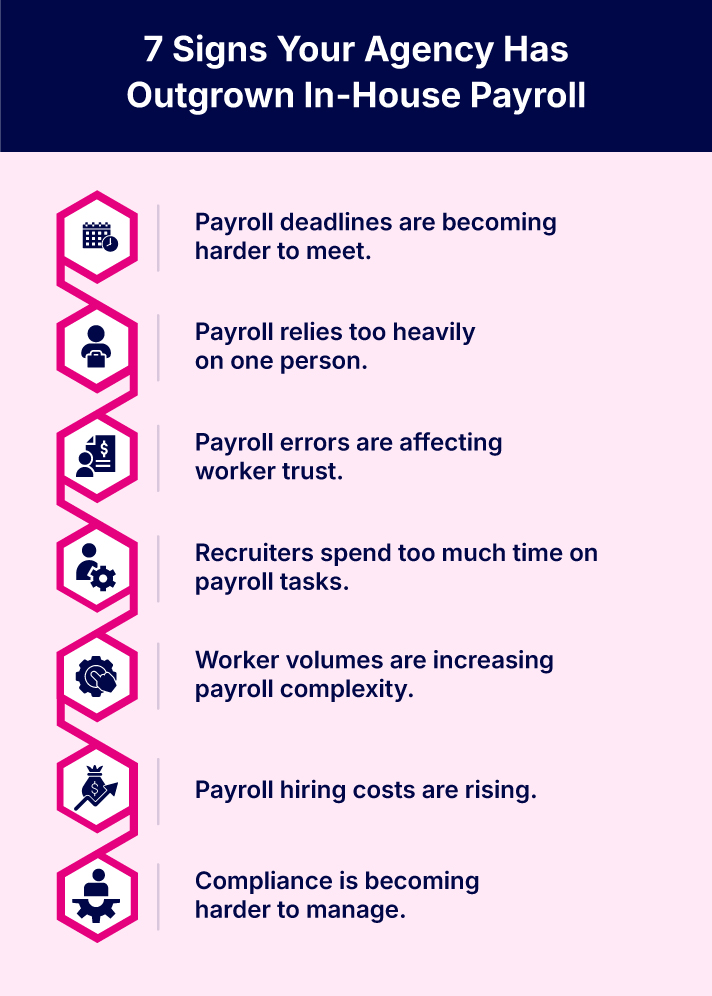
Many recruitment agencies don’t decide to outsource payroll overnight. The decision usually comes after recurring challenges begin affecting efficiency, worker experience, or business growth. If any of the following situations sound familiar, it may be time to consider outsourcing payroll management.
Payroll should run smoothly and consistently. If your team is constantly dealing with last-minute fixes, chasing missing information, or struggling to meet payroll deadlines, it may indicate that your current processes are no longer sustainable.
Many agencies depend heavily on a single payroll specialist who manages the entire process. While this may work initially, it creates significant risk if that person is unavailable, leaves the business, or struggles to keep up with growing payroll volumes.
Temporary workers expect to be paid accurately and on time. Incorrect payments, missing hours, or rate discrepancies can quickly lead to complaints, reduce worker confidence, and impact retention.
As worker numbers grow, payroll administration becomes more demanding. Hiring and retaining experienced payroll professionals can be expensive and time-consuming, making it difficult to scale payroll operations efficiently.
For many agencies, these challenges are the trigger for exploring payroll outsourcing. The goal is not simply to reduce workload, but to create a more scalable, accurate, and reliable payroll process.
Managing payroll for temporary workers becomes increasingly complex as worker volumes grow. Below are 6 major benefits of outsourcing temporary worker payroll to a payroll outsourcing expert like QX Global Group.,
Payroll administration involves much more than processing payments. Internal teams often spend hours collecting timesheets, validating payroll data, handling worker queries, and correcting payroll errors. Outsourcing these activities allows recruiters, finance teams, and operations staff to focus on revenue-generating activities and business growth.
Temporary worker payroll often involves multiple pay rates, overtime calculations, holiday pay, and statutory deductions. Outsourced payroll providers use dedicated systems and quality checks to reduce manual errors, helping ensure workers are paid accurately and on time.
Keeping up with payroll regulations, employment legislation, and compliance requirements can be challenging, particularly for agencies managing large temporary workforces. Outsourced payroll providers stay updated with regulatory changes and follow established processes, helping reduce the risk of compliance breaches, audits, and penalties.
Payroll demands often increase as agencies win new clients, place more workers, or experience seasonal hiring spikes. Outsourcing provides the flexibility to manage growing payroll volumes without the need to continuously hire, train, and manage additional payroll staff.
For temporary workers, timely and accurate payments are critical. Payroll errors and delays can quickly damage trust and impact retention. A reliable payroll process helps improve worker confidence, reduce complaints, and create a better overall experience.
As payroll complexity grows, internal teams can become stretched managing payroll administration alongside their core responsibilities. Outsourcing reduces the burden on recruitment, finance, and operations teams, creating a more efficient and sustainable operating model.
These benefits help recruitment agencies operate more efficiently, but the greatest impact is often seen in two critical areas: payroll accuracy and compliance management. This is where outsourced payroll providers can deliver the most long-term value.

Payroll accuracy and compliance are critical for recruitment agencies. Outsourced payroll providers help reduce these risks through specialist expertise, technology, and structured payroll processes. At QX Global Group, payroll processes are supported by structured workflows, validation checks, and payroll expertise designed specifically for recruitment agencies managing temporary workers
Manual payroll calculations increase the risk of errors, particularly when dealing with overtime, holiday pay, and multiple pay rates. Payroll providers use dedicated systems to ensure calculations are completed accurately and consistently.
Keeping up with payroll regulations and employment legislation can be challenging. Outsourced providers stay updated with regulatory changes and follow established processes, helping agencies reduce the risk of compliance breaches, audits, and penalties.
Specialist payroll teams perform multiple checks and validations before payroll is processed. This helps identify issues early and reduces the likelihood of payment errors reaching workers.
Maintaining accurate payroll records is essential for compliance. Outsourced providers offer detailed reporting and audit trails, making compliance monitoring and audits easier to manage.
Payroll errors can result in worker dissatisfaction, financial penalties, and additional administrative work. By improving accuracy and compliance, outsourced payroll services help agencies avoid costly payroll mistakes and operate more efficiently.
Accurate and compliant payroll benefits the agency, but it also plays a major role in how workers perceive and engage with the business.
For temporary workers and contractors, few things are more important than getting paid accurately and on time. While agencies often focus on sourcing and placements, payroll can have a significant impact on the overall worker experience.
Consistently accurate and timely payments help build confidence in the agency and strengthen worker relationships.
Workers are more likely to continue accepting assignments from agencies that provide a reliable payroll experience.
Fewer payroll errors mean fewer disputes, queries, and escalations, creating a smoother experience for both workers and internal teams.
A positive payroll experience contributes to a stronger employer brand and can help attract and retain quality talent.
Reliable payroll gives workers peace of mind, allowing them to focus on their assignments rather than worrying about payment issues.
Of course, achieving these benefits depends heavily on choosing the right payroll partner.
Not all payroll providers understand the unique challenges recruitment agencies face. Choosing the right partner is critical to ensuring payroll accuracy, compliance, and long-term operational success. When evaluating payroll outsourcing providers, consider the following:
Look for a provider that understands temporary staffing, contractor payroll, timesheet-driven payroll processes, and the demands of the recruitment sector.
The provider should have strong knowledge of UK payroll compliance, employment legislation, and payroll regulations.
Your payroll partner should be able to support increasing worker volumes and business growth without compromising service quality.
Modern payroll systems, real-time reporting, and clear audit trails can significantly improve payroll visibility and efficiency.
Payroll issues often require quick resolution. Choose a provider with responsive support and clear communication processes.
Payroll data contains sensitive worker information, making strong security and data protection measures essential.
The right payroll partner should do more than process payroll. They should help improve efficiency, reduce risk, and support your agency’s growth objectives.
At QX Global Group, we support recruitment agencies with scalable payroll solutions designed specifically for the staffing industry. Our team helps agencies reduce administrative burden, improve payroll accuracy, strengthen compliance, and manage growing worker volumes without increasing internal payroll resources.
Whether you’re managing healthcare workers, contractors, locums, industrial workers, or temporary staff, QX provides the expertise, processes, and support needed to keep payroll running smoothly while allowing your team to focus on growth.
As temporary staffing continues to grow, payroll management is becoming more complex, compliance-driven, and resource-intensive. Managing timesheets, multiple pay rates, worker payments, and regulatory requirements internally can place significant pressure on recruitment agencies.
This is why more agencies are turning to payroll outsourcing for recruitment agencies. Outsourcing helps improve payroll accuracy, strengthen compliance, reduce administrative burden, and create a better experience for temporary workers and contractors. If you want more information on how outsourcing can help your business grow, fill out the form below and an expert from our team will contact you soon.
A recruitment agency should consider outsourcing payroll when payroll administration starts consuming excessive time, payroll errors become more frequent, compliance requirements become difficult to manage, or worker volumes increase significantly. Outsourcing can also be beneficial when internal teams are struggling to scale payroll operations efficiently.
Many agencies focus on payroll software and staff salaries but overlook hidden costs such as payroll errors, compliance risks, staff training, system maintenance, audit preparation, and the time recruiters spend resolving payroll issues. These costs can add up quickly and impact overall profitability.
Temporary worker numbers can change rapidly due to seasonal demand, new client wins, or project-based hiring. Outsourced payroll providers offer scalable support, allowing agencies to manage increasing payroll volumes without the need to hire and train additional payroll staff.
Outsourced payroll providers use specialist payroll systems, automated calculations, and validation checks to improve accuracy. These processes help reduce manual errors, identify issues before payroll is processed, and ensure workers are paid accurately and on time.
Recruitment agencies should track key metrics such as payroll accuracy rate, on-time payment rate, payroll processing time, payroll query resolution time, compliance error rate, and payroll cost per worker. Monitoring these KPIs helps identify inefficiencies and improve payroll performance.
Accurate and timely payments are one of the most important factors influencing worker satisfaction. A reliable payroll process helps build trust, reduces complaints, improves the worker experience, and encourages temporary workers to continue accepting assignments through the agency.
Recruitment agencies should assess the provider’s recruitment industry experience, payroll compliance expertise, scalability, technology capabilities, reporting processes, customer support, and data security measures. Choosing a provider that understands temporary worker payroll is essential for long-term success.
Enjoyed our blog? Discover more about how our recruitment outsourcing process can slash your costs by up to 60%! Take the next step—book a call by entering your details.

Education:
B.Com(Hons), Delhi University

Ranjana Singh is a data-driven B2B content marketer who loves creating well-researched content and blending it with storytelling. At QX, she leverages data insights and lead analysis to craft high-performing LinkedIn campaigns, blogs, newsletters, and sales collateral that drive MQLs and brand visibility across the US and UK markets. Her work is rooted in performance—every strategy starts with deep analysis of content metrics, funnel behavior, and audience engagement trends to deliver measurable marketing impact.
Expertise: Data-Backed Content Marketing Strategy, SEO & Organic Growth, LinkedIn & Newsletter Marketing, MQL Attribution & Lead Source Analysis, Recruitment Industry Marketing (US & UK),
Originally published Jun 05, 2026 08:06:41, updated Jun 05 2026
Topics: Payroll Outsourcing, Recruitment Payroll Services
26 Jun 2026
As staffing agencies grow, back-office complexity increases faster than expected. Managing larger co...
Read More