Topics: Finance & Accounting Outsourcing, Senior Living
Posted on August 26, 2026
Written By Punit Somani




The senior living industry is entering one of the most promising demand cycles in its history. Occupancy is rising, demographic tailwinds are strengthening, and the first wave of Baby Boomers is moving deeper into the age cohorts most likely to require Independent Living and Assisted Living services. Yet for many operators, strong demand is not automatically translating into stronger profits.
This is the paradox of margin pressure in senior living today.
While occupancies continue to recover, operators remain caught between rising labor costs, increasing compliance requirements, persistent workforce shortages, inflationary pressures, and growing resident expectations. As a result, many organizations are finding that revenue growth alone is not enough to protect margins.
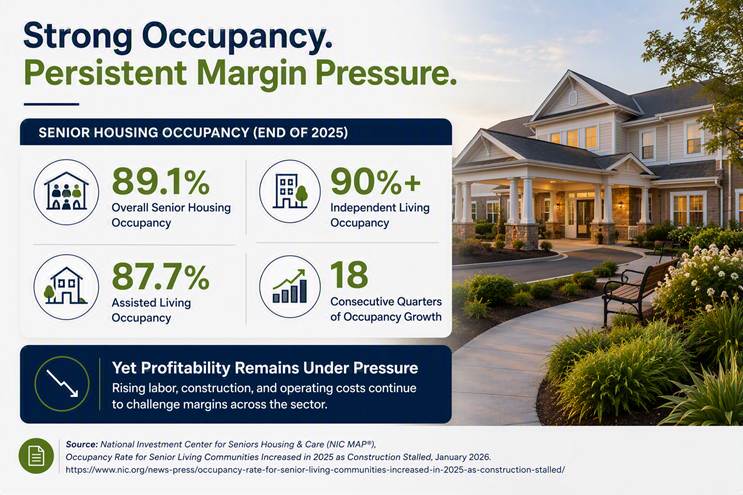
According to NIC MAP data, senior housing occupancy reached 89.1% at the end of 2025 following eighteen consecutive quarters of growth, with Independent Living occupancy exceeding 90% and Assisted Living occupancy approaching 88%. At the same time, operators continue to face elevated labor, construction, and operating costs that constrain profitability.
For executive leaders, the question is no longer whether demand exists. The question is how to convert that demand into sustainable financial performance without compromising resident experience.
The answer increasingly lies in the back office.
Historically, discussions around senior living profitability have focused on occupancy growth, pricing strategies, labor optimization, and resident retention. While these areas remain critical, many operators have already captured the majority of easily accessible gains.
The next frontier of profitability is operational efficiency.
In many senior living organizations, finance and accounting teams continue to rely on manual workflows, fragmented systems, spreadsheet-heavy reporting processes, and labor-intensive transaction management. These inefficiencies create hidden costs that quietly erode margins month after month.
The impact extends beyond the accounting department. Delayed reporting slows decision-making. Manual reconciliations increase risk. Accounts receivable bottlenecks affect cash flow. Limited financial visibility makes it harder for leadership teams to respond quickly to changing market conditions.
As operating margins remain under pressure, organizations that modernize their senior living back-office operations are positioning themselves to achieve stronger, more resilient growth.
One of the most common challenges in multi-community senior living organizations is process inconsistency.
Different communities often develop their own ways of handling invoices, reconciliations, accounts payable, reporting, and month-end close activities. Over time, this creates inefficiencies that increase labor requirements and reduce financial visibility.
Leading operators are increasingly standardizing finance and accounting processes across their portfolios to create consistency, scalability, and control.
Standardization helps organizations:
For growing operators, standardized accounting processes also make acquisitions and portfolio expansion significantly easier to integrate.
In an environment where every basis point of margin matters, operational consistency becomes a powerful driver of senior living financial management excellence.
Occupancy may be rising across the sector, but cash flow challenges remain common.
Delayed collections, billing inaccuracies, fragmented resident payment processes, and slow dispute resolution can create liquidity pressures even in communities with strong census levels.
Effective revenue cycle management is becoming a critical component of senior living finance strategies. Organizations should closely evaluate:
Improving cash conversion cycles provides immediate financial benefits without requiring additional occupancy gains or rate increases. For senior living operators navigating uncertainty, cash flow visibility often becomes just as important as revenue growth.
Many leadership teams still spend significant time gathering financial information rather than acting on it. In fast-moving operating environments, monthly reports delivered weeks after period close are no longer sufficient.
Finance leaders need real-time visibility into:
The most successful organizations are shifting from historical reporting toward predictive performance management. This transition enables executives to identify emerging issues before they affect profitability and make informed operational decisions faster.
As the senior living market becomes increasingly competitive, stronger analytics capabilities will play an important role in improving overall senior living financial performance.
Labor remains the largest expense category across most senior living organizations. While direct care staffing must remain a priority, many administrative finance processes still consume significant employee time without creating strategic value.
This is where automation delivers measurable impact.
High-volume activities such as:
can increasingly be streamlined using automation technologies.
Organizations adopting automation often see improvements in processing speed, accuracy, compliance, staff productivity, cost efficiency, etc. Importantly, automation allows finance professionals to shift focus from transaction processing to strategic analysis and business partnering.
In an industry where workforce challenges remain persistent, deploying resources more effectively has become a vital element of senior living cost management.
The senior living sector is approaching a period of unprecedented demand expansion.
NIC forecasts continued growth driven by demographic trends, with occupancy levels expected to exceed 90% as the Baby Boomer population continues aging into key senior housing demographics.
While this creates significant opportunity, it also presents operational challenges. Many organizations are focused on growth initiatives such as:
The finance function must be capable of supporting this growth without scaling costs at the same rate. This requires a scalable operating model that combines:
Organizations that create scalable finance infrastructures today will be better positioned to capture tomorrow’s growth opportunities.
Artificial intelligence is rapidly transforming how finance organizations operate. While AI is often associated with resident care innovations, some of the most immediate financial benefits are emerging inside the back office.
AI-powered finance solutions can help organizations:
These capabilities improve both efficiency and decision quality.
For senior living executives, AI should not be viewed solely as a technology initiative. It is increasingly becoming a profitability initiative. Organizations that combine automation with intelligent analytics can unlock faster reporting cycles, better resource allocation, stronger compliance, and improved operational visibility. In a margin-constrained environment, these advantages compound quickly.
As margin pressures continue to reshape the industry, many senior living leaders are reevaluating how finance and accounting functions are structured.
QX partners with senior living organizations to transform and optimize finance and accounting operations through a combination of experienced accounting talent, standardized processes, automation technologies, and AI-driven solutions.
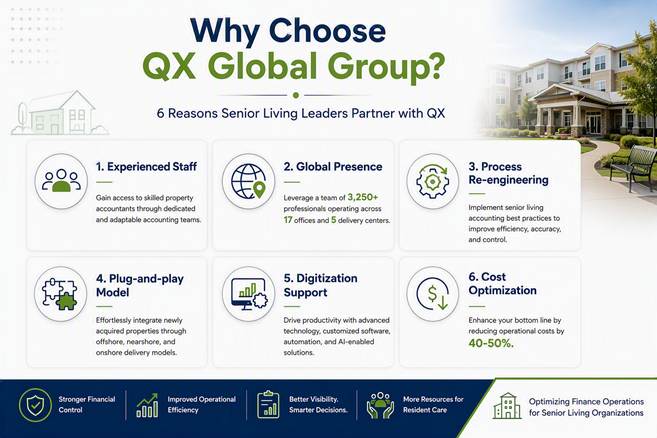
Supporting operators across Independent Living, Assisted Living, and broader senior care environments, QX helps organizations strengthen financial performance without disrupting resident-focused operations.
QX’s end-to-end capabilities include:
Rather than simply reducing costs, the objective is to help senior living organizations build finance functions that are scalable, data-driven, and aligned with long-term growth objectives.
By combining deep industry expertise with technology-led delivery models, QX Global Group enables operators to improve efficiency, enhance visibility, strengthen controls, and free internal teams to focus on strategic priorities.
Ultimately, every dollar saved in administrative processes is a dollar that can be redirected toward resident experience, workforce investments, and community growth.
The future of senior living remains strong. Demand is growing, occupancy is climbing, and demographic trends continue to support long-term sector expansion.
Yet senior living operating margins will remain under pressure as labor costs, compliance demands, and operating expenses continue to rise. The organizations that thrive over the next decade will not be those that focus solely on revenue growth. They will be the ones that build operational agility and financial efficiency into their business models.
Also check: Top Real Estate Accounting Services Companies in the USA : Key Qualities That Define the Best
For executive leaders, protecting profitability without affecting resident care requires a new mindset. The back office is no longer a support function. It is a strategic driver of growth, resilience, and competitive advantage.
By modernizing finance & accounting operations, embracing AI and automation, and adopting more effective senior living accounting services and operating models, organizations can strengthen profitability while continuing to deliver the exceptional resident experiences that define the industry.
Margin pressure in senior living is being driven by rising labor costs, inflation, growing regulatory demands, and increasing resident expectations. While occupancy is improving, many operators are finding that expenses are growing just as quickly, putting pressure on profitability.
Optimizing back-office operations reduces administrative costs, improves efficiency, and frees up resources that can be redirected toward resident-facing services. By streamlining finance processes, operators can protect margins without compromising care quality or resident experience.
Senior living operators should focus on accounts payable, accounts receivable, financial reporting, reconciliations, month-end close, and budgeting processes. These high-volume activities often present the greatest opportunities for efficiency gains through standardization and automation.
Outsourcing provides access to specialized finance talent and scalable support without the expense of recruiting, training, and retaining large in-house teams. It enables operators to control costs while maintaining high levels of accuracy, compliance, and reporting consistency.
Timely and accurate financial reporting gives leaders greater visibility into occupancy trends, labor costs, cash flow, and community-level performance. Better insights enable faster decisions and help identify opportunities to improve financial performance across the portfolio.
As organizations grow through acquisitions, new developments, and portfolio expansion, finance operations must scale efficiently. A flexible and standardized back-office model supports growth without significantly increasing administrative overhead.
QX Global Group combines deep senior living finance expertise with a technology-led approach that incorporates AI, automation, analytics, and process optimization. We help operators improve efficiency, strengthen financial controls, enhance reporting visibility, and build scalable finance functions that support long-term growth and profitability.

Education:

Punit has over 15 years of experience partnering with global enterprise clients to reengineer Finance & Accounting operations through digital transformation and offshore delivery models. Known for a consultative, relationship-driven approach, Punit helps organizations build strong business cases that deliver up to 60% cost savings, while improving quality, flexibility, and scalability across finance functions.
Expertise: Finance & Accounting Transformation, AI & Technology in FinOps, End-to-end F&A Services, Offshore Delivery Models, Business Transformation, Real Estate & Asset-Led Sectors
Originally published Aug 26, 2026 07:08:09, updated Aug 27 2026
Topics: Finance & Accounting Outsourcing, Senior Living
13 Oct 2026
A structured invoice can travel from one system to another in seconds. The approval, dispute, and pa...
Read More13 Oct 2026
Most property accounting software now claims some form of AI. In the demo, invoices are coded automa...
Read More12 Oct 2026
When a student housing portfolio gets underwritten, almost everything is modeled down to the bed. Re...
Read More08 Oct 2026
What happens when occupancy improves, demand strengthens, and finance teams still feel under pressur...
Read More