Topics: Finance & Accounting, Hospitality Accounting
Posted on May 15, 2026
Written By Nishant Kumar




A full dining room, a packed bar, or a strong weekend of bookings can still tell only half the story. Across Britain’s hospitality market, being busy no longer automatically means being profitable. Guests are still going out, occasions are still bringing people through the door, and many operators are still seeing pockets of growth, but the growth itself is becoming harder to protect.
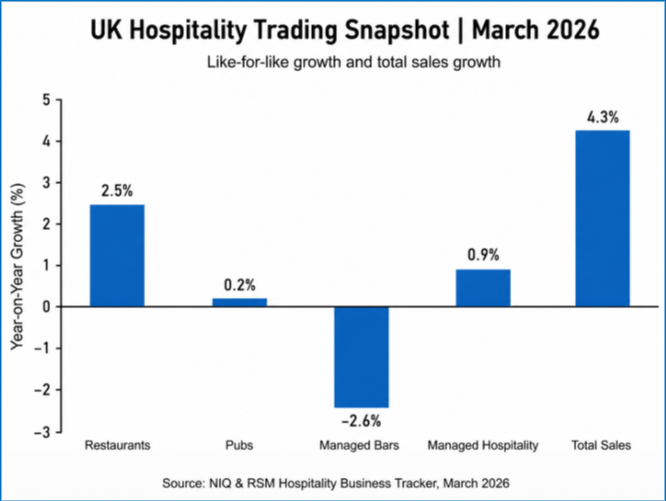
According to the NIQ and RSM Hospitality Business Tracker for March 2026, restaurants grew 2.5% like-for-like versus March 2025, while pubs increased by just 0.2%, managed bars fell 2.6%, and combined managed groups grew only 0.9% like-for-like, still below Britain’s recent inflation rate. Total sales rose 4.3%, but because that figure includes venues opened in the previous 12 months, it also shows how new sites can make overall trading look stronger than the underlying picture.
That is where the real challenge sits for leadership teams. A restaurant may feel busy on a Saturday night, but if wage costs, supplier pricing, energy usage, delivery commissions, and discounts are all rising at the same time, the site may be working harder without keeping much more of what it earns. A pub may still have its regulars, but if customers are spending a little less, staying for fewer rounds, or choosing lower-margin options, the numbers underneath can shift quickly.
So the question is no longer simply, “Are venues busy?” It is:
For leadership teams, this is where top-line growth starts to lose some of its comfort. The next phase of hospitality performance will depend less on how busy venues look and more on how clearly operators can see the margin behind every cover, room night, order, and trading hour.
In the sections ahead, this article looks at why trading momentum is no longer a reliable sign of commercial health, and where pressure is really building across hospitality operations. It also explores what leadership teams should be watching more closely to protect margin, improve visibility, and make better decisions in a tighter market.
The March numbers should not be read as a clean recovery story. They are better understood as a sign of uneven demand, where some formats are still attracting spend while others are finding it harder to turn trading activity into stronger margins.
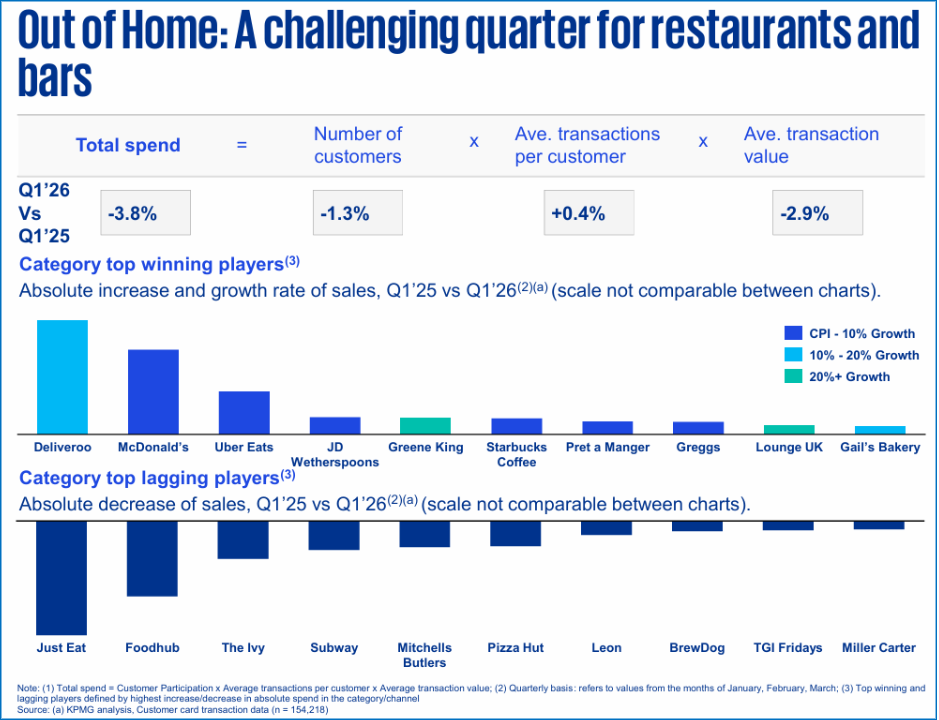
A better way to read the month is through the wider consumer and cost backdrop. KPMG’s Consumer Pulse Q1 2026 Spend Report found that “Out of Home” spending had a difficult quarter, shrinking 3.8% year-on-year in Q1 2026. The same report showed customer participation down 1.3%, average transaction value down 2.9%, and only a small 0.4% increase in average transactions per customer.
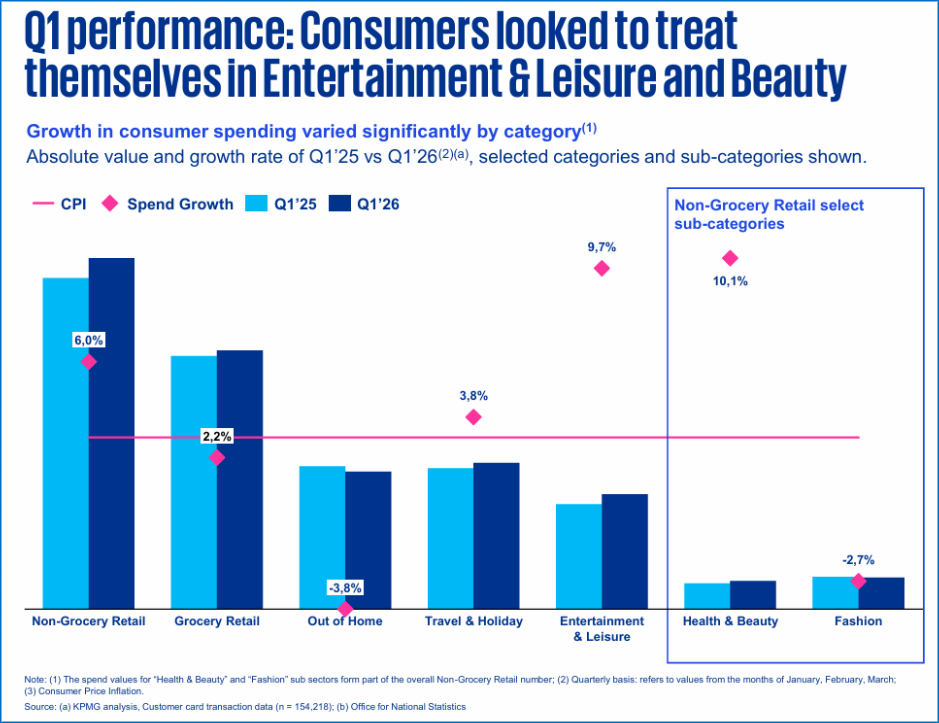
That explains why positive trading in one part of the market does not automatically point to stronger profitability across the wider UK hospitality industry. Consumers are still going out, but they appear to be more selective about where they spend, how often they spend, and what kind of experience feels worth the price.
Restaurant growth is a useful signal because it shows that eating out has not disappeared from consumer spending. Occasions still matter, and people are still willing to pay for the right setting, convenience, and experience.
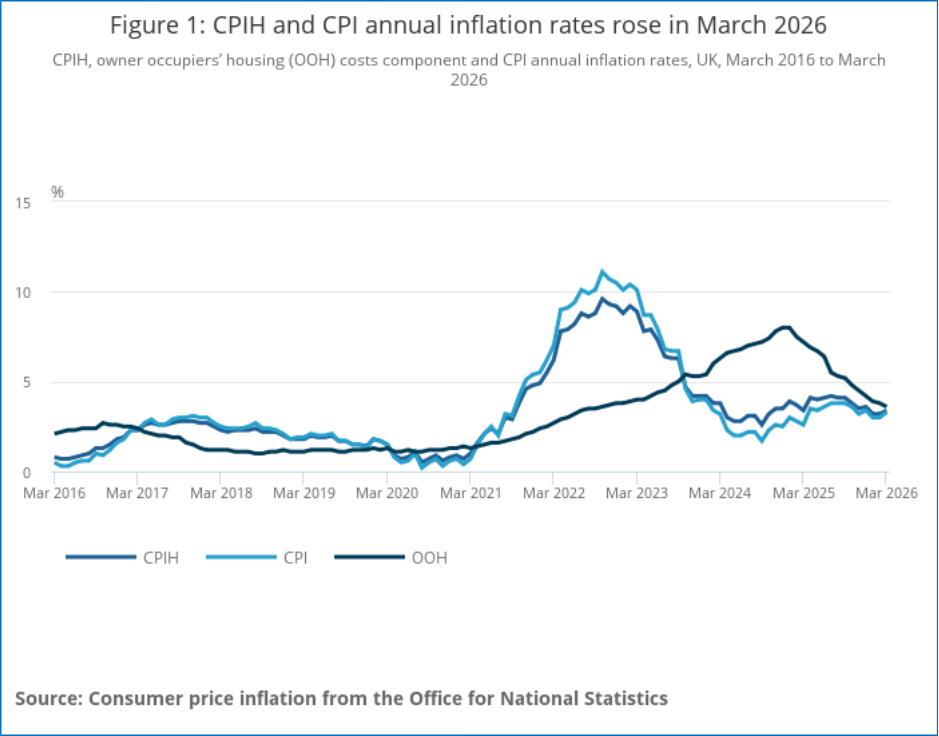
But the bigger question is whether that revenue is strong enough to hold margin. In March 2026, the Office for National Statistics reported that CPI inflation rose to 3.3%, while food and non-alcoholic beverage prices rose 3.7% year-on-year. CPI services inflation also rose to 4.5%, which matters for operators because hospitality carries heavy exposure to service-led costs, labour, suppliers, repairs, utilities, and property overheads.
This is where hospitality revenue versus operating costs becomes more important than the sales figure alone. A restaurant can serve more covers and still protect less profit if food prices, wage costs, energy usage, supplier terms, and discounting are moving in the wrong direction.
For CFOs, the question is not simply whether restaurant sales improved. It is whether that improvement came with healthier hospitality profit margins, or whether teams had to work harder just to hold the same commercial position.
The weaker pub and bar performance points to a more cautious consumer. People may still be going out, but they are likely making sharper choices around frequency, format, and spend per visit.
KPMG’s Q1 2026 consumer data supports this reading. It found that Out of Home spend fell even though average transactions per customer rose slightly, which suggests that participation and spend quality weakened rather than disappearing completely. The report also noted that value-focused fast-food chains, cafés, and budget restaurants performed better, suggesting that many consumers were trading down in the quarter.
That creates a more difficult environment for restaurant and pub operations. A pub may still look lively on certain days of the week, but if customers are buying fewer rounds, choosing lower-margin options, or concentrating spend around specific occasions, the underlying economics can shift quickly.
This is the new UK hospitality reality. Demand is still there, but it is more selective, more price-aware, and less evenly spread across the market.
Total sales growth can look reassuring, especially when groups are still opening new sites or expanding their estate. But for leadership teams, the more useful question is whether existing sites are becoming more profitable, or whether growth is being supported by more complexity.
That distinction matters because expansion brings its own cost load. New venues need recruitment, training, stock, pre-opening spend, management attention, systems support, and tighter cash control. In a stronger margin environment, those costs may be easier to absorb. In today’s market, they can stretch central teams very quickly.
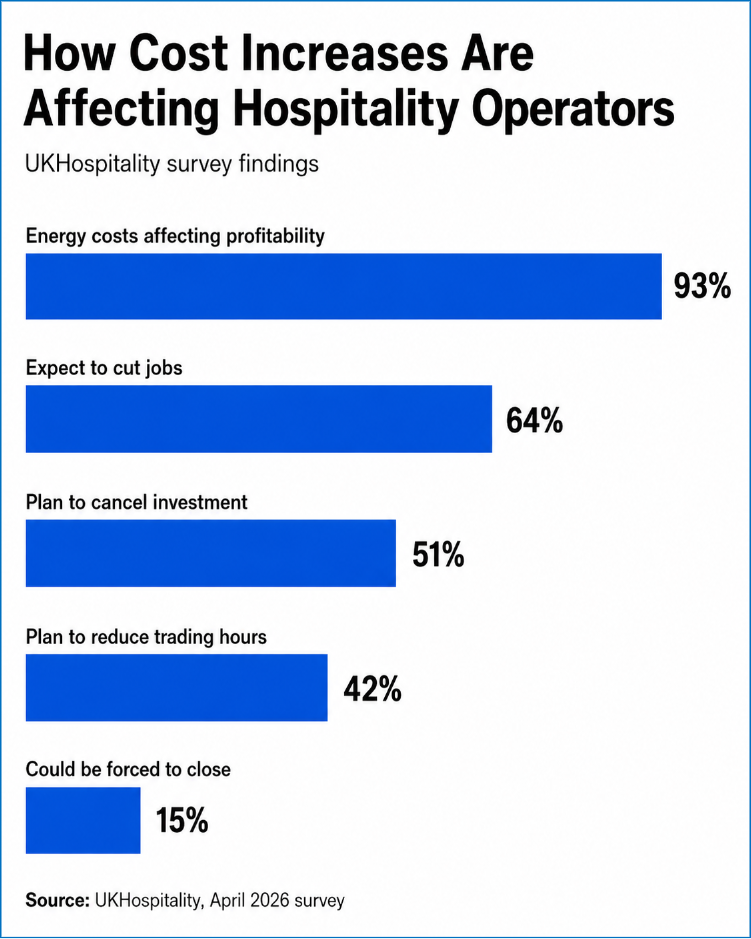
The pressure is already showing up in operator decisions. UKHospitality’s April 2026 member survey found that, as a direct result of cost increases, 64% of businesses expected to cut jobs, 51% planned to cancel investment, and 42% planned to reduce trading hours. The same survey found that 93% of businesses said energy costs were affecting profitability.
This is why the managed hospitality sector UK needs to separate top-line growth from actual trading quality. A business can become larger, busier, and more complex without becoming more resilient.
For hospitality leaders, March was not simply a recovery signal. It was a margin-quality signal. The question is not whether sales grew, but whether growth came from stronger existing-site economics or from adding more pressure to the operating model.
Explore how stronger back-office support can help hospitality teams spot revenue gaps, reduce reporting delays, and improve financial control after close.
When growth sits below the real cost of running the business, the P&L can look busy without becoming stronger. That is the uncomfortable part of the new UK hospitality reality. A venue may be serving more guests, taking more bookings, and keeping teams stretched across longer trading hours, but if the cost base is moving faster than revenue, the business is only working harder to stand still.
This is why small like-for-like growth needs careful reading. For operators, the question is not just, “Did sales go up?” It is, “Did sales grow enough to protect margin after wages, food, energy, rates, and supplier costs moved?”
That distinction now matters more than ever. UK Hospitality said the 2026 wage increases alone represent £1.4 billion in additional cost for hospitality businesses, with the National Living Wage rising to £12.71 from April 2026. At the same time, its April 2026 survey found that 93% of hospitality businesses said energy costs were affecting profitability.
So, yes, a site can look lively. But underneath that, the margin may be thinning out quietly.
If sales growth is lower than the cost increases sitting underneath the business, it is not really progress. It may still mean more shifts to fill, more stock to buy, more tables to turn, more rooms to service, and more pressure on site managers.
That is where hospitality revenue versus operating costs becomes a better measure than revenue alone. A restaurant, pub, or hotel can grow sales and still lose ground if every pound of revenue is carrying more cost than it did last year.
For CFOs, this changes the way performance needs to be read. The sharper questions are:
This is also where labour cost visibility becomes essential. Without it, operators may see the sales uplift first and the margin damage later.
Food costs still matter, but they are no longer the whole story. The pressure now sits across several lines of the P&L at the same time.
The Foodservice Price Index February 2026 recorded a small 0.2% month-on-month decline in food and drink prices, taking the index to 152.6. That sounds like relief, but NIQ also described it as short-term easing after the “intense inflationary spikes of late 2025.”
That is important because easing does not mean operators get their lost margin back. A small drop in one month does not automatically reverse higher supplier prices, menu engineering pressure, waste, labour intensity, or energy costs.
For hospitality leaders, food and energy cost inflation now needs to be seen as part of a bigger cost stack. The real pressure is coming from several places at once:
This is why hospitality cost management strategies need to move beyond “watch food cost” or “tighten rotas”. The more useful view is how each cost line behaves at site level and how quickly managers can act when something starts drifting.
Headline inflation is useful context, but it does not show what a hospitality operator actually feels. A multi-site restaurant, pub, hotel, or venue group has a very different cost basket from the average consumer.
Hospitality carries heavier exposure to labour, food, energy, property, waste, repairs, supplier movement, and trading-hour complexity. That means the pressure inside the business can be sharper than the national inflation number suggests.
Business rates are a good example. From 1 April 2026, hospitality will have two lower RHL multipliers, but UKHospitality also notes that properties with a rateable value above £500,000 will face a 50.8p high-value multiplier, meaning larger premises will pay more than the standard multiplier. It also warns that any benefit from a lower multiplier could be cancelled out by large increases in rateable value.
For C-suite leaders, that is the key point. The problem is not one cost line. It is the combined effect of many cost lines moving at once, and not always evenly across the estate.
This is where site level profitability analysis becomes more useful than broad group-level reporting. A flagship city-centre site, a regional pub, a hotel restaurant, and a high-volume casual dining venue may all feel inflation differently. If the finance view is too broad, those differences stay hidden for too long.
Also Read: Accounting for the Hospitality Industry: What UK Businesses Need to Know?
A busy venue can still be a thin-margin venue. That is the part many operators are now having to sit with.
For years, strong footfall gave hospitality leaders a certain level of comfort. If the floor was full, the tills were moving, and the team was rushed off its feet, the site usually felt healthy. But in the current UK hospitality industry, volume has become a more complicated signal.
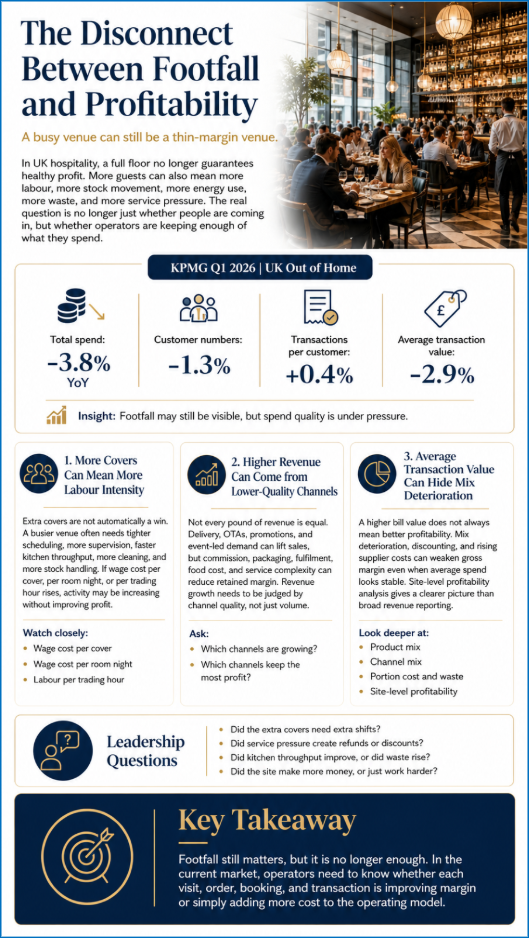
More guests can mean more revenue, but it can also mean more labour, more stock movement, more energy use, more waste, more service pressure, and more operational drag. So the question is no longer just, “Are people coming in?” It is, “Are we keeping enough of what they spend?”
KPMG’s Q1 2026 UK consumer spending data gives a useful clue here. Its “Out of Home” category, covering restaurants and bars, had a difficult quarter, with total spend down 3.8% year-on-year. The same chart showed customer numbers down 1.3%, average transactions per customer up 0.4%, and average transaction value down 2.9%. In plain terms: some people may still be visiting, but spend quality is under pressure.
More covers are not automatically a win if they come with heavier labour requirements. A busier restaurant, pub, bar, or hotel F&B outlet needs more than just people through the door. It needs tighter scheduling, more supervision, faster kitchen throughput, more cleaning, more stock handling, and quicker recovery when service starts to stretch.
This is where labour cost visibility becomes so important. If a site is measuring labour only as a percentage of sales, it may miss what is really happening underneath. A venue can be busier, but if wage cost per cover, per room night, or per trading hour is rising, the extra activity may not be improving profit.
For leadership teams, the useful questions are simple. Did:
This is where hospitality financial performance metrics need to move beyond sales and footfall. A full dining room looks good, but margin is made in the gap between what the guest spends and what the site spends to serve them.
Not every pound of revenue is equal. That is one of the biggest shifts in restaurant and pub operations right now.
A site may lift sales through delivery, third-party booking platforms, OTA-led hotel demand, promotions, event-led trading, or discount-led campaigns. On the surface, that can make the revenue line look stronger. But once commissions, packaging, fulfilment, labour, food cost, wastage, and service complexity are added back in, the retained margin may look very different.
This is especially important in a market where guests are more value-conscious. KPMG noted that aggregator platforms continued to see mixed results, while value-focused fast-food chains performed better. It also said consumers appeared to trade down, with fast food, cafés, and budget restaurants among the best-performing sub-categories.
That tells us something important about hospitality margin pressure. The guest has not disappeared, but the guest may be spending differently. For operators, that means revenue growth needs to be judged by channel quality, not just by volume.
A simple example: a hotel may fill rooms through an OTA, but the commission cost can reduce the value of that booking. A restaurant may grow delivery orders, but if packaging, platform fees, food cost, and kitchen labour rise at the same time, the order may be less profitable than a dine-in cover.
A higher bill value does not always mean better profitability. Sometimes it only means prices have moved up while the product mix has moved down.
That is why average transaction value needs to be read carefully. A pub might see a stable average spend, but if more of that spend is coming from lower-margin items, discount-led offers, or promotions, restaurant and pub profitability UK can still weaken. A restaurant may increase menu prices, but if supplier costs rise faster, the gross margin may not improve.
KPMG’s report makes this point indirectly. It said Out of Home spend shrank in Q1 2026, and that growth in the previous quarter had been driven by average transaction value, “but not this quarter,” which could indicate that consumers were unwilling or unable to absorb further price increases.
That is a sharp signal for operators. If customers are becoming less willing to absorb price increases, businesses cannot rely only on menu pricing to defend hospitality profit margins. They need a better view of product mix, channel mix, portion cost, waste, discounting, and labour intensity at site level.
This is where site level profitability analysis becomes much more useful than broad revenue reporting. The real story sits inside the detail. Which:
For hospitality leaders, the busy venue illusion is now one of the biggest commercial risks. The question is not, “Are people coming in?” It is, “Which guests, through which channels, buying which products, at what labour and cost-to-serve?”
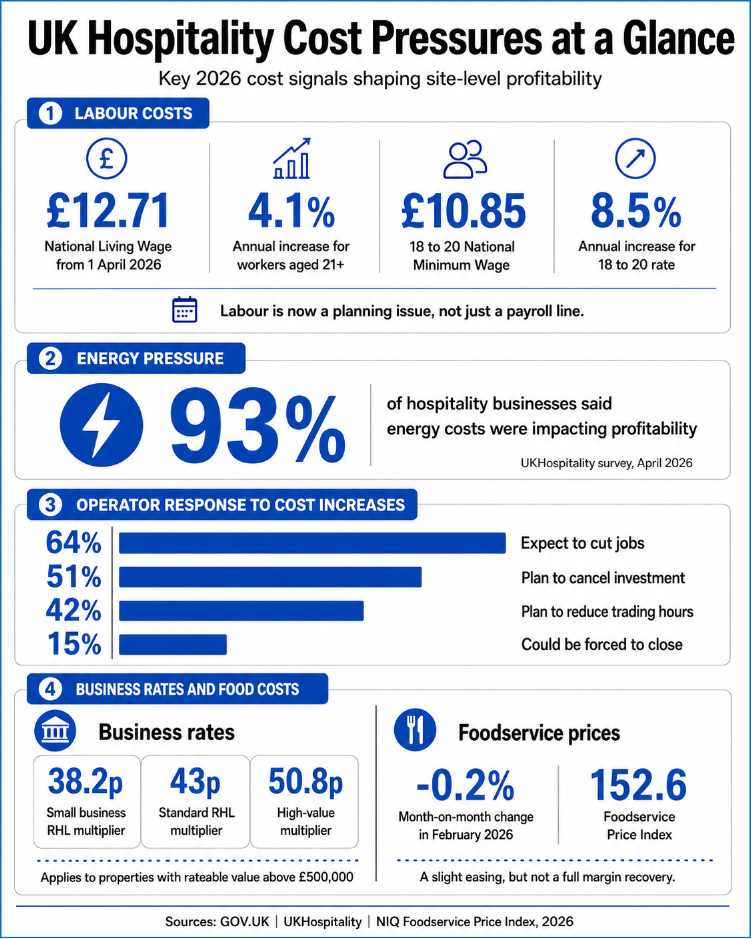
The pressure on hospitality is no longer coming from one cost line. It is labour, energy, rates, food, supplier terms, repairs, and operating complexity moving together.
That is why UK hospitality operating costs need to be viewed as a connected cost stack, not as separate budget lines. A site may have a strong trading week, but if several cost lines move at once, the margin impact can appear long before month-end reporting catches up.
For leadership teams, the key question is not simply, “Are costs rising?” It is, “Which sites are most exposed, and where is the pressure already affecting profitability?”
Labour should not be treated only as a cost to reduce. In hospitality, people directly shape service quality, guest experience, kitchen flow, table turns, housekeeping, and recovery when something goes wrong.
From 1 April 2026, GOV.UK confirmed that the National Living Wage rose by 4.1% to £12.71 per hour for eligible workers aged 21 and over. The National Minimum Wage for 18 to 20-year-olds also increased by 8.5% to £10.85 per hour.
The issue is not that operators need tighter rotas. It is that they need better labour modelling. Finance, operations, and site managers need to work from the same demand forecast, so staffing decisions are linked to covers, room nights, trading hours, service levels, and expected revenue.
Without proper labour cost visibility, a site can look efficient on payroll percentage but still lose margin through poor service, slower table turns, refunds, overtime, or agency reliance.
Energy can no longer sit quietly in the background as a fixed cost reviewed after month end. For many operators, it now behaves more like a live operating cost.
UK Hospitality’s April 2026 survey found that 93% of businesses said energy costs were impacting profitability. That matters because kitchens, refrigeration, heating, cooling, laundry, lighting, and extended trading hours all affect site-level costs differently.
The question for operators is no longer, “Has the energy bill gone up?”
It is:
This is where food and energy cost inflation needs to be part of operational reporting, not just a finance explanation after the close.
Business rates are another area where the impact will not be even across operators or sites.
From 1 April 2026, UK Hospitality notes that two lower hospitality multipliers apply: the small business RHL multiplier at 38.2p and the standard RHL multiplier at 43p. However, this is funded by a 50.8p high-value multiplier for properties with a rateable value above £500,000.
For multi-site operators, this creates an important distinction. A flagship city-centre site, a large hotel, a regional pub, and a suburban restaurant may all sit within the same estate, but the rates pressure will not land in the same way.
That is why site level profitability analysis matters. Stronger sites can easily mask weaker ones if business rates are only reviewed at group level.
Food and drink costs may be showing some signs of easing, but that does not mean lost margin returns automatically.
NIQ’s Foodservice Price Index reported a 0.2% month-on-month decline in February 2026, bringing the index to 152.6. NIQ described this as short-term relief after the sharp inflation spikes seen in late 2025.
That distinction matters. A small monthly easing does not undo months of higher supplier pricing, menu pressure, waste, portion changes, or customer resistance to price increases.
For operators, the useful question is not just whether food cost is up or down. It is which:
This is where hospitality cost management strategies need to become more detailed and site-specific.
Take a closer look at the numbers shaping UK hospitality in 2026, and what they could mean for operators, finance teams, and future planning.
A group-level P&L can tell leadership that the business is holding up. It cannot always tell them where the margin is quietly slipping away.
That is the real problem for multi-site hospitality operators. One strong flagship site can cover the weakness of three smaller venues. A hotel may show stable revenue while its F&B outlet is losing margin. A pub group may look steady overall, even though some locations are carrying heavier labour costs, higher energy usage, or weaker product mix.
In the new UK hospitality reality, the best operators will not simply report margin more accurately. They will see margin risk earlier.
Group numbers are useful, but they can be dangerously comforting. They smooth out the detail.
A multi-site operator may see stable revenue across the estate, but individual sites may be dealing with very different pressures. One location may be heavily exposed to delivery commissions. Another may have a tougher rent profile. Another may be losing margin through agency labour, energy consumption, or supplier pricing.
That is why site level profitability analysis is becoming so important. It helps leadership teams move from, “The estate is broadly fine,” to, “These specific sites need attention now.”
For CFOs and operators, the questions become sharper:
Looking at revenue and wage cost alone is no longer enough. Hospitality margins are shaped by too many moving parts.
A stronger site-level view should connect:
This is where hospitality financial performance metrics need to become more operational. They should not only explain what happened last month. They should help site teams understand what is happening while they can still act.
For example, if a restaurant is growing delivery sales but losing more through platform fees, packaging, kitchen pressure, and refunds, the issue may not appear clearly in headline revenue. If a hotel is improving occupancy but relying more heavily on OTA bookings, room revenue may grow while retained margin weakens.
The detail matters because margin is no longer lost in one obvious place. It is often lost in small amounts across labour, energy, waste, discounts, channel costs, and supplier movement.
Month-end reporting is still necessary, but it is not enough for the current market. By the time the pack shows margin erosion, the rota has already been worked, the stock has already been used, the discounts have already been applied, and the trading window has already closed.
That delay matters. Hospitality is a fast-moving business, but finance visibility often arrives after the operational decisions have already been made.
C-suite leaders now need rolling visibility into margin leakage during the trading period, not only after the accounts are closed. This does not mean drowning teams in dashboards. It means giving finance, operations, and site managers a shared view of the few numbers that actually change decisions.
The strongest operators will be the ones that can spot the issue early:
That is where better reporting, stronger processes, and more consistent hospitality accounting services can make a difference. Not by adding more complexity, but by helping leadership teams see the right numbers sooner.
Revenue growth can look reassuring, but it does not always mean the business is becoming more profitable. In today’s market, the real question is not just how much revenue a site generates, but where that revenue comes from and how much margin it leaves behind.
That is why channel mix has become an underused lever in protecting hospitality profit margins. Two venues may show similar sales growth, but one may be growing through direct, higher-margin trade while the other relies more on commission-heavy, labour-intensive, or discount-led channels.
Not every sale carries the same cost-to-serve.
For restaurants and pubs, dine-in, delivery, click-and-collect, private events, corporate bookings, third-party platforms, and promotions all affect margin differently.
For hotels, direct bookings, OTAs, corporate travel, groups, events, F&B, extended stay, and ancillary income each bring a different commercial profile.
A direct booking is not the same as an OTA-led room night. A dine-in cover is not the same as a delivery order. This is where hospitality revenue versus operating costs becomes more useful than revenue alone.
A site can grow revenue and still weaken profitability if lower-margin channels take up a larger share of the mix.
Delivery may add sales, but it can also bring platform fees, packaging costs, kitchen pressure, refunds, and less control over guest experience. OTA-led bookings may lift hotel occupancy, but commission costs can reduce retained margin. Promotions may protect footfall, but they can also pull customers towards discounts.
For restaurant and pub profitability UK, this means revenue growth needs to be judged by quality, not just volume. Growth only matters if it improves contribution after labour, commission, wastage, fulfilment, and service costs are considered.
Finance teams should not only ask:
Which channel grew?
They should ask:
Which channel produced profitable growth after labour, commission, wastage, fulfilment cost, and service complexity?
PwC’s UK Hotels Forecast 2025 to 2026 makes a similar point for hotel operators, noting that hotels need to rethink product flexibility, use underutilised spaces better, explore extended-stay or hybrid accommodation models, and strengthen ancillary income streams to build resilience.
That thinking applies beyond hotels. Restaurants, pubs, bars, and wider hospitality operators need the same discipline around revenue quality.
Also Read: Accounting for the Hospitality Industry: Why Standard Finance Models Don’t Work?
In a thinner-margin environment, leadership teams do not need more reports for the sake of reporting. They need better questions.
The old review rhythm of “sales up, wage percentage stable, food cost within range” is no longer enough. The pressure is now more layered. Costs are moving at different speeds across sites, customer behaviour is less predictable, and revenue growth does not always mean stronger contribution.
For C-suite leaders, the real value is in asking questions that reveal where margin is being protected, where it is being diluted, and where the business is finding out too late.
Labour is one of the biggest moving parts in hospitality, but it cannot be viewed only as a percentage of sales. That view is useful, but it is too narrow on its own.
The sharper questions are:
This is where labour cost visibility becomes essential. A site can look efficient on payroll percentage but still lose margin if service slows, complaints rise, or table turns weaken.
Food and beverage costs can look controlled at group level while problems build quietly inside categories, suppliers, menus, and sites.
C-suite leaders should be asking:
This is especially important when food and energy cost inflation keeps shifting. Operators need to know not just whether food cost is up, but where it is moving, why it is moving, and whether pricing, portioning, or procurement needs to change.
Energy can no longer sit in the background as a cost that gets explained after month end. It now needs to be visible enough for site teams to act during the trading period.
The questions should be practical:
For multi-site operators, energy visibility is not just a finance issue. It is part of hospitality cost management strategies, especially when usage patterns differ widely across restaurants, pubs, hotels, and late-night venues.
Revenue mix is now one of the clearest tests of margin quality. A growing channel is not always a profitable channel.
Leadership teams should be asking:
This matters because hospitality revenue versus operating costs can look very different by channel. A direct booking, delivery order, private event, OTA room night, or discounted offer may all lift revenue, but each leaves a different level of margin behind.
The biggest question is whether finance is still explaining the past, or helping the business act sooner.
CFOs and leadership teams should be asking:
This is where hospitality financial performance metrics need to become more operational. The goal is not to create more dashboards. It is to make the right numbers visible early enough to protect margin.
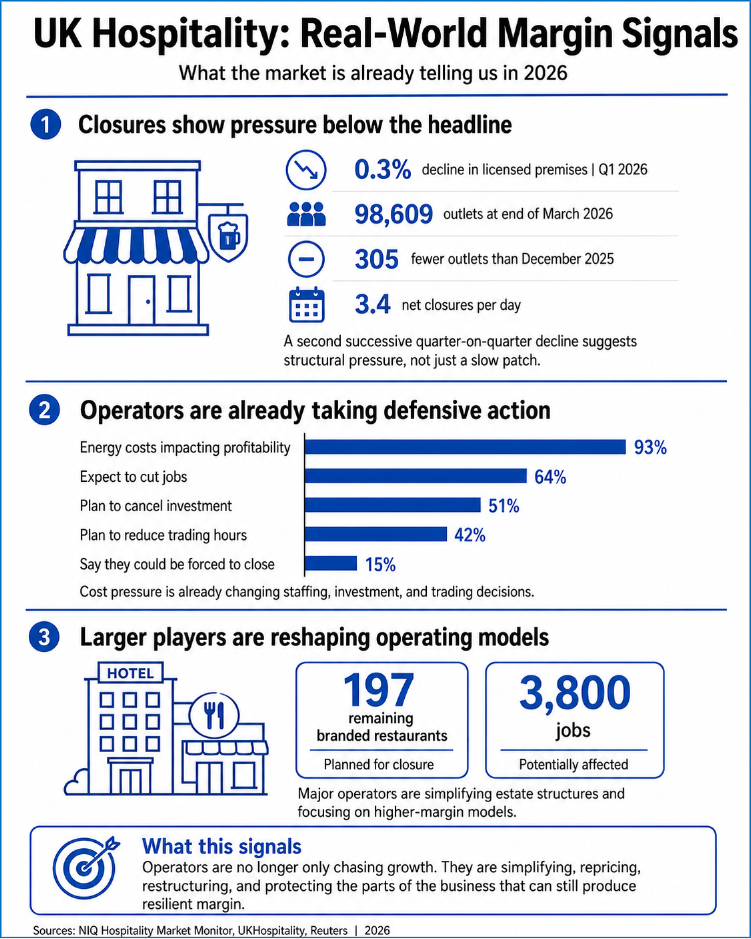
The signal from the market is clear: operators are no longer only chasing growth. They are simplifying, repricing, restructuring, and protecting the parts of the business that can still produce resilient margin.
This is not about reading too much into one company announcement or one quarter of closures. It is about recognising a wider shift in the UK hospitality industry. When costs rise faster than trading confidence, operators start making harder decisions around estate shape, staffing, investment, opening hours, and brand complexity.
For C-suite leaders, these are not isolated headlines. They are early signs of how hospitality margin pressure is changing operating models.
Closures are one of the clearest signs that pressure is sitting below the trading surface.
NIQ’s Hospitality Market Monitor, April 2026 reported that Britain’s number of licensed premises fell 0.3% in the first quarter of 2026. The report said there were 98,609 outlets at the end of March 2026, which was 305 fewer than in December 2025, equal to an average of 3.4 net closures per day. NIQ also noted that this was the second successive quarter-on-quarter decline.
That does not suggest a sector going through a short, temporary wobble. It suggests weaker operating models are being exposed more quickly, especially where sites are carrying high rent, labour, rates, energy, or supplier pressure.
The important point for leadership teams is not only that venues are closing. It is that margin weakness can sit inside the estate long before closure becomes the final outcome.
The cost pressure is already changing operating decisions.
UKHospitality’s April 2026 member survey found that, as a direct result of cost increases, 64% of businesses expected to cut jobs, 51% planned to cancel investment, and 42% planned to reduce trading hours. Around 15% said they would be forced to close. The same survey also found that 93% said energy costs were impacting profitability.
Those figures matter because they show finance pressure moving from the spreadsheet into day-to-day operations. This is not just a question of tighter budgeting. It is affecting staffing, capex, trading hours, and business continuity.
For operators, the uncomfortable question is:
Are these decisions being made with enough site-level visibility, or are they being made once the pressure has already become too obvious to ignore?
The pressure is not limited to smaller or independent operators. Larger groups are also rethinking estate structure, margin quality, and operating complexity.
Reuters reported on 30 April 2026 that Whitbread, the owner of Premier Inn, plans to shut its 197 remaining branded restaurants and sell more meals through its hotels, with the plan potentially affecting around 3,800 jobs. Reuters also reported that the strategy is designed to help Whitbread become a higher-margin, higher-returning pure-play hotel business.
This is a useful example because it is not simply a closure story. It shows how a major operator is trying to simplify its model, reduce complexity, and focus capital and management attention on the parts of the business it believes can produce stronger returns.
That is the wider lesson for the managed hospitality sector UK. In a thinner-margin market, operators are not only asking where they can grow. They are asking which parts of the business deserve capital, labour, and operational focus.
For UK hospitality leaders, the finance challenge is no longer just about closing the books faster. It is about whether finance can keep pace with the trading rhythm of the business.
A venue can have a strong week on paper and still lose margin through labour drift, supplier movement, energy usage, discounts, delivery commissions, or weak product mix. The issue is not always poor performance. Often, it is late visibility.
By the time the month-end pack lands, the decisions that shaped the margin have already been made.
Hospitality finance has traditionally been measured by accuracy, timeliness, and control. Those still matter. But in a thin-margin market, finance also needs to help the business see commercial leakage earlier.
The useful signals are often very practical:
This is where finance becomes more than a reporting function. It becomes part of the operating rhythm.
Most operators already have enough systems. EPOS, PMS, payroll, procurement, booking platforms, accounting software, and reporting dashboards are all there.
The problem is that the data often arrives in pieces.
Sales sit in one place. Labour in another. Supplier pricing somewhere else. Channel cost, refunds, discounts, wastage, and site-level profitability may only come together properly after the fact.
For leadership teams, that creates a blind spot. They may know the estate is busy, but not which sites are producing quality margin, which ones are being carried, and which ones need intervention now.
The advantage is not automation on its own. It is finance visibility that is joined up, timely, and close enough to the trading floor to be useful.
This is where outsourcing needs to be viewed differently. For C-suite leaders, the question is not, “Should we hand finance over?” It is, “Which finance processes are slowing our internal team down from focusing on performance?”
For some hospitality groups, the answer may be a more scalable finance model, where external support strengthens the repeatable parts of finance while internal teams stay firmly in control of governance, commercial judgement, and strategy.
That could include support across:
QX Global Group supports UK hospitality businesses with hospitality accounting services that help finance teams create cleaner processes, stronger reporting discipline, and better operational visibility.
The value is not in replacing internal control. It is in taking pressure off stretched teams so they can spend more time on margin, cash, performance, and decisions that move the business forward.
If your finance team is reviewing how to improve visibility, reporting accuracy, or site-level financial control across hospitality operations, you can connect with QX Global Group for a practical conversation around what stronger finance support could look like.
The UK hospitality sector is not short of activity. Restaurants are still bringing guests in, hotels are still finding selective demand, and many operators are still seeing growth in the right pockets.
But the margin environment has changed.
A busy venue now needs more than a strong trading week to prove it is commercially healthy. It needs sharper finance visibility, better labour planning, clearer channel economics, and faster site-level reporting.
The real issue is not lower demand. It is lower tolerance for poor visibility. When costs are moving quickly, channels are carrying different margins, and site-level performance is uneven, leadership teams cannot afford to wait for the month-end pack to confirm what the business may have already felt too late.
The winners in this next phase will not simply be the operators that grow sales. They will be the ones that know which:
That is the new UK hospitality reality. Busy is still good, but visible, controlled, and profitable is what will matter more.
Busy hospitality venues can still struggle with profitability when operating costs rise faster than revenue. Higher footfall often brings extra labour, stock, energy usage, waste, delivery costs, and service pressure.
In the UK, many venues are still seeing demand, but hospitality profit margins are being squeezed because each sale is carrying a heavier cost-to-serve.
Rising operating costs are forcing hospitality businesses to look beyond top-line sales and focus more closely on retained margin. Labour, food, energy, rent, rates, supplier pricing, and compliance costs are now affecting site-level profitability more sharply.
This means operators need stronger hospitality cost management strategies, better labour planning, and clearer visibility into which sites and channels are actually profitable.
Revenue growth is no longer enough because not all revenue is equally profitable. A venue may grow sales through delivery, discounting, OTA bookings, or promotions, but these channels often carry higher commissions, fulfilment costs, labour pressure, or lower retained margins.
Hospitality leaders now need to assess hospitality revenue versus operating costs, not just whether sales have increased.
The biggest margin pressures for restaurants and pubs include labour costs, food inflation, energy usage, supplier price changes, waste, discounting, delivery platform fees, and weaker product mix.
For restaurant and pub profitability UK, the challenge is not only getting customers through the door. It is understanding whether each cover, order, or booking is contributing enough after all site-level costs are included.
Hospitality finance leaders should respond by tracking cost movement at site level rather than relying only on group-level reporting. Different venues may face different pressures depending on labour patterns, rent, rates, supplier terms, energy use, and channel mix.
The priority should be stronger labour cost visibility, faster reporting, and more detailed site level profitability analysis so teams can act before margin pressure becomes a month-end surprise.
Financial data visibility helps hospitality leaders see where margin is being made, lost, or hidden across sites, channels, products, and cost lines. Without it, busy venues may look healthy even when profitability is weakening underneath.
Better visibility allows finance and operations teams to spot labour overspend, supplier variance, energy spikes, discounting impact, and channel margin issues early enough to respond.

Education:

Nishant Kumar is a senior commercial leader with 20+ years of experience supporting hospitality and accommodation businesses through technology-enabled outsourcing and operational transformation. At QX Global Group, he works with property owners, asset managers, and hospitality leaders across the UK and Europe to improve profitability, modernise back-office operations, and build scalable operating models. His expertise spans finance and accounting, payroll, and digital enablement for multi-property and franchise-led hospitality organisations, with a strong focus on cost optimisation, standardisation, and automation-led efficiencies.
Expertise: Hospitality and accommodation outsourcing, Multi-entity finance transformation, Shared services and global delivery models, Automation-led cost optimisation, Strategic commercial advisory
Originally published May 15, 2026 04:05:53, updated May 15 2026
Topics: Finance & Accounting, Hospitality Accounting
22 Jul 2026
Most cash flow problems do not begin when an invoice becomes overdue. They begin much earlier, throu...
Read More22 Jul 2026
From the top, accounts payable usually looks like one of the easier to manage parts of finance. Invo...
Read More21 Jul 2026
Most finance leaders know their biggest customers inside out. They know which products are performin...
Read More21 Jul 2026
A company can hit its revenue target and still weaken EBITDA. That sounds counterintuitive until you...
Read More