Topics: Finance and Accounting Transformation, Hospitality Accounting
Posted on April 23, 2026
Written By Nishant Kumar




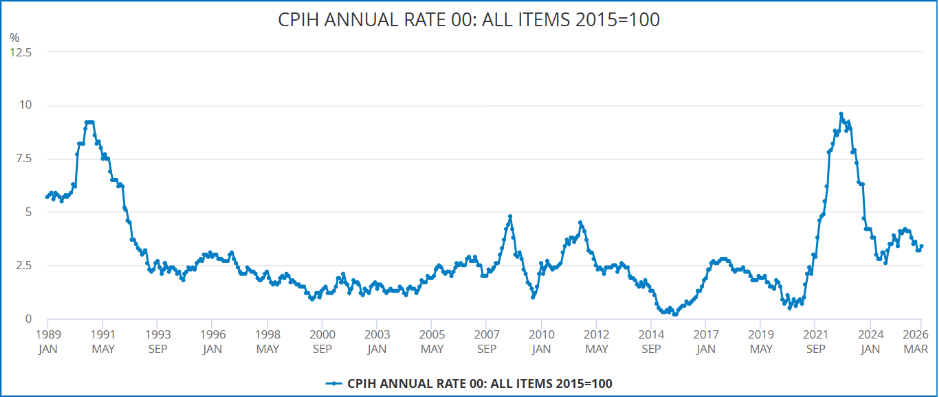
Margins in UK hospitality are under sustained pressure. According to the Office for National Statistics, input cost inflation across sectors, particularly driven by energy and labour, has remained a persistent concern for businesses.
But here’s where it gets interesting.
If revenue visibility has improved… why hasn’t financial clarity followed?
Most finance functions are still built on models designed for predictability. Linear revenue. Period-end adjustments. Clean data flows. Hospitality rarely offers any of that. Instead, it runs on constant movement, where performance shifts daily and decisions need to keep pace.
A single day can include:
Finance teams are left piecing together performance after it has already moved on.
That is the real tension. What appears to be a margin problem is often a visibility lag. And what looks like operational inefficiency is, in many cases, a finance model that was never designed for this level of complexity.
This blog explores why standard finance models fall short in hospitality and what a more reality-aligned approach needs to look like.
Most sectors can afford to let finance look backwards for a few weeks. Hospitality cannot.
That is the first distinction worth making. Accounting for hospitality industry is not simply about recording income and costs for period-end reporting. It is about translating fast-moving trading activity into numbers that leadership can actually trust, often while the business is still trading. In other words, the real job of hospitality industry finance is not just compliance. It is commercial interpretation at speed.
And that is exactly why standard finance models tend to fall short here. They assume stability. Hospitality runs on movement.
At a surface level, it is the management of financial operations for hotels, restaurants, pubs, serviced apartments, and wider leisure businesses. But that definition is too flat to be useful.
In practice, accounting for hotels and restaurants is about managing a business where the trading day itself creates accounting complexity. Revenue does not arrive neatly through one channel. Costs do not behave uniformly across sites. And operational decisions made at noon can distort the financial picture by evening if the underlying controls are weak.
That is why the best finance leaders do not treat hospitality accounting as a back-office discipline. They treat it as an operating system.
A few realities make this different:
So yes, this is bookkeeping. But not only bookkeeping.
It is also:
A hotel group may appear to be growing because top-line room revenue is up. But if the mix has shifted towards higher-cost booking channels, labour is running ahead of occupancy, and F&B margins are softening, the finance picture is telling a very different story. That is where hospitality accounting becomes strategic.
Hospitality finance looks straightforward from a distance. Up close, it is full of moving parts.
Many businesses in this sector process hundreds or thousands of low-to-mid value transactions every day. That sounds manageable until you consider refunds, voids, split payments, discounts, no-shows, deposits, third-party commissions, service charges, and VAT treatment across categories.
This is not just volume. It is high volume transaction processing with layered operational meaning.
In many sectors, finance can afford to wait for the month-end story. Hospitality cannot. A delay of even a few days can hide leakage, distort site performance, or weaken cash visibility.
That is why daily revenue reconciliation matters so much. It is not merely an accounting control. It is an early warning mechanism.
If yesterday’s revenue cannot be reconciled cleanly today, what confidence should anyone have in the month-end number?
This is where many generic explanations stop too early. Yes, hospitality has rooms, F&B, events, ancillaries, memberships, late check-outs, spa income, and more. But the real issue is not the number of streams. It is that each stream behaves differently.
Some are seasonal, some commission-heavy, some labour-intensive, and others offer stronger margins but less predictability. That makes multi revenue stream accounting far more than a coding exercise. It affects forecasting quality, pricing decisions, and departmental accountability.
Hospitality does not just deal with seasonality. It deals with intra-week volatility, event-led surges, weather impact, staffing fluctuations, and demand swings by site, segment, and channel.
This is where hotel accounting systems and broader finance design either support the business or slow it down. If systems cannot capture operational nuance quickly enough, finance ends up smoothing over volatility instead of explaining it.
And once volatility gets smoothed, decision-making becomes slower and less precise. That is expensive.
If you’re looking to understand how these financial pressures are shaping the sector more broadly, this data-led outlook offers a useful perspective on where UK hospitality is heading next.
Because hospitality is not simply selling a product. It is monetising capacity, service, timing, and experience all at once.
That creates a very particular kind of hospitality financial reporting complexity. Finance is expected to report accurately on a business where the commercial reality shifts daily, the data often sits across disconnected platforms, and the margin story is shaped as much by operations as by accounting policy.
A manufacturer may ask, “What did we sell this month?” A hospitality CFO is often asking something more difficult:
Standard finance models are built for businesses where activity is relatively predictable, reporting cycles are fixed, and operational disruption is limited. They are designed to bring order, consistency, and control to financial management, which is exactly why they work so well in many sectors.
The problem is not that these models are wrong. The problem is that they assume the business behaves in a fairly orderly way. Hospitality rarely does.
Traditional or standard finance models are typically built around three assumptions.
1. Periodic reporting cycles: Performance is reviewed in weekly, monthly, or quarterly intervals, with finance largely focused on closing the period accurately and explaining variance afterwards. That works well when the business does not change materially from one day to the next.
2. Stable revenue assumptions: These models assume revenue flows are reasonably consistent, easy to classify, and not constantly shifting by channel, format, or customer behaviour. In other words, finance expects the commercial engine to be fairly linear.
3. Limited operational variability: They also work best where cost drivers are easier to predict, transaction volumes are manageable, and operations do not change shape every day. Finance can therefore focus more on control and less on constant interpretation.
That sounds sensible. In the right environment, it is.
Traditional finance structures tend to perform strongly in sectors where the operating model is more stable and less dependent on real-time trading visibility.
1. Manufacturing: Production cycles are usually planned in advance, revenue recognition is more structured, and margins can be tracked against clearer input-output relationships. Variability exists, of course, but it is often easier to isolate.
2. Professional services: Revenue tends to be linked to contracts, retainers, project milestones, or billable hours. Transaction volumes are lower, and the financial story is usually easier to follow without constant daily reconciliation.
3. Low-volume transaction industries: Businesses with fewer transactions and less fragmented revenue channels can rely comfortably on periodic reporting. Finance does not need to reconstruct performance every day because the underlying activity is already more visible and controlled.
That is where standard models earn their reputation. They are efficient, disciplined, and reliable in environments built around predictability.
But hospitality is not built that way. And that is where the tension begins.
The problem with standard finance models is not that they lack discipline. It is that they were built for businesses where the commercial pattern is easier to follow. Hospitality is different. Revenue shifts by channel, by site, by daypart, and sometimes by the hour. Costs move with occupancy, covers, staffing, events, and seasonality. By the time a traditional model has produced a clean monthly view, the business has often already changed shape.
That is why many finance teams in hospitality are not struggling with reporting alone. They are struggling with timing, visibility, and fit.
Most traditional finance structures assume revenue behaves in a fairly linear way. Hospitality revenue does not.
Rooms, F&B, events, spa, memberships, third-party delivery, cancellation fees, packages, and ancillary services all sit within the same business, but they do not behave the same way. They carry different margins, different operational dependencies, and often different recognition challenges. This makes multi revenue stream accounting far more demanding than a standard chart-of-accounts approach can handle.
A property may post strong total revenue for the month, yet still underperform commercially because the mix has shifted towards lower-margin channels. That nuance often disappears inside generic reporting structures. And once that happens, finance stops guiding the business and starts merely summarising it.
Hospitality does not just generate revenue quickly. It generates financial noise quickly.
A typical operation may process refunds, split bills, voids, deposits, service charges, no-shows, discounts, commissions, and payment adjustments all within the same day. This is where high volume transaction processing becomes a structural finance issue, not just an admin burden.
Traditional finance models tend to work best when transaction environments are relatively controlled and exceptions are limited. Hospitality is the opposite. Exceptions are part of daily trade. So when finance teams rely on models designed for lower-volume industries, they spend too much time cleaning and reworking data, and not enough time interpreting performance.
Hospitality rarely has the luxury of waiting until month-end to understand what is going wrong.
A weak weekend, an overstaffed rota, a drop in spend per cover, or a spike in OTA dependency can all affect profitability long before the formal close process catches up. Yet many legacy finance structures are still built around periodic reporting cycles, where insight arrives after the operating window has passed.
That delay is costly. It means finance often explains margin erosion after it has happened, rather than helping the business respond while it is still manageable. In a sector shaped by daily movement, reporting that arrives too late is not just slow. It is strategically limiting.
This is one of the most overlooked weak spots in hospitality finance.
In many industries, reconciliation is largely a control activity. In hospitality, daily revenue reconciliation is also a source of commercial intelligence. It tells leadership whether the numbers coming through from operations, systems, and sites can actually be trusted.
When reconciliation is slow or manual, several problems follow:
And here is the real issue: once reconciliation slips, confidence in the wider finance picture slips with it. A board pack may still look polished, but the underlying data can already be compromised.
Many finance models fail in hospitality simply because they sit too far away from the way the business actually trades.
Hotels and restaurants rely on PMS, POS, payroll, booking engines, procurement tools, and a growing mix of operational platforms. If finance is not well integrated with those systems, data has to be extracted, adjusted, mapped, and interpreted manually. That creates lag, inconsistency, and unnecessary exposure.
This is where hotel accounting systems and wider finance infrastructure matter far more than many businesses initially expect. Good systems do not just automate reporting. They help finance stay connected to live operations. Poor integration does the opposite. It turns finance into a reconstruction exercise.
That challenge is especially visible in accounting for hotels and restaurants, where operational data changes rapidly and departmental performance needs to be understood in context, not just in totals.
Hospitality finance rarely breaks because leaders do not know their numbers. It breaks because the operating environment moves faster than the reporting model. That is the real tension. For finance teams, the issue is not just complexity on paper. It is complexity in motion: cash, occupancy, pricing, labour, channels, and exceptions all shifting at once.
In hospitality, yesterday’s numbers matter today. If revenue is not reconciled quickly, leadership is forced to make trading decisions on partial information. That is why daily revenue reconciliation is not a routine control task. It is a visibility discipline.
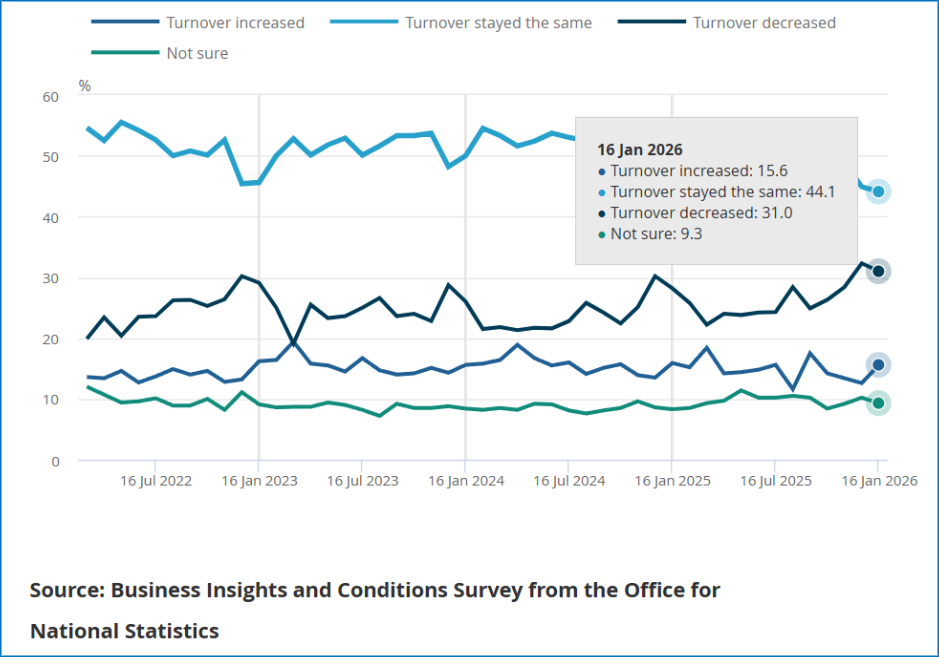
The volatility is real. In the ONS Business Insights release for 19 February 2026, the accommodation and food service sector had the highest proportion of businesses reporting a monthly turnover decline, at 52%, even when businesses were asked to compare January 2026 with December 2025 excluding seasonal trading. That is a useful reminder that finance volatility in hospitality is not always just “the season”. Sometimes it is the trading model itself.
Multi-site hospitality reporting often looks neat in a board pack and messy in reality. One region can be lifting occupancy and rate, while another is softening at exactly the same moment. Aggregated reporting hides that very quickly.
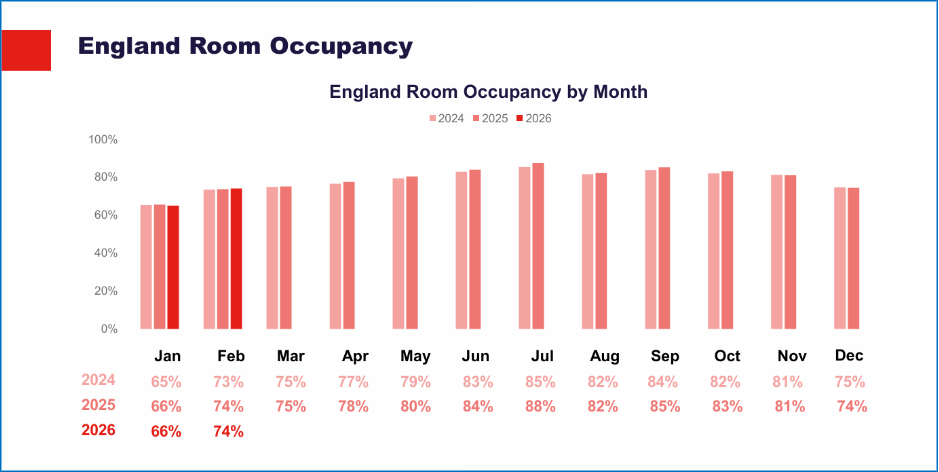
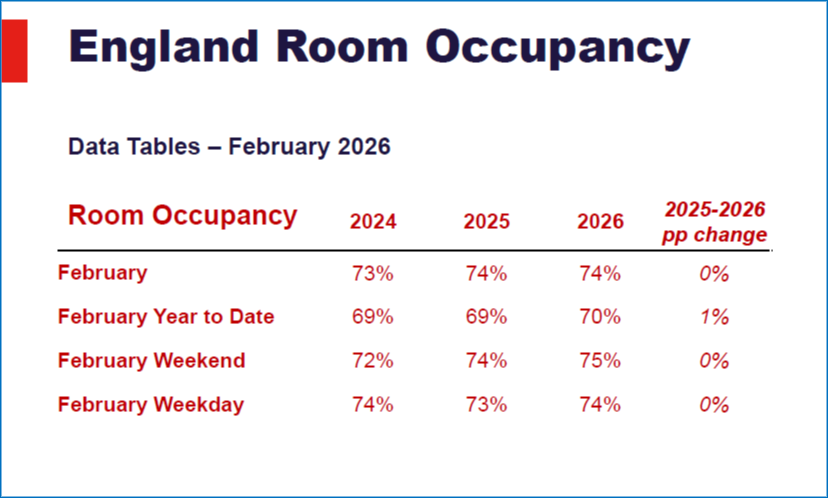
VisitBritain’s latest England hotel occupancy release shows this clearly. For February 2026, room occupancy was 74%, ADR reached £140, and RevPAR hit £104. But the regional pattern was uneven: the South West and North West recorded year-on-year occupancy gains, while the North East declined.
That is exactly why hospitality financial reporting complexity tends to increase with scale. More sites do not just mean more numbers. They mean more divergence behind the numbers.
Seasonality is only part of the story. Hospitality operators also have to deal with mid-week versus weekend swings, event-led demand spikes, staffing pressure, channel mix changes, and cost movements that do not rise or fall in sync with revenue.
That pressure is visible in sector data. UKHospitality reported that 95% of hospitality businesses had experienced increased wage costs, alongside higher food, insurance, and energy costs. For finance teams, that means even small misses in labour allocation, procurement control, or site-level reporting can have an outsized effect on margin. Put simply, when the cost base is moving this sharply, finance cannot afford to be slow or approximate.
This is the challenge that often gets underestimated. Revenue sits in one place, payroll in another, procurement elsewhere, and booking data somewhere else again. By the time finance pulls everything together, the business has already moved on.
The problem is not a lack of data. It is that too much of it sits across disconnected platforms, which makes hotel accounting systems and broader integration design critical. In practice, fragmented data slows close cycles, weakens comparability across sites, and makes it harder to spot leakage early enough to act on it.
Hospitality is one of the worst sectors in which to rely on “close enough”. High volumes, refunds, discounts, split tenders, commissions, and frequent exceptions create a constant risk of small errors compounding into reporting noise.
That matters even more when margin pressure is high. In the ONS release from 22 May 2025, 82% of accommodation and food service businesses reported at least one challenge impacting turnover, and 66% cited labour costs as the main challenge.
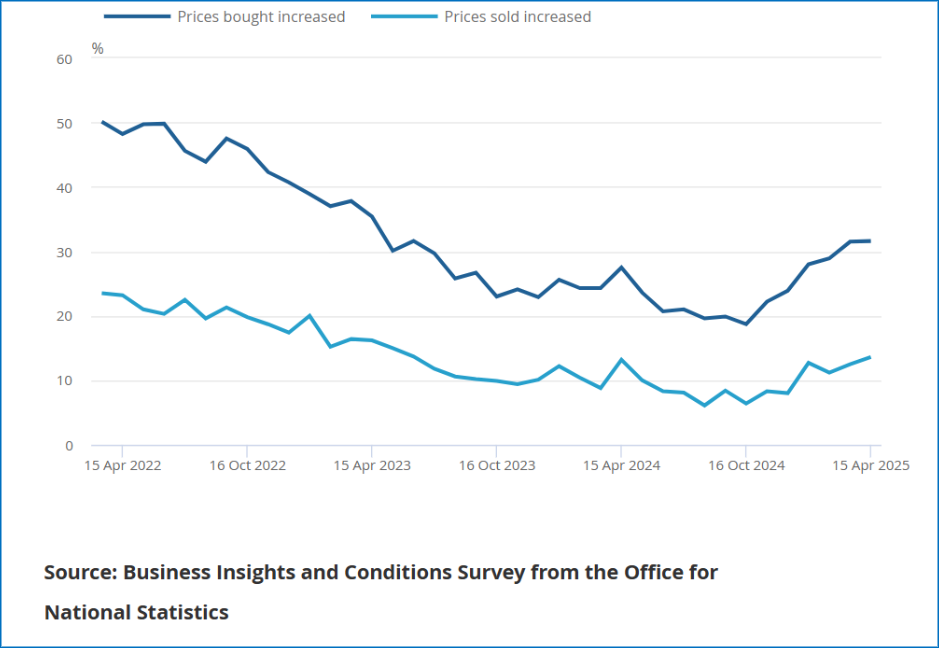
The same release also shows 60% of businesses in the sector reported increased prices for goods or services bought. In an environment like that, accuracy stops being a back-office concern. It becomes a commercial necessity.
If you’re exploring how finance needs to adapt in this sector, this piece offers a useful perspective on what UK businesses should be thinking about when it comes to hospitality accounting.
The smartest hospitality accounting services do not just “improve reporting”. They redesign how finance sees the business.
That matters because the sector’s real problem is not volume alone. It is timing, comparability, and signal quality. When the Office for National Statistics reported that the accommodation and food service sector had the highest share of businesses with turnover down month on month in January 2026, at 52%, it was also a reminder that hospitality moves quickly, even when seasonal effects are stripped out.
Most finance teams still treat daily revenue reconciliation as a matching exercise. The better model is to treat it as a risk filter.
That means specialised teams do not just ask, “Do the numbers tie?” They ask which:
This is where outsourced hospitality accounting can be more useful than many boards expect. Done properly, it creates a sharper daily close rhythm, one that flags trading risk early instead of burying it in the month-end pack.
Here is the trap: many groups think they have standardised reporting when they have merely standardised templates.
Real comparability is harder. It requires site-by-site numbers to be normalised for trading mix, channel mix, department structure, and local operating realities. Otherwise, one property looks “better” simply because revenue is being grouped differently.
That matters even more when regional performance diverges. VisitBritain’s latest England update reported 74% hotel occupancy for February 2026, with ADR at £140 and RevPAR at £104. But it also noted that some regions improved while others declined, with the North East down year on year.
That is why specialised hospitality financial reporting complexity is solved not by rolling everything up faster, but by creating a like-for-like reporting spine across the estate.
Seasonality is the easy explanation. The harder truth is that many margin swings are operational, not seasonal.
Good hospitality industry finance teams therefore build reporting around leading indicators, not just lagging ones. They connect labour deployment, covers, occupancy, booking channel mix, and department performance before the P&L fully lands.
Why does that matter? Because UKHospitality’s quarterly survey found that 95% of hospitality businesses had seen increased wage costs, alongside higher food, insurance, and energy costs.
When cost pressure is that broad-based, finance cannot afford to be descriptive. It has to be anticipatory.
This is the bit many operators underestimate.
The problem is rarely that data does not exist. It is that PMS, POS, payroll, procurement, booking, and banking data all sit in different places, using different logic. So finance spends too much time translating data instead of interpreting it.
Specialised support fixes this by building a finance-owned data layer across hotel accounting systems and adjacent platforms. Not glamorous. Very effective.
The practical gain is simple:
For accounting for hotels and restaurants, that is often where control starts to feel real.
In hospitality, accuracy does not come from checking everything equally. It comes from knowing what deserves attention.
The stronger model for high volume transaction processing is exception-led control. Finance rules are set to isolate anomalies such as unusual void patterns, deposit mismatches, commission variances, duplicate postings, or abnormal discounting. Teams then investigate the outliers, not every ordinary transaction.
That is a subtle shift, but an important one. It reduces noise, improves response time, and makes restaurant financial management and group reporting far more credible at board level.
For UK hospitality businesses, the finance challenge is rarely just volume. It is the combination of fragmented systems, fast-moving site-level activity, and reporting models that struggle to keep pace with trade. QX Global Group addresses that gap through specialised hospitality accounting services built around the realities of accounting for hotels and restaurants, not generic finance workflows.
Their approach is designed to help operators:
Rather than forcing hospitality businesses into standard finance models, QX Global Group applies structured delivery, sector-specific knowledge, and automation-led processes to reflect how the sector actually trades. The result is a more connected finance function, one that is better equipped to handle multi revenue stream accounting, reduce reporting friction, and support stronger decision-making across hospitality operations.
If these finance challenges sound familiar, you can book a consultation with QX Global Group to explore what a more hospitality-aligned finance model could look like for your business.
Multiple revenue streams make accounting for hospitality industry more complex because rooms, F&B, events, memberships, and ancillary services all behave differently. Each stream has its own margin profile, timing, and reporting needs, which is why multi revenue stream accounting is a core part of strong hospitality industry finance.
The main hospitality finance challenges include daily revenue reconciliation, fragmented data, seasonal demand shifts, and maintaining accuracy in high volume transaction processing. For businesses focused on accounting for hotels and restaurants, financial reporting often becomes harder as locations, systems, and revenue channels increase.
Hospitality businesses improve accuracy by standardising processes, reducing manual work, and integrating finance more closely with operational systems. Stronger hotel accounting systems, better controls, and faster reconciliation help reduce errors and improve visibility across UK hospitality business operations.
Hospitality businesses need specialised support because generic finance models do not reflect the pace and complexity of the sector. Hospitality accounting services are better suited to handle multi-site reporting, volatile trading patterns, and the reporting demands that come with accounting for hospitality industry.
High volumes do not automatically create accurate reporting. In hospitality, large transaction counts often mean more refunds, adjustments, commissions, split payments, and exceptions, which increase the risk of errors if controls are weak. That is why high volume transaction processing often leads to reporting issues when finance processes are still manual or fragmented.
Manual processes create delays, duplicate work, and missed exceptions, which makes it easier for small errors to turn into revenue leakage. In hospitality, weak manual controls can affect daily revenue reconciliation, reduce auditability, and limit visibility into what is really happening across sites and departments.
Outsourced hospitality accounting can improve efficiency by bringing in structured processes, sector-specific expertise, and better reporting discipline. It helps businesses reduce manual effort, strengthen controls, and build more scalable finance operations without losing visibility into performance.

Education:

Nishant Kumar is a senior commercial leader with 20+ years of experience supporting hospitality and accommodation businesses through technology-enabled outsourcing and operational transformation. At QX Global Group, he works with property owners, asset managers, and hospitality leaders across the UK and Europe to improve profitability, modernise back-office operations, and build scalable operating models. His expertise spans finance and accounting, payroll, and digital enablement for multi-property and franchise-led hospitality organisations, with a strong focus on cost optimisation, standardisation, and automation-led efficiencies.
Expertise: Hospitality and accommodation outsourcing, Multi-entity finance transformation, Shared services and global delivery models, Automation-led cost optimisation, Strategic commercial advisory
Originally published Apr 23, 2026 07:04:30, updated Apr 23 2026
Topics: Finance and Accounting Transformation, Hospitality Accounting
10 Sep 2026
Late March 2026. Boardrooms across UK hospitality did the same sum. Days before 1 April, the n...
Read More02 Sep 2026
Hospitality has become one of the most data-rich industries in the world. Every reservation, room sa...
Read More01 Sep 2026
For much of the year, operations run relatively predictably. Then leasing season arrives and the pre...
Read More21 Aug 2026
The 12th Revised Edition of USALI became mandatory on 1 January 2026, and six months on, a lot of po...
Read More