Topics: commercial real estate, Finance & Accounting, real estate
Posted on May 01, 2026
Written By Probhangshu Goswami



In many real estate businesses, real estate accounts receivable tends to stay in the background until something starts tightening elsewhere. Cash flow gets less predictable. Ageing starts getting uncomfortable. A few properties begin showing slower collections than expected. By the time finance steps in with urgency, the issue has usually been building for a while.
That is what makes AR risk easy to miss in real estate. It rarely arrives as one obvious problem. It builds through smaller points of friction — delayed tenant payments, disputed charges, billing inconsistencies, weak follow-up discipline, or cash that has been received but not applied cleanly. Together, they start weakening the reliability of the entire accounts receivable (AR) process.
The bigger issue is that this usually gets treated as a collections matter when it is really a finance issue. Once receivables stop converting into cash cleanly, the impact moves quickly into liquidity, forecasting, and overall working capital risk management. That is why accounts receivable in real estate industry deserves more attention than it often gets.
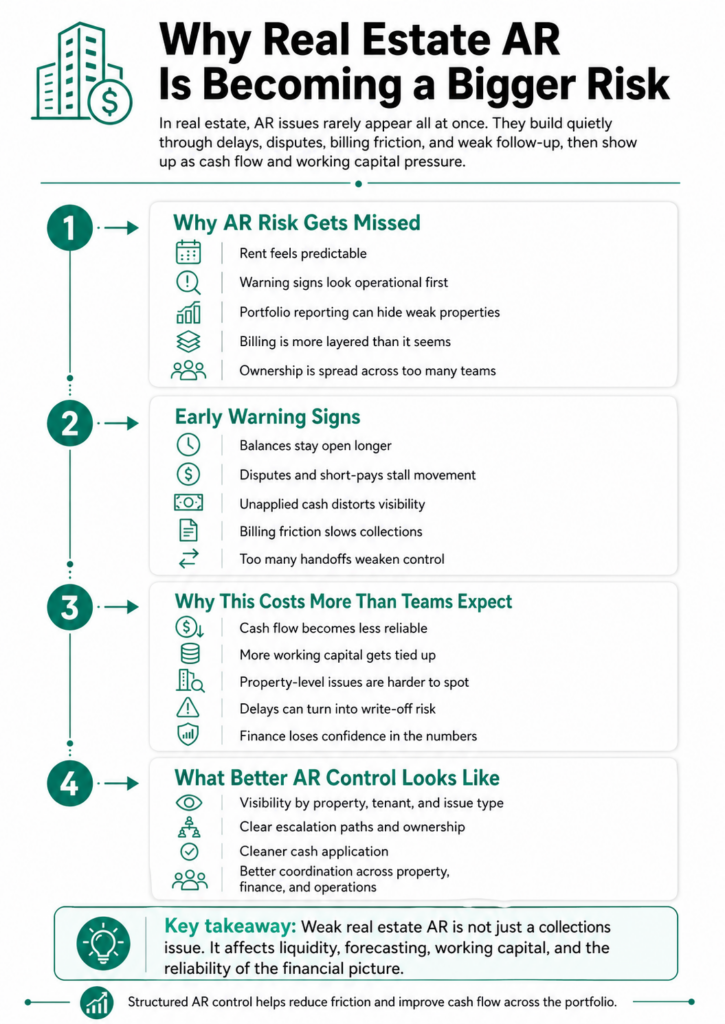
There are a few reasons AR risk gets underestimated in real estate, even in firms with experienced finance teams.
One of the biggest reasons is mindset. Lease-based income feels more stable than many other revenue streams, so receivables often get treated as lower-risk by default. The assumption is that if the tenant base is stable, the cash should follow.
That is not always how it plays out. Tenant payment delays, short-pays, deductions, and billing disputes can still create pressure inside the cycle, especially when they are not being escalated early enough.
Receivables issues often surface first as day-to-day noise. A payment is delayed. A charge is disputed. A recovery sits unresolved. A tenant account remains open longer than expected.
Because those problems usually sit close to leasing, operations, or property teams, they do not always get treated as part of a wider finance risk. By the time the issue shows up in ageing or cash flow, the underlying weakness has often been sitting in the background for months.
This is where things get more difficult. At portfolio level, the AR picture may still look manageable. Stronger-performing assets can offset weaker collections elsewhere, and the overall number can look more stable than the underlying position really is.
That makes it easier for accounts receivable ageing issues to build at the property level without getting enough attention early on.
Receivables in real estate are rarely just about monthly rent. There are recoveries, escalations, reconciliations, adjustments, concessions, and other charge-level complexities that can slow collections or create avoidable friction.
That is why lease billing complexity matters so much. The issue is not always non-payment. Sometimes it is a billing structure that is harder to execute, track, or resolve cleanly across the cycle.
In many real estate environments, AR does not sit neatly with one team. Property operations may own parts of the tenant relationship. Finance may own reporting and ageing. Leasing may influence account context. Asset managers may step in once performance starts slipping.
When ownership is spread too widely, real estate AR management becomes harder to control. Everyone touches the issue, but no one always owns the full outcome.
RELATED BLOG: 5 Financial Shifts Reshaping Commercial Real Estate in 2026 — What CFOs Need to Know
By the time AR becomes a visible concern, the receivables book has usually been weakening for some time. The shift shows up in smaller patterns that make the balances look collectible for longer than they really are.
Ageing is one signal, but it does not always explain the problem. A balance may be overdue because follow-up was slow, because the tenant relationship is under strain, because a charge is being questioned, or because no one has pushed the issue hard enough to get clarity. That is what makes accounts receivable ageing issues harder to manage than they first appear.
A receivable may still sit on the books as collectible, but in practice it has stopped moving. A deduction is sitting unresolved. A dispute is going in circles. A short-pay has not been escalated properly. The balance is still there, but the path to cash is no longer clean.
That is one of the more serious real estate accounts receivable risks. The ledger still carries the value, but the quality of that value has already started weakening.
In some cases, the problem is not collections but visibility. Cash comes in, but it is not applied quickly enough. Accounts appear older than they really are. Or the opposite happens — unapplied cash creates false comfort around what is actually outstanding. Either way, the AR position becomes harder to read with confidence.
Real estate billing is rarely simple. Recoveries, escalations, adjustments, reconciliations, one-time charges, concessions, and property-specific billing rules all create room for friction. The receivable may be valid, but if the billing is difficult to follow or easy to challenge, collection slows down before the account is even properly in motion.
That is where lease billing complexity starts doing more damage than many teams expect. It weakens collection rhythm before the AR team has even entered the picture.
This is often where control starts slipping fastest. Property teams may know the tenant history. Finance holds the ageing. Leasing knows the commercial context. Asset managers step in later, once performance starts moving in the wrong direction. Everyone has part of the picture, but not always in a way that creates a clean line of action. That makes real estate AR management harder than it should be. The process keeps moving, but too much of it depends on coordination rather than ownership.
Weak real estate accounts receivable is not just an AR problem sitting inside finance. It changes how cash moves, how performance gets read, and how quickly management can respond when something starts slipping.
This is usually the first sign. Collections are still happening, but not cleanly enough or quickly enough. Cash starts landing later than planned. Forecasts need more adjustment. Liquidity feels tighter than the revenue line suggests.
That is where working capital risk management starts getting harder. The issue is no longer whether balances are technically recoverable. It is whether the business can rely on them to convert into cash when needed.
A receivable can still look fine on paper and still be a problem in practice.
If balances are ageing too slowly, sitting in disputes, or waiting on billing clarification, the business is carrying more drag than the portfolio view may show. That is one of the more important realities of accounts receivable in real estate industry. Revenue may already be booked, but the cash is still stuck inside the cycle.
This is where weak AR starts distorting decision-making.
At portfolio level, the overall position may still look manageable. A few stronger assets can make up for weaker collection performance elsewhere. But underneath that, property management accounts receivable may already be deteriorating in ways that deserve attention. When that happens, accounts receivable ageing issues become harder to isolate, explain, and act on quickly.
Not every overdue balance becomes bad debt. But unresolved receivables do not stand still.
A disputed charge that sits too long, a deduction that is never cleared properly, a short-pay that does not get escalated — all of these reduce the quality of the receivables book over time. This is where real estate accounts receivable risks start shifting from timing issues to value loss.
This is often the biggest cost, even if it is the least visible one. Once the AR picture gets harder to trust, it becomes much harder to tell what is really happening at the property level. Is cash flow under pressure because collections are slower or because billing is messy? Because tenant payment delays are rising? Because cash has not been applied properly?
If finance cannot answer those questions cleanly, the accounts receivable (AR) process is no longer supporting decision-making the way it should.
That is why weak real estate AR management deserves more attention than it usually gets. The damage does not stop at collections. It reaches cash flow, working capital, property-level visibility, and the reliability of the financial picture itself.
Finance teams need more than a rolled-up ageing number. They need to see where pressure is building by property, tenant, and issue type. If balances are getting stuck because of deductions, unapplied cash, disputed charges, or slower payment behavior, that should be visible early enough to act on.
Receivables should not sit too long in the grey zone between “still open” and “actively being resolved.” Better control comes from clear follow-up discipline, defined escalation paths, and stronger ownership of disputed or delayed items before they start ageing into something harder to recover.
If cash is coming in but not being matched properly, the ledger starts telling the wrong story. Stronger AR control means cleaner posting, faster application, and less noise in the receivables position, so finance can trust what is actually outstanding.
In real estate, AR rarely sits with one team alone. Property teams, finance, leasing, and asset managers all influence the outcome in different ways. The stronger models are the ones where that coordination is built into the workflow, instead of depending on ad hoc follow-ups and scattered communication.
RELATED BLOG: Top Real Estate Accounting Companies in the USA: Key Qualities That Define the Best
That is where QX Global Group can help. Through specialized accounts receivable outsourcing services across collections workflows, ageing visibility, cash application discipline, and broader accounting services for property management, QX helps real estate businesses strengthen control over real estate accounts receivable without adding unnecessary strain to internal teams.
Talk to QX’s real estate finance experts to explore how a more structured AR model can improve visibility, reduce friction, and support healthier cash flow across your portfolio.
Lease structures directly shape the level of risk inside real estate accounts receivable. Different billing terms, recoveries, escalations, concessions, and adjustment clauses can all create friction inside the accounts receivable (AR) process. The more layered the billing structure, the more room there is for disputes, delays, and collection gaps. That is why lease billing complexity often becomes a major driver of real estate accounts receivable risks.
The strongest way to benchmark property management accounts receivable is to compare ageing patterns, collection speed, dispute levels, unapplied cash, and overdue balances at property level rather than relying only on portfolio-wide numbers. That gives finance teams a clearer view of where AR discipline is strong and where it is slipping. In accounts receivable in real estate industry, benchmarking works best when performance is segmented by property, tenant type, and issue category.
Tenant segmentation helps finance teams understand where AR pressure is actually coming from. Not all tenants behave the same way, and not all overdue balances carry the same level of risk. Segmenting by tenant type, payment behavior, property, or dispute history makes real estate AR management more targeted and helps teams act earlier on higher-risk accounts. It also improves visibility into tenant payment delays before they turn into larger ageing issues.
Some of the clearest warning signs are rising overdue balances, slower cash application, more unresolved deductions, growing dispute backlogs, and weaker visibility into what is driving ageing. In real estate property management, declining AR performance often shows up first as small changes in follow-up rhythm or collections consistency before it becomes obvious in the numbers. That is why accounts receivable ageing issues and rent collection inefficiencies should be watched closely.
Coordination improves when ownership is clearer and information moves faster between teams. Leasing often holds commercial context, while AR holds payment visibility and ageing data. If those two sides are not aligned, disputes take longer to resolve and collections lose momentum. Stronger coordination usually comes from shared escalation paths, clearer handoffs, and reporting that gives both teams a cleaner view of what is holding the receivable up.
Real estate firms should consider accounts receivable outsourcing services when ageing keeps rising, collections are becoming inconsistent, cash application is weak, or internal teams no longer have enough capacity to stay on top of the cycle. It also becomes relevant when real estate accounts receivable is starting to affect cash flow visibility and working capital control. In those situations, outsourcing can bring more discipline, better reporting, and stronger execution without increasing pressure on internal teams.

Education:

Probhangshu Goswami (Ray) is a senior transformation leader with 17+ years of experience partnering with CFOs and executive teams across finance operations, shared services, and global delivery models. At QX Global Group, he works with C-suite stakeholders across North America to design and scale finance operating models for the rental housing and property management sectors, with a focus on governance, automation, and sustainable cost structures. His experience spans student housing, multifamily, and large property management platforms, where he has led complex, multi-year transformation programs. Prior to QX, he held leadership roles at BlackBeltHelp and Quatrro.
Expertise: Finance & Accounting Outsourcing (FAO),Finance Operating Model Design,Shared Services & Global Delivery,Process Transformation & Intelligent Automation, Cost Optimization & Scalability
Originally published May 01, 2026 05:05:25, updated May 01 2026
Topics: commercial real estate, Finance & Accounting, real estate
02 Sep 2026
Hospitality has become one of the most data-rich industries in the world. Every reservation, room sa...
Read More27 Aug 2026
In June 2026, Morgan Stanley and Ridgeback paid £1.045 billion for Metra Living, L&Q’s re...
Read More20 Aug 2026
On a June morning this year, retirement housing found itself in the one room operators would rather ...
Read More13 Aug 2026
When John Lewis walks away from something, the rest of the sector tends to sit up and take notice.&n...
Read More