Topics: BTR, Build to Rent, Finance & Accounting
Posted on May 14, 2026
Written By Nishant Kumar




Operational stock in BTR is gaining investor attention because it offers what development-stage assets cannot always provide: proven income, live occupancy data, clearer operating costs, and fewer delivery unknowns.
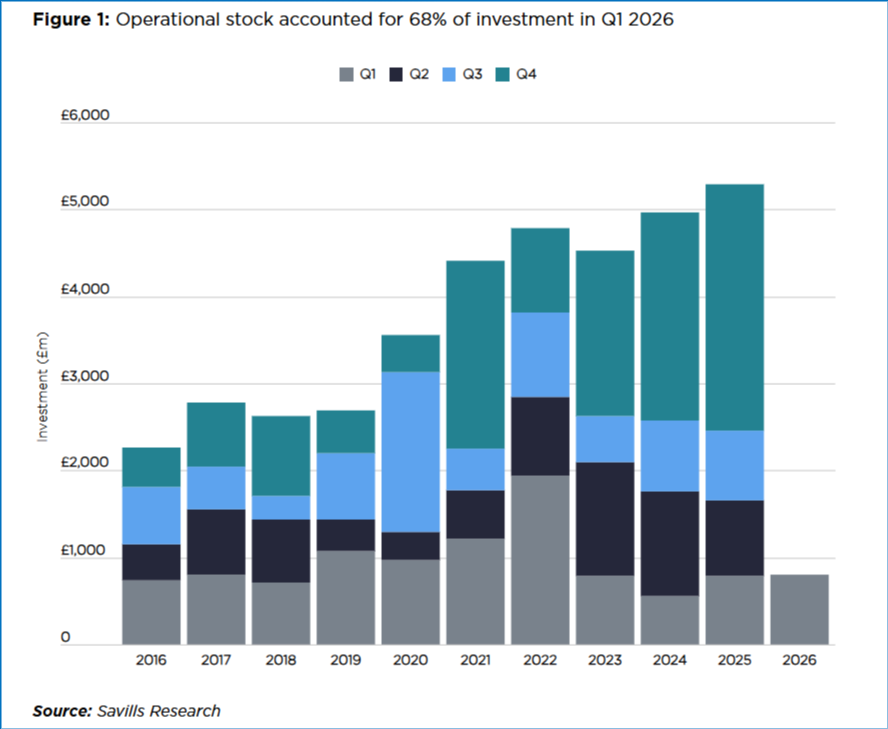
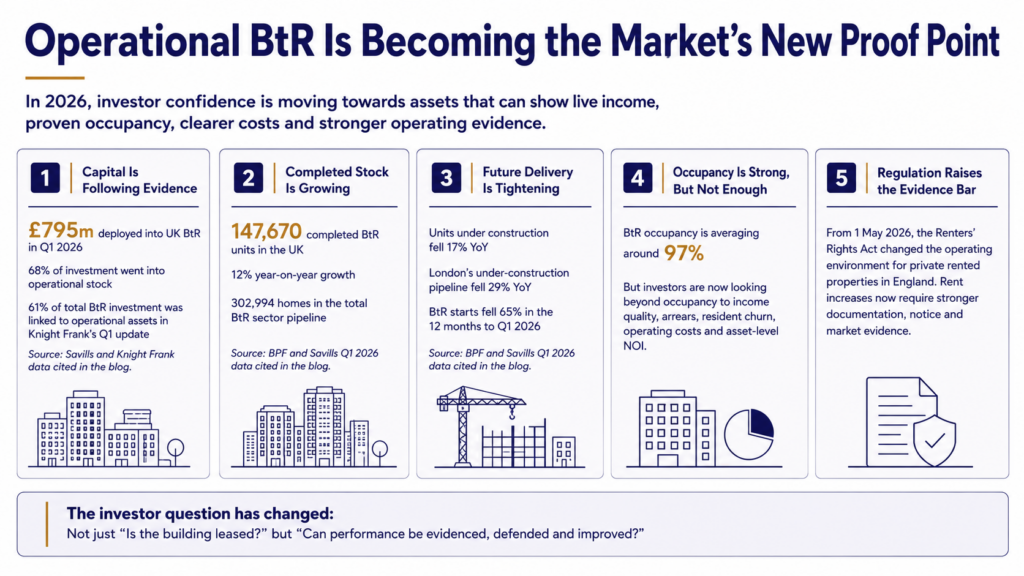
That shift is already visible in the numbers. Savills reported £795 million deployed into UK BTR in Q1 2026, the strongest first quarter since 2022, with operational stock accounting for 68% of investment. Knight Frank’s Q1 2026 update tells a similar story, with operational assets accounting for 61% of total BTR investment.
But the more interesting question is not simply “Why are investors buying operational stock?”
It is this:
Are investors still backing BTR growth, or are they now backing BTR proof?
For years, BTR value was built around development conviction: secure the site, build the scheme, lease it up, and wait for stabilisation. That model still matters, but the market is becoming less patient with risk that cannot be evidenced.
Today, income visibility is doing more of the heavy lifting.
Investors want to see:
That is why operational stock is starting to look like the sector’s new safe haven. Not because it is risk-free, but because the risks are easier to see, measure, and manage.
This blog explores why capital is moving towards stabilised BTR assets, what this says about investor appetite in 2026, and why operators now need stronger reporting, finance visibility, resident retention data, and operational control to protect asset value.
The Q1 2026 data should not be read as a simple investment-volume story.
The more important signal is this: institutional rental housing investors are becoming more selective about the type of risk they want on their balance sheet. Capital has not walked away from the build to rent (BtR) sector UK. It is moving towards assets where performance can be evidenced, tested, and reported.
Knight Frank described Q1 2026 as a muted start, with just shy of £700 million invested across 12 transactions, marking the slowest first quarter since 2018. But the same update also noted that activity was “driven primarily by investors acquiring operational stock”. That distinction matters because it shows a market that is cautious, but not inactive.
The real story is not lower appetite. It is sharper underwriting.
Investors are asking a different set of questions now:
That is why operational stock in BtR is becoming more attractive. It gives investors something development-stage schemes cannot always offer: evidence from the asset itself.
Development-stage BtR still has a clear role in the market, especially where location, design and supply shortage support long-term demand.
But the gap between “good development opportunity” and “fundable development opportunity” has widened.
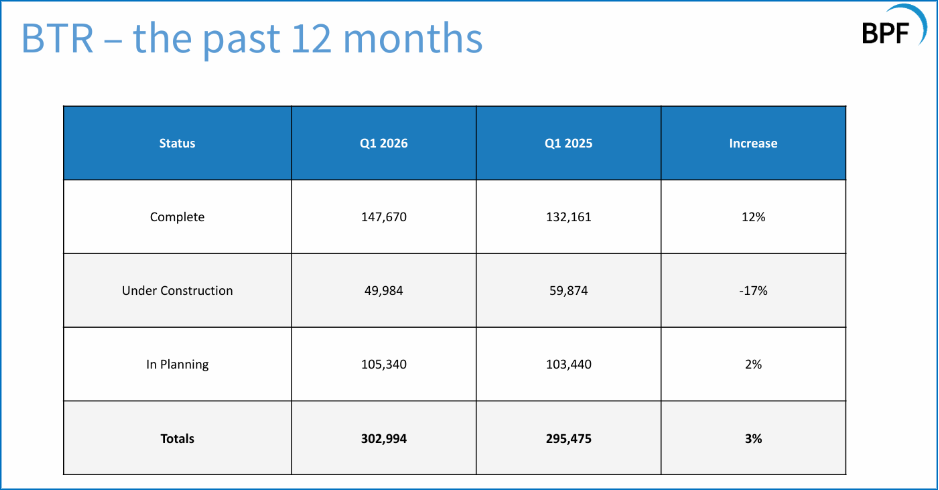
The BPF and Savills Q1 2026 data shows why. There were 147,670 completed BtR units in the UK, up 12% year on year, but units under construction fell by 17% over the same period. In London, the contraction was sharper, with under-construction units down 29%.
That creates a subtle but important shift in the UK real estate investment market.
Completed stock is growing. Future delivery is becoming harder. Existing income-producing real estate assets are therefore starting to carry a higher strategic value because they are already through planning, funding, construction, building safety and lease-up risk.
For C-suite leaders, this changes the conversation from:
“How much BtR can we build?”
to:
“How well can we operate, evidence and optimise what is already built?”
The strongest supporting signal is not just the investment figure. It is the delivery pipeline behind it.
According to the BPF and Savills Q1 2026 report, annual completions have outpaced starts for nine consecutive quarters. The same report states that in the 12 months to Q1 2026, there were 5,619 starts in total, down 65% from Q1 2025 and down 68% from the 2017-19 Q1 average.
That is a material signal for build to rent investments trends UK.
If starts continue to lag completions, the market may have more completed stock today but less new deliverable stock coming through tomorrow. That makes BtR operational assets more than a defensive play. They become scarce platforms of proven income.
This is where stabilised BtR assets begin to look different from ordinary standing stock.
The strongest assets will not simply be the ones that are complete. They will be the ones that can show:
In other words, stabilisation alone is not enough. Stabilised rental portfolio performance is what investors will increasingly underwrite.
A few years ago, leasing velocity was one of the clearest proof points for a BtR scheme. If the units let quickly, the asset looked successful.
That is no longer enough.
A fully let building can still hide weak income quality, rising arrears, poor resident retention, service charge leakage, inefficient maintenance workflows or slow finance reporting. These issues may not show up in headline occupancy, but they directly affect asset value.
This is why the next phase of BtR asset management strategy needs to be more operationally mature.
Investors are not just buying the building. They are buying the operating record behind it.
That operating record includes how:
This is also where build to rent operational efficiency becomes more than a back-office issue. It becomes part of the asset’s investment case.
Operational stock may reduce development risk for investors, but it increases scrutiny on operators.
Once an asset is stabilised, value creation depends less on the promise of future lease-up and more on the quality of day-to-day performance. Operators need to show that they can retain residents, manage cost creep, report accurately and protect net operating income.
That places more pressure on finance teams, asset managers and operating platforms.
For larger portfolios, this is where specialist build to rent finance and accounting services can support the operating model. The requirement is not just bookkeeping. It is asset-level visibility, faster reporting, cleaner reconciliations, stronger arrears tracking and better evidence for investor decisions.
The Q1 2026 signal is clear:
The market is not only rewarding BtR assets that are already built. It is rewarding assets that can prove they are being run well.
Operational stock looks safer in 2026 because investors are not only pricing demand. They are pricing certainty.
In the build to rent (BtR) sector UK, the risk conversation has moved from “Can this market absorb more homes?” to “Can this asset prove income, cost discipline and operating resilience today?”
That is why operational stock in BtR is gaining ground. It gives investors live evidence, not just assumptions in a development appraisal.
A development-stage BtR scheme may still offer stronger upside. Investors can influence design, specification, amenity mix, unit configuration and sustainability standards from the start.
But that upside now sits alongside risks that are harder to price neatly.
Savills notes that urban multifamily funding transactions remain muted because deals are taking longer to progress, with headwinds around planning, building safety and construction cost inflation. It also adds that geopolitical uncertainty is pushing up the cost of finance, affecting development.
That changes the investor calculation.
For institutional rental housing investors, BtR operational assets offer something increasingly valuable: performance that can be checked.
Investors can look at the actual rent roll, resident behaviour, arrears, operating expenditure, renewal rates and net operating income movement.
That makes operational stock easier to challenge, compare and benchmark.
Operational stock offers:
This is why stabilised BtR assets are starting to behave more like income producing real estate assets than development-led growth bets.
The return profile may look less dramatic on paper, but the evidence base is stronger.
Development-stage BtR should not be dismissed.
In undersupplied locations, it can still create long-term value, especially where the scheme is well designed, well located and aligned with changing resident expectations.
It offers:
But the pressure points are now more visible.
Construction costs, planning timelines, building safety requirements, debt pricing and lease-up risk can all move during the development period. A scheme that looked viable at land acquisition can look very different by the time it reaches practical completion.
The delivery pipeline shows why investors are becoming more cautious around new development.
The BPF and Savills Q1 2026 data shows 147,670 completed BtR units, up 12% year on year, while units under construction fell to 49,984, down 17% year on year.
That split matters.
Completed stock is growing, but the construction pipeline is shrinking. In London, where planning, building safety and viability pressures are often more acute, units under construction fell 29% year on year.
There is another pressure point: delay.
The same BPF and Savills report states that the time taken for BtR apartment schemes to secure planning permission has risen since 2019, and that in London, the time doubled between 2019 and 2024.
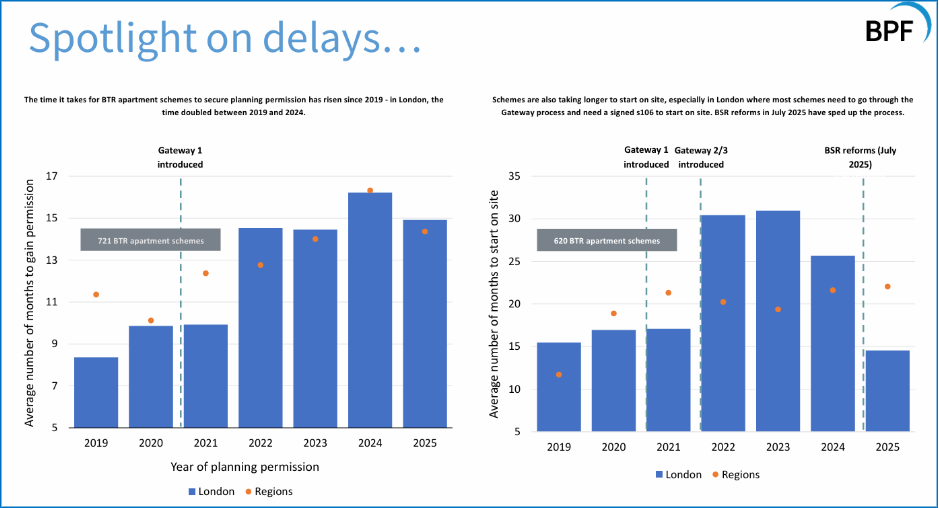
For investors, that means time itself has become a risk factor.
The longer a scheme takes to secure permission, start on site and move through delivery, the more exposed it becomes to cost movement, policy changes, debt repricing and market sentiment.
Stabilised rental portfolio performance is becoming easier to defend in investment committees than development-stage potential.
That does not mean stabilised assets are automatically better. A poorly run operational asset can still suffer from arrears, cost leakage, weak resident retention, poor reporting and margin erosion.
But those risks are at least visible.
In a stabilised asset, investors can ask:
This is where BtR asset management strategy becomes central to value.
The asset is no longer judged only by location, design or occupancy. It is judged by how well it performs after stabilisation.
Operational stock may look safer for investors, but it raises the bar for operators.
Once the building is complete and leased, there are fewer excuses. Performance has to come from resident retention, cost control, reporting quality, arrears management, maintenance discipline and operational asset optimisation.
That is where build to rent operational efficiency becomes part of the investment case.
For larger portfolios, finance teams need to support asset-level reporting, accurate reconciliations, stronger income visibility and timely performance packs. This is also where specialist build to rent finance and accounting services can help operators manage the level of scrutiny that comes with institutional capital.
The sharper point is this:
At headline level, the build to rent (BtR) sector UK still looks healthy. BPF and Savills Q1 2026 data shows 147,670 completed BtR units and a total sector pipeline of 302,994 homes.
But the deeper signal is less comfortable.
While completed stock is rising, future delivery is slowing. Units under construction fell 17% year on year, and in London, the drop was sharper at 29%. BtR starts were also down 65% in the 12 months to Q1 2026.
That creates a clear supply paradox.
The market is not short of demand. It is at risk of becoming short of deliverable, institutionally investable stock.
For investors, this makes operational stock in BtR more attractive. These assets are already built, leased, income-producing and past the riskiest stages of planning, construction, funding and stabilisation.
This is why BtR operational assets are becoming more than a defensive play. They offer live performance evidence, clearer rent roll visibility and a stronger basis for underwriting than development-stage schemes.
For operators, however, this shift raises expectations.
If capital is moving towards stabilised BtR assets, investors will want stronger proof of:
In this environment, build to rent operational efficiency becomes part of the investment case. Strong BtR asset management strategy, better finance visibility and sharper operational asset optimisation will decide which assets command investor confidence.
The real signal is simple: completed BtR stock is growing, but future delivery is tightening. That makes existing operational assets more valuable, but only if operators can prove they are being run well.
The old BtR value model was relatively straightforward:
Build → Lease → Stabilise → Sell or hold
That model worked when the biggest question was whether a scheme could lease up at pace. But as more BtR operational assets come into the market, the value equation is changing.
The new model looks more like this:
Operate → Retain → Report → Optimise
This is where operational stock in BtR becomes more interesting. Once an asset is built and leased, investors are no longer buying future potential alone. They are buying the quality of the operating platform behind the income.
In operational BtR, performance is shaped by what happens after the lease is signed.
Operators need to manage repairs, resident experience, compliance, rent collection, service delivery and operating costs with the same discipline seen in the managed hospitality sector UK.
For investors, this matters because poor operations can quietly weaken NOI even when occupancy looks strong.
Resident retention is no longer just a customer experience measure. It is a value protection measure.
Lower churn can reduce void periods, reletting costs, marketing spend and incentive pressure. That makes retention central to stabilised rental portfolio performance.
The real question is not just:
Are units occupied?
It is:
Are residents staying long enough to protect income quality?
As capital moves towards stabilised BtR assets, reporting quality becomes harder to ignore.
Investors want visibility across:
This is where build to rent finance and accounting services can support operators, especially across larger portfolios where reporting delays, reconciliation gaps or inconsistent data can weaken investor confidence.
The next phase of value creation will not only come from building more units. It will come from improving the performance of assets that already exist.
That includes pricing, staffing models, procurement, maintenance workflows, energy efficiency, finance processes and resident engagement.
This is why operational asset optimisation is becoming central to BtR asset management strategy. The best operators will not simply maintain stabilised assets. They will keep improving them.
A 97% occupancy rate looks strong on paper. And in the build to rent (BtR) sector UK, it is a clear sign that demand remains resilient.
CBRE’s 2026 UK Real Estate Market Outlook states that BTR occupancy is averaging around 97%, with income growth expected to continue into 2026.

But for investors, occupancy is now the starting point, not the full story.
A full building can still hide weak income quality.
The better questions are:
This is where the conversation moves beyond leasing.
For stabilised BtR assets, investors want to understand whether the income is durable, reportable and repeatable. High occupancy may prove demand, but it does not automatically prove stabilised rental portfolio performance.
The stronger signal is whether the operator can retain residents, control costs, manage arrears, and report asset-level performance clearly.
That is why build to rent operational efficiency is becoming more important in the UK real estate investment market. Once an asset is full, the next layer of value comes from better operations, not just better leasing.
The Renters’ Rights Act has changed the operating environment for private rented properties in England from 1 May 2026. Most existing assured shorthold tenancies automatically became assured periodic tenancies, and new private tenancies now run on a rolling basis.
For the build to rent (BtR) sector UK, this is not just a legal update. It changes the level of evidence operators need around rent, tenancy records, arrears and possession grounds.
GOV.UK states that landlords can only increase rent once a year, must use Form 4A, and must give tenants at least two months’ notice. Tenants can also challenge a proposed increase that is above market rent.
That puts more pressure on operators to maintain clean, audit-ready records.
For BtR operational assets, the key requirement is stronger evidence across:
This matters because operational stock is now being assessed not only on occupancy and income, but also on how well that income can be evidenced and defended.
For institutional rental housing investors, weak documentation can become a value risk. If rent reviews, arrears escalation or possession processes are inconsistent, the asset may look less controlled than its headline numbers suggest.
This is where BtR asset management strategy needs to become more joined up. Finance, operations, compliance and resident teams need to work from the same evidence base.
Buying operational stock in BtR is not the same as buying a completed building.
Investors are buying an income profile, an operating record, and the quality of evidence behind both. That makes due diligence more focused on performance, reporting and control.
For institutional rental housing investors, the key questions will look like this:
Investors will want to know how much rental income is recurring, collectible and supported by market evidence.
A strong rent roll is useful. But the stronger signal is whether that income can hold up under affordability pressure, rent review scrutiny and changing resident behaviour.
High occupancy is not enough on its own.
Investors will ask whether occupancy has been achieved through genuine demand or supported by concessions, discounts or short-term incentives. This is important because incentivised occupancy can flatter performance without proving long-term income quality.
Resident retention is now a financial metric.
If churn is high, the asset may face more void days, reletting costs, marketing spend and operational pressure. For stabilised BtR assets, retention directly affects stabilised rental portfolio performance.
Investors will look closely at whether operating costs are predictable, benchmarked and recoverable where relevant.
This includes repairs, maintenance, utilities, staffing, service delivery, procurement and compliance costs. In the current UK real estate investment market, cost control is becoming as important as rental growth.
A low arrears figure may not tell the full story.
Investors will want to see whether arrears are one-off, seasonal or increasing across the portfolio. They will also want clear visibility into recovery processes, write-offs and bad debt exposure.
Operational assets still need capital planning.
Investors will ask whether lifecycle costs, major repairs, energy upgrades, compliance works and amenity refreshes are properly forecast. Weak capex visibility can make an income-producing asset look stronger than it really is.
This is where many operators will be tested.
Investors will expect quick, accurate and asset-level reporting across occupancy, arrears, rent collection, operating costs, NOI and resident performance. For larger portfolios, specialist build to rent finance and accounting services can help improve reporting quality and reduce finance process gaps.
Regulatory readiness is now part of operational value.
Investors will want to know whether tenancy records, rent review evidence, complaints, arrears escalation and possession processes are properly documented. Poor records can weaken confidence in even a well-occupied asset.
Also Read: Scaling Build-to-Rent Portfolios: Is Your Finance Ops Ready?
If capital is moving towards operational stock in BtR, operators need to prove one thing clearly:
Their platform can manage stabilised assets better than the market average.
That means the operator’s role is no longer limited to leasing units, managing residents and keeping the building running. In a more selective investment market, operators are becoming part of the asset’s value story.
For BtR operational assets, investors will expect stronger control across finance, reporting, arrears, service costs and resident performance.
As more capital moves towards stabilised BtR assets, operators need to show that performance is not being managed informally or reactively.
They need cleaner visibility across:
This is where build to rent operational efficiency becomes commercially important. Investors do not just want to know that the asset is occupied. They want to know whether the operating model can protect income, control costs and explain performance quickly.
A busy operating team does not automatically mean a well-controlled asset.
The stronger benchmark is whether the operator can answer investor questions with reliable data.
For example:
This is why BtR asset management strategy needs to connect operations, finance, compliance and resident experience. If these functions work in silos, performance becomes harder to evidence.
For larger portfolios, finance visibility will become one of the clearest signs of operational maturity.
Operators need timely reconciliations, accurate rent roll data, clear aged debt reporting, operating cost variance analysis and faster month-end packs.
This is where specialist build to rent finance and accounting services can support operators by improving the quality, speed and consistency of asset-level reporting.
The aim is not just to process numbers faster. It is to give investors confidence that the asset’s income, costs and risks are properly understood.
The next phase of the build to rent (BtR) sector UK will not be judged only by how much capital enters the market.
It will be judged by what kind of stock that capital trusts.
CBRE expects multifamily investment to remain focused on stabilised assets in early 2026, with forward-funding deals likely to re-emerge later in the year as viability pressures ease. This points to a more selective market, where investors want income certainty first and development upside second.
That does not mean development is off the table.
In fact, CBRE also notes that improvements to the Gateway 2 stage under the Building Safety Act could strengthen development viability and support a healthier pipeline in 2026. Planning reform may also help, with the draft National Planning Policy Framework looking to introduce a “default yes” approach for developments around train stations.
But these changes will take time to flow through.
For now, operational stock in BtR has a clearer advantage: it shows what investors can actually earn, not just what a development appraisal assumes.
Why Operational Assets Will Shape Pricing
Operational assets are becoming the market’s evidence base.
They show live data on:
That makes BtR operational assets more useful as pricing benchmarks. They help investors understand what income-producing real estate assets are actually worth in the current UK real estate investment market.
Savills also points to a wider investor issue: access to stock and the ability to scale platforms have become more pressing concerns in 2026. That matters because if investable stock is harder to access, high-performing operational assets become even more strategically valuable.
CBRE’s view on the Renters’ Rights Act is measured. It says institutional investors and operators are broadly already compliant, and that some investors are setting aside funds for possible rent challenges as prudent housekeeping rather than a material risk.
That is an important distinction.
The regulatory shift may not derail investor appetite, but it will make evidence stronger currency. Operators will need cleaner records around rent reviews, resident communication, arrears, complaints and tenancy documentation.
For stabilised BtR assets, this means performance will increasingly be judged by both financial results and the quality of evidence behind those results.
Operational stock will become the benchmark for BTR value because it gives investors a clearer answer to three questions:
This is where BtR asset management strategy becomes central.
The strongest operators will not only chase occupancy. They will improve build to rent operational efficiency, strengthen reporting, protect resident retention and show clear operational asset optimisation across the portfolio.
For larger operators, this also increases the need for sharper finance visibility. Specialist build to rent finance and accounting services can support stronger month-end reporting, arrears tracking, service charge visibility and investor-ready performance packs.
The future outlook is clear:
Operational BTR assets will increasingly set pricing benchmarks because they show what the market can earn in real time. Development appraisals still matter, but operational evidence will carry more weight.
Operational stock is becoming the new safe haven in BTR because it gives investors something increasingly valuable: evidence before exposure.
It offers clearer visibility into income, occupancy, resident behaviour, operating costs, arrears, service performance and regulatory readiness. In a market where development risk is harder to price cleanly, that evidence carries weight.
But the real shift is bigger than stabilised income.
BTR value is moving from the development spreadsheet to the operating platform. The strongest assets will not only be the ones that are built, leased and well located. They will be the ones that can prove their performance consistently.
For investors, this means better information before deployment.
For operators, it means reporting quality, resident retention, cost control, arrears discipline and finance visibility will increasingly shape asset value.
The next phase of BTR will not simply reward those who own operational assets. It will reward those who can operate, evidence and optimise them better than the market.
For BTR operators reviewing how their finance, reporting and operational processes are keeping pace with investor expectations, QX Global Group can support with a more structured conversation around visibility, controls and scalable finance operations.
Book a consultation call with QX Global Group to explore how stronger finance and accounting support can help improve operational confidence across your BTR portfolio.
Investors are shifting toward operational stock in the UK BtR sector because it offers proven income, live occupancy data, clearer operating costs and lower development risk.
Unlike development-stage assets, operational BtR assets allow investors to assess real rent collection, resident demand, arrears, service costs and net operating income before committing capital.
Stabilised BtR assets are changing investment strategies by shifting focus from future development potential to current income performance.
Investors are no longer only asking whether a scheme can be built and leased. They are asking whether the asset can retain residents, control costs, report accurately and produce reliable long-term returns.
Operational performance is becoming more important because BtR value now depends on how well assets perform after they are built.
High occupancy alone is not enough. Investors want to see strong rent collection, low arrears, resident retention, controlled operating costs and clear reporting that supports long-term income quality.
BtR operators can improve value by using better reporting to identify income leakage, cost pressure, arrears trends, resident churn and maintenance issues early.
Strong operational asset optimisation helps operators improve pricing, procurement, service delivery, finance processes and resident experience, all of which can protect net operating income.
The BtR sector is moving from “build and lease” to “operate and optimise” because more assets are now stabilised, and investors need proof of ongoing performance.
The next layer of value is not just in creating new stock. It is in running existing assets better through stronger retention, cost control, compliance, reporting and resident engagement.
Finance and operations teams can improve long-term BtR profitability by working from the same asset-level data across rent collection, arrears, occupancy, costs, capex and resident retention.
When finance reporting is accurate and operations data is visible, operators can make faster decisions, reduce income leakage, manage costs better and improve stabilised rental portfolio performance.

Education:

Nishant Kumar is a senior commercial leader with 20+ years of experience supporting hospitality and accommodation businesses through technology-enabled outsourcing and operational transformation. At QX Global Group, he works with property owners, asset managers, and hospitality leaders across the UK and Europe to improve profitability, modernise back-office operations, and build scalable operating models. His expertise spans finance and accounting, payroll, and digital enablement for multi-property and franchise-led hospitality organisations, with a strong focus on cost optimisation, standardisation, and automation-led efficiencies.
Expertise: Hospitality and accommodation outsourcing, Multi-entity finance transformation, Shared services and global delivery models, Automation-led cost optimisation, Strategic commercial advisory
Originally published May 14, 2026 06:05:05, updated May 14 2026
Topics: BTR, Build to Rent, Finance & Accounting
02 Sep 2026
Hospitality has become one of the most data-rich industries in the world. Every reservation, room sa...
Read More27 Aug 2026
In June 2026, Morgan Stanley and Ridgeback paid £1.045 billion for Metra Living, L&Q’s re...
Read More20 Aug 2026
On a June morning this year, retirement housing found itself in the one room operators would rather ...
Read More13 Aug 2026
When John Lewis walks away from something, the rest of the sector tends to sit up and take notice.&n...
Read More